
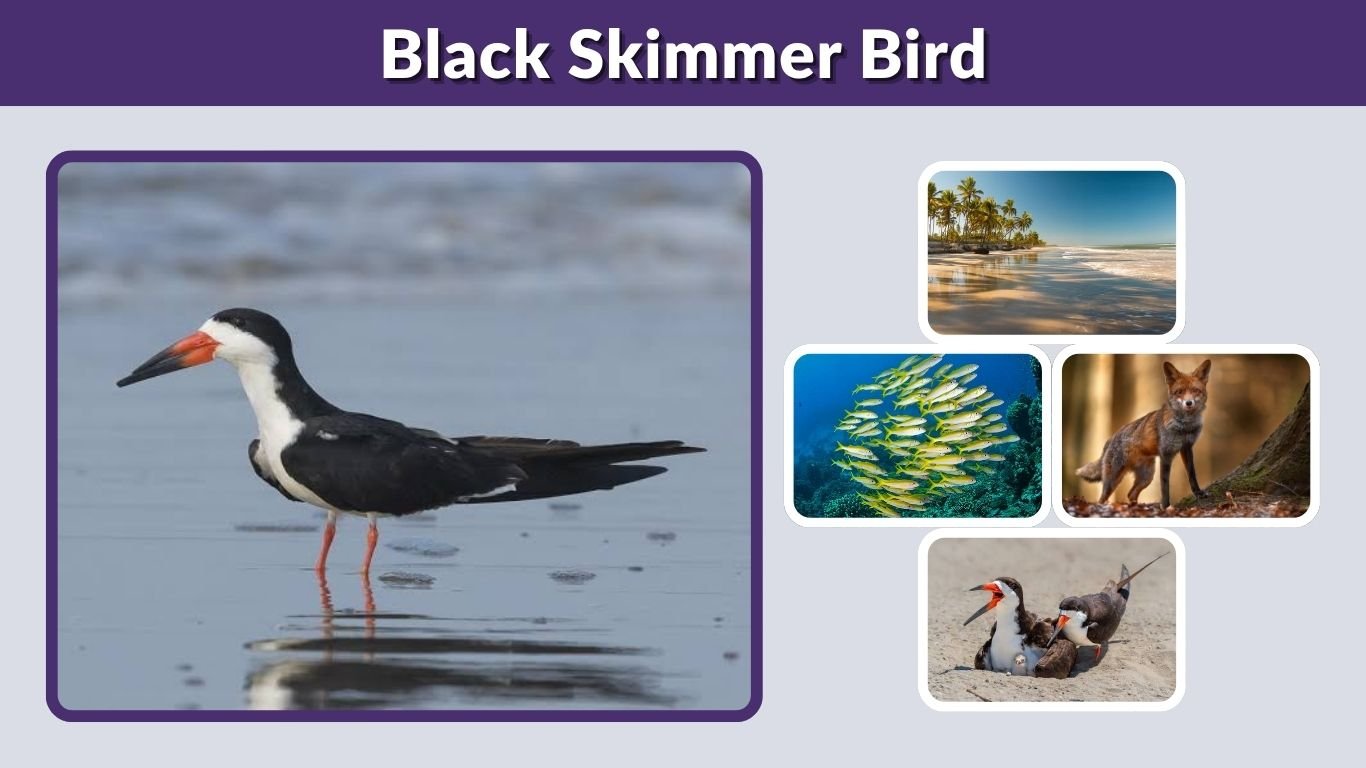
The black skimmer bird is an unmistakable coastal bird known for its black-and-white plumage and unusual red-and-black bill. Scientifically called Rynchops niger, it feeds differently from almost every other bird by flying low over the water and dragging its longer lower bill through the surface to catch fish. Black skimmers inhabit beaches, sandbars, estuaries, lagoons, and coastal islands across the Americas. They are especially noticeable in places such as Florida and New Jersey, where colonies gather to nest on open sandy ground.
What Is a Black Skimmer Bird?
The black skimmer is a waterbird in the gull and tern family, Laridae. It is one of only a few living skimmer species worldwide and the only skimmer naturally found throughout much of the Americas.
Its specialized bill and feeding technique make it easy to distinguish from gulls, terns, and other shorebirds.
Black Skimmer Identification
Important identification features include:
- Black upperparts
- Bright white underparts
- Long, narrow wings
- Short red legs
- Large red-and-black bill
- Lower bill longer than the upper bill
- Dark cap and back
- Deeply forked or notched tail
- Long-winged appearance in flight
Adults in breeding condition usually have darker, cleaner head markings than nonbreeding birds.
Young birds are browner and more mottled than adults.
Black Skimmer Size
Black skimmers are medium-to-large coastal birds with very long wings compared with their bodies.
Adults are generally around 16–20 inches long and can have a wingspan approaching 4 feet.
Their long wings help them remain close to the water while skimming efficiently. Males are usually noticeably larger than females, especially in bill size.
Why Is the Black Skimmer’s Bill Different?
The lower mandible extends farther than the upper mandible, an extremely unusual adaptation among birds.
When feeding, a skimmer opens its bill and places the lower half into the water. If it contacts a fish, the upper bill quickly snaps downward.
This specialized structure gives the bird its common name.
Black Skimmer Habitat and Range
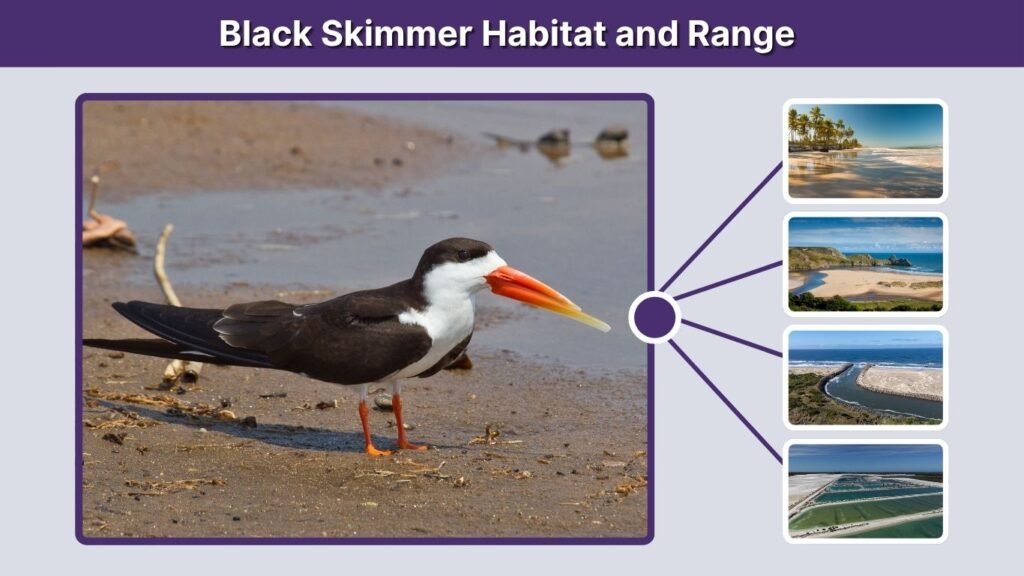
Black skimmers are strongly associated with open water and low, relatively bare nesting sites. Coastal habitats are especially important because they provide both shallow feeding areas and sandy locations suitable for breeding.
Their movements vary considerably depending on geography and season.
Where Are Black Skimmer Birds Found?
Black skimmers occur throughout parts of North, Central, and South America.
Typical habitats include:
- Ocean beaches
- Coastal bays
- Estuaries
- Lagoons
- Tidal creeks
- River mouths
- Sandbars
- Dredge islands
- Salt marshes
- Large inland rivers in parts of their range
Northern populations may migrate south after breeding, while birds in warmer regions can remain relatively close to their breeding areas throughout the year.
Black Skimmer Birds in Florida
Florida provides excellent habitat for black skimmers because of its extensive coastline, bays, islands, and estuaries.
Birds can occur in the state throughout much of the year. They often gather on sandy beaches and barrier islands, where nesting colonies may form alongside terns and other coastal birds.
Human recreation can create problems when nests are located on popular beaches. Temporary protected zones are therefore sometimes established around breeding colonies.
Black Skimmer Birds in New Jersey
Black skimmers also breed along the New Jersey coast.
Suitable sites include barrier beaches, coastal islands, and areas containing relatively undisturbed sand or shell substrate.
Because nesting birds place their eggs directly on the ground, colonies are vulnerable to people, vehicles, dogs, flooding, predators, and changing beach conditions.
Black Skimmers in South America
The black skimmer’s range extends deep into South America.
Populations occur around major rivers, wetlands, lagoons, and coastal areas. South American birds may use extensive river systems and sandy riverbanks in addition to marine environments.
This broad distribution demonstrates that black skimmers are not exclusively ocean birds.
What Do Black Skimmers Eat?
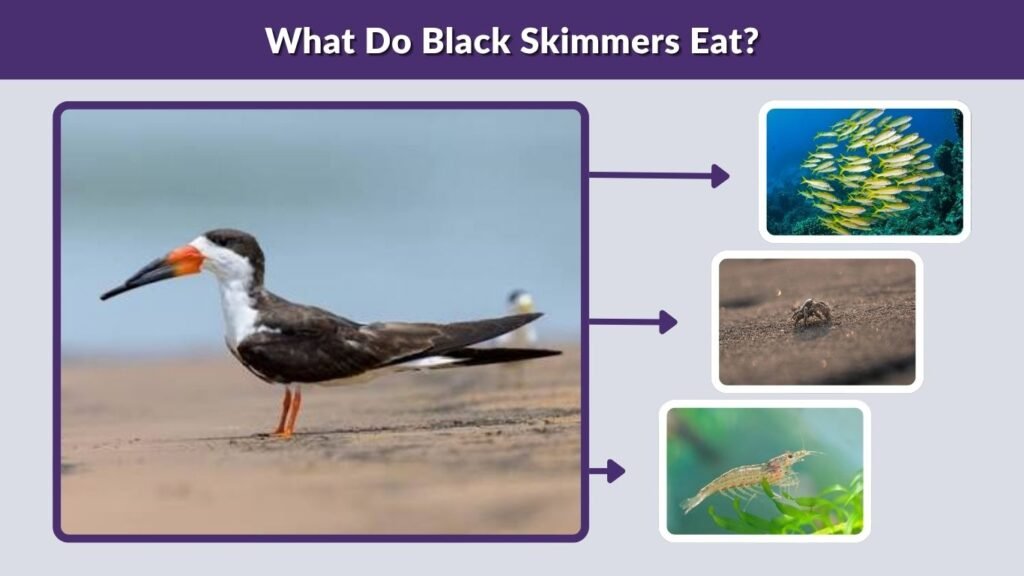
Black skimmers are primarily fish eaters. Their feeding behavior is one of the most remarkable adaptations among North American birds.
They often forage during calm conditions and may be active during early morning, evening, or nighttime.
Black Skimmer Diet
Their diet primarily consists of:
- Small fish
- Fish near the water surface
- Small crustaceans
- Shrimp
- Other small aquatic animals
The exact prey depends on location and what is available near the surface.
Fish make up the most important part of their diet.
How Does a Black Skimmer Hunt?
The bird flies only a short distance above the surface with its lower bill cutting through the water.
When the bill encounters prey, the bird quickly closes its mouth and captures it.
Skimmers can feed without seeing every individual fish in advance. This allows them to forage under low-light conditions when visual hunters may be less effective.
Why Do Black Skimmers Feed at Night?
Black skimmers are capable of feeding during daylight, but they are often active around dusk, dawn, and nighttime.
Their touch-based feeding method allows them to locate prey even when visibility is poor.
Tidal conditions and prey availability also influence when they forage, so activity can change considerably from one location to another.
Black Skimmer Nesting
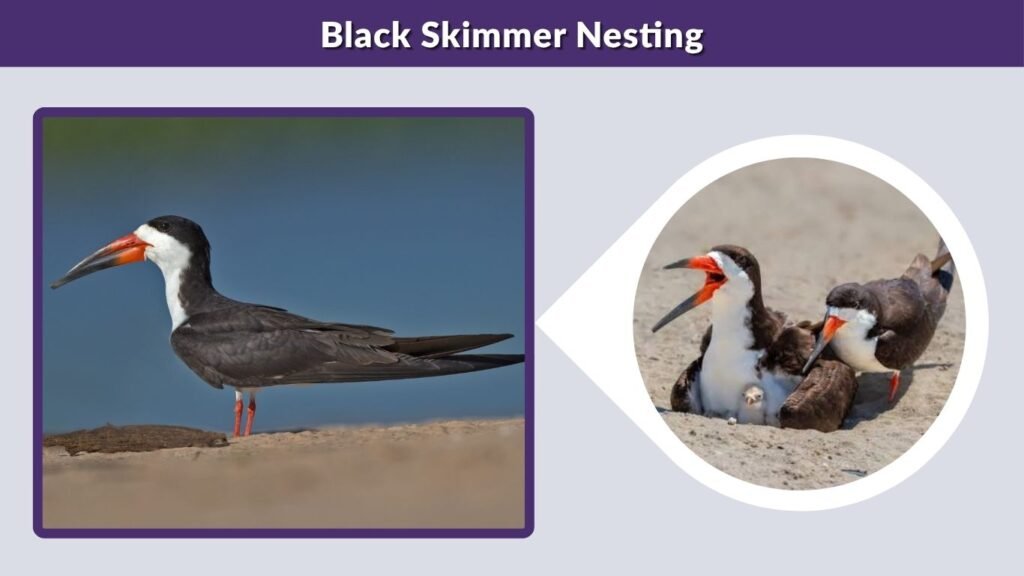
Black skimmers are colonial nesters. Many breeding pairs gather in the same open area, sometimes alongside terns.
Their nests are extremely simple, consisting primarily of a shallow depression scraped into sand, shell, gravel, or similar substrate.
Where Do Black Skimmers Nest?
Common nesting locations include:
- Sandy beaches
- Barrier islands
- Sandbars
- Dredge-material islands
- Shell-covered flats
- River islands
- Open coastal ground
Nesting sites must be sufficiently open for adults to detect approaching predators.
Unfortunately, these same locations are often attractive to people.
Black Skimmer Eggs
A female usually lays several eggs in a shallow scrape.
The eggs are pale with darker spots and markings that help them blend into sandy surroundings.
Both parents participate in incubation and care of the chicks.
Because the nest is on the ground, eggs can be vulnerable to extreme heat, flooding, predators, accidental trampling, and vehicles.
Black Skimmer Chicks
Young skimmers hatch covered in down and remain dependent on their parents for food.
Their bills are initially more similar in length. The characteristic elongated lower mandible becomes more pronounced as they develop.
Parents bring captured fish back to the colony and feed their young until the chicks become increasingly independent.
Black Skimmer Bird Call
Black skimmers are social and vocal, particularly around nesting colonies.
Their sounds can be heard as adults interact with mates, chicks, neighboring birds, or potential threats.
What Does a Black Skimmer Sound Like?
The black skimmer commonly produces short barking or nasal calls.
Some vocalizations can sound somewhat dog-like, especially when several birds are calling simultaneously.
Colonies can become noisy because dozens or hundreds of adults may be communicating at the same time.
Calls can help birds maintain contact with mates and young within crowded breeding areas.
Black Skimmer Behavior
Outside the breeding season, black skimmers frequently rest in groups on beaches, sandbars, and exposed flats.
They may sit close together with their bodies low to the ground before suddenly taking flight as a group.
Typical Behaviors
Black skimmers commonly:
- Rest in large flocks
- Fly low over water
- Feed by skimming the surface
- Nest in colonies
- Gather on open beaches
- Become active around dawn and dusk
- Defend areas around nests
- Participate in courtship feeding
Their flight is graceful and controlled, with long wings allowing them to follow the water’s surface closely.
Courtship Behavior
During the breeding season, males may present fish to females.
Food presentation can play an important role in pair formation and reinforces the connection between successful fishing and reproductive behavior.
Pairs then establish small territories inside the larger colony.
Black Skimmer Predators and Threats
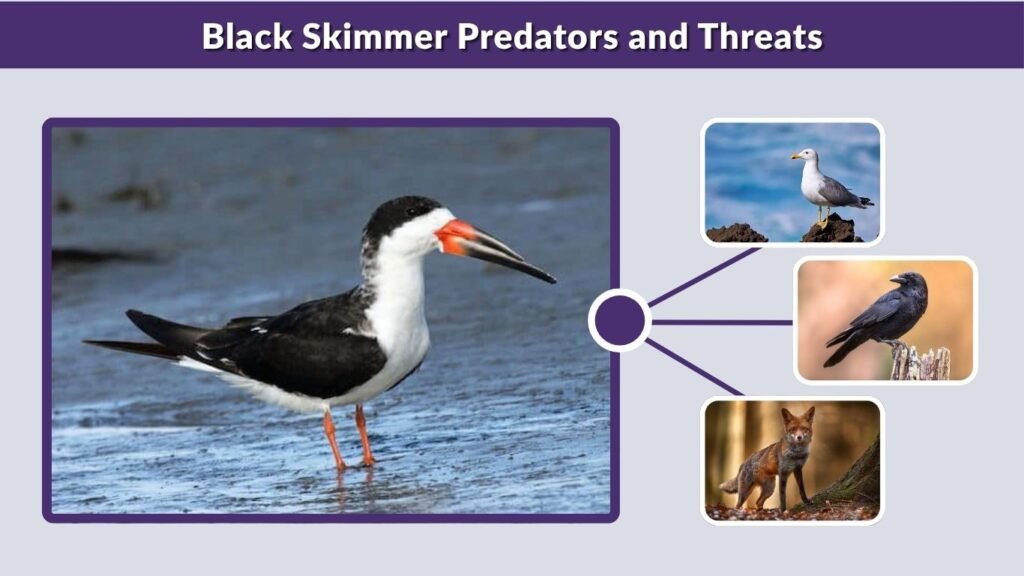
Adults are capable flyers, but eggs and chicks are highly vulnerable because they remain on exposed ground.
Nesting colonies therefore depend heavily on suitable, relatively undisturbed habitat.
Natural Predators
Potential predators include:
- Gulls
- Crows and ravens
- Raccoons
- Foxes
- Coyotes
- Birds of prey
- Other egg-eating animals
Predator pressure can cause severe losses at some nesting sites.
Human-Related Threats
Major problems can include beach development, human disturbance, off-road vehicles, dogs, coastal construction, and loss of suitable nesting habitat.
Rising water and severe storms can also flood low-lying colonies.
Fishing line and other debris may create additional hazards for adults and young.
Black Skimmer Conservation
Protecting nesting colonies is one of the most effective ways to help black skimmers.
Because birds often choose heavily used beaches, conservation organizations and wildlife agencies may temporarily fence or mark important nesting areas.
How Black Skimmers Can Be Protected
Conservation measures include:
- Protecting nesting beaches
- Keeping people away from active colonies
- Keeping dogs away from nesting birds
- Restricting vehicles near nests
- Controlling invasive predators where necessary
- Preserving barrier islands and sandbars
- Removing dangerous fishing line and debris
- Monitoring breeding colonies
Giving nesting birds enough space can significantly improve the survival of eggs and chicks.
Interesting Black Skimmer Bird Facts
The black skimmer has several unusual characteristics that distinguish it from almost every other bird found along American coastlines.
Black Skimmer Facts
- Its scientific name is Rynchops niger.
- Its lower bill is longer than its upper bill.
- It catches fish while flying over water.
- Black skimmers can forage in low-light conditions.
- Males are generally larger than females.
- They commonly nest in colonies.
- Their nests are simple scrapes in sand.
- Young skimmers do not initially have dramatically unequal bill lengths.
- They occur in North, Central, and South America.
- Florida supports important breeding and wintering populations.
FAQs
What is a black skimmer bird?
The black skimmer is a black-and-white waterbird that catches fish by flying low over water with its elongated lower bill cutting through the surface.
What is the scientific name of the black skimmer?
Its scientific name is Rynchops niger. It belongs to the family Laridae, along with gulls and terns.
Where do black skimmer birds live?
They occur throughout parts of the Americas and inhabit beaches, estuaries, bays, lagoons, river systems, sandbars, and coastal islands.
What do black skimmers eat?
They primarily eat small fish but can also consume shrimp, crustaceans, and other small aquatic prey.
Where do black skimmers lay their eggs?
Black skimmers usually lay their eggs in shallow scrapes on open sand, shell, gravel, beaches, sandbars, or islands.
