
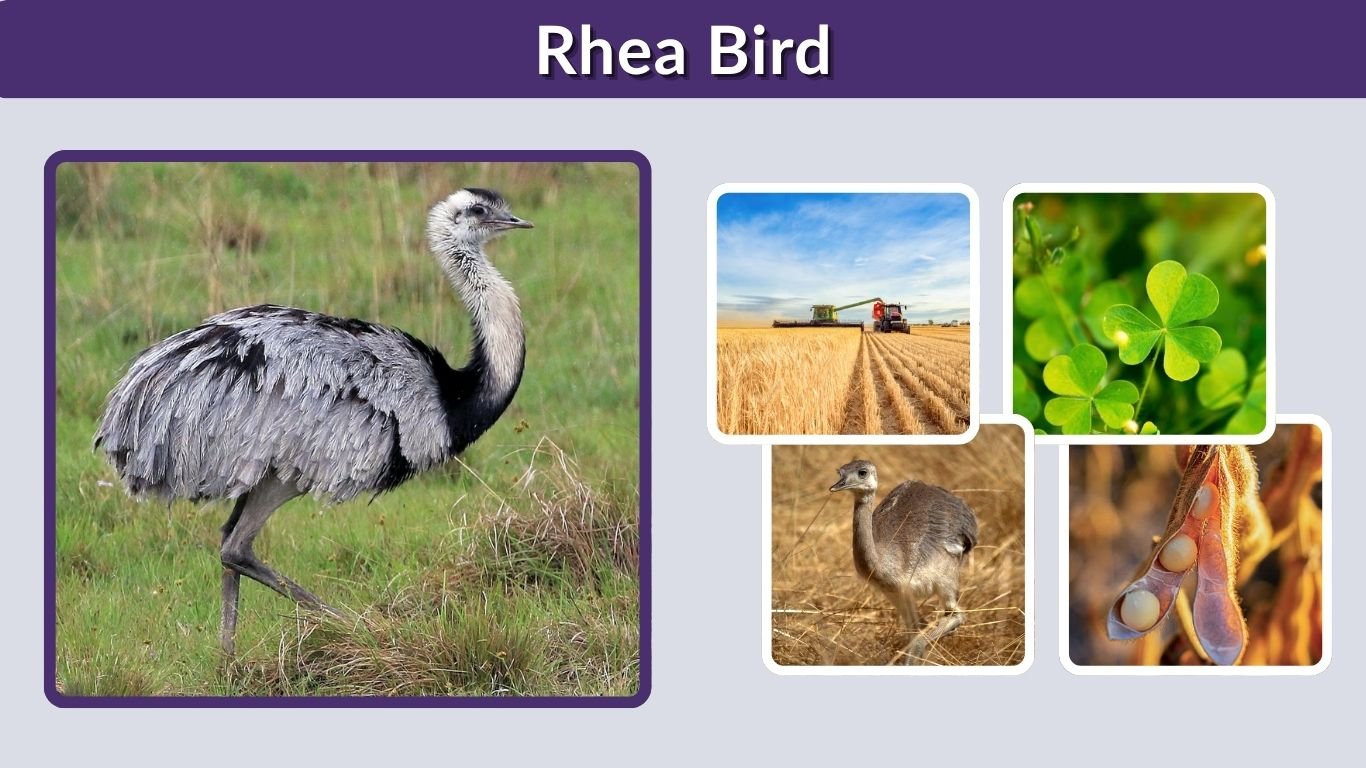
The rhea bird is a large, flightless bird native to South America. With its long neck, powerful legs, soft gray-brown feathers, and impressive running ability, a rhea can look like a smaller relative of an ostrich. These unusual birds spend most of their lives walking and running through grasslands and open country. Rheas are also fascinating parents because males build the nest, incubate the eggs, and care for the chicks. Here is everything you need to know about rhea birds, including their size, habitat, diet, lifespan, eggs, behavior, and differences from emus and ostriches.
What Is a Rhea Bird?
A rhea is a large terrestrial bird belonging to the family Rheidae. Rheas cannot fly, despite having relatively large wings. Instead, they use their wings for balance and steering when running and making sudden turns.
Rheas are native to South America and belong to the broader group of flightless birds that also includes ostriches, emus, cassowaries, and kiwis. The greater rhea (Rhea americana) is the largest South American bird.
What Does a Rhea Bird Look Like?
A rhea has an oval-shaped body, very long legs, a long neck, and a comparatively small head. Its appearance is somewhat similar to an ostrich, although rheas are noticeably smaller.
Most greater rheas have grayish-brown plumage with lighter underparts. Unlike ostriches, rheas have feathers covering much of their neck and upper legs.
Another major identifying characteristic is their feet. Rheas have three toes on each foot, while ostriches have only two.
Rhea Bird Size and Height
Rheas are among the world’s largest living birds. Greater rheas commonly stand approximately 3 to 5 feet (0.9–1.5 meters) tall and weigh around 33 to 66 pounds (15–30 kg). Some adult males can reach even greater measurements, and males are generally larger than females.
Their large bodies are supported by long, muscular legs designed for covering considerable distances across open landscapes.
Greater Rhea vs. Lesser Rhea
The greater area is larger and is mainly associated with eastern and central parts of South America.
The lesser rhea, also called Darwin’s rhea, is smaller. Adults are roughly 92.5–100 cm tall and generally weigh about 15–25 kg. Lesser rheas occur farther west and south, including Patagonia and areas near the Andes.
Where Do Rhea Birds Live?
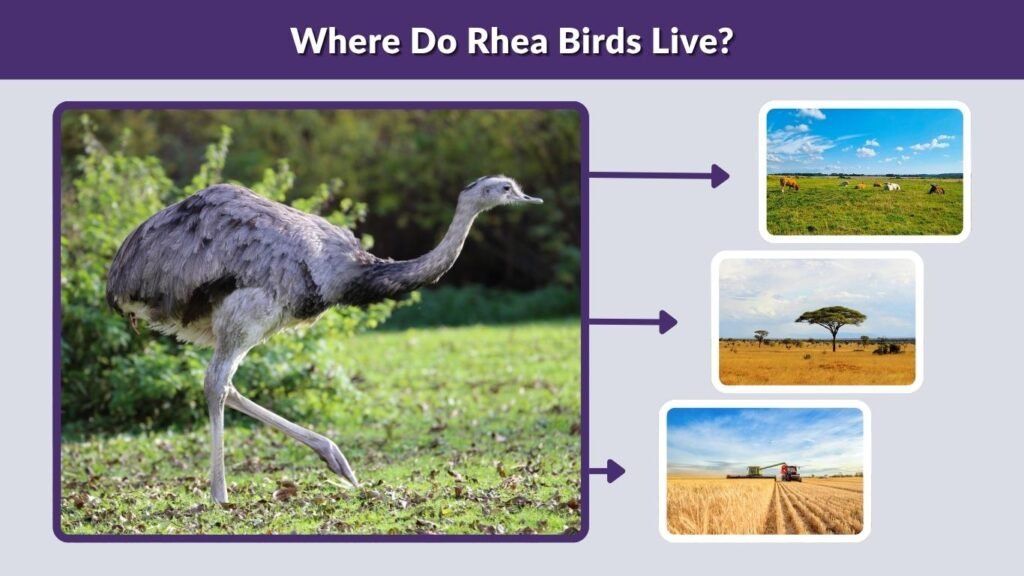
Rhea birds are native to South America. Greater rheas occur in countries including Argentina, Brazil, Bolivia, Paraguay, and Uruguay.
Their preferred environments include open grasslands, pampas, savannas, semiarid scrubland, and some agricultural landscapes. Greater rheas may also use marshes and areas near rivers or lakes, particularly during breeding periods.
Rhea Bird Habitat
Open landscapes are especially useful to rheas because they allow the birds to search for food while watching for predators.
Typical rhea habitat may include:
- Open grasslands
- Pampas
- Savannas
- Scrublands
- Marsh edges
- Agricultural fields
- Open woodland
Although they spend almost all their time on land, rheas can also swim when necessary.
What Do Rhea Birds Eat?

Rhea birds are omnivores, meaning they consume both plant and animal foods. Much of their diet consists of vegetation, but they opportunistically eat small animals when available.
Common foods include broad-leaved plants, grasses, clover, seeds, roots, fruits, and insects. Rheas may also eat small vertebrates, including lizards, frogs, small birds, and snakes.
How Do Rheas Find Food?
Rheas generally forage while walking slowly across open ground. They continually move through suitable feeding areas, picking vegetation and small prey from the ground.
Their varied diet helps them survive in environments where food availability changes with the season.
Can Rhea Birds Fly?
No. Rheas are completely flightless birds.
Their wings are larger than might be expected for a flightless species, but they cannot generate enough lift for flight. Instead, the wings have another important purpose.
While running, a rhea can extend its wings and use them somewhat like rudders. This helps the bird maintain balance and rapidly change direction when escaping danger.
How Fast Can a Rhea Bird Run?
Rheas are exceptionally capable runners. Members of the rhea family can reach speeds of around 60 km/h (37 mph).
When threatened, a rhea may run in a zigzag pattern rather than following a straight path. Its wings help with sharp turns, making the bird surprisingly agile despite its large body.
Powerful running ability is the rhea’s primary defense because it cannot escape predators by flying.
Rhea Bird Eggs and Reproduction
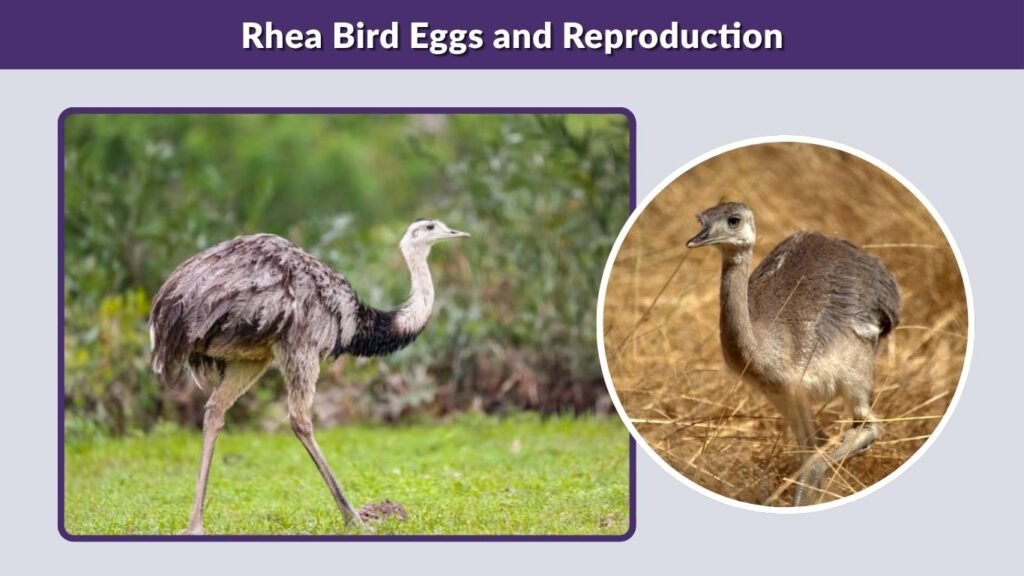
Rhea breeding behavior is one of the most unusual aspects of these birds.
Rather than females performing most parental duties, the male rhea takes responsibility for the nest and chicks. A male creates a shallow nest on the ground and may mate with several females.
Multiple females can deposit their eggs into the same nest, producing a very large combined clutch. The male then incubates the eggs and protects the nest.
Who Takes Care of Baby Rhea Birds?
The male does.
After the chicks hatch, the father continues guarding and caring for them. Male rheas with chicks can become highly defensive and may charge animals or people that approach too closely.
Young rheas grow quickly and follow their father while learning to forage and avoid danger.
Rhea Bird Lifespan
Exact lifespan varies between species and living conditions. Reliable information about the maximum lifespan of wild greater rheas remains limited.
Greater rheas have been recorded living up to about 13 years in captivity, although they may potentially live longer. Older information for Darwin’s rheas suggests that individuals can survive considerably longer under favorable conditions.
Food availability, predation, disease, habitat quality, and human activity can all influence survival in the wild.
Rhea Bird vs. Ostrich vs. Emu
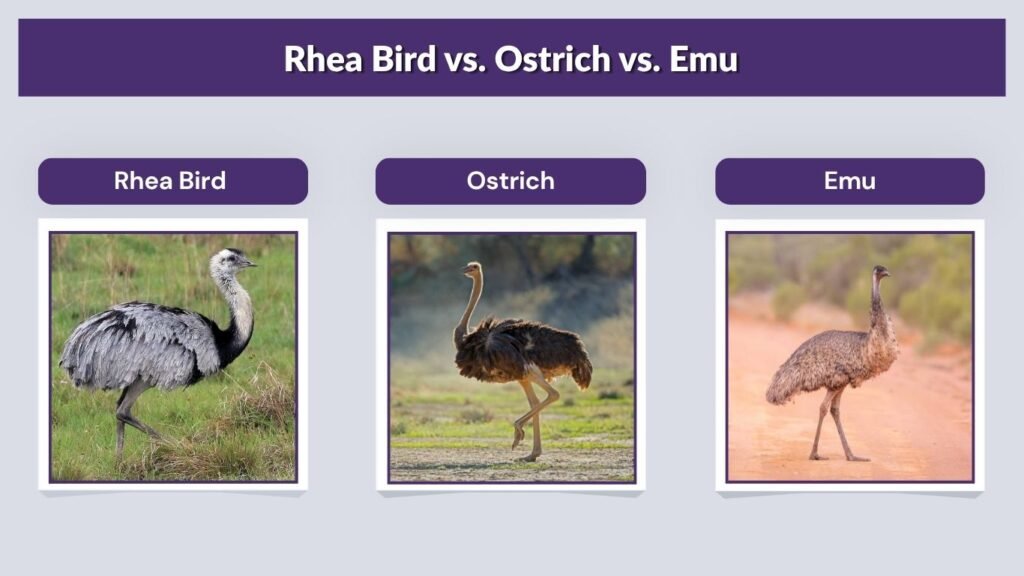
Rheas, ostriches, and emus are all large flightless birds, but they are different animals from different regions.
| Feature | Rhea | Ostrich | Emu |
| Native region | South America | Africa | Australia |
| Flight | Flightless | Flightless | Flightless |
| Toes | 3 | 2 | 3 |
| Relative size | Medium-large | Largest | Larger than most rheas |
| Wings | Relatively prominent | Relatively small | Very small |
| Main movement | Running | Running | Running |
The easiest distinction is geography and body size. Ostriches are substantially larger, while rheas are South America’s characteristic large flightless birds.
Are Rhea Birds Dangerous?
Rheas normally prefer avoiding humans rather than confronting them. However, they are large, powerful animals capable of defending themselves.
Their strong legs and feet can potentially cause injury, and breeding males may become particularly defensive around nests and chicks. The safest approach is to give rheas plenty of space and never corner or provoke one.
Can Rhea Birds Be Pets?

Rheas are sometimes raised on farms or kept on large private properties, but they are not conventional household pets.
An adult rhea requires extensive outdoor space, secure fencing, appropriate nutrition, shelter, and knowledgeable handling. Their strength and running ability make them unsuitable for small yards or indoor environments.
Local wildlife, livestock, zoning, and animal-keeping laws can also regulate ownership, so anyone considering keeping rheas must check the applicable rules first.
Interesting Rhea Bird Facts
- Rheas are native exclusively to South America.
- They are unable to fly but have unusually large wings.
- Rheas can use their wings to steer while running.
- Greater rheas can reach around five feet in height.
- They have three toes on each foot.
- Rheas eat both vegetation and small animals.
- Several females may lay eggs in one male’s nest.
- Male rheas incubate the eggs.
- Fathers also protect and raise the chicks.
- Rheas can run at approximately 37 mph (60 km/h).
- They may travel and forage in groups outside parts of the breeding season.
FAQs
Is a rhea a bird?
Yes. A rhea is a large flightless bird native to South America. It belongs to the family Rheidae.
Is a rhea an ostrich?
No. Rheas and ostriches are different birds. Rheas occur naturally in South America, while ostriches are native to Africa. Ostriches are also considerably larger.
Why can’t rhea birds fly?
Rheas have heavy bodies and wing structures adapted for functions other than powered flight. Their strong legs are their primary method of transportation, while their wings help with balance and steering.
Are there white rhea birds?
Yes. Unusually pale or white rheas can occur, particularly through genetic color variations in captive populations. The typical wild rhea, however, has primarily gray-brown plumage.
Where is the rhea bird found?
Rheas are found naturally in South America. Depending on the species, their range includes countries such as Brazil, Argentina, Bolivia, Paraguay, Uruguay, Chile, and Peru.
