
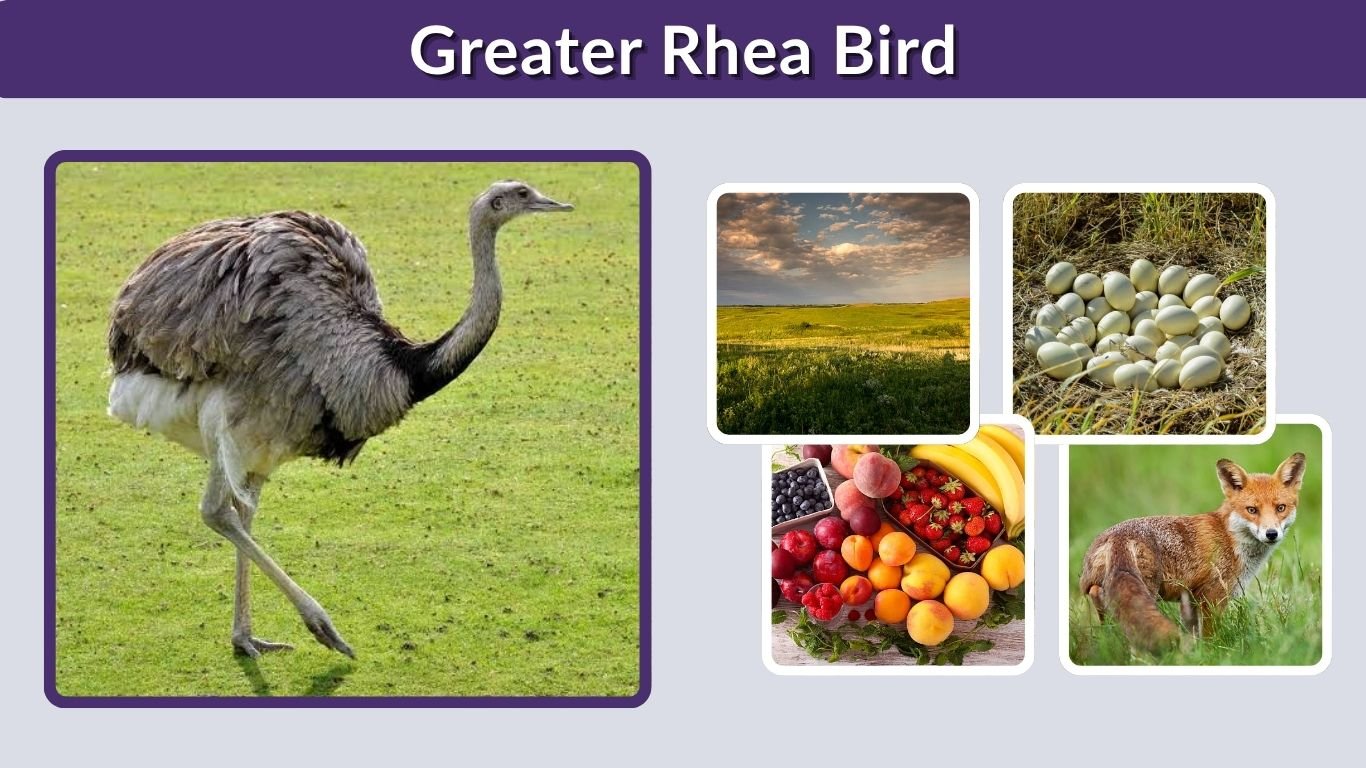
The Greater Rhea is a large, flightless bird native to South America, where it inhabits grasslands, savannas, and open countryside. Although it resembles an ostrich, it belongs to a different bird family and is generally smaller. Greater Rheas are fast runners with long legs, broad wings, and a surprisingly varied diet that includes plants, seeds, fruits, and small animals. Their unusual breeding system, social behavior, and ability to survive in open habitats make them one of South America’s most distinctive birds.
What Is a Greater Rhea Bird?
The Greater Rhea is a large ratite, a group of mostly flightless birds that also includes ostriches, emus, cassowaries, and kiwis. Its scientific name is Rhea americana. Unlike many flying birds, it has reduced flight muscles but extremely strong legs that allow it to move quickly across open landscapes and escape predators.
Greater Rhea Identification
The Greater Rhea can be identified by several features:
- Scientific name: Rhea americana
- Body length: Around 1.3–1.5 meters
- Height: Commonly up to about 1.5 meters
- Weight: Often around 20–30 kg
- Plumage: Grayish-brown
- Neck: Long and lightly feathered
- Legs: Long and powerful
- Feet: Three toes on each foot
- Wings: Large but incapable of sustained flight
Males are generally larger and darker than females.
Greater Rhea vs. Ostrich
Greater Rheas are often confused with ostriches because both are large and flightless.
However, ostriches are much larger and have two toes on each foot, while rheas have three. Ostriches are native to Africa, whereas Greater Rheas naturally occur in South America. Rheas also have fully feathered necks, giving them a softer appearance than ostriches.
Where Does the Greater Rhea Live?
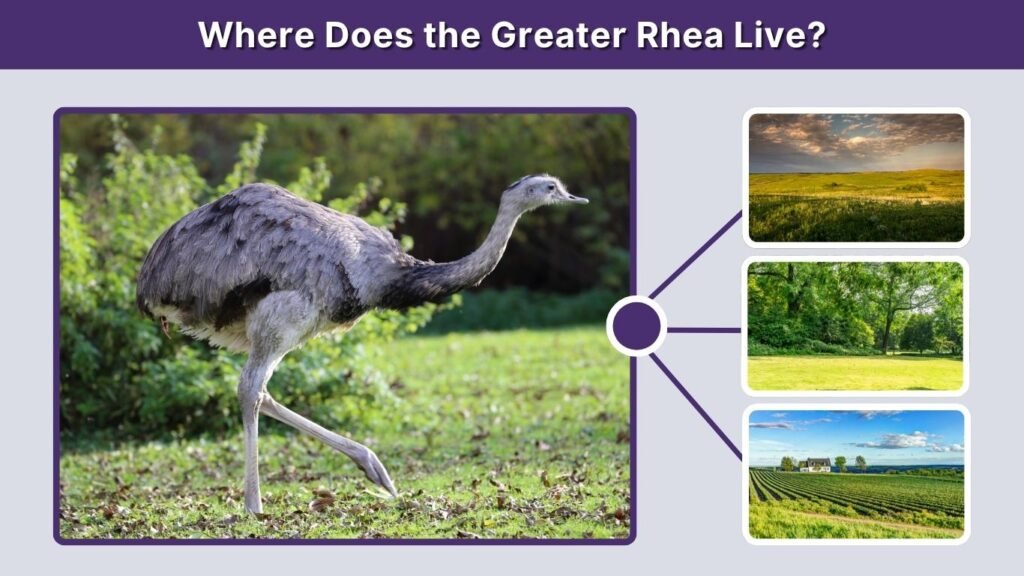
Greater Rheas live primarily in open areas of South America. They are especially associated with grasslands and agricultural landscapes where they can run freely and find a wide range of food. Their natural distribution includes several countries across the continent, and they can tolerate both relatively dry and seasonally wet environments.
Greater Rhea Range in South America
Greater Rheas occur naturally in:
- Brazil
- Argentina
- Paraguay
- Uruguay
- Bolivia
They are particularly associated with the Pampas and Cerrado regions, although their exact distribution varies between populations.
Greater Rhea Habitat
Suitable habitats include:
- Grasslands
- Savannas
- Open woodland
- Shrublands
- Agricultural fields
- Pasture
- Marshy grasslands
- Areas near rivers and wetlands
They usually avoid very dense forests because open terrain provides better visibility and space for running.
Why Is the Greater Rhea Flightless?
The Greater Rhea has wings but cannot use them for true powered flight. Over evolutionary time, its body became specialized for life on the ground. Strong legs became more important than flight because the bird could escape danger by running rapidly across wide, open areas.
Flightless Adaptations
Important adaptations include:
- Powerful leg muscles
- Long legs for rapid running
- Three-toed feet for stability
- Reduced flight muscles
- Large wings used for balance
- Long neck for spotting predators
- Strong eyesight
- Lightweight feathers
Their wings are especially useful when making sudden turns while running.
How Fast Can a Greater Rhea Run?
Greater Rheas can run at impressive speeds, particularly when threatened. They may stretch their wings outward while moving, using them like rudders to maintain balance and change direction.
Running is their main defense against many predators. Young birds depend more heavily on hiding and remaining near their protective father.
What Does a Greater Rhea Eat?
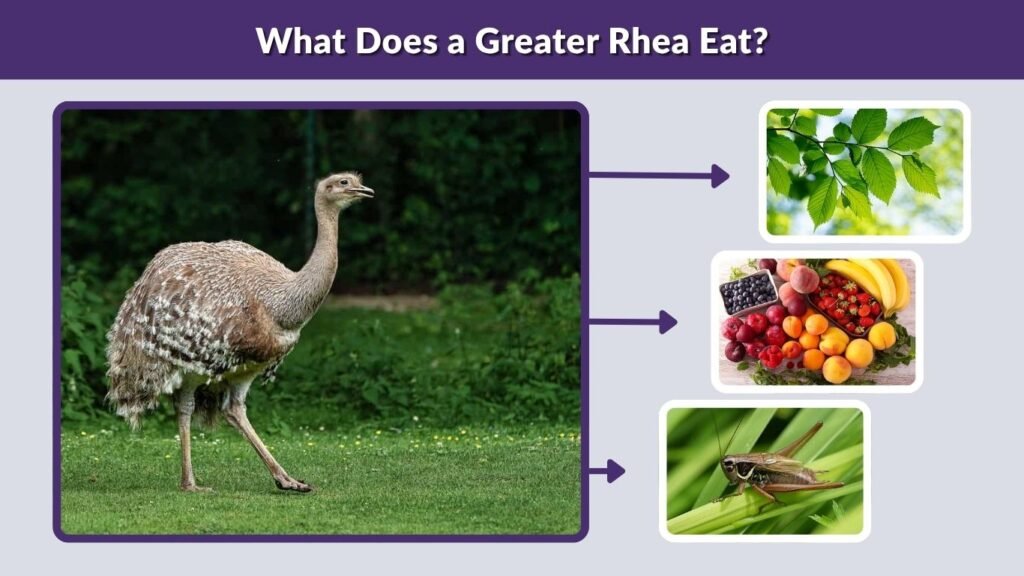
Greater Rheas are omnivores, meaning they consume both plant and animal material. Their broad diet helps them survive in environments where food availability changes seasonally. Most of their food consists of vegetation, but insects and small animals can provide valuable protein.
Greater Rhea Diet
Their diet may include:
- Grasses
- Leaves
- Seeds
- Roots
- Fruits
- Agricultural crops
- Insects
- Grasshoppers
- Beetles
- Small reptiles
- Frogs
- Small rodents
Young rheas typically consume proportionally more animal matter because protein supports rapid growth.
How Greater Rheas Find Food
Greater Rheas spend much of their day walking slowly through open landscapes while searching for food.
They use their beaks to pick vegetation, seeds, and small animals from the ground. Unlike specialized predators, they do not depend on one particular food source, which makes them highly adaptable.
They may also swallow small stones that help grind food inside the digestive system.
Greater Rhea Behavior
Greater Rheas are social birds for much of the year. Outside the breeding season, they may form groups containing several individuals. Their social structure changes dramatically when breeding begins, with males becoming territorial and females moving between males to lay their eggs.
Social Behavior
Greater Rheas may:
- Form groups outside breeding season
- Travel together while feeding
- Run in groups when disturbed
- Communicate through body movements
- Use warning postures
- Become more territorial during breeding
- Gather around good feeding areas
Group living can provide additional protection because several birds can watch for danger at once.
Daily Activity
Greater Rheas are primarily active during daylight. They spend much of their time feeding, walking, resting, and watching their surroundings.
During very hot periods, activity may decrease around midday. They may become more active during cooler morning and evening hours.
Their excellent vision helps them detect predators from a considerable distance.
Greater Rhea Breeding and Life Cycle
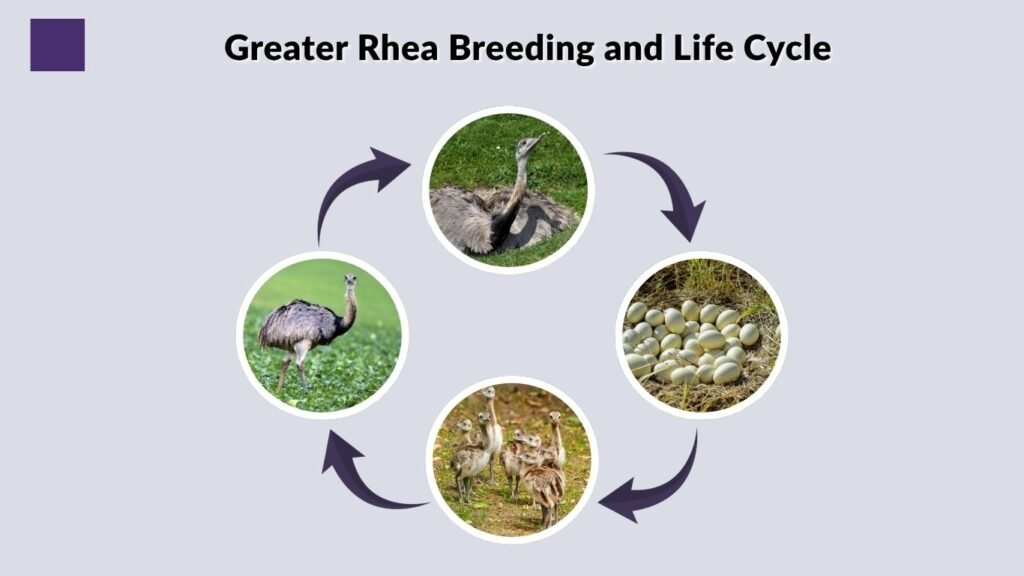
The Greater Rhea has one of the most interesting breeding systems among large birds. Males take responsibility for constructing the nest, incubating the eggs, and caring for the young. Several females may lay eggs in the same nest, resulting in a surprisingly large clutch.
Nesting and Eggs
A breeding male typically:
- Creates a shallow ground nest
- Collects vegetation around the nest
- Mates with multiple females
- Receives eggs from several females
- Incubates the entire clutch
- Defends the nest aggressively
- Cares for chicks after hatching
A single nest may contain dozens of eggs because multiple females contribute to it.
Greater Rhea Chicks
After hatching, the chicks remain with the male rather than their mothers.
The male protects them and leads them to feeding areas. Young rheas are able to walk and feed soon after hatching, although they remain vulnerable to predators.
As they grow, their legs become stronger and their running ability improves rapidly.
Greater Rhea Predators and Defense
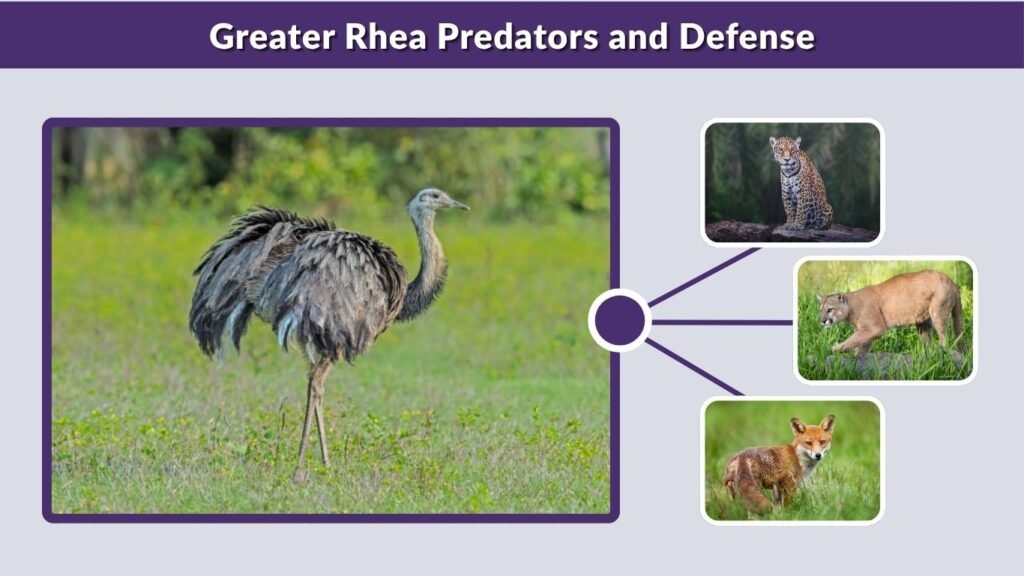
Adult Greater Rheas are large enough to discourage many predators, but they are not completely safe. Eggs and chicks are particularly vulnerable. Their primary defenses are sharp eyesight, speed, group vigilance, and powerful legs.
Common Predators
Potential predators include:
- Jaguars
- Pumas
- Large wild canids
- Foxes
- Birds of prey
- Snakes that raid nests
- Other egg predators
Adult rheas usually attempt to escape rather than fight, although cornered birds can kick powerfully.
Defensive Behavior
When threatened, a Greater Rhea usually runs rapidly while changing direction.
Its open wings help stabilize its body during turns. Birds may also lower their heads while running, making their bodies appear less obvious in tall vegetation.
Males guarding eggs or chicks can be much more defensive than birds encountered at other times.
Greater Rhea Lifespan and Conservation
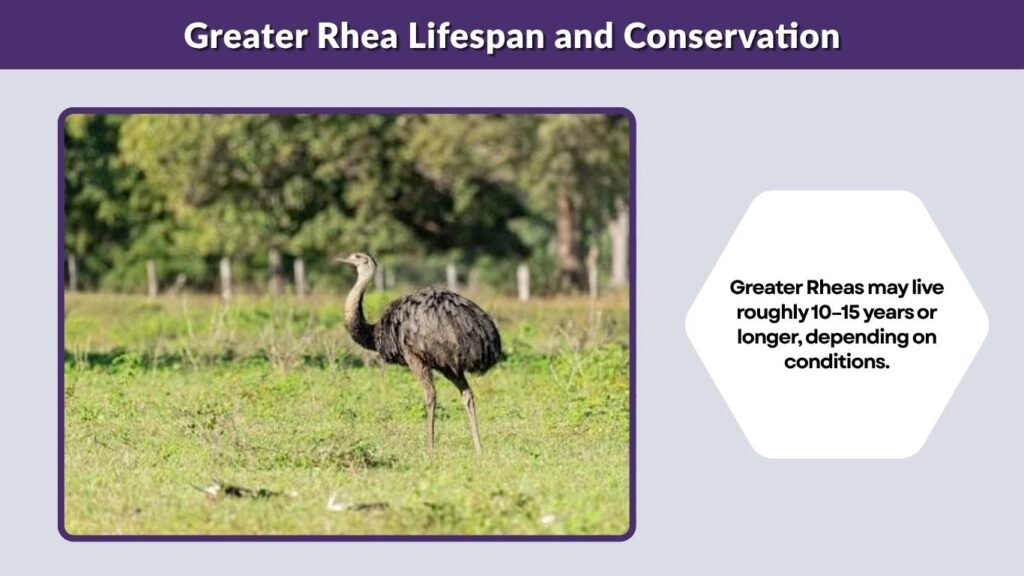
Greater Rheas can survive for many years when they avoid predation, hunting, habitat destruction, and other threats. Their ability to use farmland provides some adaptability, but agricultural expansion can also reduce natural grasslands and create conflicts with people.
Greater Rhea Lifespan
Greater Rheas may live roughly 10–15 years or longer, depending on conditions.
Survival is usually lowest among eggs and chicks because they face predators, weather, and food shortages. Adults that reach maturity have a better chance of surviving for several years.
Conservation Threats
Major threats include:
- Grassland conversion
- Agricultural expansion
- Hunting
- Egg collection
- Road collisions
- Habitat fragmentation
- Disturbance around nesting sites
- Competition with livestock
Protecting natural grasslands and reducing illegal hunting are important for maintaining healthy populations.
Interesting Greater Rhea Facts
The Greater Rhea is unusual not only because it cannot fly but also because of its breeding behavior and impressive running abilities. Its combination of long legs, strong eyesight, flexible diet, and social behavior makes it highly adapted to open South American environments.
Greater Rhea Facts
- Greater Rheas are native to South America.
- Their scientific name is Rhea americana.
- They are unable to fly.
- They have three toes on each foot.
- Males incubate the eggs.
- Several females may lay eggs in one nest.
- Males care for the chicks.
- They use their wings for balance while running.
- They are omnivores.
- They are smaller than African ostriches.
FAQs
Is the Greater Rhea a flightless bird?
Yes. The Greater Rhea has wings but cannot achieve sustained flight. It relies on strong legs and fast running to escape predators.
Where does the Greater Rhea live?
Greater Rheas live in South America, particularly in Brazil, Argentina, Paraguay, Uruguay, and Bolivia. They prefer grasslands, savannas, pasture, and other open habitats.
What does a Greater Rhea eat?
Greater Rheas eat grasses, leaves, seeds, fruits, insects, small reptiles, amphibians, and occasionally small mammals. They are considered omnivores.
Is a Greater Rhea an ostrich?
No. Although Greater Rheas resemble ostriches, they belong to a different family. Rheas are native to South America, are smaller, and have three toes instead of two.
Who cares for Greater Rhea chicks?
The male cares for the eggs and chicks. He incubates eggs laid by several females and continues guarding the young after they hatch.
