

The magnificent frigatebird (Fregata magnificens) is a fascinating seabird recognized for its enormous wingspan, deeply forked tail, and remarkable flying abilities. Found across tropical and subtropical regions of the Americas, this bird can soar effortlessly above the ocean for hours. Male magnificent frigatebirds are especially famous for their bright red inflatable throat pouches, which they display during courtship. Despite their impressive size, these seabirds are surprisingly lightweight and rarely land on water. Their unique appearance, feeding behavior, breeding habits, and extraordinary aerial adaptations make them one of the most distinctive seabirds in the world.
What Is a Magnificent Frigatebird?
The magnificent frigatebird is a large marine bird belonging to the family Fregatidae. It is one of five living frigatebird species and is widely distributed around tropical American coastlines.
Sometimes called the man-of-war bird, it is known for chasing other seabirds and stealing their freshly caught food. However, magnificent frigatebirds also catch fish and other marine animals independently.
Their lightweight bodies, pointed wings, and excellent gliding abilities make them highly adapted to life above the ocean.
Magnificent Frigatebird Size and Physical Characteristics
Magnificent frigatebirds are among the largest members of their family. Their extraordinary wingspan allows them to travel long distances while using relatively little energy.
Size and Wingspan
| Characteristic | Measurement |
| Scientific name | Fregata magnificens |
| Body length | 89–114 cm (35–45 inches) |
| Wingspan | 217–224 cm (85–88 inches), commonly reported range |
| Weight | 1–1.9 kg (2.2–4.2 pounds) |
| Lifespan | At least 19 years in the wild |
| Conservation status | Least Concern |
Females are generally larger and heavier than males. Their long, angular wings and deeply forked tails help them maneuver efficiently in the air.
Male vs. Female Magnificent Frigatebird
Male magnificent frigatebirds have glossy black plumage with a striking red throat pouch. During the breeding season, males inflate this pouch to attract females.
Female magnificent frigatebirds have dark heads and prominent white breast patches. Unlike males, they do not possess the large inflatable red throat pouch.
Juvenile magnificent frigatebirds typically have white heads and underparts. Their plumage gradually darkens as they mature, making young birds look noticeably different from adults.
Magnificent Frigatebird Habitat and Range
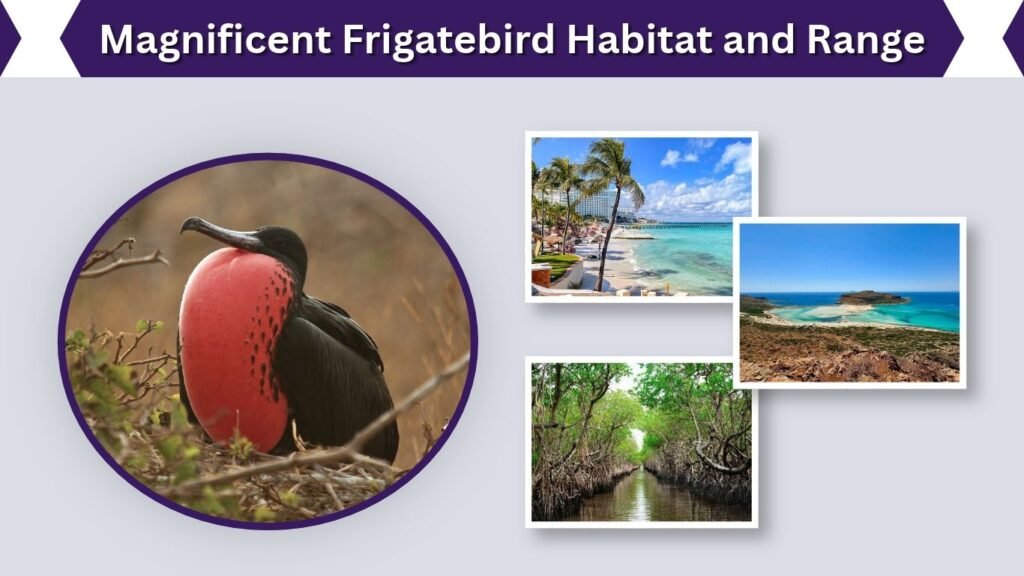
Magnificent frigatebirds inhabit warm coastal and oceanic environments throughout tropical and subtropical regions of the Americas.
They are commonly associated with coastal islands, mangrove forests, lagoons, coral reefs, and open ocean waters.
Where Do Magnificent Frigatebirds Live?
Their geographic distribution includes several well-known coastal regions:
- Florida: Frequently observed near the Florida Keys and other southern coastal areas.
- Mexico: Found along the Gulf, Caribbean, and Pacific coasts, including areas near Cancún.
- Caribbean Islands: Common around suitable coastal habitats and nesting islands.
- Galápagos Islands: Found around the archipelago, sometimes alongside great frigatebirds.
- Central and South America: Distributed along many tropical coastlines.
Although these birds often fly far offshore, they depend on land-based nesting locations. Small islands with mangroves, shrubs, or low trees provide important breeding habitats.
What Do Magnificent Frigatebirds Eat?
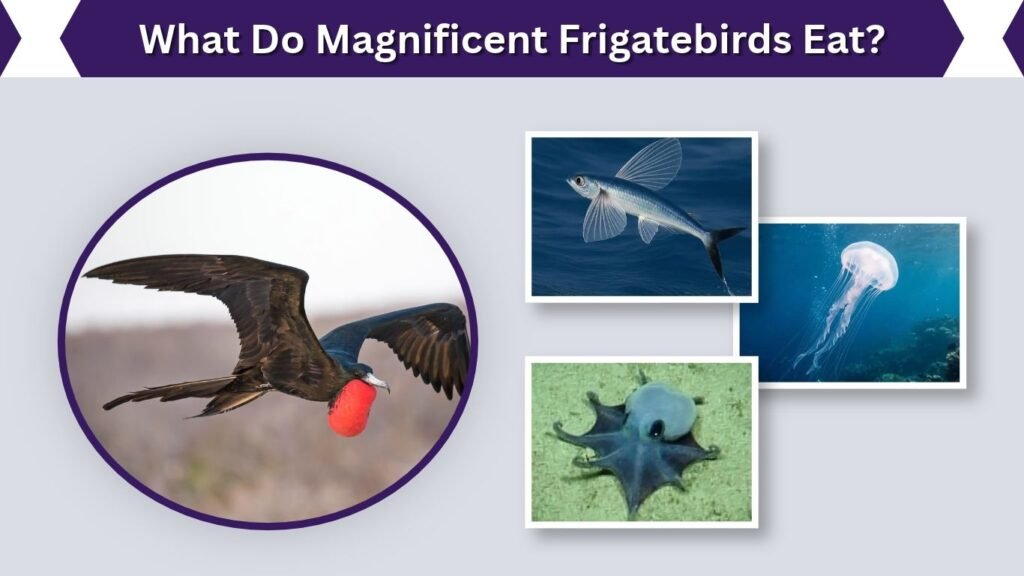
Magnificent frigatebirds are carnivorous seabirds that primarily feed on fish and other small marine animals.
Their long, hooked bills allow them to catch prey near the water’s surface without fully entering the ocean.
Magnificent Frigatebird Diet
Their food sources include:
- Flying fish and other small fish.
- Squid and other marine invertebrates.
- Jellyfish and crustaceans.
- Fish scraps discarded by fishing boats.
- Food stolen from other seabirds.
How Do Magnificent Frigatebirds Catch Food?
Magnificent frigatebirds use two important feeding strategies.
Surface feeding: They fly close to the ocean and grab fish or other animals from the surface. They may also capture flying fish that leap from the water.
Kleptoparasitism: They chase seabirds until those birds release or regurgitate food. The frigatebird then catches the food in midair.
Although food stealing is one of their most famous behaviors, magnificent frigatebirds obtain much of their food through independent hunting.
Magnificent Frigatebird Flight and Adaptations
Magnificent frigatebirds are exceptionally efficient aerial travelers. Their long wings and lightweight bodies allow them to use rising air currents to remain airborne with minimal effort.
Their deeply forked tails act as steering surfaces, providing excellent control while soaring.
Unlike many marine birds, they lack sufficiently waterproof plumage for regular swimming. Landing directly on water can make taking flight difficult.
Their short legs and small feet also make walking on land challenging. Instead, they spend much of their lives flying or resting on elevated perches.
These specialized adaptations allow magnificent frigatebirds to exploit food resources over extensive ocean areas.
Why Do Male Magnificent Frigatebirds Have Red Throat Pouches?
The male magnificent frigatebird possesses a bright red inflatable throat pouch known as the gular sac.
During courtship, males gather in breeding colonies and inflate their pouches into large red balloons. They also spread their wings, raise their bills, shake their heads, and make distinctive sounds.
Females fly above the colony and examine displaying males before selecting their partners.
The gular sac is primarily used for courtship signaling rather than collecting or storing food. Its striking appearance is one of the most recognizable features of this species.
Magnificent Frigatebird Breeding and Nesting
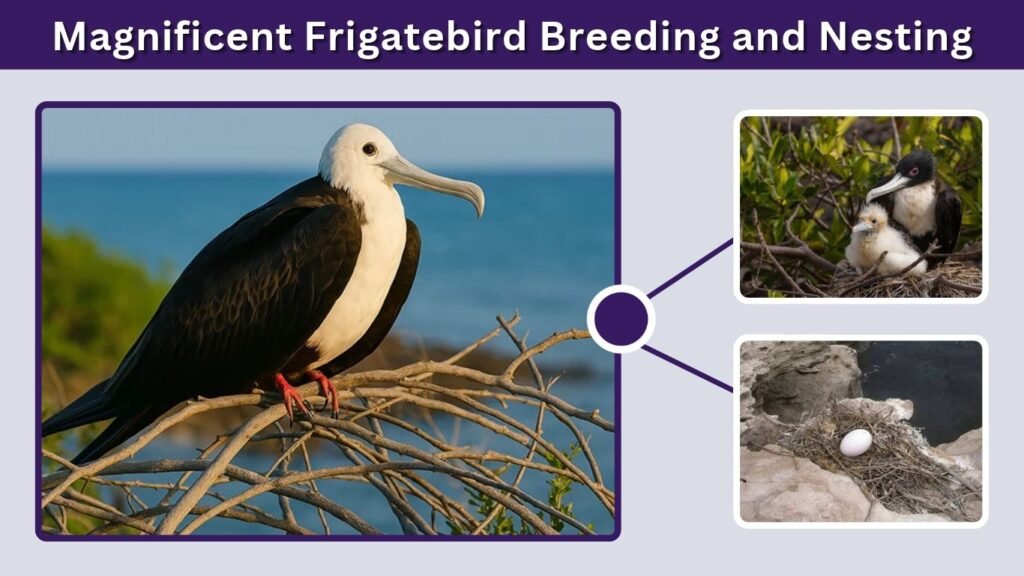
Magnificent frigatebirds reproduce in colonies, often on isolated islands surrounded by warm ocean waters.
Their nests are usually constructed in mangrove trees, shrubs, or other low-growing vegetation.
Nesting and Egg Development
Once a pair forms, the male collects nesting materials while the female arranges them into a simple platform of sticks.
The female normally lays one white egg. Both parents participate in incubation, which typically lasts approximately 53–61 days.
After hatching, the chick depends completely on parental care.
Raising Young Frigatebirds
Both parents initially feed and protect the chick. However, the male generally leaves before the young bird becomes independent.
The female continues providing food for an extended period, sometimes until the offspring is approximately one year old.
Because raising a chick requires substantial time and energy, female magnificent frigatebirds generally do not breed every year.
Great Frigatebird vs. Magnificent Frigatebird
The great frigatebird (Fregata minor) and magnificent frigatebird have similar appearances, but several characteristics can help distinguish them.
| Feature | Magnificent Frigatebird | Great Frigatebird |
| Scientific name | Fregata magnificens | Fregata minor |
| Size | Generally slightly larger | Generally slightly smaller |
| Main range | Tropical Americas | Indian and Pacific Oceans |
| Male plumage | Often purple iridescence | Often green iridescence |
| Female head | Dark head, white breast | May show a paler throat |
| Male throat pouch | Red | Red |
Both species occur in the Galápagos Islands, where careful observation is necessary for accurate identification.
Plumage differences can be subtle, so location, age, sex, and multiple field marks should be considered together.
Magnificent Frigatebird Lifespan and Predators
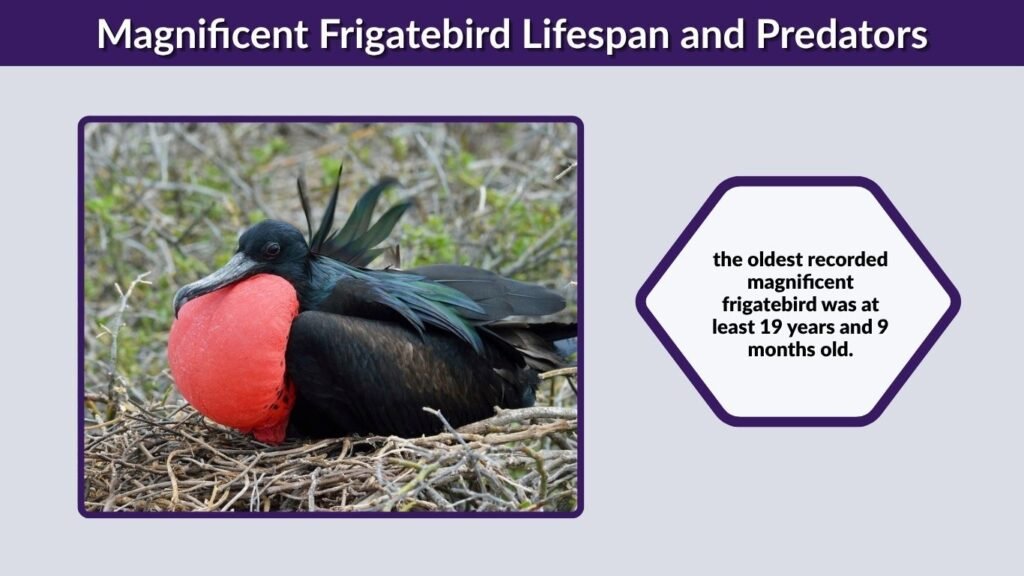
Magnificent frigatebirds are relatively long-lived seabirds. According to Cornell Lab of Ornithology, the oldest recorded magnificent frigatebird was at least 19 years and 9 months old.
Adult birds have relatively few natural predators while flying above the ocean. However, eggs and chicks are more vulnerable to attacks from other birds and introduced predators on nesting islands.
Disturbance near nesting colonies can also reduce breeding success, especially when adult birds leave vulnerable eggs or chicks unattended.
Is the Magnificent Frigatebird Endangered?
The magnificent frigatebird is currently classified as Least Concern by the International Union for Conservation of Nature (IUCN).
However, this does not mean every population is secure. Some breeding colonies face environmental pressures from coastal development, habitat destruction, introduced predators, and disturbances associated with human activity.
Protecting nesting islands and conserving healthy marine environments are important for maintaining stable populations.
FAQs
1. How wide is a magnificent frigatebird’s wingspan?
A magnificent frigatebird typically has a wingspan of approximately 217–224 cm (7.1–7.3 feet), although some females can have larger wingspans.
2. Can magnificent frigatebirds swim?
No. Magnificent frigatebirds are poorly adapted for swimming because their feathers are not sufficiently waterproof and their legs and feet are small. They generally avoid landing on water.
3. How long do magnificent frigatebirds live?
Magnificent frigatebirds can survive for many years in the wild. The oldest documented individual was at least 19 years and 9 months old, although some birds may live longer.
4. Are magnificent frigatebirds monogamous?
Magnificent frigatebirds form breeding pairs, but these relationships generally last for only part of a breeding cycle. After the male leaves, the female usually continues raising the chick alone.
5. What sound does a magnificent frigatebird make?
Magnificent frigatebirds are often quiet while flying over the ocean. During courtship, males produce rattling, clattering, and guttural sounds to attract females.