
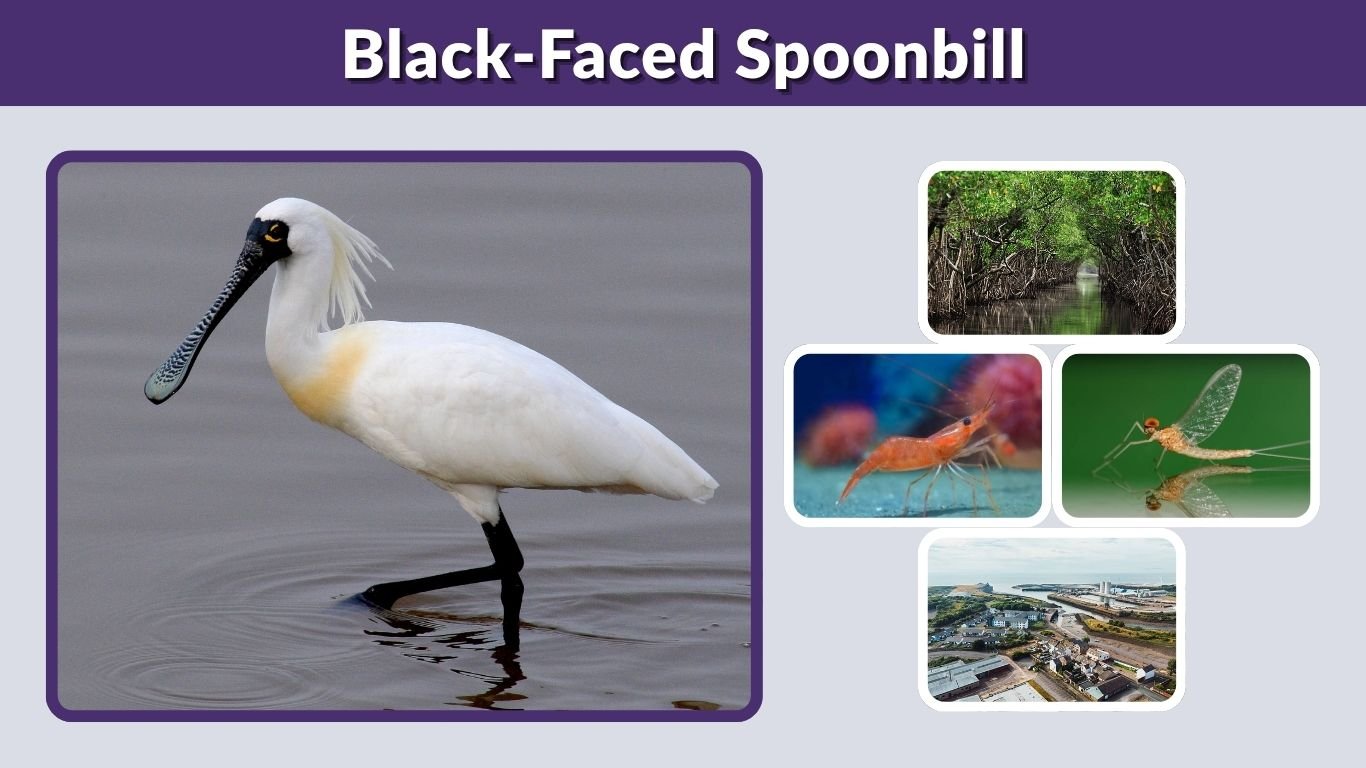
The Black-faced Spoonbill (Platalea minor) is a distinctive East Asian waterbird recognized by its white plumage, black facial skin, long black legs, and flattened spoon-shaped bill. Once reduced to only a few hundred birds, the species has made an impressive recovery through decades of wetland protection and international conservation. It breeds mainly around Korea and northeastern China before migrating to wintering grounds in Taiwan, Hong Kong, southern China, Japan, and Vietnam. Despite its recovery, protecting coastal wetlands remains essential for its future.
What Is a Black-Faced Spoonbill?
The Black-faced Spoonbill is one of six living spoonbill species. Its scientific name is Platalea minor, and it belongs to the ibis and spoonbill family, Threskiornithidae.
Its combination of an entirely black face and a long, flattened bill makes identification relatively easy. Despite searches for terms such as black spoonbill or black-billed spoonbill, the accepted English name is Black-faced Spoonbill.
Black-Faced Spoonbill Identification
- Scientific name: Platalea minor
- Primarily white plumage
- Bare black facial skin
- Long, flattened black spoon-shaped bill
- Long black legs
- Approximately 70–80 cm long
- Adults develop a crest during breeding season
- Breeding adults may show yellow or golden coloration on the head, neck, and upper chest
- Juveniles have less-developed facial coloration and different bill details
The Black-faced Spoonbill is considered the smallest of the world’s spoonbill species.
Black-Faced Spoonbill Habitat
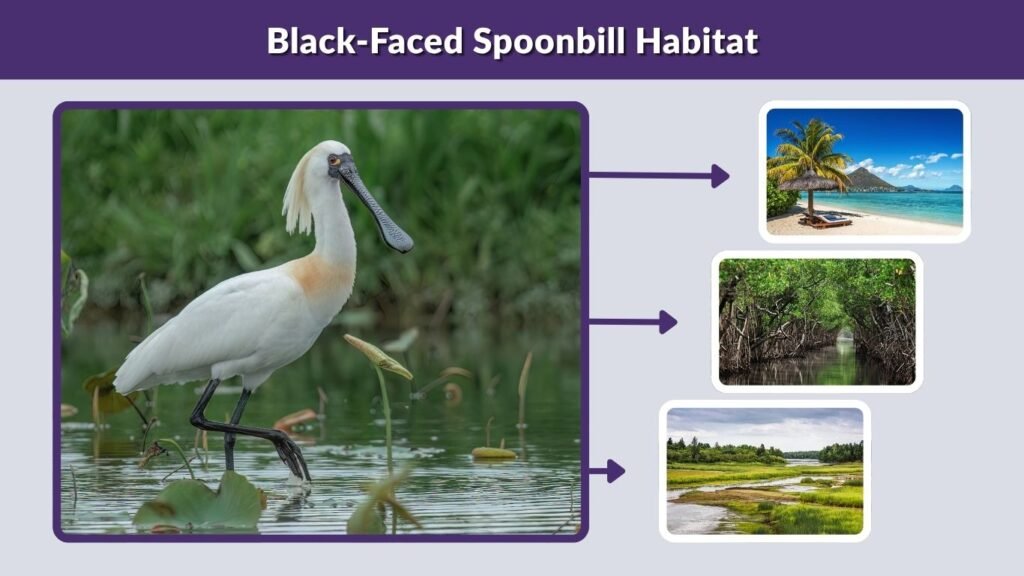
Black-faced Spoonbills are strongly associated with wetlands. They require shallow water for feeding and relatively undisturbed locations for resting and breeding.
They occur in coastal and inland wetland habitats throughout their East Asian range.
Preferred Habitats
- Tidal mudflats
- Estuaries
- Coastal lagoons
- Mangrove wetlands
- Marshes
- Shallow fish ponds
- Flooded rice fields
- Reservoir margins
- Brackish wetlands
During winter, birds often alternate between sheltered daytime roosts and shallow feeding sites. Fish ponds can provide valuable feeding habitat when their water level is low enough.
What Does a Black-Faced Spoonbill Eat?
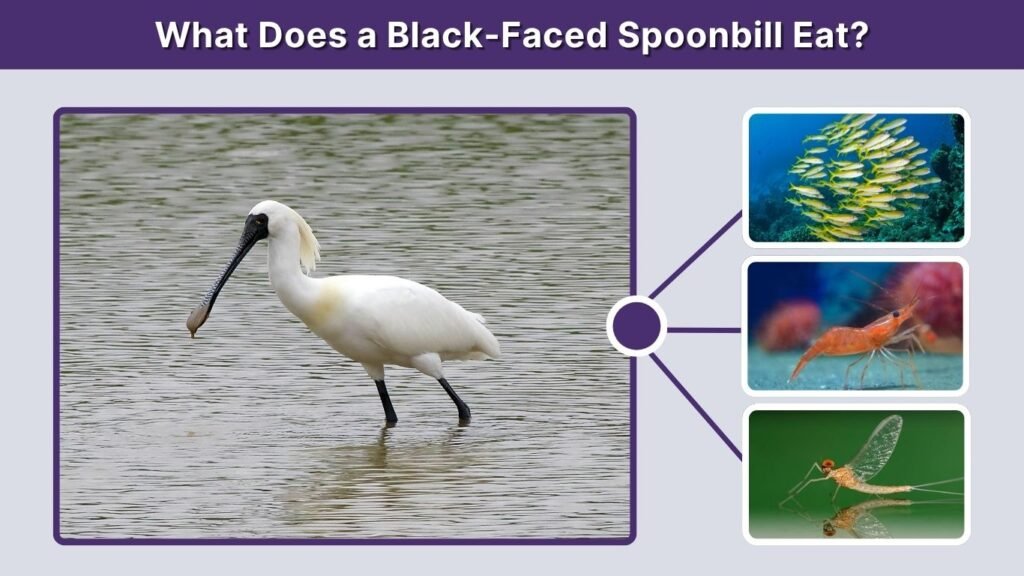
The Black-faced Spoonbill diet consists mainly of small aquatic animals.
It feeds by walking slowly through shallow water with its bill partly submerged. The bird sweeps its head and bill repeatedly from side to side. When its sensitive bill touches prey, it snaps shut.
Common Foods
- Small fish
- Shrimp
- Crabs
- Other crustaceans
- Aquatic insects
- Small aquatic animals
Hong Kong Wetland Park describes Black-faced Spoonbills using this characteristic side-to-side feeding technique to capture fish, shrimp, and crabs.
Black-Faced Spoonbill Breeding
Black-faced Spoonbills migrate north when the breeding season approaches. The Korean Peninsula contains their most important breeding areas, with additional breeding sites in northeastern China and a small breeding presence in southeastern Russia.
Breeding Behavior
The breeding season generally begins in spring. Birds may nest on small offshore islands, isolated islets, cliffs, or protected coastal sites.
In South Korea, nests have been recorded on the ground and low vegetation, while birds in parts of China and North Korea may use steep cliffs. A typical clutch contains around three eggs, although four may occasionally occur.
Adult birds become particularly attractive during this period. They develop longer crest feathers and yellowish-golden coloration around the head and upper breast.
Black-Faced Spoonbill Migration
The species is an important migratory bird of the East Asian-Australasian Flyway.
Many birds arrive at breeding areas in Korea around March. After nesting, they gradually move south toward their wintering grounds.
Major Wintering Areas
Important wintering regions include Taiwan, southern mainland China, Hong Kong, Macao, Japan, Vietnam, and southern Korea. Smaller numbers may also reach the Philippines and other parts of Southeast Asia.
Birds normally remain in major wintering areas from approximately autumn through early spring, although some immature birds may stay farther south during summer.
Black-Faced Spoonbill in Taiwan and Tainan
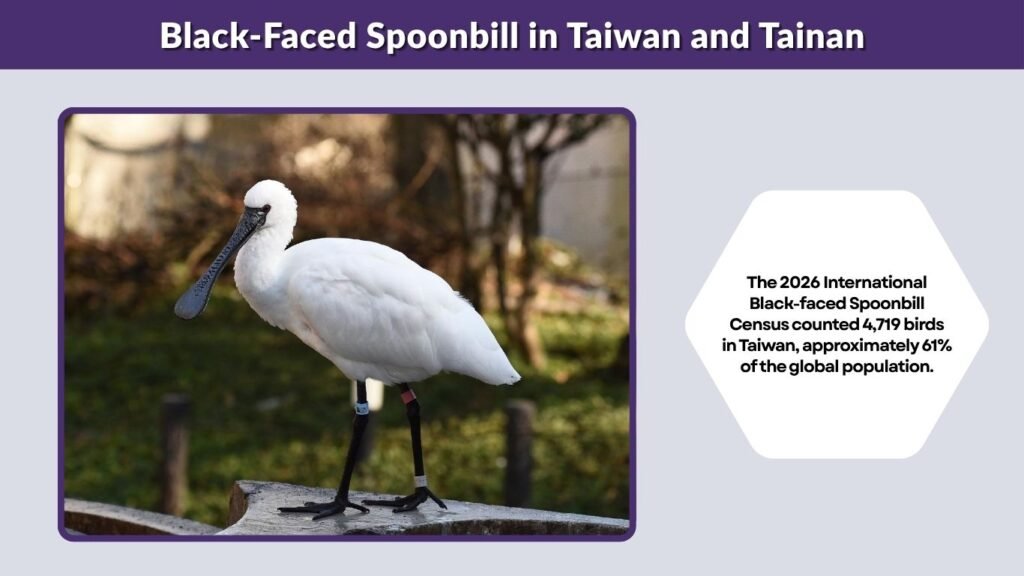
Taiwan is now the world’s most important wintering region for the species. The 2026 International Black-faced Spoonbill Census counted 4,719 birds in Taiwan, approximately 61% of the global population.
Tainan is especially important.
The Zengwen River estuary and surrounding Qigu wetlands provide extensive shallow-water habitat, fish ponds, roosting areas, and feeding grounds. A 300-hectare Black-faced Spoonbill refuge has been established on the north bank of the Zengwen River estuary.
Birdwatchers can commonly look for wintering spoonbills around Tainan from autumn through early spring.
Black-Faced Spoonbill in Hong Kong
Hong Kong is another significant wintering area, particularly around Deep Bay and associated wetlands.
At Hong Kong Wetland Park, Black-faced Spoonbills can be observed foraging on mudflats during winter and early spring.
However, recent numbers in the region have caused concern. Although the global population continues to increase, the proportion wintering in Deep Bay has declined. In the 2026 census, Deep Bay held only about 4.4% of the global population, its lowest recorded proportion.
Black-Faced Spoonbill Population
The species represents one of East Asia’s notable bird-conservation successes.
When international monitoring began, only a few hundred individuals were known. Numbers have increased substantially due to habitat protection, monitoring, wetland management, and cooperation among countries along the migratory flyway.
Current Population
The 2026 International Black-faced Spoonbill Census recorded 7,746 individuals worldwide, a record high and an increase of 665 birds from the previous year’s count.
Taiwan alone supported 4,719 birds, while mainland China remained another major wintering region.
Are Black-Faced Spoonbills Endangered?
Not currently under the latest IUCN global classification.
The Black-faced Spoonbill was classified as Endangered for many years, which explains why many older articles and conservation materials still describe it that way.
The IUCN’s 2025-2 assessment moved Platalea minor from Endangered to Vulnerable following its substantial population recovery.
This does not mean the species is completely secure. Vulnerability is still a threatened category.
Threats to Black-Faced Spoonbills

Wetland loss remains one of the most important concerns.
Major Threats
- Coastal wetland development
- Land reclamation
- Loss of tidal flats
- Pollution
- Disturbance at feeding and breeding areas
- Disease outbreaks such as botulism
- Changes to fish ponds and agricultural wetlands
- Climate-related changes to coastal habitat
- Predation at breeding colonies
The species is also highly concentrated geographically. Large portions of the population depend on relatively few breeding and wintering areas, meaning damage to a key wetland could affect many birds at once.
Black-Faced Spoonbill Conservation
Protection has involved governments, conservation groups, researchers, and local communities across East Asia.
Important measures include protecting breeding islands, preserving tidal flats, maintaining fish ponds as feeding habitats, monitoring migration, reducing disturbance, and conducting annual population censuses.
Taiwan has also developed programs that encourage fish farmers to manage harvested ponds in ways that provide additional feeding habitat for migratory birds.
The remarkable increase to more than 7,700 birds demonstrates how sustained habitat protection can help a highly threatened species recover.
Black Spoonbill Fish vs. Black-Faced Spoonbill
A Black-faced Spoonbill is a bird, not a fish.
The term “spoonbill fish” is sometimes used for paddlefish because of their long, paddle-shaped snout. That animal is completely unrelated to the Black-faced Spoonbill.
The bird’s “spoonbill” name comes from the broad, flattened tip of its bill, which it uses to detect aquatic prey while sweeping through shallow water.
FAQs
1. Where does the Black-faced Spoonbill live?
It breeds primarily around the Korean Peninsula and northeastern China and winters mainly in Taiwan, southern China, Hong Kong, Japan, and Vietnam.
2. Why does the Black-faced Spoonbill have a spoon-shaped bill?
The flattened bill is specialized for feeding. The bird sweeps it sideways through shallow water and closes it when it detects fish, shrimp, or other prey.
3. Is the Black-faced Spoonbill endangered?
It was formerly listed as Endangered, but the latest IUCN assessment classifies it as Vulnerable following substantial population recovery.
4. How many Black-faced Spoonbills are left?
The 2026 international census recorded 7,746 Black-faced Spoonbills worldwide, the highest count on record.
5. Where is the best place to see Black-faced Spoonbills in Taiwan?
Tainan is one of the most important locations, particularly the Zengwen River estuary, Qigu wetlands, and surrounding fish ponds. Large numbers winter in this region each year.
