
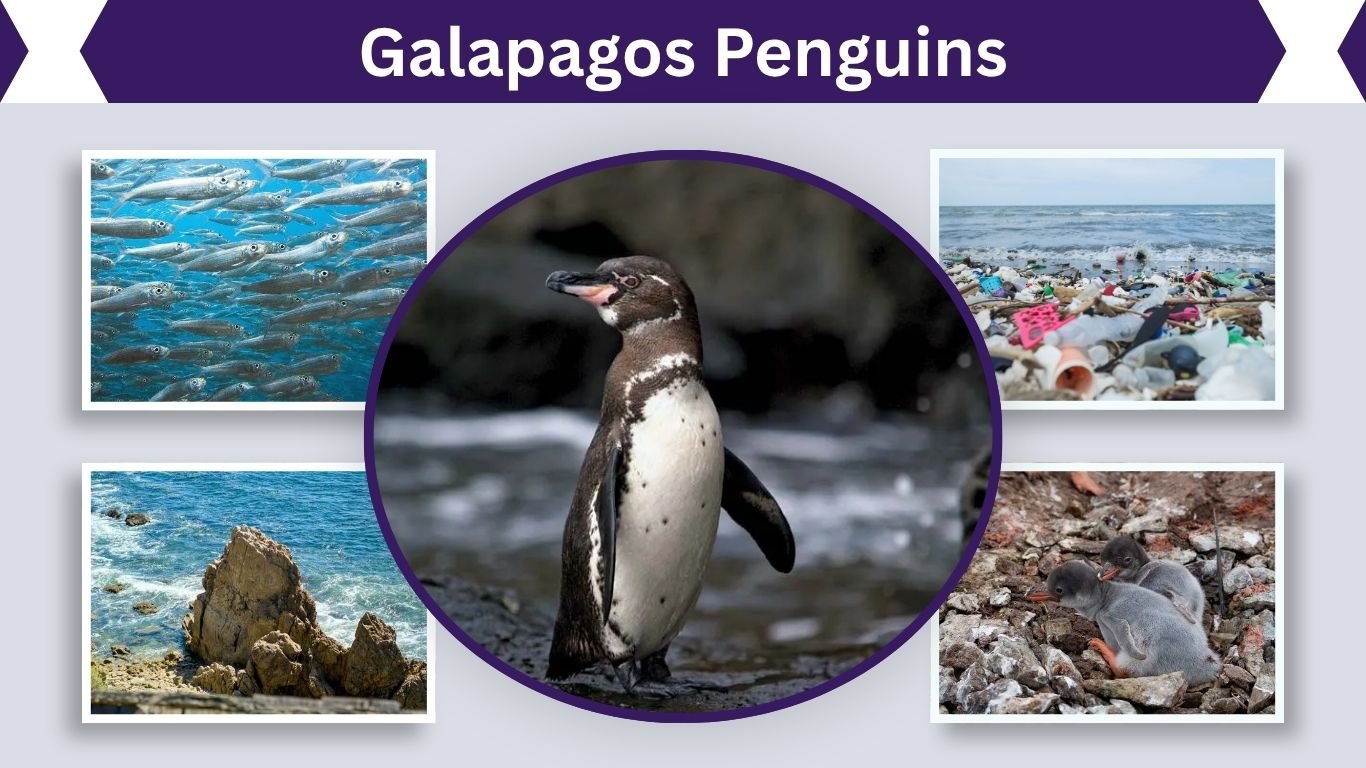
Galapagos penguins are among the rarest and most unusual penguins in the world, living on tropical islands near the equator instead of the frozen Antarctic. Scientifically known as Spheniscus mendiculus, these small seabirds inhabit the Galapagos Islands of Ecuador, where cool ocean currents provide food and suitable living conditions. Despite their remarkable adaptations, Galapagos penguins face serious threats from climate change, predators, and declining fish populations. This guide explores their habitat, diet, physical characteristics, breeding behavior, endangered status, and fascinating facts about their survival.
What Are Galapagos Penguins?
The Galapagos penguin is a small, flightless seabird belonging to the family Spheniscidae. It is endemic to Ecuador’s Galapagos Islands, meaning it naturally occurs nowhere else in the world. Unlike Antarctic penguins, this species lives in a warm tropical environment and depends on cool ocean currents for survival. Its compact body and specialized behaviors help it tolerate challenging equatorial conditions.
Galapagos Penguin Identification
- Scientific name: Spheniscus mendiculus.
- Height: Approximately 19–21 inches (49–53 cm).
- Weight: Around 5.5 pounds (2.5 kg).
- Body color: Black upperparts with a mostly white underside.
- Facial markings: Thin white markings extending around the eyes and toward the throat.
- Chest pattern: A distinctive dark band crossing the upper chest.
- Beak: A narrow, dark bill with pinkish skin near its base.
What Makes Galapagos Penguins Unique?
Galapagos penguins are the only penguin species that naturally lives on both sides of the equator.
They are among the smallest penguin species and belong to the same genus as African, Humboldt, and Magellanic penguins.
Their ability to survive intense tropical sunlight makes them especially unusual among penguins.
Where Do Galapagos Penguins Live?
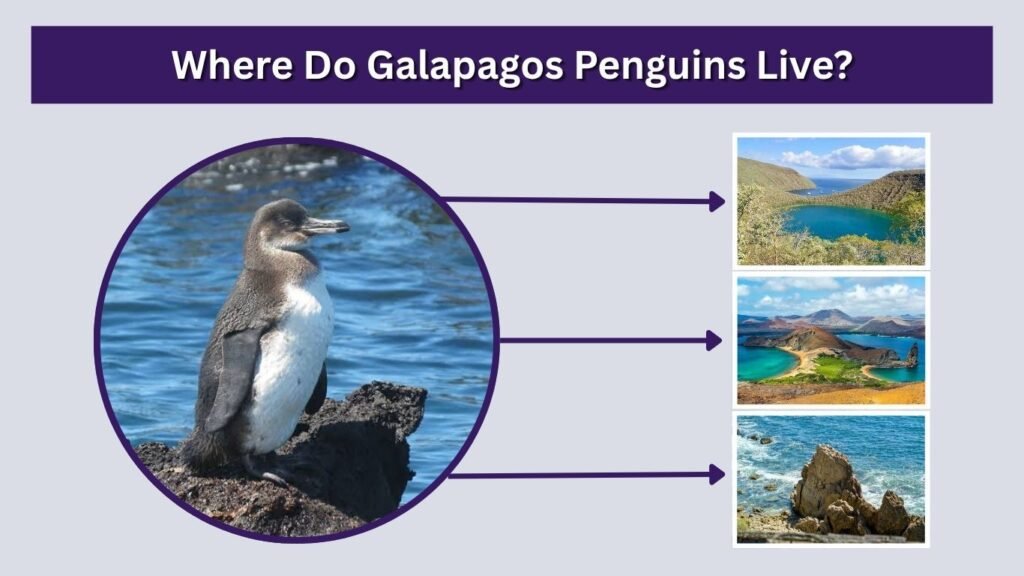
Galapagos penguins inhabit the volcanic coastlines and surrounding waters of the Galapagos Islands, approximately 1,000 kilometers west of mainland Ecuador. Their distribution is closely connected to cold, nutrient-rich currents that support abundant marine life. Although penguins occur across several islands, most individuals concentrate in the western archipelago, where ocean conditions are especially favorable for feeding and reproduction.
Galapagos Penguin Habitat and Distribution
Approximately 95% of the population occurs around Isabela and Fernandina islands.
Smaller populations inhabit areas around Santiago, Bartolomé, and Floreana.
These birds prefer rocky coastlines, sheltered lava crevices, and nearby ocean waters. Natural caves provide shade and protection from extreme temperatures.
Why Can Penguins Live Near the Equator?
The Galapagos Islands receive cooling influences from the Humboldt Current and the upwelling of the Cromwell Current.
These currents bring nutrient-rich water toward the surface, supporting fish populations that penguins depend on.
Without these cooler waters, finding sufficient food and avoiding overheating would become considerably more difficult.
What Do Galapagos Penguins Eat?
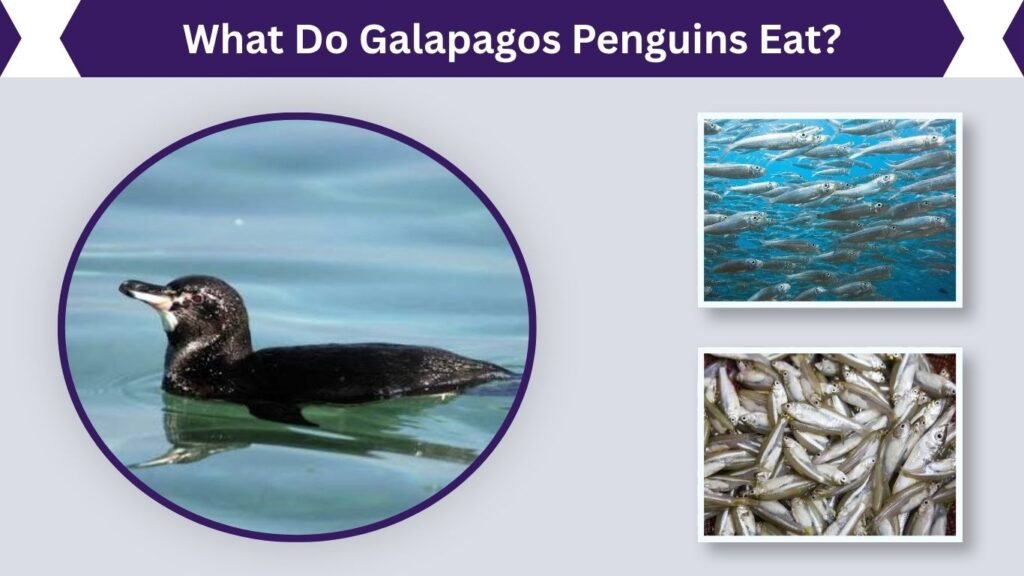
Galapagos penguins are carnivorous seabirds that primarily consume small schooling fish. Their diet depends on seasonal ocean productivity and the availability of prey near the islands. They are skilled underwater hunters, using streamlined bodies and powerful flippers to pursue fish. Changes in sea temperature can significantly affect their feeding success, particularly during strong El Niño events.
Galapagos Penguin Diet
Their common prey includes:
- Sardines: Small schooling fish that provide important energy and nutrients.
- Anchovies: A major food source found in productive coastal waters.
- Mullets: Fish occasionally captured while foraging near rocky shorelines.
- Other small fish: Additional species eaten depending on local availability.
How Do Galapagos Penguins Hunt?
Galapagos penguins catch prey underwater, using their flippers to propel themselves through the water.
They often hunt close to shore, sometimes alone or in small groups. Their sharp vision allows them to track moving fish.
Their strong swimming ability helps them capture prey efficiently, even when fish schools change direction rapidly.
Galapagos Penguin Adaptations
Living near the equator presents major challenges for an animal covered in insulating feathers. Galapagos penguins must prevent overheating while remaining efficient underwater predators. Over many generations, they developed physical and behavioral adaptations that help regulate body temperature and conserve energy. These characteristics allow them to survive in one of the warmest environments occupied by penguins.
Adaptations for Tropical Survival
- Small body size: Helps release excess body heat more easily than larger penguins.
- Panting: Allows evaporative cooling when temperatures become uncomfortable.
- Extended flippers: Helps increase exposed surface area for heat loss.
- Shaded nesting: Protects eggs, chicks, and adults from direct tropical sunlight.
- Bare skin patches: Assist with releasing heat around parts of the face.
- Efficient swimming: Enables penguins to hunt in cooler water while reducing time spent on hot land.
How Did Galapagos Penguins Evolve?
Galapagos penguins likely descended from ancestors related to South American banded penguins that reached the islands through Pacific ocean currents.
Over time, populations adapted to tropical conditions while remaining dependent on productive coastal waters.
Their evolutionary history illustrates how animal populations can develop specialized traits after becoming geographically isolated.
Galapagos Penguin Breeding and Life Cycle
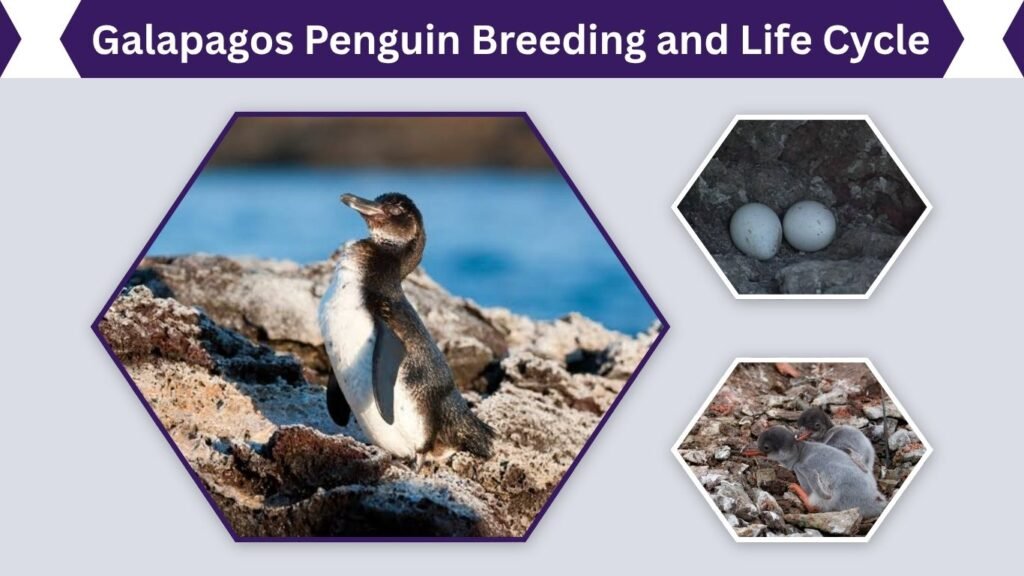
Unlike many penguin species with predictable annual breeding seasons, Galapagos penguins reproduce when environmental conditions are favorable. Cool waters and abundant fish encourage nesting, while periods of food scarcity can interrupt reproduction. These birds commonly form long-term breeding pairs and shelter their eggs in volcanic rock cavities. Both parents participate in incubation and feeding their offspring.
Galapagos Penguin Eggs and Chicks
Females generally lay one or two white eggs inside a protected nesting cavity.
Both parents incubate the eggs for approximately 35–40 days. After hatching, the chicks depend on adults for warmth, protection, and food.
Young penguins typically develop their juvenile plumage and leave the nest after about eight to nine weeks.
Do Galapagos Penguins Migrate?
Galapagos penguins are generally nonmigratory and remain within the archipelago throughout the year.
They may move between islands or feeding locations when food availability changes, but they do not undertake the long seasonal migrations associated with some other seabirds.
Their restricted geographic range makes them particularly sensitive to environmental disturbances.
Why Are Galapagos Penguins Endangered?
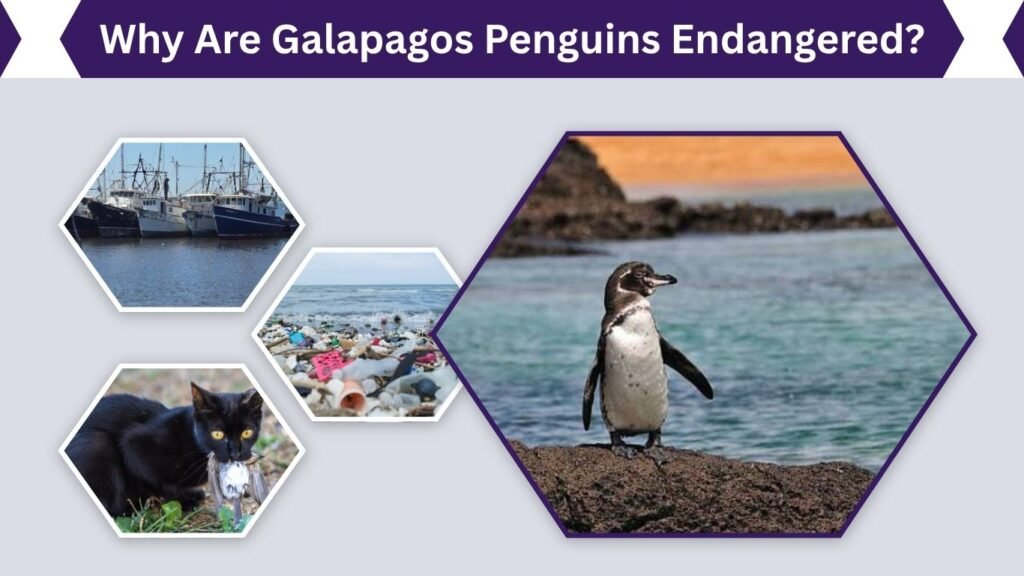
Galapagos penguins are classified as Endangered by the International Union for Conservation of Nature (IUCN). Their small population, restricted distribution, and dependence on cold-water marine ecosystems make them vulnerable to environmental changes. Severe El Niño events have historically caused dramatic population declines by reducing available food. Introduced predators, pollution, and fishing-related threats create additional challenges for their long-term survival.
How Many Galapagos Penguins Are Left?
Conservation organizations commonly estimate the population at around 2,000 individuals, although estimates vary and numbers fluctuate considerably between survey periods.
The population experienced devastating declines during strong El Niño events in 1982–1983 and 1997–1998.
Although conservation work has supported recovery, the species remains highly vulnerable to future ocean warming and food shortages.
Major Threats to Galapagos Penguins
- Climate change: Ocean warming can disrupt productive marine ecosystems.
- El Niño events: Warmer waters reduce fish availability and breeding success.
- Introduced predators: Cats and rats can prey on penguins, eggs, and chicks.
- Marine pollution: Plastic waste and other pollutants threaten marine wildlife.
- Fishing activities: Accidental entanglement and competition for prey can affect survival.
- Natural predators: Sharks and certain marine mammals may attack penguins at sea.
How Can We Protect Galapagos Penguins?
Conservation efforts focus on protecting breeding habitats, controlling introduced predators, monitoring populations, and maintaining healthy marine ecosystems.
Scientists and park authorities have also developed artificial nesting shelters to provide protected breeding locations.
Responsible tourism and continued research are essential for improving the species’ long-term survival prospects.
Where and When Can You See Galapagos Penguins?
Galapagos penguins are a remarkable attraction for wildlife enthusiasts visiting Ecuador’s volcanic islands. Because these birds remain in the archipelago year-round, sightings are possible during different seasons. However, their distribution is uneven, and encounters depend on ocean conditions, location, and wildlife activity. Responsible observation allows visitors to appreciate these endangered birds without disturbing their natural behavior.
Best Places to See Galapagos Penguins
Western Isabela is part of the penguins’ main population range and offers opportunities to observe them along suitable coastal habitats.
Bartolomé Island, particularly the waters around Pinnacle Rock, is another recognized location for penguin sightings.
Penguins may sometimes swim near snorkelers, but encounters are never guaranteed.
Best Time to See Penguins in the Galapagos
Galapagos penguins can be observed throughout the year.
The cooler season, generally June through November, often brings productive marine conditions that support feeding and breeding activity.
Visitors should maintain at least two meters of distance from wildlife, avoid feeding or touching penguins, and follow Galapagos National Park guidance.
FAQs
Galapagos penguins attract considerable interest because they survive in a tropical environment where most people would never expect penguins to live. Their small population, specialized diet, and unusual breeding habits make them especially fascinating. These frequently asked questions explain important facts about their conservation status, natural habitat, lifespan, and the adaptations that allow them to survive near the equator.
1. Are there penguins in the Galapagos Islands?
Yes. The Galapagos Islands are home to the Galapagos penguin, the only penguin species that naturally occurs north of the equator.
2. Why are Galapagos penguins endangered?
They are endangered because of their small population, restricted habitat, climate change, severe El Niño events, introduced predators, and other environmental threats.
3. How long do Galapagos penguins live?
Galapagos penguins may live approximately 15–20 years, although actual survival varies with food availability, environmental conditions, and predation.
4. What eats Galapagos penguins?
Potential predators include sharks, sea lions, and fur seals. On land, introduced cats and rats threaten penguins, eggs, and chicks.
5. Can Galapagos penguins survive in hot weather?
Yes. They survive warm conditions through adaptations such as panting, extending their flippers, resting in shade, and spending time in cooler ocean waters.