
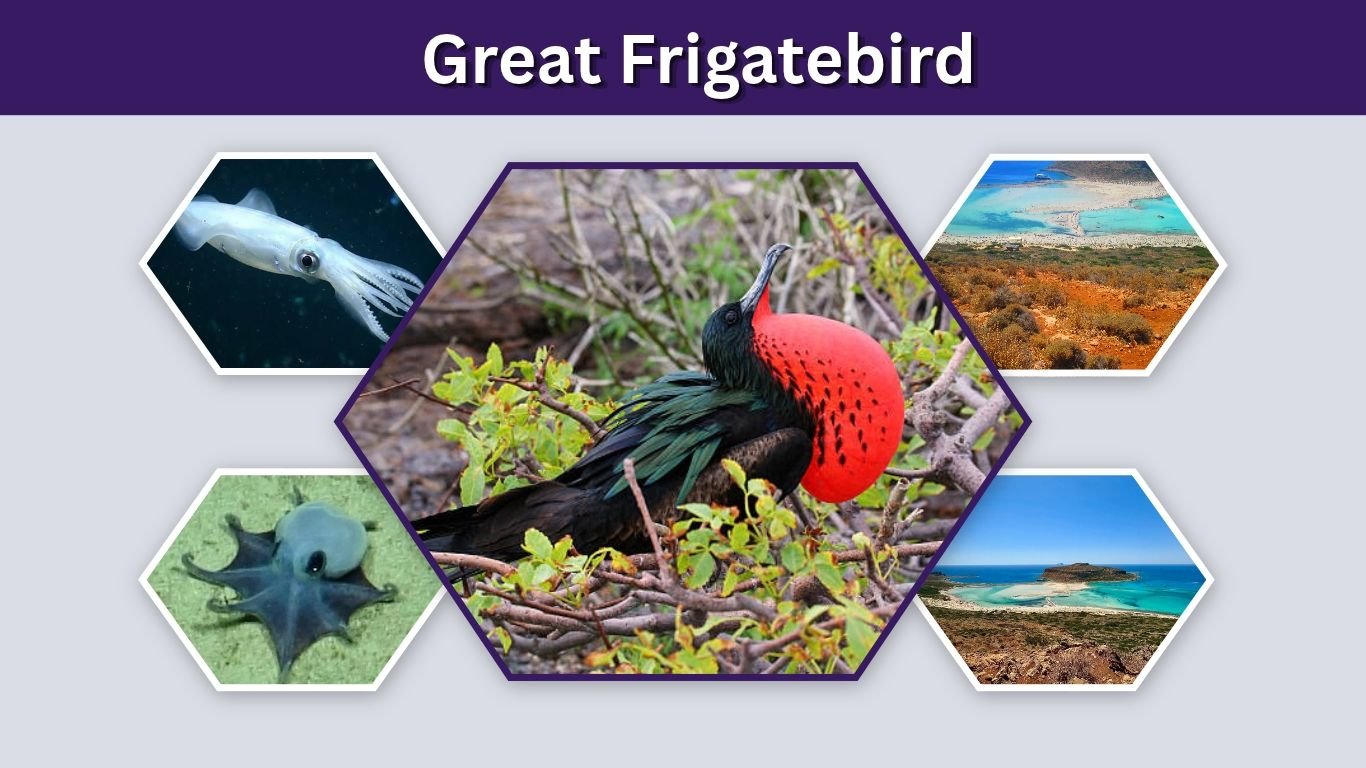
The great frigatebird (Fregata minor) is a remarkable seabird famous for its enormous wingspan, deeply forked tail, and exceptional flying abilities. Found mainly across tropical regions of the Pacific and Indian Oceans, this bird can soar for days with very little wing movement. Male great frigatebirds are recognized by their bright red inflatable throat pouches, while females have distinctive white breast markings. These fascinating seabirds rarely land on water and sometimes steal food from other birds. Their unique adaptations, feeding behavior, breeding habits, and impressive flight endurance make them among the most extraordinary seabirds in the world.
What Is a Great Frigatebird?
The great frigatebird is a large seabird belonging to the family Fregatidae and order Suliformes. It is one of five living frigatebird species and is sometimes called the greater frigatebird or man-of-war bird.
In Hawaii, the great frigatebird is known as the ʻiwa, meaning thief. This traditional name refers to its habit of chasing other seabirds and stealing their food.
Despite this reputation, great frigatebirds catch most of their prey themselves. Their lightweight bodies and specialized wings allow them to travel enormous distances across open oceans.
Great Frigatebird Size and Physical Characteristics
Great frigatebirds have long, narrow wings, streamlined bodies, and deeply forked tails. Their distinctive appearance makes them recognizable when soaring high above tropical coastlines.
Great Frigatebird Size and Wingspan
| Characteristic | Description |
| Scientific name | Fregata minor |
| Body length | 85–105 cm (33–41 inches) |
| Wingspan | 205–230 cm (6.7–7.5 feet) |
| Weight | 1–1.8 kg (2.2–4 pounds) |
| Lifespan | Approximately 30–40 years |
| Conservation status | Least Concern |
Despite their impressive wingspan, great frigatebirds are relatively lightweight. Their large wing area helps them glide efficiently while conserving energy during long flights.
Male vs. Female Great Frigatebird
Male great frigatebirds have predominantly black plumage, sometimes showing a greenish sheen. During courtship, they inflate a bright red throat pouch called the gular sac.
Female great frigatebirds are generally larger than males and have white breast patches with grayish throat markings.
Juvenile great frigatebirds usually have white heads and underparts. Their plumage changes gradually as they approach adulthood.
Great Frigatebird Habitat and Distribution

Great frigatebirds inhabit tropical and subtropical marine environments, particularly around remote islands surrounded by warm ocean waters.
They spend most of their time flying over open seas but depend on land for breeding, nesting, and resting.
Where Do Great Frigatebirds Live?
Their main habitats and distribution include:
- Hawaii: Commonly seen soaring above coastal areas and nesting in the Northwestern Hawaiian Islands.
- Galápagos Islands: Found around the islands, including established breeding colonies.
- Indian Ocean: Occur around remote tropical islands, including the Seychelles.
- Australia: Found around tropical northern waters and offshore islands.
- Pacific Islands: Widespread around suitable island habitats, including French Polynesia.
Great frigatebirds prefer nesting in trees and shrubs on relatively isolated islands. These locations offer elevated resting places and suitable breeding conditions.
Outside the breeding season, individuals may travel considerable distances over open ocean.
What Do Great Frigatebirds Eat?

Great frigatebirds are carnivorous seabirds that primarily consume fish and other marine animals. They usually capture food near the ocean’s surface without landing on the water.
Great Frigatebird Diet
Their common food sources include:
- Flying fish and other small fish.
- Squid and other small marine animals.
- Prey driven toward the surface by larger fish.
- Food stolen from seabirds such as boobies and terns.
How Do Great Frigatebirds Hunt?
Great frigatebirds mainly use two feeding strategies.
Surface hunting: They fly close to the ocean and grab fish or squid using their long, hooked bills. They also catch flying fish as they leap above the water.
Kleptoparasitism: They chase other seabirds until those birds drop or regurgitate recently caught food. The frigatebird then catches it in midair.
Although food stealing is a well-known behavior, research summarized by Cornell suggests that it accounts for only a small portion of their overall diet.
Great Frigatebird Flying Abilities
The great frigatebird is exceptionally well adapted to aerial life. Its long, narrow wings and lightweight body allow it to use rising air currents for extended soaring flights.
Its deeply forked tail acts as a steering mechanism, allowing precise turns and changes in direction.
Unlike many seabirds, great frigatebirds cannot swim effectively. Their feathers lack sufficient waterproofing, and their small feet make movement on land and water difficult.
As a result, they rarely land on the ocean’s surface. Instead, they capture prey while flying and rest on elevated perches when returning to land.
Can Great Frigatebirds Sleep While Flying?
Yes. Scientific research published in Nature Communications in 2016 confirmed that great frigatebirds can sleep during flight.
Researchers monitored brain activity in flying birds and discovered that they could sleep using one brain hemisphere or both hemispheres simultaneously.
The study found that birds flying over the ocean slept for an average of approximately 42 minutes daily, much less than when resting on land.
This extraordinary adaptation helps great frigatebirds remain airborne during extended journeys across the ocean.
Great Frigatebird Breeding and Courtship Behavior
Great frigatebirds breed in colonies, usually on remote tropical islands with suitable trees or shrubs.
Their breeding behavior includes elaborate courtship displays, nest construction, and an unusually long period of parental care.
Why Do Male Great Frigatebirds Have Red Pouches?
Male great frigatebirds possess inflatable red gular sacs that become particularly noticeable during the breeding season.
Males gather in groups and inflate their throat pouches while spreading their wings, raising their bills, and producing warbling sounds.
Females inspect these displays before selecting mates.
The red pouch is primarily used to attract females rather than to carry or store food.
Nesting and Raising Chicks
After mating, the pair constructs a platform nest using sticks, twigs, and other plant materials.
The female normally lays a single white egg. Both parents participate in incubation and initially care for the chick.
Young frigatebirds generally remain in the nest for approximately 120–160 days before their first flight.
Even after fledging, young birds may continue receiving food from their parents for many months.
Because reproduction requires considerable time and energy, successful breeding commonly occurs only every two years.
Great Frigatebird vs. Magnificent Frigatebird

The great frigatebird and magnificent frigatebird are closely related seabirds with similar appearances. However, their geographic distribution and subtle plumage differences help distinguish them.
| Feature | Great Frigatebird | Magnificent Frigatebird |
| Scientific name | Fregata minor | Fregata magnificens |
| Relative size | Slightly smaller | Slightly larger |
| Main range | Indian and Pacific Oceans | Tropical Americas |
| Male appearance | Black with pale upperwing panel | Mostly uniformly dark |
| Female throat | Often grayish or pale | Usually dark |
| Male throat pouch | Inflatable red pouch | Inflatable red pouch |
| Flight behavior | Excellent soaring ability | Excellent soaring ability |
Both species occur in the Galápagos Islands, where distinguishing them requires careful examination of their plumage.
Male great frigatebirds may show a pale upperwing panel, while females often have a less distinctly dark throat than magnificent frigatebirds.
Great Frigatebird Lifespan and Predators

Great frigatebirds are relatively long-lived seabirds, with individuals capable of surviving approximately 30–40 years.
According to Hawaii’s Division of Forestry and Wildlife, one recorded great frigatebird reached 37 years of age.
Adult great frigatebirds have relatively few natural predators while flying over the open ocean.
However, eggs and young chicks are vulnerable to predators, including introduced rats and other animals that may reach nesting colonies.
Disturbance and habitat damage can also affect the survival of young frigatebirds.
Great Frigatebird Conservation Status
The great frigatebird is currently classified as Least Concern on the IUCN Red List.
Cornell Lab of Ornithology reports a global population estimate of approximately 120,000 mature individuals, based on the IUCN’s 2020 assessment.
Despite its widespread distribution, the species faces several environmental threats, including disturbance at nesting colonies, introduced predators, habitat degradation, and changes in marine food availability.
Protecting breeding islands and maintaining healthy ocean ecosystems are important for supporting these birds in the future.
5 Interesting Facts About Great Frigatebirds
Great frigatebirds possess several unusual characteristics that distinguish them from many other seabirds.
- They can sleep while flying. Scientific research has confirmed that great frigatebirds can obtain short periods of sleep during long ocean flights.
- They have enormous wingspans. Their wings can stretch approximately 7.5 feet across, making them excellent gliders.
- Their Hawaiian name means thief. The name ʻiwa reflects their reputation for stealing food from other seabirds.
- They cannot swim effectively. Their limited waterproofing and small feet make landing on water risky.
- They provide unusually long parental care. Young frigatebirds may remain dependent on parental feeding for many months after leaving the nest.
FAQs
1. How big is a great frigatebird?
A great frigatebird measures approximately 85–105 cm in body length and has a wingspan of 205–230 cm. Females are generally larger than males.
2. Where can you see great frigatebirds in Hawaii?
Great frigatebirds are frequently seen soaring above the Hawaiian coastline. They breed mainly in the Northwestern Hawaiian Islands and also roost around offshore islets of the main Hawaiian Islands.
3. What sound does a great frigatebird make?
Great frigatebirds are generally quiet while soaring. During courtship, males produce warbling calls and other vocal sounds while displaying their inflated red throat pouches.
4. How long can a great frigatebird stay in the air?
Great frigatebirds can remain airborne for days. Researchers have documented ocean flights lasting up to ten days, demonstrating their exceptional endurance and soaring abilities.
5. Is the great frigatebird endangered?
No. The great frigatebird is currently classified as Least Concern by the IUCN. However, protecting nesting habitats and reducing disturbances remain important for long-term conservation.