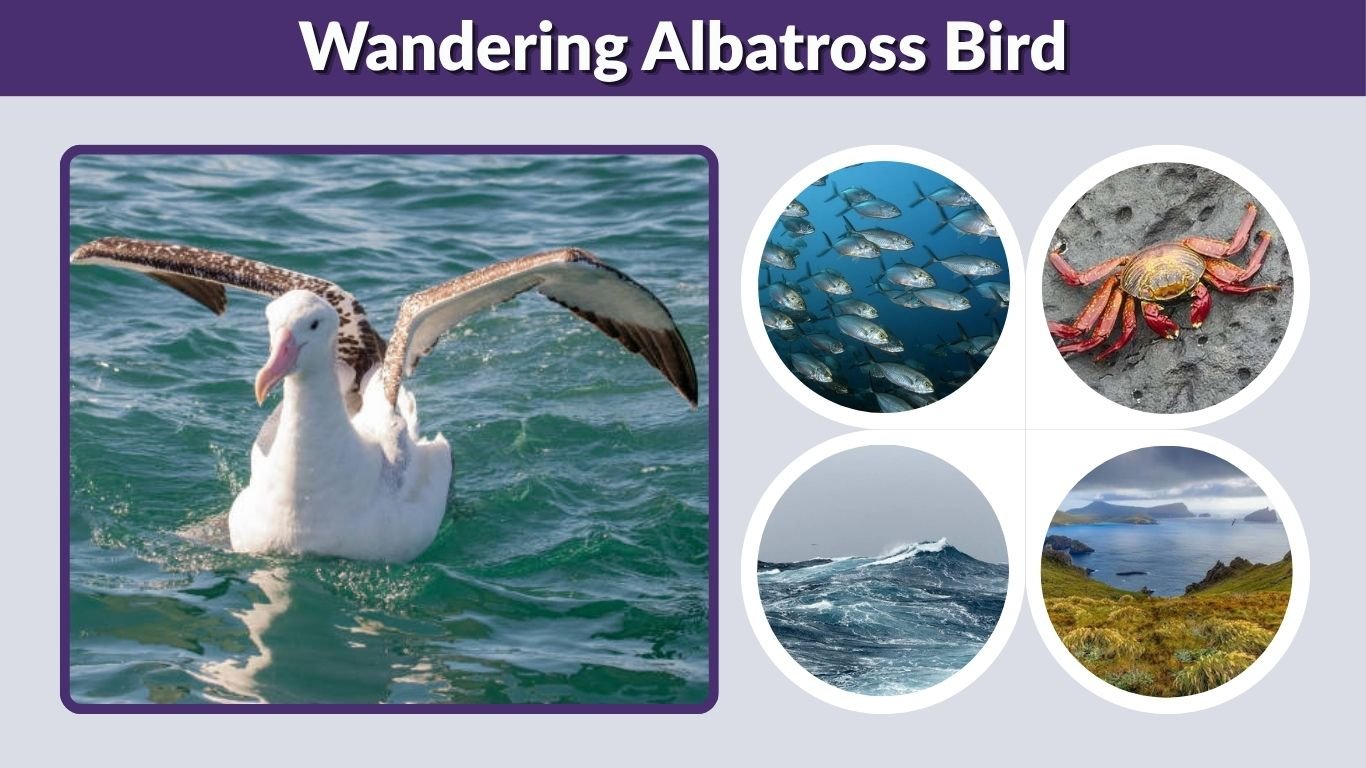
The Wandering Albatross (Diomedea exulans) is one of the most remarkable seabirds in the world, famous for having the largest wingspan of any living bird. With wings stretching up to 3.5 meters (11.5 feet), this ocean traveler can glide across enormous distances while using very little energy. Wandering Albatrosses spend most of their lives over the Southern Ocean, returning to remote islands mainly for breeding. Their extraordinary flying abilities, lifelong pair bonds, long lifespan, and specialized feeding habits make them fascinating examples of adaptation to life at sea.
What Is a Wandering Albatross Bird?
The Wandering Albatross is a large seabird belonging to the family Diomedeidae and the order Procellariiformes. Its scientific name is Diomedea exulans.
This bird is closely associated with the Southern Ocean, where it spends much of its life flying above open water.
Unlike most land birds, Wandering Albatrosses rarely need to return to land except during breeding periods. Their long, narrow wings allow them to travel tremendous distances using powerful ocean winds.
Wandering Albatross Bird Facts
| Feature | Description |
| Common name | Wandering Albatross |
| Scientific name | Diomedea exulans |
| Family | Diomedeidae |
| Order | Procellariiformes |
| Body length | Approximately 80–135 cm |
| Wingspan | Up to 3.5 meters (11.5 feet) |
| Weight | Approximately 7–12 kg |
| Diet | Squid, fish, and other marine animals |
| Habitat | Southern Ocean |
| Breeding locations | Remote subantarctic islands |
| Lifespan | Can exceed 60 years |
| Breeding frequency | Usually every two years after successful breeding |
| Conservation status | Vulnerable |
Wandering Albatross Bird Identification
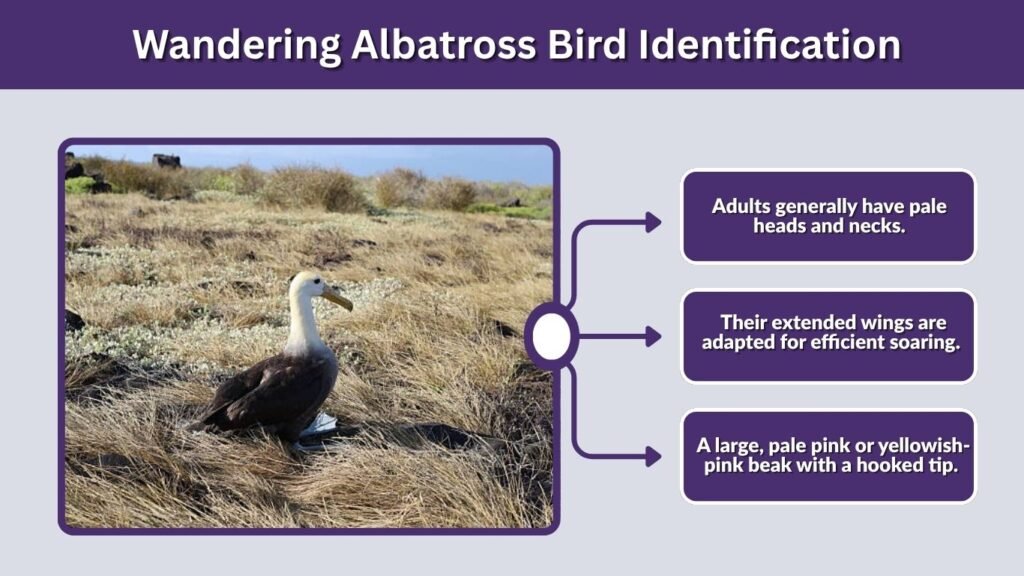
Wandering Albatrosses are enormous seabirds with distinctive white plumage, long wings, and large hooked bills.
Their appearance changes considerably as they mature.
Physical Appearance
Adult Wandering Albatrosses are predominantly white, although their wings often display dark markings.
Important identification features include:
- White head and neck: Adults generally have pale heads and necks.
- Long, narrow wings: Their extended wings are adapted for efficient soaring.
- Pinkish bill: A large, pale pink or yellowish-pink beak with a hooked tip.
- Dark wing markings: Black and dark brown patterns may appear on the upper wings.
- Wedge-shaped tail: A relatively short tail compared with the wings.
- Webbed feet: Help the birds swim and remain stable on the ocean surface.
- Large body: A heavy, streamlined body suited to long-distance ocean travel.
Young Wandering Albatrosses are much darker than adults.
Their plumage gradually becomes whiter as they grow older, sometimes taking several years to develop the characteristic adult appearance.
Male vs. Female Wandering Albatross
Male Wandering Albatrosses are generally larger and heavier than females.
Adult males may weigh approximately 8–12 kilograms, while females often weigh around 7–9 kilograms.
However, both sexes have similar physical characteristics, and identifying males and females by appearance alone can be difficult.
Is the Wandering Albatross the Largest Flying Bird?
The Wandering Albatross is widely recognized as the living bird with the greatest wingspan.
Its wings can stretch approximately 3.5 meters from tip to tip, making it exceptionally well adapted for soaring over vast oceans.
However, it is important to distinguish wingspan from body weight.
The Wandering Albatross holds the record for the largest wingspan among living birds, but it is not the heaviest living bird or necessarily the heaviest bird capable of flight.
Wandering Albatross Wingspan
Most adult Wandering Albatrosses have wingspans exceeding 3 meters.
Their long wings are relatively narrow, an adaptation that reduces the energy required for sustained soaring.
This wing structure allows the birds to travel impressive distances without continuously flapping.
Rather than relying mainly on muscular effort, they use changing wind speeds above ocean waves to maintain flight.
Where Do Wandering Albatross Birds Live?
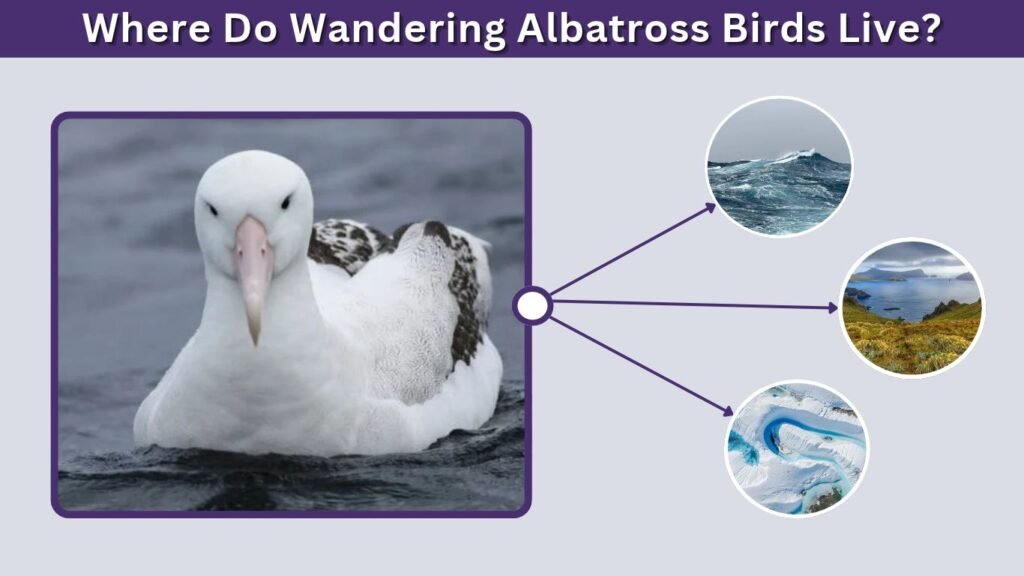
Wandering Albatrosses inhabit the Southern Ocean, particularly the waters surrounding Antarctica and the subantarctic islands.
They travel across enormous marine areas rather than remaining within a small geographic region.
Wandering Albatross Habitat
Their primary habitat is the open ocean, where strong winds provide favorable conditions for long-distance soaring.
They occur in:
- Southern Ocean waters
- Subantarctic seas
- Temperate southern oceanic regions
- Waters surrounding Antarctica
- Deep ocean areas south of Australia, Africa, and South America
Wandering Albatrosses generally spend much of their lives far from coastlines.
Unlike seabirds that regularly rest on beaches or coastal cliffs, these birds are highly adapted to living over open water.
Where Do Wandering Albatrosses Breed?
Wandering Albatrosses return to remote islands for breeding.
Important breeding locations include:
- South Georgia
- Crozet Islands
- Kerguelen Islands
- Prince Edward Islands
- Marion Island
- Macquarie Island
These isolated islands provide nesting habitat away from many mainland predators.
Breeding colonies are often located on grassy slopes, ridges, and open areas with sufficient space for the birds to take off and land.
How Do Wandering Albatross Birds Fly?
The Wandering Albatross is one of the world’s most efficient long-distance flying birds.
Its enormous wings allow it to remain airborne for extended periods while expending relatively little energy.
Dynamic Soaring
Wandering Albatrosses use a specialized flying technique called dynamic soaring.
This technique takes advantage of differences in wind speed at different heights above the ocean surface.
The bird repeatedly climbs into faster-moving air, turns, and descends toward the water.
By following this flight pattern, it extracts energy from the wind and maintains speed without frequent wingbeats.
This adaptation is especially useful over the Southern Ocean, where strong winds are common.
How Far Can a Wandering Albatross Fly?
Wandering Albatrosses can travel thousands of kilometers during extended journeys.
One recorded bird traveled approximately 6,000 kilometers in just 12 days.
Some individuals also make enormous journeys around the Southern Ocean, following prevailing winds and searching for food.
Their efficient flight makes these long-distance movements possible without requiring constant muscular effort.
Can Wandering Albatrosses Sleep While Flying?
Wandering Albatrosses spend extended periods traveling at sea, but their exact sleeping patterns during flight remain incompletely understood.
Although some seabirds have demonstrated an ability to sleep during flight, it should not automatically be assumed that Wandering Albatrosses routinely sleep while soaring.
They can rest on the ocean surface between periods of flying and feeding.
What Do Wandering Albatross Birds Eat?
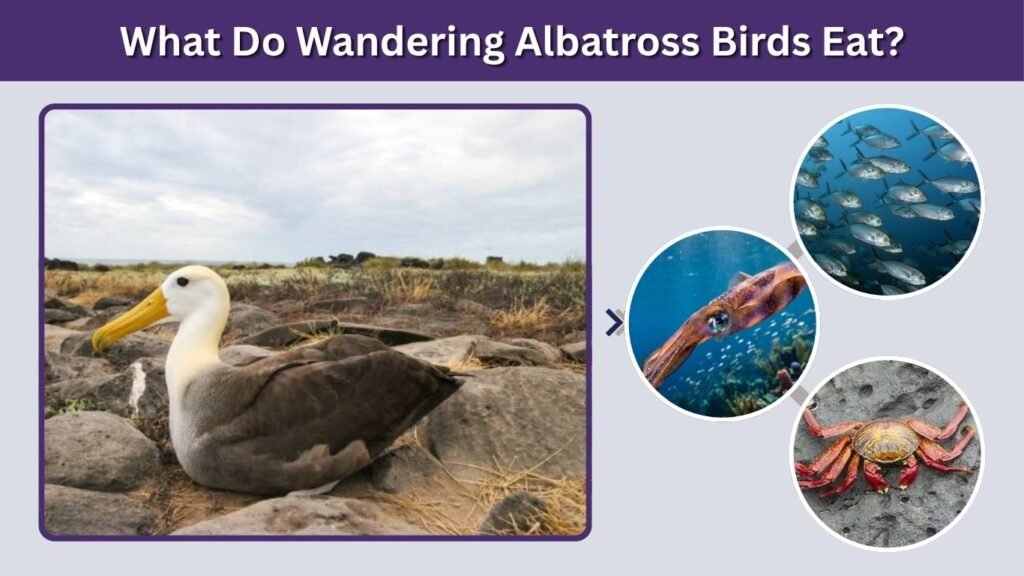
Wandering Albatrosses are carnivorous seabirds that feed primarily on marine animals.
Their diets depend on available prey and the oceanic regions they visit.
Wandering Albatross Diet
Common foods include:
- Squid: One of their most important food sources.
- Fish: Captured near the surface of the ocean.
- Cuttlefish: Consumed when available.
- Other cephalopods: Additional marine animals related to squid.
- Crustaceans: Occasionally eaten.
- Jellyfish: May form part of their diet.
- Carrion: Dead marine animals or floating remains.
Wandering Albatrosses are also known to follow fishing vessels, where they may scavenge discarded fish and other food.
However, this behavior exposes them to dangerous fishing equipment.
How Do Wandering Albatrosses Catch Food?
Wandering Albatrosses generally search for prey while flying above the ocean.
When they locate suitable food, they land on the water and capture it using their powerful hooked bills.
Many feeding activities occur at night, particularly when squid and other marine animals approach the surface.
Their excellent sense of smell also helps them locate food across large ocean areas.
Wandering Albatross Breeding and Life Cycle
Wandering Albatrosses have one of the longest breeding cycles among birds.
Successfully raising a chick requires considerable effort from both parents.
Mating and Nesting Behavior
Wandering Albatrosses form long-term breeding partnerships.
During courtship, birds perform elaborate displays involving head movements, bill clapping, calling, and spreading their wings.
These displays help establish and maintain pair bonds.
Their nests are generally constructed from vegetation, mud, and other materials available on the breeding island.
Females normally lay a single large egg per breeding attempt.
Wandering Albatross Eggs and Chicks
Both parents participate in incubating the egg.
Incubation lasts approximately 78–80 days.
After hatching, the chick remains in the nest for many months while its parents travel across the ocean searching for food.
Young Wandering Albatrosses develop slowly and may take around eight months after hatching to become capable of leaving the nest.
Because the breeding process is so demanding, successful pairs generally do not breed again until the following year has passed.
Do Wandering Albatross Birds Mate for Life?
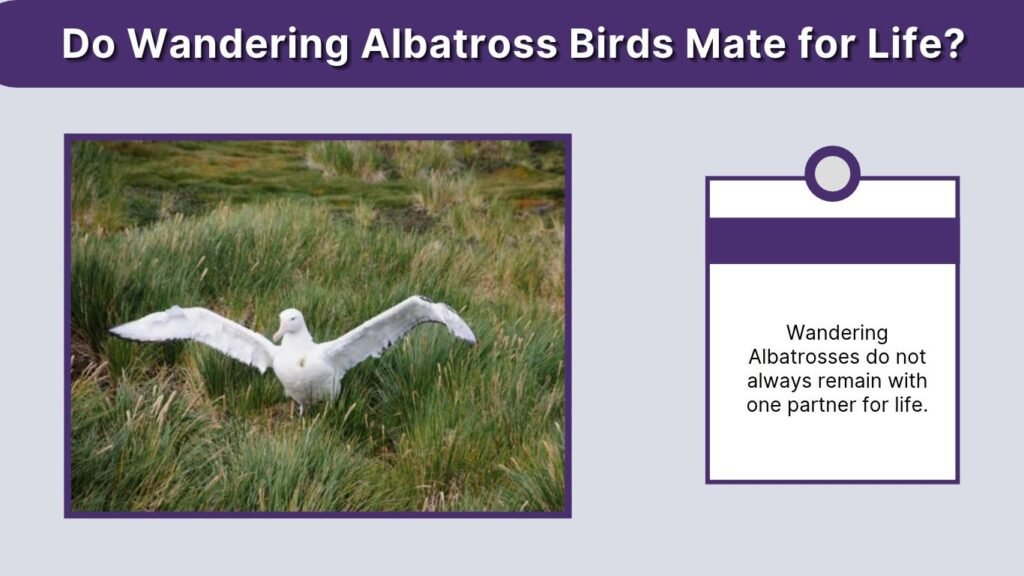
Wandering Albatrosses are famous for forming strong, long-lasting pair bonds.
Many individuals remain with the same partner through multiple breeding seasons, sometimes for decades.
This behavior has made the species a well-known example of social monogamy among birds.
However, Wandering Albatrosses do not always remain with one partner for life.
Scientific research has documented occasional pair separations, sometimes described as divorce.
Factors such as breeding history, partner availability, and individual behavior can influence whether a pair remains together.
Despite these exceptions, long-term partnerships are a characteristic feature of the species.
How Long Do Wandering Albatross Birds Live?
Wandering Albatrosses are exceptionally long-lived seabirds.
Some individuals have survived for more than 60 years.
Their long lifespan is associated with delayed maturity and relatively slow reproduction.
Young Wandering Albatrosses may spend several years at sea before returning to their birth colonies.
Many begin breeding at around 10 years of age, although the timing varies.
This slow reproductive strategy makes the species particularly vulnerable when adult birds die prematurely.
Giant Petrel Bird vs. Wandering Albatross
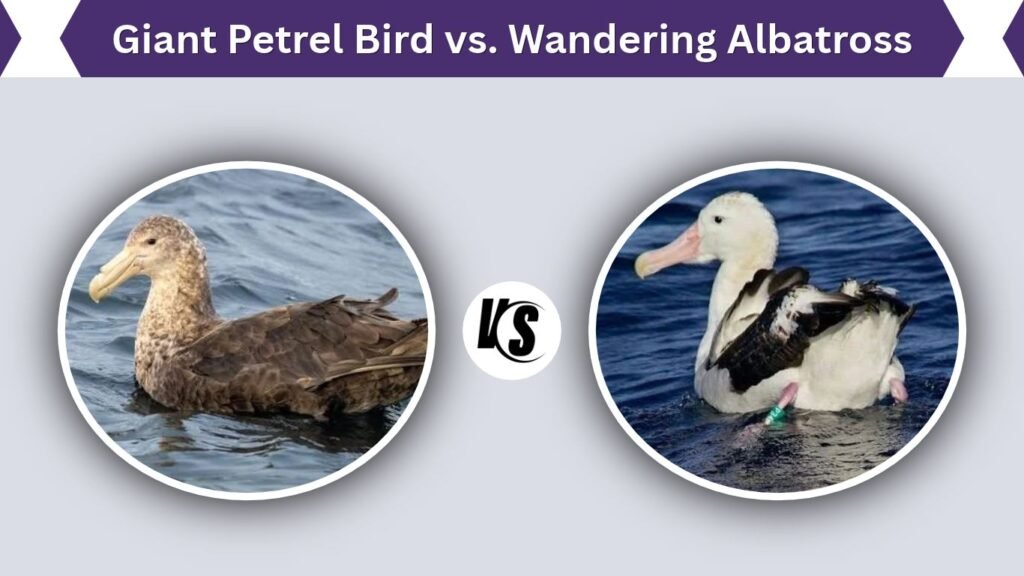
Wandering Albatrosses are sometimes confused with giant petrels because both inhabit the Southern Ocean and have large bodies, long wings, and hooked bills.
However, several physical characteristics help distinguish them.
| Feature | Wandering Albatross | Southern Giant Petrel |
| Scientific name | Diomedea exulans | Macronectes giganteus |
| Family | Diomedeidae | Procellariidae |
| Wingspan | Up to 3.5 meters | Approximately 2 meters |
| Body appearance | Predominantly white in mature adults | Commonly brown or gray-brown |
| Bill | Large pinkish bill | Heavy bill with a distinctive tubular nasal structure |
| Feeding | Mainly squid and fish | Fish, carrion, and other marine animals |
| Flight | Highly efficient long-distance soaring | Powerful soaring and gliding |
How to Identify the Difference
The Wandering Albatross generally has much longer, narrower wings and a larger overall wingspan.
Adult Wandering Albatrosses are also usually much whiter than typical giant petrels.
Giant petrels have a particularly massive bill with a prominent nasal tube on top, while albatrosses have separate nasal tubes along the sides of their bills.
These features are useful for identifying the birds at sea.
Are Wandering Albatross Birds Endangered?
The Wandering Albatross is currently classified as Vulnerable on the IUCN Red List.
Although the species occupies an extensive oceanic range, several threats affect its long-term survival.
Major Threats
Important threats include:
- Fishing bycatch: Birds may become hooked or entangled in fishing gear.
- Longline fishing: Baited hooks can attract albatrosses and cause accidental drowning.
- Climate change: Shifting ocean conditions may affect food availability and breeding habitats.
- Plastic pollution: Marine debris can be swallowed or otherwise harm seabirds.
- Invasive species: Introduced animals can threaten eggs and chicks on breeding islands.
Reducing accidental capture in fisheries is particularly important for Wandering Albatross conservation.
Bird-scaring lines, weighted hooks, and other fishing practices can help reduce the number of seabirds killed accidentally.
7 Interesting Facts About Wandering Albatross Birds
- They have the largest wingspan of any living bird. Their wings can reach approximately 3.5 meters across.
- They can live for more than 60 years. Wandering Albatrosses are among the longest-lived seabirds.
- They travel extraordinary distances. Some individuals make journeys spanning thousands of kilometers across the Southern Ocean.
- They use wind energy to fly. Dynamic soaring allows them to travel efficiently with relatively few wingbeats.
- They usually lay only one egg. Both parents invest months of care in raising their chick.
- They form long-term partnerships. Many breeding pairs remain together for multiple decades.
- Young birds can remain at sea for years. Juveniles often spend several years wandering over the ocean before returning to breeding colonies.
FAQs
1. Is the Wandering Albatross an Antarctic Bird?
The Wandering Albatross is closely associated with the Southern Ocean and subantarctic islands. Although it occurs in Antarctic waters, it is primarily an oceanic bird rather than a species restricted to the Antarctic continent.
2. Is the Wandering Albatross the Biggest Bird in the World?
The Wandering Albatross has the largest wingspan of any living bird. However, the ostrich is the largest living bird by overall body size and weight.
3. Can Wandering Albatrosses Fly Across an Ocean?
Yes. Wandering Albatrosses regularly travel enormous distances across the Southern Ocean. Their specialized wings and ability to use ocean winds allow them to complete journeys spanning thousands of kilometers.
4. How Often Do Wandering Albatrosses Return to Land?
Wandering Albatrosses spend most of their lives at sea. Adults return to remote breeding islands to reproduce, while young birds may remain away from land for several years before visiting their birth colonies.
5. Why Is the Wandering Albatross Vulnerable to Extinction?
The greatest threats include accidental capture in fishing gear, changing ocean conditions, and environmental pressures affecting breeding and feeding. Their slow reproductive rate makes it difficult for populations to recover quickly from high adult mortality.