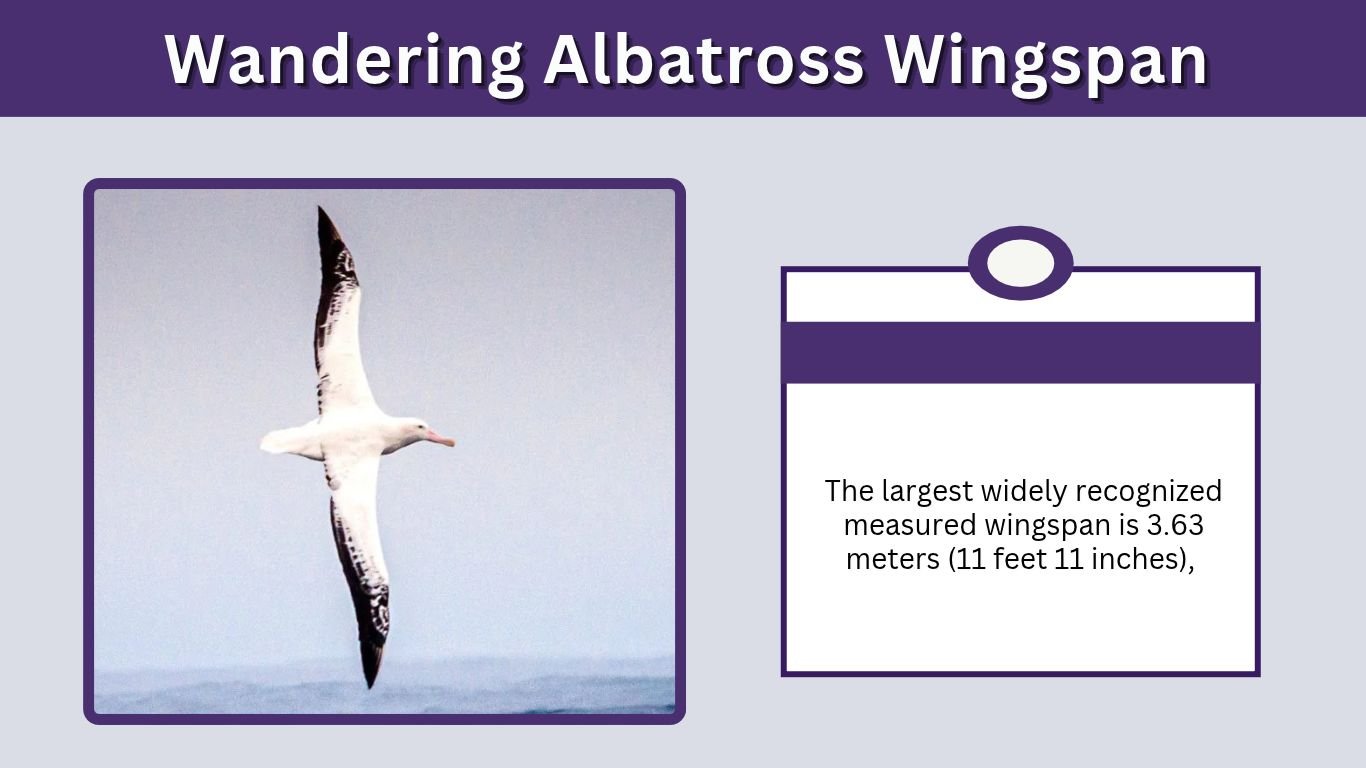
The Wandering Albatross (Diomedea exulans) has the largest wingspan of any living bird, with its enormous wings stretching up to approximately 3.5 meters (11.5 feet). The largest widely recognized measured wingspan is 3.63 meters (11 feet 11 inches), making this seabird one of nature’s most impressive long-distance flyers. Its exceptionally long, narrow wings allow it to glide across the Southern Ocean for hours with very little flapping. Compared with a human, an adult Wandering Albatross can have a wingspan roughly twice the height of an average-sized adult, demonstrating the extraordinary size of this ocean-dwelling bird.
What Is the Wingspan of a Wandering Albatross?
The Wandering Albatross typically has a wingspan ranging from approximately 2.5 to 3.5 meters (8.2–11.5 feet).
This measurement represents the distance from one wingtip to the other when both wings are fully extended.
Its enormous wings are significantly longer than those of most other living birds.
Wandering Albatross Wingspan Measurements
| Measurement | Wingspan |
| Lower end of reported adult range | 2.5 meters (8.2 feet) |
| Upper end of typical reported range | 3.5 meters (11.5 feet) |
| Largest widely recognized measured record | 3.63 meters (11 feet 11 inches) |
| Wingspan in centimeters at 3.5 m | 350 cm |
| Wingspan in inches at 3.5 m | 137.8 inches |
| Wingspan in feet at 3.5 m | 11.48 feet |
An individual approaching the upper end of this range has wings wide enough to extend across much of a small room.
This enormous wingspan is not simply a physical characteristic. It is a crucial adaptation that allows the bird to travel efficiently over the ocean.
Wandering Albatross Wingspan Compared to a Human
The Wandering Albatross appears even more impressive when its wingspan is compared with human height and arm span.
A large Wandering Albatross can have a wingspan approximately twice the height of a person measuring 1.75 meters (5 feet 9 inches).
Wandering Albatross Next to a Human
Consider the following size comparison:
- Adult human height: 1.75 meters (5.7 feet)
- Adult human arm span: Approximately 1.75 meters (5.7 feet)
- Large Wandering Albatross wingspan: 3.5 meters (11.5 feet)
- Recorded maximum wingspan: 3.63 meters (11 feet 11 inches)
A Wandering Albatross with a 3.5-meter wingspan would have wings extending approximately twice as far as the outstretched arms of a person with a 1.75-meter arm span.
However, the bird’s body is much smaller than its full wingspan might suggest.
Its body length is generally around 1–1.35 meters, meaning most of its impressive width comes from the wings rather than its body.
Why Does the Wandering Albatross Look So Large?
The bird’s exceptionally long wings create a dramatic appearance when fully extended.
Its body is relatively compact compared with its wingspan.
This gives the Wandering Albatross a distinctive silhouette, particularly when viewed from below as it glides over the ocean.
The narrow shape of its wings also makes the bird appear more streamlined than other large seabirds with broader wings.
Does the Wandering Albatross Have the Largest Wingspan?
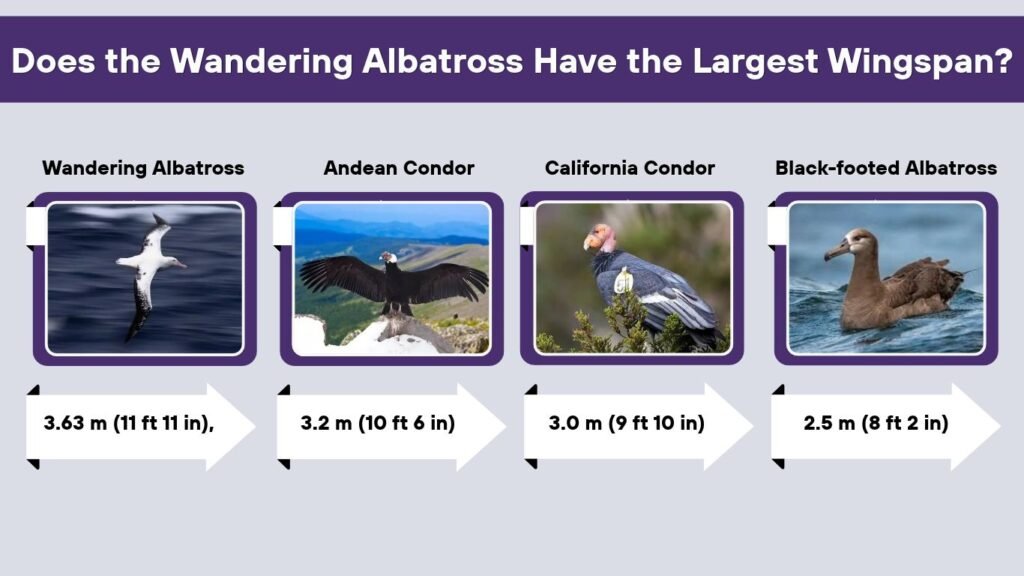
Yes. The Wandering Albatross holds the record for the greatest wingspan among living bird species.
Although several other large birds have impressive wingspans, none is known to exceed the reliably recorded maximum of the Wandering Albatross.
Wandering Albatross Wingspan Comparison With Other Birds
| Bird | Approximate Maximum Wingspan |
| Wandering Albatross | 3.63 m (11 ft 11 in), recorded |
| Andean Condor | 3.2 m (10 ft 6 in) |
| California Condor | 3.0 m (9 ft 10 in) |
| Black-footed Albatross | 2.5 m (8 ft 2 in) |
These measurements show how the Wandering Albatross stands out among the world’s largest flying birds.
The Andean Condor comes relatively close in wingspan but is a different type of bird adapted to soaring over mountainous terrain.
The Wandering Albatross, by contrast, specializes in traveling across open oceans.
Wandering Albatross Wingspan World Record
The largest widely recognized measured wingspan for a living bird belongs to a Wandering Albatross recorded at 3.63 meters (11 feet 11 inches).
This measurement was associated with a male Wandering Albatross documented in 1965.
Does the Wandering Albatross Have a 12-Foot Wingspan?
A 12-foot wingspan equals approximately 3.66 meters.
The established measurement of 3.63 meters is extremely close to 12 feet, which explains why the Wandering Albatross is sometimes described as having a 12-foot wingspan.
However, 11 feet 11 inches is a more precise representation of the widely recognized record.
Reports of even larger wingspans exist, but measurements exceeding four meters have not been reliably confirmed.
Therefore, describing the species as having wingspans reaching approximately 3.5 meters is accurate for general identification, while 3.63 meters represents the documented record.
Why Does the Wandering Albatross Have Such Long Wings?
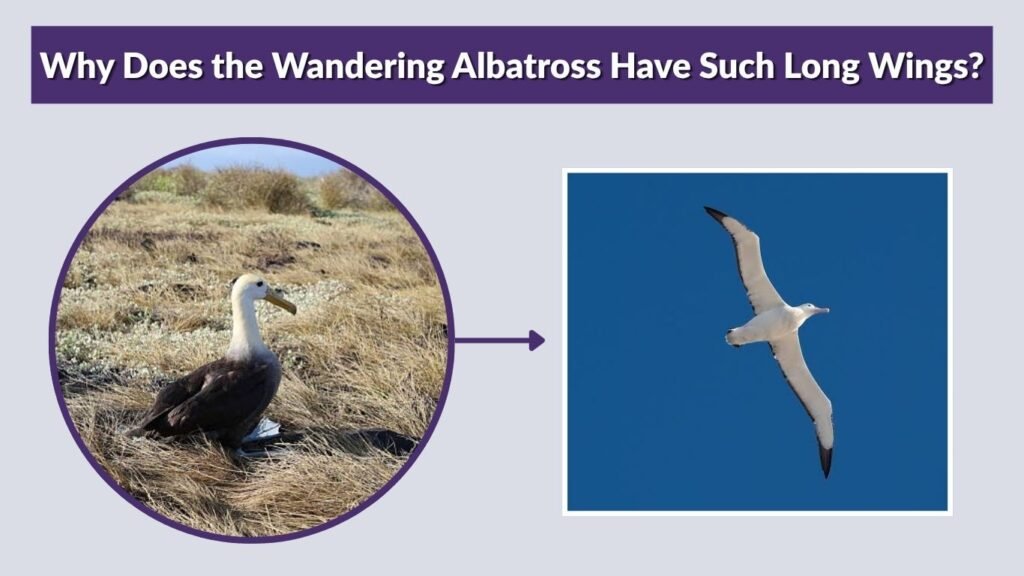
The Wandering Albatross spends much of its life traveling across the Southern Ocean.
Its long wings provide major advantages for efficient flight over large distances.
1. Efficient Long-Distance Flight
Long, narrow wings allow the bird to maintain lift while minimizing the energy required for continuous flight.
Unlike smaller birds that must flap frequently, Wandering Albatrosses can travel for extended periods without repeated wingbeats.
This reduces energy expenditure while searching for widely scattered food.
2. Taking Advantage of Ocean Winds
The Southern Ocean experiences powerful and persistent winds.
Wandering Albatrosses use these winds to maintain speed and travel across enormous distances.
Their specialized wing structure allows them to take advantage of changes in airflow above the water.
3. Covering Large Feeding Areas
Food sources such as squid and fish can be widely distributed across the ocean.
The bird’s enormous wings make it possible to search extensive marine areas without constantly expending large amounts of energy.
This ability is particularly important when adults must travel long distances to obtain food for their chicks.
How Does the Wandering Albatross Fly Without Flapping?
Wandering Albatrosses use a flying technique called dynamic soaring.
This technique allows them to gain energy from differences in wind speed above the ocean surface.
What Is Dynamic Soaring?
Dynamic soaring involves repeated climbing, turning, and descending movements.
The bird rises into faster-moving air above the ocean, changes direction, and then descends toward slower-moving air closer to the waves.
This movement allows it to extract energy from the surrounding wind.
The process reduces the need for constant wing flapping.
Instead of relying primarily on muscular power, the Wandering Albatross uses environmental conditions to maintain flight.
Can Wandering Albatrosses Fly Without Wind?
Wandering Albatrosses can still fly under relatively calm conditions, but taking off and maintaining efficient flight become more demanding.
Their large bodies and long wings are particularly well suited to windy environments.
When wind and waves are gentle, taking off from the water can require significant muscular effort.
Research has shown that their heart rate increases sharply during takeoff, while efficient soaring flight requires comparatively little additional energy.
How Far Can a Wandering Albatross Fly With Its Large Wingspan?
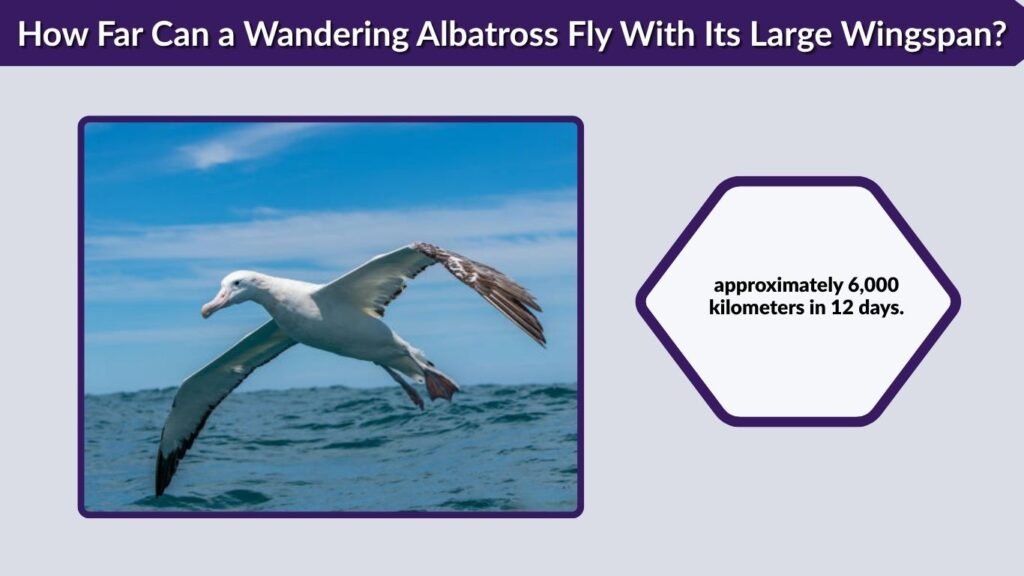
Wandering Albatrosses are capable of traveling thousands of kilometers during long-distance journeys.
Their extraordinary flight efficiency allows them to cross vast ocean regions while searching for food.
One recorded bird traveled approximately 6,000 kilometers in 12 days.
Some individuals also make extensive movements around the Southern Ocean, using prevailing winds to travel between different feeding regions.
The combination of enormous wings, efficient gliding, and specialized flight behavior makes these journeys possible.
Does Wandering Albatross Wingspan Change With Age?
Young Wandering Albatrosses gradually develop the adult body proportions and flying abilities needed for life at sea.
Their wings grow during the long chick-rearing period before they leave the nest.
Juvenile Wandering Albatross Wings
Juvenile Wandering Albatrosses develop large wings before their first oceanic flight.
During their final weeks at the nest, they exercise their wings and prepare for independent life.
By the time they depart the breeding colony, their wings are sufficiently developed for sustained flight.
Their feather coloration continues to change as they age, with dark juvenile plumage gradually becoming whiter.
This change in feather color should not be confused with a continuous increase in wingspan throughout adulthood.
Wandering Albatross vs. Andean Condor Wingspan
The Andean Condor (Vultur gryphus) is another enormous flying bird known for its impressive wingspan.
Although both species are excellent soaring birds, they inhabit very different environments.
Wingspan Difference
The Wandering Albatross can reach approximately 3.5 meters in wingspan, with a recorded maximum of 3.63 meters.
The Andean Condor can reach around 3.2 meters.
At their respective maximum reported measurements, the Wandering Albatross has the greater wingspan.
Differences in Flight Adaptations
The Wandering Albatross has long, relatively narrow wings designed for efficient oceanic soaring.
The Andean Condor has broader wings with separated primary feathers that help it soar on rising air currents over mountains and valleys.
Both birds use environmental air movement to conserve energy, but their wing shapes reflect their different habitats and flying techniques.
Wandering Albatross Wingspan vs. Pterodactyl
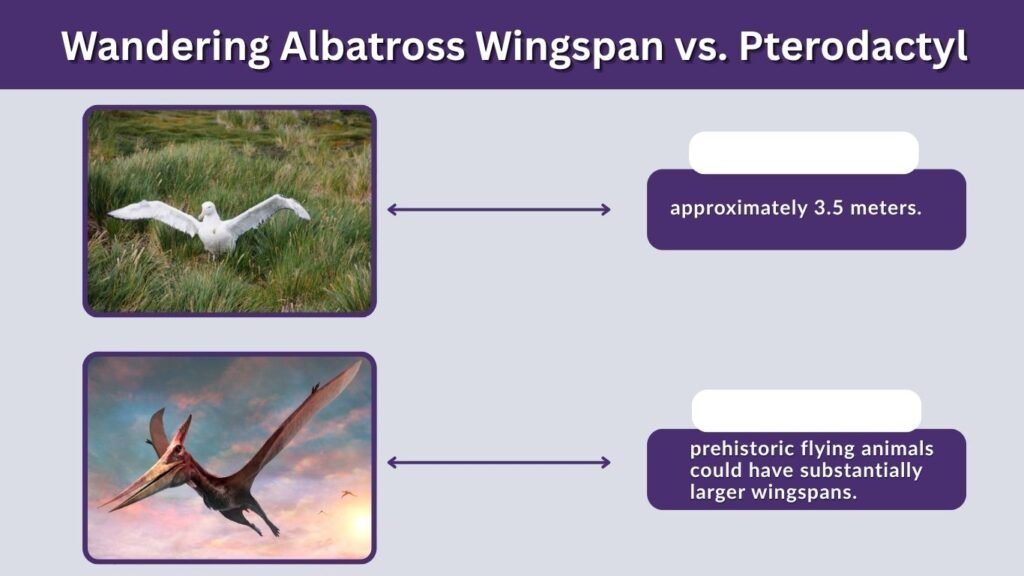
The word “pterodactyl” is often used informally to describe prehistoric flying reptiles called pterosaurs.
However, pterosaurs were not birds, and their wings were structurally different from those of modern seabirds.
Wandering Albatross vs. Quetzalcoatlus
One of the largest known flying reptiles was Quetzalcoatlus northropi.
Scientists estimate that this prehistoric animal had a wingspan of approximately 10 meters (33 feet).
By comparison, the Wandering Albatross reaches approximately 3.5 meters.
This means the estimated wingspan of Quetzalcoatlus was nearly three times as great.
Although the Wandering Albatross is the largest-winged living bird, prehistoric flying animals could have substantially larger wingspans.
How Does Wingspan Help Wandering Albatrosses Survive?
The Wandering Albatross depends on efficient flight to survive in one of the world’s most demanding marine environments.
Its large wings provide several important advantages:
- Reduce the energy needed for sustained soaring
- Allow efficient travel across large ocean areas
- Help exploit wind currents above ocean waves
- Support long-distance searches for food
- Reduce dependence on frequent wing flapping
However, its large wings also create challenges.
Taking off in calm conditions can be difficult, and the bird requires sufficient space and favorable airflow for efficient flight.
The species’ success depends on a balance between its enormous wingspan, physical strength, and ability to use changing ocean winds.
Interesting Facts About Wandering Albatross Wingspan
- Largest wingspan: The Wandering Albatross has the greatest wingspan of any living bird.
- Nearly 12 feet wide: The largest widely recognized record measures 3.63 meters.
- Twice a human’s height: A large individual’s wingspan can be approximately twice the height of an adult person.
- Designed for ocean travel: Its wings are specialized for efficient long-distance soaring.
- Low-energy flight: Dynamic soaring allows the bird to travel with relatively little flapping.
- Enormous travel distances: Wandering Albatrosses can cover thousands of kilometers during oceanic journeys.
- Prehistoric comparison: Some giant pterosaurs had wingspans nearly three times greater than those of Wandering Albatrosses.
FAQs
1. What Is the Average Wingspan of a Wandering Albatross?
Reported wingspans generally range from approximately 2.5 to 3.5 meters. Measurements vary among individuals, with large adults approaching the upper end of this range.
2. What Is the Largest Recorded Wandering Albatross Wingspan?
The largest widely recognized measured wingspan is 3.63 meters, or approximately 11 feet 11 inches.
3. Is a Wandering Albatross Wingspan Bigger Than a Human?
Yes. A large Wandering Albatross can have a wingspan roughly twice the height or arm span of an adult human.
4. Which Has a Larger Wingspan, a Wandering Albatross or an Andean Condor?
The Wandering Albatross has the larger maximum recorded wingspan. It reaches approximately 3.5 meters or more, compared with around 3.2 meters for an Andean Condor.
5. Why Is the Wandering Albatross Wingspan So Large?
Its long wings are adapted for efficient soaring over the ocean. They allow the bird to use wind energy, cover large distances, and search for food while minimizing the need for continuous wing flapping.