
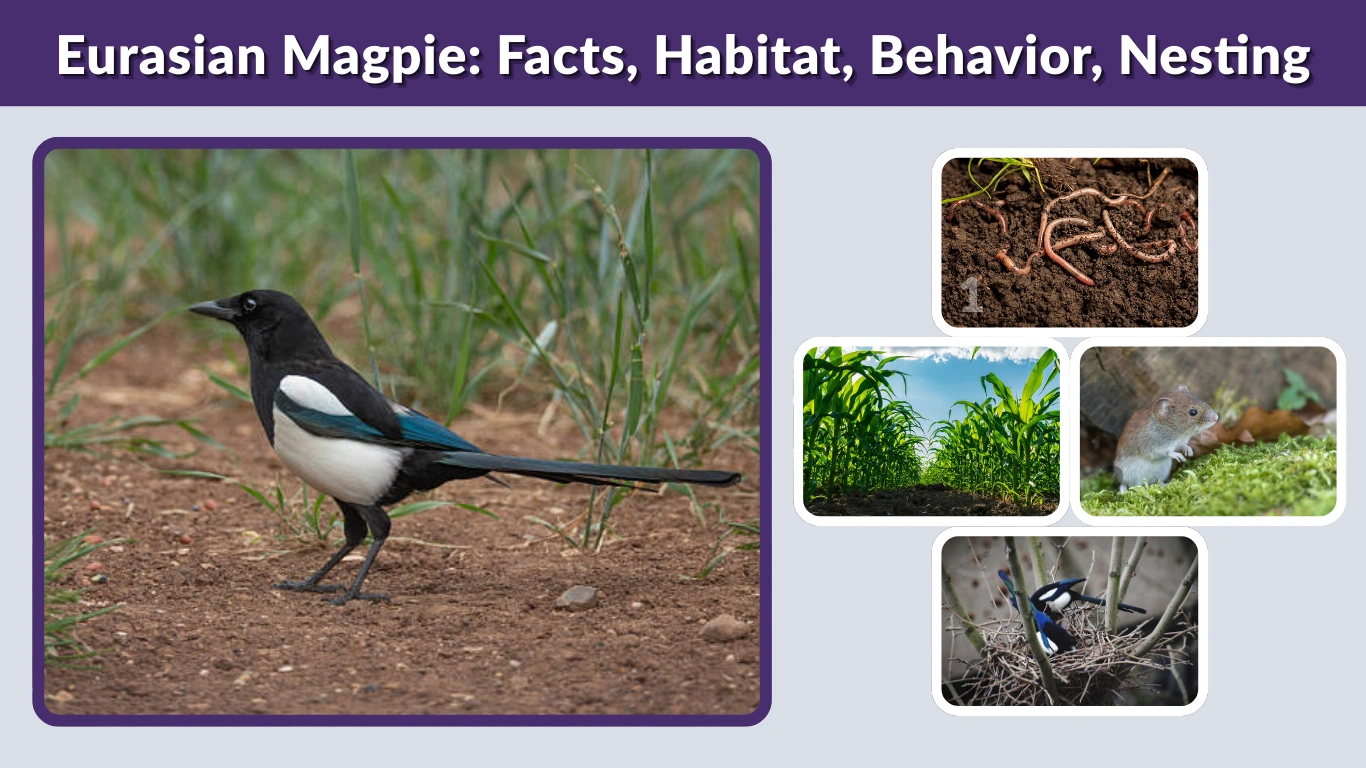
The Eurasian magpie (Pica pica) is one of the most recognizable and intelligent birds in the world. With its bold black-and-white plumage and long, iridescent tail, this striking member of the corvid family stands out in both countryside and city landscapes. Found across Europe and large parts of Asia, the Eurasian magpie has adapted remarkably well to human environments. Beyond its beauty, it is known for advanced problem-solving skills, complex social behavior, and fascinating cultural symbolism.
What Is the Eurasian Magpie?
Scientific Classification
The Eurasian magpie belongs to the family Corvidae, which also includes crows, ravens, and jays—birds widely regarded for their intelligence. Its scientific name is Pica pica. Like other corvids, it possesses strong cognitive abilities, excellent memory, and highly developed social behaviors.
Taxonomically, the magpie is classified as:
- Kingdom: Animalia
- Phylum: Chordata
- Class: Aves
- Order: Passeriformes
- Family: Corvidae
- Genus: Pica
- Species: Pica pica
Recent genetic research has revealed regional variations within magpie populations, though Pica pica remains the primary Eurasian species recognized across its broad range.
Physical Appearance and Identification
The Eurasian magpie is medium-sized, measuring about 44–46 cm (17–18 inches) in length, with more than half of that length made up by its long, graduated tail. Adults typically weigh between 200 and 250 grams and have a wingspan of approximately 52–60 cm.
Its plumage is unmistakable. The head, chest, and back are glossy black, while the shoulders and belly are bright white. When sunlight hits its feathers, the black areas shimmer with metallic shades of blue, green, and purple. This iridescence is especially visible on the wings and tail.
Magpies also have strong black bills and legs. Their flight appears slightly labored but graceful, with slow wingbeats followed by glides. On the ground, they move confidently with a distinctive hopping walk. Their harsh, chattering call—often described as a sharp “chack-chack”—makes them easy to identify even before they are seen.
Eurasian Magpie Habitat and Distribution
Geographic Range
The Eurasian magpie has one of the widest distributions of any corvid species. It is found throughout most of Europe, extending across Northern Africa and into large parts of Central and East Asia, including China, Korea, and Japan (in closely related regional forms).
Its adaptability has allowed it to thrive in diverse climates, from temperate woodlands to semi-arid landscapes. In many regions, magpie populations remain stable or are even increasing due to their ability to coexist with humans.
Preferred Habitats
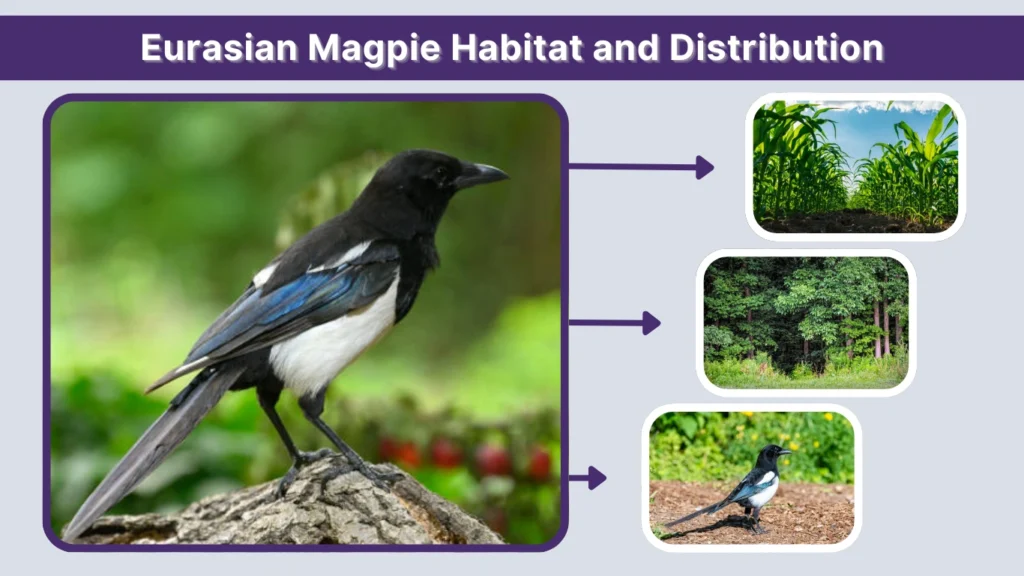
Eurasian magpies prefer open landscapes with scattered trees. Ideal habitats include:
- Farmland and agricultural fields
- Woodland edges
- Meadows and grasslands
- Riverbanks
- Parks and gardens
Unlike some forest-dependent birds, magpies avoid dense, continuous forests. They favor environments that offer both open foraging areas and tall trees for nesting. This balance allows them to search efficiently for food while maintaining safe nesting sites away from ground predators.
Urban Adaptation
One of the most remarkable traits of the Eurasian magpie is its success in urban environments. Cities and suburban neighborhoods provide abundant food sources, including insects, scraps, and ornamental fruits. Tall trees and even large shrubs offer suitable nesting spots.
Their intelligence plays a major role in this adaptation. Magpies quickly learn traffic patterns, recognize potential threats, and adjust their behavior around people. In many European cities, they are now a familiar sight in residential areas, demonstrating their impressive behavioral flexibility.
Diet and Feeding Behavior
What Do Eurasian Magpies Eat?
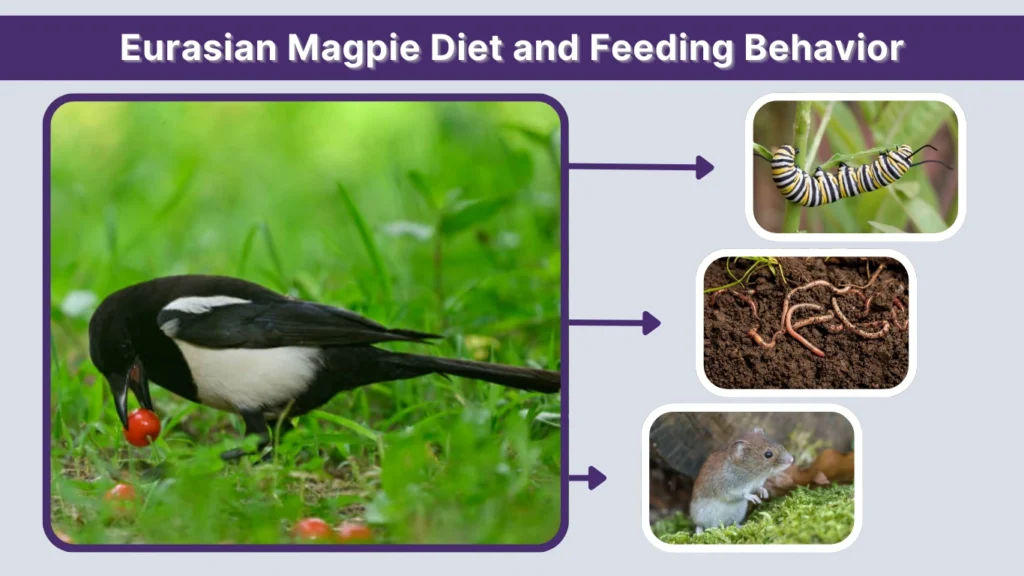
Eurasian magpies are omnivorous, meaning they consume both plant and animal matter. Their varied diet is one of the key reasons for their survival across diverse habitats.
Their food sources include:
- Insects such as beetles, caterpillars, and grasshoppers
- Earthworms and other invertebrates
- Small mammals like voles
- Bird eggs and nestlings
- Fruits, berries, and seeds
- Carrion (dead animals)
- Human food scraps in urban areas
Magpies forage mostly on the ground, using their strong bills to probe soil or leaf litter. They are opportunistic feeders, taking advantage of whatever resources are available seasonally. During spring and summer, animal protein becomes especially important to support breeding and chick development.
Food Caching and Memory
Like many corvids, Eurasian magpies store surplus food for later consumption—a behavior known as caching. They hide food items in soil, under leaves, or in small crevices.
What makes this behavior remarkable is their memory. Magpies can remember dozens, sometimes hundreds, of cache locations. This advanced spatial memory allows them to retrieve stored food during scarce periods, particularly in winter.
Studies suggest that corvids, including magpies, possess some of the most advanced cognitive abilities among birds. Their ability to plan ahead and remember hidden food sources demonstrates a level of intelligence once thought to exist only in mammals.
Intelligence and Social Behavior
The Eurasian magpie is widely regarded as one of the most intelligent bird species. Belonging to the same family as crows and ravens, it exhibits advanced cognitive skills rarely seen outside primates.
Research has shown that magpies can solve complex problems and adapt their behavior based on experience. In controlled studies, they have demonstrated the ability to recognize themselves in mirrors—a trait associated with self-awareness. This discovery placed them among a small group of animals, including dolphins and great apes, capable of passing the mirror test.
Socially, magpies often form long-term monogamous pairs. They are territorial during the breeding season but may gather in loose groups outside of it. Communication plays a key role in their social interactions. Through a range of calls and body movements, magpies signal danger, defend territory, and maintain pair bonds.
Their curious and investigative nature also contributes to their reputation. Magpies are known to examine unfamiliar objects in their environment. Although popular myths claim they are obsessed with stealing shiny objects, research suggests this behavior is exaggerated. Their interest is more about curiosity than attraction to glittering items.
Breeding and Nesting Habits
Nest Construction
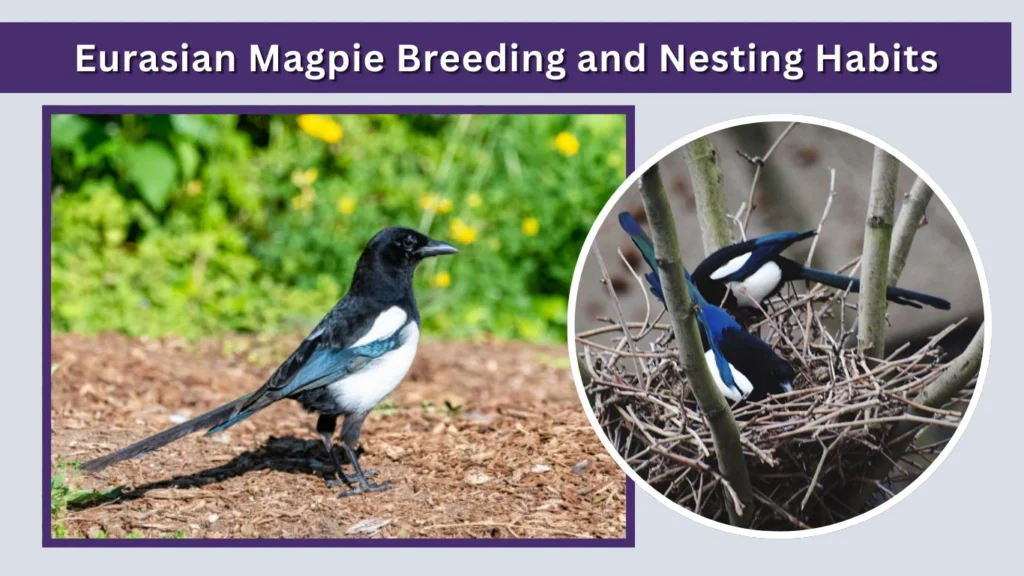
Eurasian magpies are skilled nest builders, creating large, dome-shaped structures that are both sturdy and protective. These nests are usually built high in trees, often between 3 and 10 meters above the ground. The dome design helps shield eggs and chicks from predators such as crows and birds of prey.
The outer structure is made of thick twigs, sometimes even thorny branches, forming a defensive barrier. Inside, the nest is carefully lined with mud, roots, grass, and softer materials to provide insulation and comfort. Construction can take several weeks, and both the male and female typically participate in gathering materials.
Breeding Season and Eggs
Breeding season usually begins in early spring, often between March and May, depending on the region. Eurasian magpies generally form monogamous pairs that may remain together for life. Once a nest is complete, the female lays a clutch of about 5 to 8 eggs, though clutch size can vary.
The eggs are small, oval-shaped, and pale green or bluish with brown speckles. Incubation lasts around 16 to 21 days and is primarily carried out by the female, while the male provides food and defends the territory. During this period, magpies can become particularly protective and vocal if threats approach the nest.
Raising the Young
After hatching, the chicks are blind and helpless, relying entirely on their parents for warmth and nourishment. Both parents share feeding duties, bringing insects, larvae, and other protein-rich foods to support rapid growth.
The young typically fledge after about 3 to 4 weeks. Even after leaving the nest, they may stay close to their parents for additional care and protection. Juvenile magpies resemble adults but often have shorter tails and duller plumage. Survival during the first year can be challenging, but attentive parental care increases their chances significantly.
Lifespan, Predators, and Threats
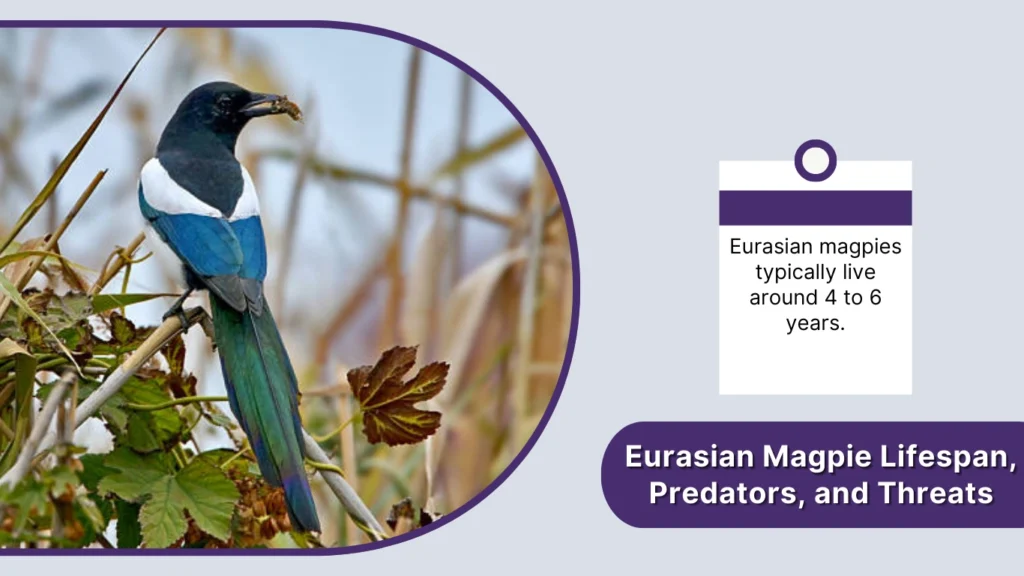
In the wild, Eurasian magpies typically live around 4 to 6 years, although some individuals may survive much longer under favorable conditions. In rare cases, magpies have been recorded living over 15 years. Like many bird species, mortality is highest during the first year of life.
Common natural predators include birds of prey such as hawks and owls. Foxes and domestic cats may prey on young or vulnerable birds. Nest predation is also a risk, particularly from other corvids.
Despite these threats, the Eurasian magpie’s intelligence and adaptability provide strong survival advantages. However, they sometimes face human-related challenges, including habitat changes, persecution due to misconceptions about nest predation, and collisions in urban environments.
Symbolism and Cultural Significance
European Folklore
The Eurasian magpie has long held a place in European folklore and superstition. One of the most famous rhymes associated with the bird is:
“One for sorrow,
Two for joy,
Three for a girl,
Four for a boy.”
This traditional verse reflects the belief that the number of magpies seen together could predict fortune. In some regions, a single magpie is considered a sign of bad luck, while seeing two brings good news. These superstitions have persisted for centuries and remain part of cultural storytelling.
Asian Cultural Views
In contrast to some European beliefs, magpies are often viewed positively in parts of Asia. In Chinese and Korean traditions, they are symbols of happiness, good fortune, and the arrival of joyful news. Their calls are sometimes interpreted as announcements of positive events.
This difference in symbolism highlights how cultural context shapes human perceptions of wildlife.
Modern Interpretation
Today, many people associate the Eurasian magpie with intelligence, adaptability, and curiosity. As scientific understanding of corvid cognition has grown, appreciation for magpies has increased. Rather than being viewed merely through superstition, they are now admired as one of the most cognitively advanced bird species in the world.
Conservation Status
The Eurasian magpie is currently classified as Least Concern by the International Union for Conservation of Nature (IUCN). Its wide distribution and stable population trends contribute to this status.
In many regions, numbers have remained steady or even increased, particularly in urban and suburban environments where food sources are plentiful. Their ability to adapt to agricultural landscapes and city life has helped them remain resilient despite environmental change.
Ecologically, magpies play an important role as scavengers and seed dispersers. By consuming carrion, they help clean the environment, and by spreading seeds, they contribute to plant regeneration. Their presence supports the balance of local ecosystems.
FAQs
Are Eurasian magpies really intelligent?
Yes, Eurasian magpies are considered among the most intelligent birds. They belong to the corvid family and have demonstrated problem-solving skills, tool use, and even mirror self-recognition in studies. Their strong memory helps them store and retrieve food, showing advanced cognitive abilities comparable to some mammals.
What do Eurasian magpies eat?
Eurasian magpies are omnivores with a varied diet. They eat insects, worms, small mammals, bird eggs, fruits, seeds, and carrion. In urban areas, they may also consume food scraps. Their flexible feeding habits allow them to survive in both rural and city environments.
Where do Eurasian magpies build their nests?
They build large, dome-shaped nests high in trees using twigs, mud, and grass. The covered design helps protect eggs and chicks from predators. Magpies usually select locations near open areas like farmland, woodland edges, or parks for easier access to food.
How long do Eurasian magpies live?
In the wild, Eurasian magpies typically live 4 to 6 years, although some individuals can survive much longer. Juvenile mortality is relatively high, but adults that reach maturity often benefit from their intelligence and adaptability, which improve survival rates.
Are magpies a sign of good or bad luck?
Magpies carry mixed symbolism depending on culture. In parts of Europe, they are linked to superstitions about luck, especially the “one for sorrow” rhyme. However, in many Asian cultures, magpies symbolize happiness, good fortune, and positive news.
Conclusion
The Eurasian magpie is far more than a striking black-and-white bird. As a highly intelligent member of the corvid family, it demonstrates advanced problem-solving skills, complex social behavior, and remarkable adaptability. From countryside fields to bustling cities, it has successfully carved out a place alongside humans.
Whether viewed through the lens of folklore or modern science, the Eurasian magpie remains a fascinating and ecologically important species—one that continues to capture attention with both its beauty and its brains.