
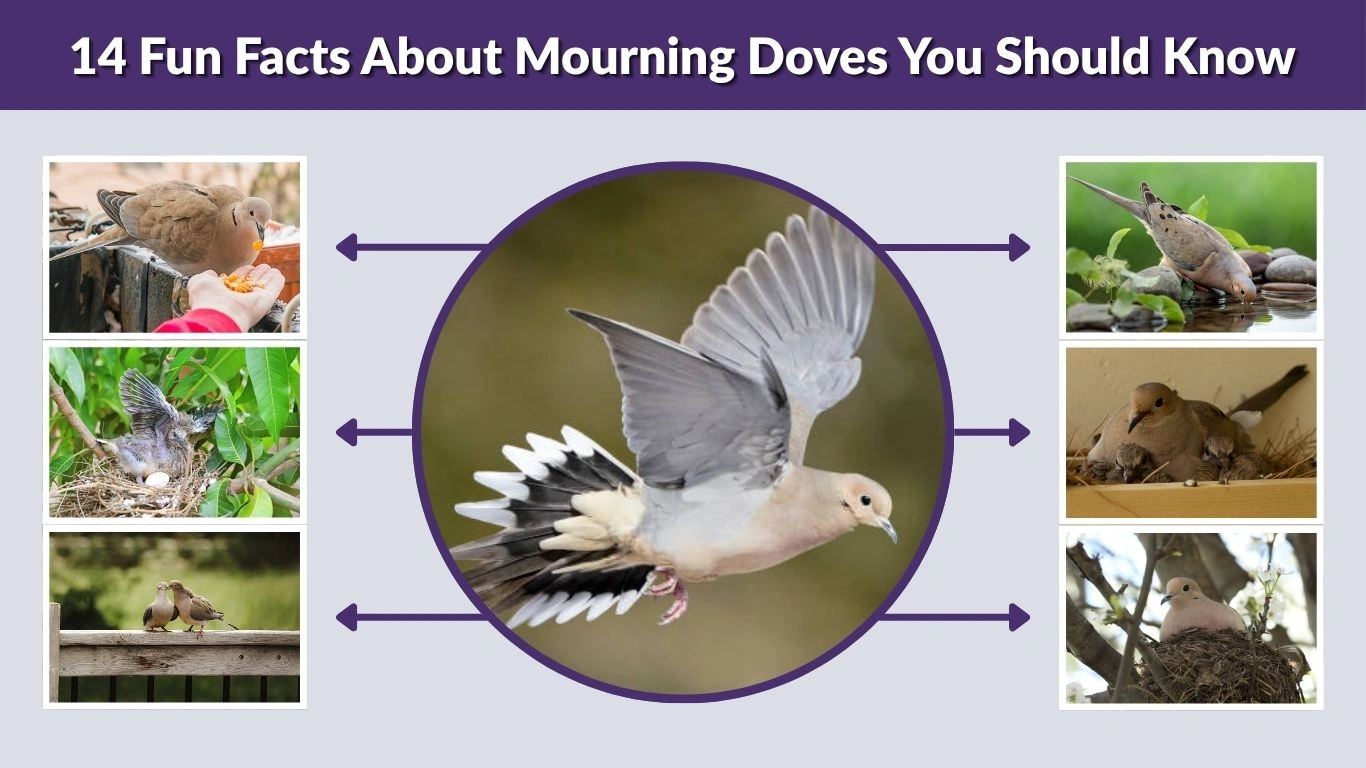
Mourning doves are one of the most familiar and peaceful birds you can spot in everyday life. Known for their soft gray color and gentle cooing sound, these birds are often seen perched on wires, rooftops, or quietly feeding on the ground. Despite their common appearance, mourning doves have many fascinating traits that most people don’t notice.
In this article, you’ll discover 14 fun facts about mourning doves, along with insights into their behavior, habitat, and unique characteristics that make them truly special.
1. Their Name Comes from Their Mournful Call
The mourning dove gets its name from its soft, low, and haunting cooing sound, which many people describe as sad or sorrowful. Early observers thought the call resembled the sound of mourning, which is why the bird was given this emotional name. However, despite how it sounds to human ears, the dove is not expressing sadness at all.
In reality, this cooking is a natural form of communication. Male mourning doves use the sound to attract a mate and to signal their presence to other doves in the area. The call is calm, rhythmic, and often repeated, especially during the breeding season. It can usually be heard in the early morning or late evening when the environment is quiet.
Interestingly, this gentle sound adds to the peaceful image of the bird. For many people, hearing a mourning dove’s call creates a sense of calm rather than sadness, making it one of the most recognizable and soothing bird sounds in nature.
2. They Are Among the Most Common Birds

Mourning doves are one of the most widespread and abundant bird species in North America. Their population is estimated to be in the hundreds of millions, making them a very common sight in both urban and rural areas. You can easily spot them sitting on telephone wires, walking on the ground in search of food, or resting quietly in trees.
One of the main reasons for their large population is their incredible adaptability. Mourning doves can thrive in a variety of environments, including cities, farmlands, deserts, and open woodlands. They are not very picky about where they live, as long as there is access to food, water, and safe nesting spots.
Another factor contributing to their abundance is their high reproduction rate. They can raise several broods in a single year, which helps maintain their population despite natural threats. Because of these traits, mourning doves continue to be one of the most familiar and easily recognized birds across their range.
3. Mourning Doves Often Mate for Life
Mourning doves are known for their strong pair bonds, and they often mate for life. Once a male and female form a pair, they typically stay together throughout the breeding season and often return to each other year after year. This loyal partnership is one of the reasons they are often seen as symbols of love and devotion.
The bonding process begins with a courtship display, where the male performs short flights, bows, and coos to attract the female. Once paired, the two birds spend a lot of time together, sitting close, preening each other, and working as a team to build nests and raise their young.
However, while they are mostly monogamous, their bond is not absolute. If one partner dies, the surviving dove will usually find a new mate. Even so, their tendency to stay with one partner for long periods shows a level of commitment that is quite remarkable in the bird world, making them especially fascinating to observe.
4. Both Parents Share Parenting Duties
Mourning doves are excellent examples of teamwork when it comes to raising their young. Unlike many bird species where one parent does most of the work, both the male and female mourning dove actively participate in caring for their eggs and chicks. This shared responsibility greatly increases the chances of survival for their offspring.
After the female lays the eggs, both parents take turns incubating them. Typically, the male sits on the nest during the day, while the female takes over at night. This balanced schedule allows each bird to rest and feed while still keeping the eggs safe and warm at all times.
Once the chicks hatch, both parents continue to work together by feeding them and protecting the nest. They produce a special nutrient-rich substance called crop milk, which is essential for the babies’ early growth. This level of cooperation not only strengthens their bond as a pair but also ensures that their young receive constant care and attention.
5. They Produce “Crop Milk” for Their Young
One of the most fascinating facts about mourning doves is that they feed their babies with a special substance called crop milk. Unlike mammals, birds do not produce milk in the traditional sense, but mourning doves have a unique adaptation that allows them to nourish their chicks in a similar way.
Crop milk is produced in a part of the bird’s digestive system called the crop. It is a thick, nutrient-rich fluid packed with proteins and fats that help baby doves grow quickly and stay healthy. Both the male and female mourning dove can produce this milk, which makes feeding more efficient and ensures the chicks are well cared for.
During feeding, the young birds place their beaks inside the parent’s mouth to receive the crop milk directly. This process may look unusual, but it is highly effective. Thanks to this nutrient-dense food, mourning dove chicks develop rapidly in their early days of life, giving them a strong start.
6. They Can Fly at Impressive Speeds
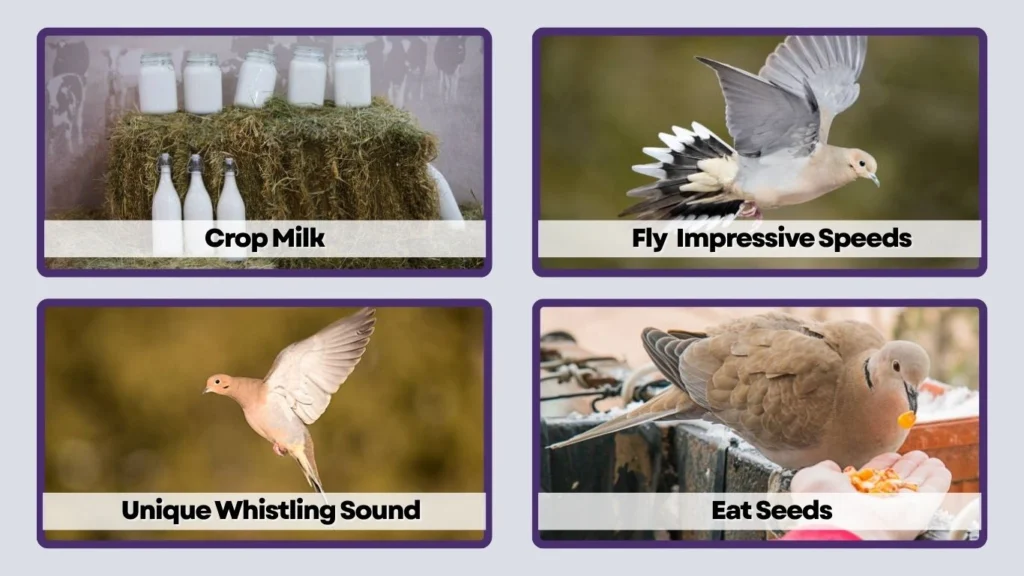
Mourning doves may appear calm and gentle, but they are actually powerful and fast fliers. These birds can reach speeds of up to 55 miles per hour (about 88 kilometers per hour), making them one of the দ্রুত flying birds in North America. Their strong wings and streamlined bodies allow them to move quickly and efficiently through the air.
This speed is especially important for survival. Mourning doves are often targeted by predators such as hawks and falcons, so being able to take off quickly and fly at high speeds helps them escape danger. Their flight is usually direct and fast, with sharp wingbeats followed by smooth gliding.
In addition to speed, they are also highly agile. They can change direction quickly while flying, which makes it even harder for predators to catch them. This combination of speed and maneuverability is one of the key reasons mourning doves have been able to thrive in so many different environments.
7. Their Wings Make a Unique Whistling Sound
One of the most distinctive features of mourning doves is the sharp whistling sound their wings make when they take off. This sound is not produced by their voice but by the air rushing through their wing feathers during rapid flight. It is especially noticeable when the bird suddenly lifts off from the ground.
This whistling noise serves an important purpose in the wild. It acts as a warning signal to other nearby birds, alerting them to potential danger such as a predator. When one dove takes flight and creates this sound, others in the area often react quickly and follow, increasing their chances of survival.
The sound is brief but effective, and once you recognize it, it becomes easy to identify. Many bird watchers use this clue to spot mourning doves even before they see them. This unique adaptation shows how even small details can play a big role in helping these birds stay safe.
8. They Primarily Eat Seeds
Mourning doves have a simple but highly effective diet that mainly consists of seeds. In fact, seeds make up about 90% of what they eat. They prefer seeds from grasses, weeds, and cultivated crops such as millet, sunflower, and corn. You will often see them walking on the ground, pecking steadily as they search for food.
Unlike many birds that pick food from trees or shrubs, mourning doves are ground feeders. They rely on open spaces where seeds are easy to find. Their strong digestive system allows them to quickly process large quantities of seeds, which helps them maintain their energy levels throughout the day.
Occasionally, they may eat small insects or grit (tiny stones), which helps them grind food in their gizzard. Their feeding habit also plays an important role in the ecosystem, as they help disperse seeds and support plant growth. This simple diet is one reason they can survive in so many different environments.
9. Mourning Doves Can Drink Without Lifting Their Heads
Most birds have to tilt their heads back to swallow water, but mourning doves are different. They have a unique ability to drink water continuously without lifting their heads. This may seem like a small detail, but it is actually a rare and fascinating trait in the bird world.
When a mourning dove drinks, it uses its beak like a straw, allowing it to suck up water in a steady flow. This method is more efficient and allows the bird to hydrate quickly, especially in hot or dry environments where water may be limited.
This adaptation gives them an advantage over many other bird species, as they can spend less time exposed while drinking and return to safety faster. It also reflects how well mourning doves have adapted to their surroundings. Small features like this play a big role in their survival and success across a wide range of habitats.
10. Their Nests Are Surprisingly Fragile
Mourning doves are not known for building strong or complex nests. In fact, their nests are often quite simple and fragile compared to those of other birds. They are usually made from loosely arranged twigs, grass, and small sticks, forming a thin platform rather than a sturdy structure.
The male typically gathers the materials, while the female assembles the nest. Despite their teamwork, the final result can look almost unfinished. Sometimes, you can even see the eggs through the gaps in the nest. These nests are often placed on tree branches, ledges, or even on the ground.
Although their nests may seem poorly built, they usually serve their purpose. Mourning doves compensate for this by nesting in safe, hidden locations and producing multiple broods each year. If one nest fails, they can quickly build another. This strategy helps ensure the survival of their species despite the delicate nature of their nests.
11. They Raise Multiple Broods Each Year

Mourning doves are highly productive breeders and can raise several broods in a single year. In favorable conditions, a pair may produce up to five or even six sets of chicks annually. This high reproduction rate plays a major role in maintaining their large population across North America.
The breeding season for mourning doves is quite long, often lasting from early spring through late summer, and sometimes even into early fall. After one group of chicks leaves the nest, the parents often begin preparing for the next brood almost immediately. This quick cycle allows them to maximize their reproductive success.
Typically, each brood consists of two eggs, which hatch after about two weeks. Because both parents share responsibilities, they can efficiently care for multiple broods throughout the season. This ability to reproduce frequently helps offset losses from predators and environmental challenges, ensuring that mourning doves remain one of the most common bird species.
12. Baby Doves Are Called Squabs
Baby mourning doves are known as squabs, and they look quite different from adult birds. When they first hatch, squabs are small, fragile, and covered in soft, sparse down feathers. Their eyes are usually closed at first, and they rely completely on their parents for warmth and food.
During the early days, both parents feed the squabs with nutrient-rich crop milk, which helps them grow rapidly. Within a short time, the chicks begin to develop feathers and gain strength. As they grow, their appearance gradually starts to resemble adult mourning doves, though their coloring may still be slightly duller.
Squabs stay in the nest for about 12 to 15 days before they are ready to leave. Even after leaving, they may remain close to their parents for a short period while learning to find food on their own. This quick development helps them adapt to their environment and increases their chances of survival.
13. They Are Strong Migrators
Mourning doves are skilled migrators, especially those living in the northern parts of North America. As the seasons change and temperatures drop, many of these birds travel long distances to reach warmer regions where food is more available. This migration usually happens in the fall, with birds returning north again in the spring.
Not all mourning doves migrate, however. Those living in milder climates may stay in the same area year-round if conditions remain suitable. This flexibility allows the species to survive in a wide range of environments.
During migration, mourning doves often travel in flocks, which provides safety in numbers and helps them conserve energy. Their strong, fast flight makes long journeys possible, allowing them to cover great distances efficiently. This ability to migrate when needed is another reason why mourning doves are so widespread and successful across different regions.
14. They Symbolize Peace and Love
Mourning doves are often seen as symbols of peace, love, and calmness across many cultures. Their gentle appearance, soft colors, and soothing cooing sound give them a peaceful presence that people naturally associate with harmony and emotional comfort.
In art, literature, and spiritual beliefs, doves are frequently used to represent hope, renewal, and devotion. Mourning doves, in particular, are sometimes connected with remembrance and emotional healing because of their quiet and reflective nature. Seeing one can feel like a moment of stillness in a busy world.
Their strong pair bonds also contribute to their symbolism of love and loyalty. Since they often stay with the same partner for long periods, they are viewed as a representation of lasting relationships. Because of these qualities, mourning doves are not just common birds—they carry deep meaning and emotional significance for many people.
FAQs
Are mourning doves rare?
Mourning doves are not rare at all. In fact, they are one of the most common birds in North America, with a population in the hundreds of millions. Their ability to adapt to cities, farms, and open landscapes helps them thrive in many environments, making them easy to spot almost anywhere.
Do mourning doves really mate for life?
Yes, mourning doves are mostly monogamous and often stay with the same partner for long periods. They form strong pair bonds and work together to raise their young. However, if one partner dies, the other will usually find a new mate to continue breeding.
Why do mourning doves sound sad?
Their cooing sounds soft and low, which humans often interpret as sad or mournful. In reality, it is simply a natural call used for communication. They use these sounds to attract mates, mark territory, and stay connected with other doves.
Can mourning doves be kept as pets?
In most countries, including the United States, it is illegal to keep mourning doves as pets because they are protected under wildlife laws. They are wild birds and are best appreciated in their natural habitat rather than being kept in captivity.
What do mourning doves eat the most?
Mourning doves primarily eat seeds, which make up about 90% of their diet. They prefer seeds from grasses, weeds, and crops like millet and sunflower. Occasionally, they may eat small insects or grit to help with digestion, but seeds remain their main food source.
