
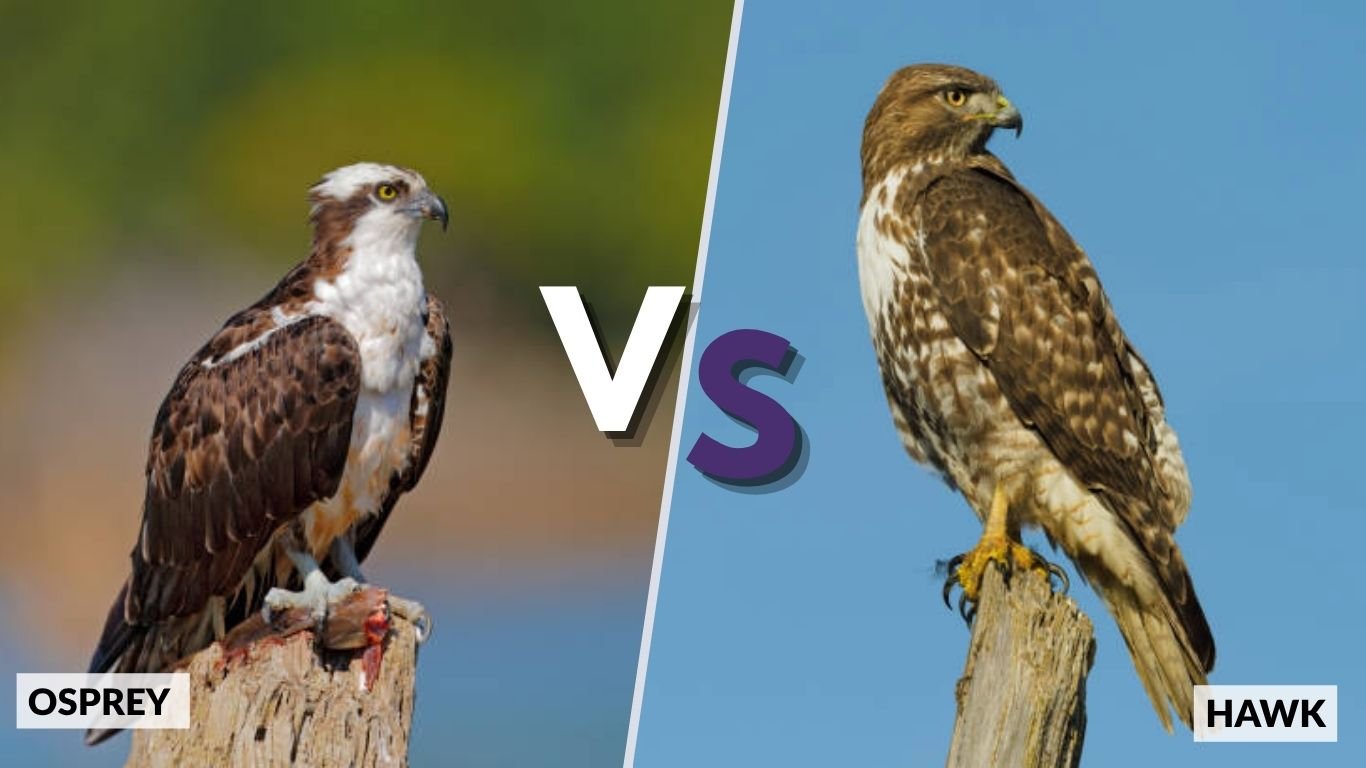
Ospreys and hawks are both powerful birds of prey, often seen soaring across skies and hunting with precision. While they may appear similar at first glance, these two birds are quite different in terms of diet, habitat, physical features, and hunting techniques. One of the biggest distinctions is that the osprey is a highly specialized fish hunter, whereas hawks are versatile predators that feed on a wide range of land animals.
Understanding the differences between osprey and hawk is important for birdwatchers and nature enthusiasts who want to identify these birds correctly in the wild. In this guide, we will explore their key differences, starting with their classification, appearance, and overall characteristics.
What Is an Osprey?
The osprey (Pandion haliaetus) is a unique bird of prey known for its exceptional fishing ability. It is the only species in its family, Pandionidae, which makes it quite distinct from other raptors.
Ospreys are found near water bodies such as rivers, lakes, and coastlines across much of the world. They are highly adapted for catching fish, which makes up nearly their entire diet. With their long wings and sharp vision, ospreys can hover above water before diving feet-first to grab fish with remarkable accuracy.
Their specialized features, such as reversible outer toes and spiny foot pads, make them perfectly suited for gripping slippery prey.
What Is a Hawk?
Hawks belong to the Accipitridae family, which includes a wide variety of birds of prey such as buzzards and eagles. Unlike the osprey, hawks are not a single species but a broad group with many variations in size and behavior.
Hawks are found in diverse habitats, including forests, grasslands, deserts, and even urban areas. They are adaptable hunters that feed on small mammals, birds, reptiles, and insects. Their versatility allows them to thrive in different environments, unlike the osprey, which is closely tied to water.
Common examples include the Red-tailed Hawk and Sparrowhawk, both known for their sharp eyesight and efficient hunting skills.
Osprey vs Hawk – Main Differences
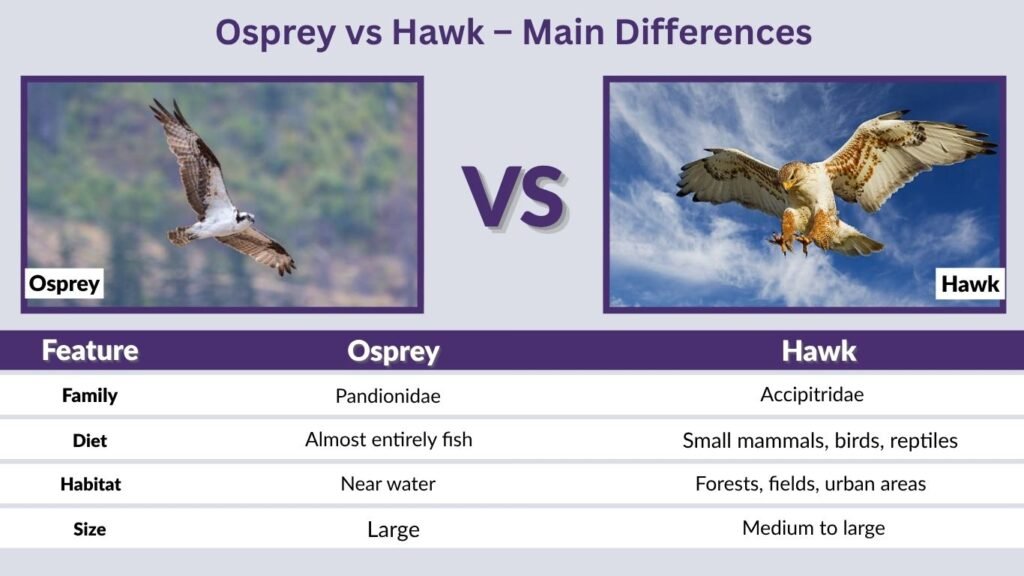
This comparison highlights how the osprey is a specialist, while hawks are more generalist predators.
Physical Differences Between Osprey and Hawk
Although both birds share typical raptor features like hooked beaks and sharp talons, their physical appearance differs in several noticeable ways.
Key Physical Traits
| Feature | Osprey | Hawk |
| Body Shape | Slender, slightly gull-like | Stocky and muscular |
| Color Pattern | White underside with dark eye stripe | Varies (often brown or gray) |
| Head | White head with bold stripe through eye | More uniform coloration |
| Beak | Curved, medium size | Strong, curved beak |
| Feet | Spiny pads, reversible toe | Standard gripping talons |
Ospreys are easy to recognize by their white head and dark eye stripe, giving them a distinctive facial appearance. Hawks, on the other hand, vary widely in color depending on the species.
Osprey vs Hawk Size Comparison
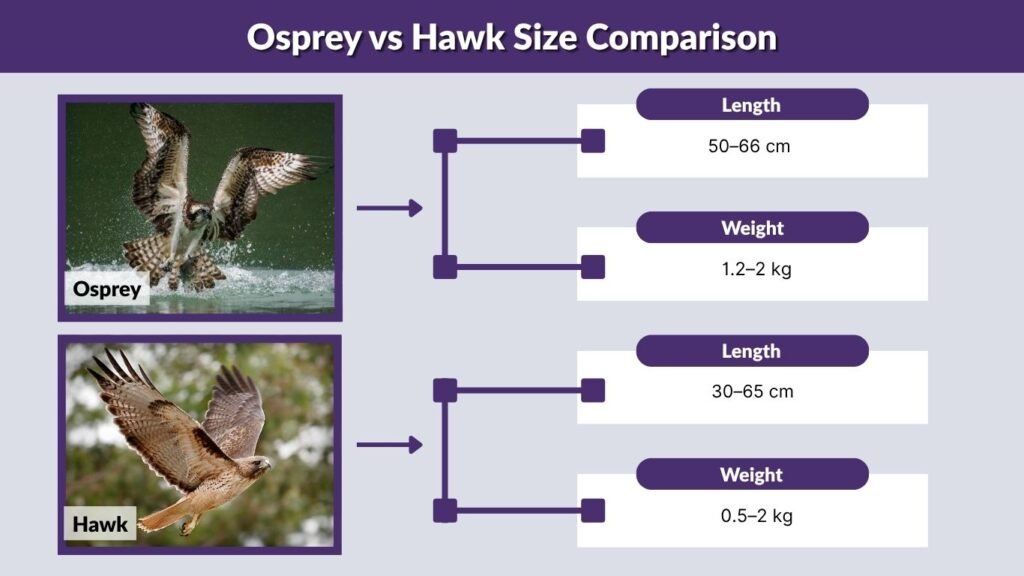
Size is another important factor when distinguishing between these birds.
| Bird | Length | Wingspan | Weight |
| Osprey | 50–66 cm | 127–180 cm | 1.2–2 kg |
| Hawk | 30–65 cm | 70–150 cm | 0.5–2 kg |
Ospreys generally have longer wingspans and appear larger in flight, especially when seen near water. Hawks vary more in size, with some species being relatively small and others approaching the size of an osprey.
Difference in Wings and Flight Style
Wing shape and flight behavior are among the easiest ways to tell an osprey from a hawk.
| Feature | Osprey | Hawk |
| Wing Shape | Long, narrow, slightly bent (M-shape) | Broad and rounded |
| Flight Style | Hovering, gliding, diving | Soaring, circling |
| Purpose | Fish hunting over water | Versatile land hunting |
Ospreys often hover in place above water before diving feet-first to catch fish. Hawks rarely hover and instead rely on soaring and gliding, often using thermal currents to stay airborne.
Hunting and Diet Differences
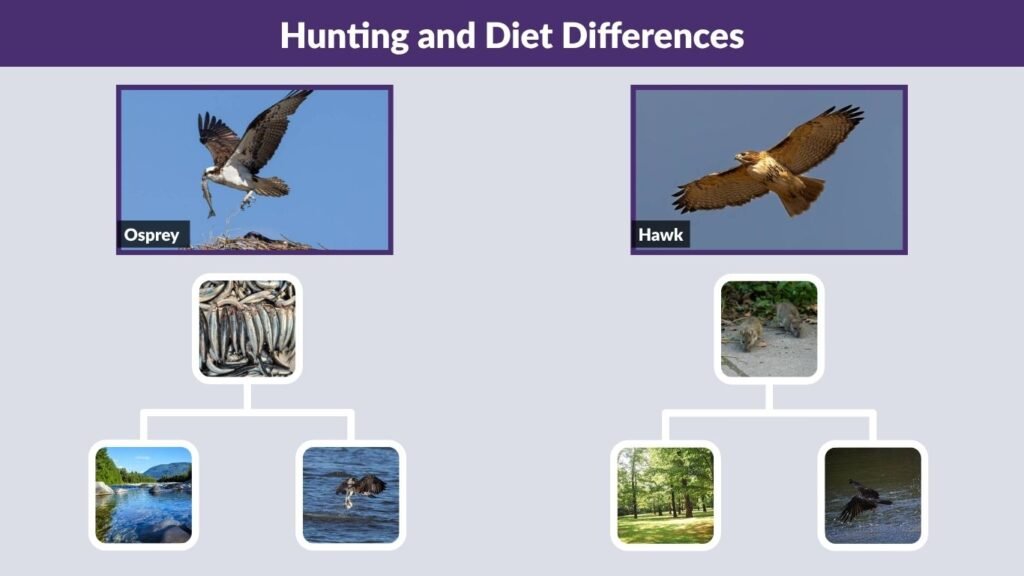
The biggest difference between osprey and hawk lies in what they eat and how they hunt.
Diet Comparison
| Feature | Osprey | Hawk |
| Primary Food | Fish | Rodents, birds, reptiles |
| Hunting Area | Water bodies | Land and trees |
| Method | Dive into water | Ambush or chase |
Ospreys are highly specialized and depend almost entirely on fish. They scan the water from above, hover briefly, and then dive to catch their prey. Hawks, however, are opportunistic hunters that catch a variety of animals on land, often attacking from a perch or while flying low.
Habitat and Distribution
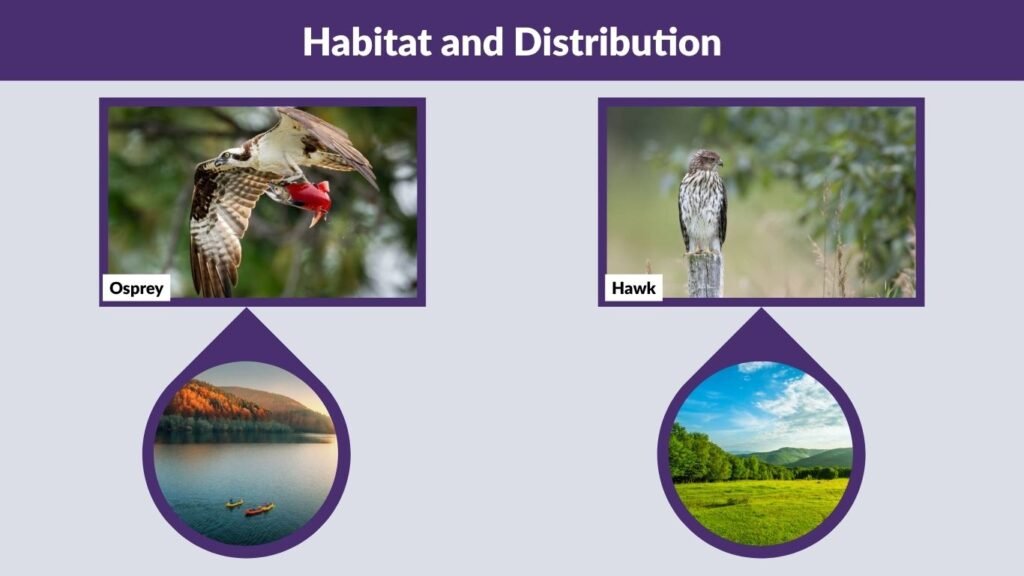
Ospreys and hawks differ greatly in where they live, mainly due to their feeding habits and adaptability.
Habitat Comparison
| Feature | Osprey | Hawk |
| Preferred Habitat | Near water (lakes, rivers, coasts) | Forests, grasslands, cities |
| Dependence on Water | Very high | Low |
| Urban Presence | Limited (near water only) | Common in many cities |
| Global Distribution | Worldwide near water bodies | Worldwide across many habitats |
Ospreys are almost always found close to water because of their fish-based diet. Hawks, however, are highly adaptable and can thrive in a wide range of environments, including urban areas.
Behavioral Differences
Ospreys and hawks also show clear differences in behavior, especially in how they hunt, interact, and survive.
Key Behavioral Traits
| Behavior | Osprey | Hawk |
| Hunting Style | Diving into water | Ambush or pursuit |
| Social Behavior | Mostly solitary | Solitary or in pairs |
| Territorial Nature | Strong near nesting sites | Strong, especially during breeding |
| Adaptability | Specialized lifestyle | Highly adaptable |
Ospreys are focused on fishing and often spend long periods near water. Hawks are more flexible and can adjust their behavior depending on available prey and habitat.
Nesting and Breeding
Reproduction and nesting habits also highlight major differences between these birds.
Nesting Comparison
| Feature | Osprey | Hawk |
| Nest Location | Near water, on tall structures | Trees, cliffs, sometimes buildings |
| Nest Size | Very large, reused yearly | Smaller, often rebuilt |
| Materials | Sticks, seaweed, debris | Twigs, leaves |
| Eggs per Clutch | 2–4 | 2–5 |
Ospreys are known for building large nests that they reuse year after year, often adding more material each season. Hawks usually build new nests or repair old ones, typically in trees or hidden locations.
How to Tell the Difference in the Wild
Identifying an osprey or a hawk becomes easier when you focus on a few simple clues.
Quick Identification Tips
- Look at location:
Near water → likely an osprey
Away from water → likely a hawk - Watch hunting behavior:
Diving into water → osprey
Attacking from trees or air → hawk - Observe wings:
Long, angled wings (M-shape) → osprey
Broad, rounded wings → hawk - Check appearance:
White head with eye stripe → osprey
Variable brown/gray body → hawk
These simple observations can help even beginners quickly identify the bird.
Which Is Stronger: Osprey or Hawk?
In terms of raw strength, hawks are generally stronger than ospreys. Hawks have powerful talons designed to capture and subdue a variety of prey, including mammals and birds.
Ospreys, on the other hand, are not built for strength in the same way. Instead, they are specialized for catching fish. Their talons are adapted for gripping slippery prey rather than overpowering large animals. This makes them highly efficient in their niche but less versatile than hawks.
Interesting Facts
- Ospreys can rotate their outer toe to better पकड़ fish
- They can close their nostrils while diving into water
- Hawks have exceptional eyesight, up to 8 times stronger than humans
- Ospreys often return to the same nesting site every year
- Hawks can live in both wild and urban environments
FAQs
What is the main difference between an osprey and a hawk?
The main difference lies in diet and habitat. Ospreys are specialized fish-eaters that live near water, while hawks are generalist predators that hunt a wide variety of animals in forests, fields, and even urban areas.
Is an osprey considered a hawk?
No, the osprey is not a hawk. It belongs to its own family, Pandionidae, while hawks belong to the Accipitridae family. Although both are birds of prey, they are classified differently.
How can you identify an osprey in flight?
An osprey can be identified by its long wings that form an “M” shape in flight and its behavior of hovering over water before diving to catch fish. Its white underside and dark eye stripe are also distinctive.
Which is bigger, an osprey or a hawk?
Ospreys are generally larger than most hawks, especially in wingspan. However, some large hawk species may come close in size, depending on the region and species.
