
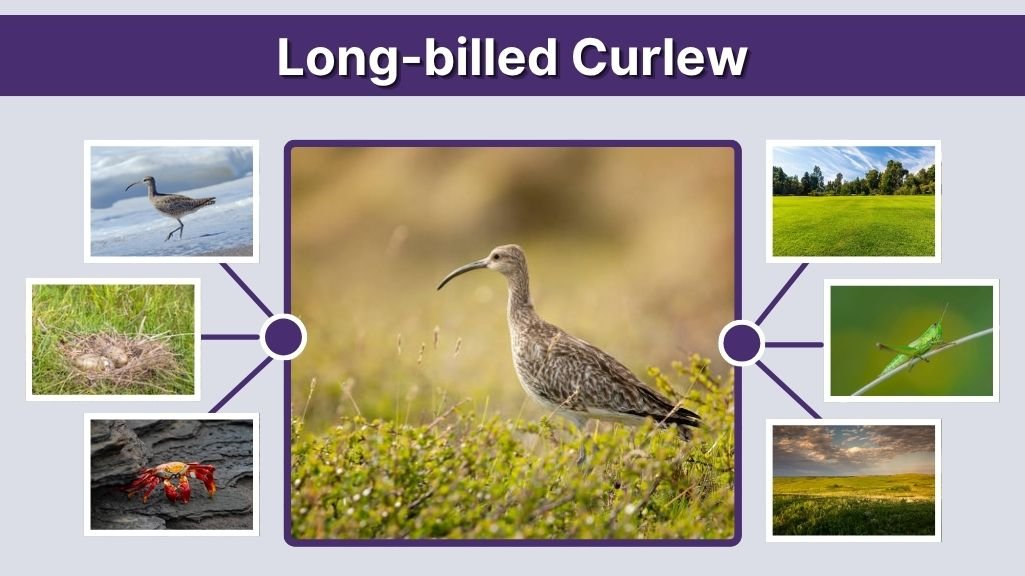
The Long-billed Curlew (Numenius americanus) is North America’s largest shorebird, recognized by its long, downward-curved bill, buffy-brown plumage, and long legs. It inhabits grasslands, estuaries, and coastal wetlands, feeding primarily on insects and invertebrates. Often compared to Whimbrels and other curlew species, its size, bill, and vocalizations are distinguishing features. This guide covers identification, habitat, diet, nesting, breeding, migration, adaptations, conservation, and interesting facts, providing a complete overview for birdwatchers, ornithologists, and conservationists.
Long-billed Curlew Overview
The Long-billed Curlew is a large shorebird with a long, curved bill and long legs, adapted to grasslands and coastal wetlands. Both sexes appear similar, with males slightly smaller than females. Its distinctive size, plumage, bill shape, and whistled call make it easily identifiable. Courtship displays and foraging behavior are characteristic features of the species.
Physical Description
Adults measure 50–65 cm in length. Their upperparts are buffy-brown, and underparts are paler with faint streaking. The extremely long, downward-curved bill allows deep probing for prey. Males and females look similar; juveniles are duller, have shorter bills, and less streaking.
Male vs Female
Females are slightly larger and may have longer bills. Juveniles are smaller, duller, and less streaked. Sex differences are subtle, making visual identification challenging in dense cover.
Vocalizations
Long-billed Curlews produce whistled “cur-lee” notes and peeps, used in courtship and to alert of predators. The song is repeated and recognizable, helping to distinguish it from Whimbrels and other shorebirds.
Long-billed Curlew Habitat and Range
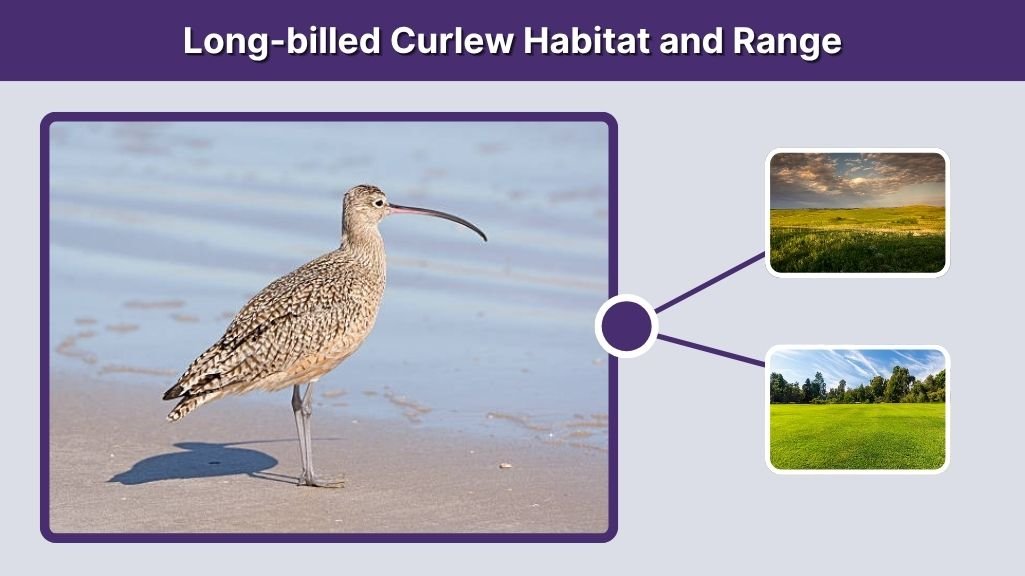
Long-billed Curlews breed in grasslands and prairies across central and western North America. In winter, they migrate to coastal wetlands, estuaries, and salt marshes. Preferred habitats provide both food and protection. They occupy inland grasslands, prairie preserves, and coastal mudflats.
Breeding Habitat
- Grasslands and prairies with short vegetation
- Open areas for predator visibility
- Sparse trees or shrubs for nesting concealment
- Native prairie preserves
Winter Habitat
In winter, they are found in coastal estuaries, mudflats, and shallow bays. Small flocks form to feed efficiently, and habitats provide abundant invertebrates and shelter.
Geographic Range
Breeding populations occur in western and central U.S. and southern Canada, including Alberta, Idaho, and Montana. Wintering sites include U.S. coasts such as California, Florida, and the Gulf Coast. Rare sightings happen outside their normal range.
Long-billed Curlew Diet and Feeding Behavior
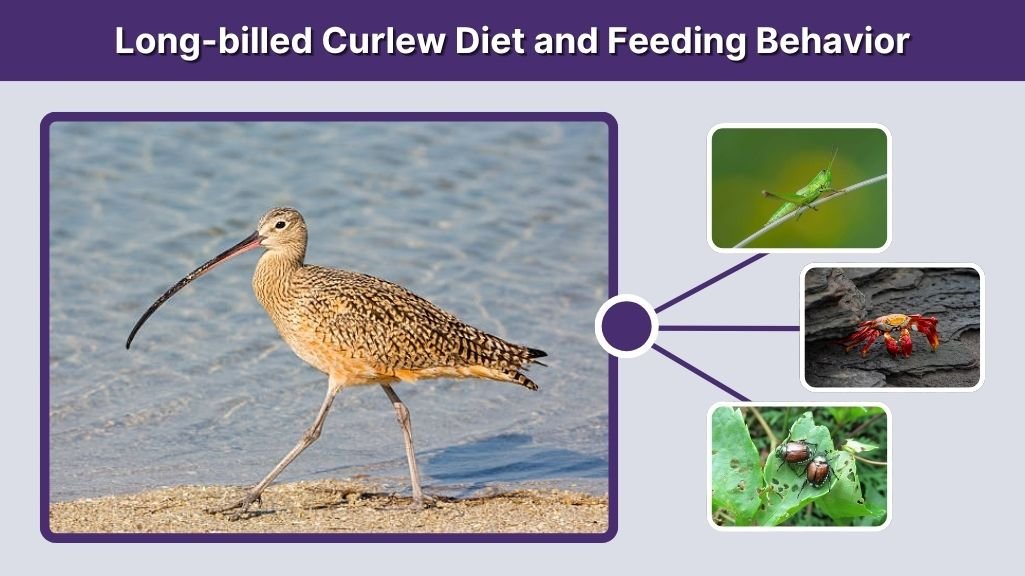
Long-billed Curlews are omnivorous, feeding mainly on insects, crustaceans, worms, and other invertebrates. Their long bills allow probing soil and mud deeply. Seasonal diet shifts occur: breeding adults focus on protein-rich prey for chicks, while wintering birds feed more on crustaceans and other invertebrates in estuaries.
Typical Diet
- Insects: grasshoppers, beetles, caterpillars
- Crustaceans: crabs, shrimp
- Worms and mollusks
- Occasionally small amphibians
Foraging Behavior
Curlews probe soil or mud with their curved bills while feeding. They forage singly or in small flocks, primarily during daylight. Grasslands and mudflats provide optimal foraging areas depending on the season.
Seasonal Variations
During summer, insects and other protein-rich prey dominate to support chick development. In fall and winter, crustaceans, worms, and small invertebrates make up most of the diet, especially in coastal habitats.
Long-billed Curlew Nesting and Breeding
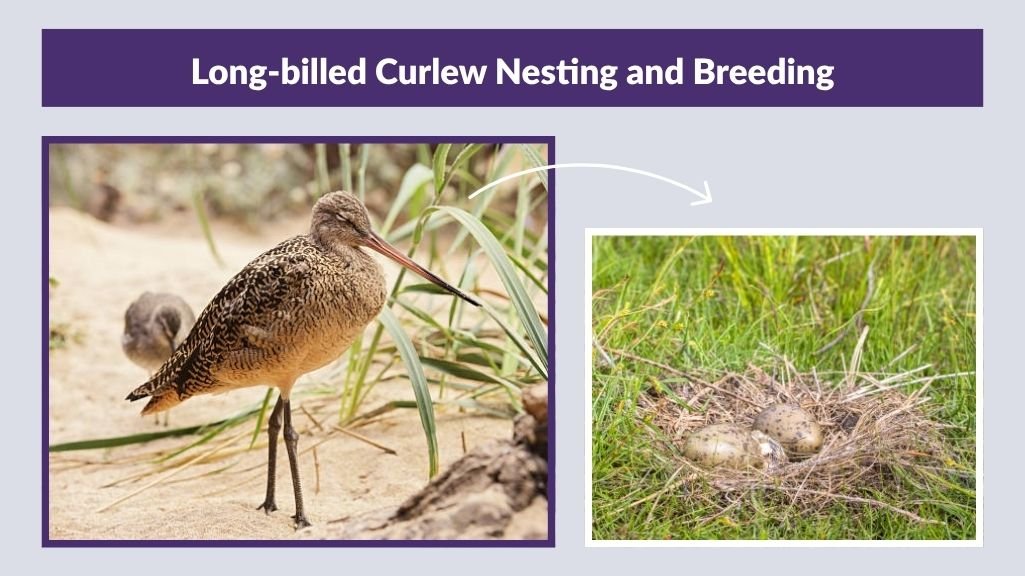
Long-billed Curlews breed in North American grasslands and prairies. Males perform elaborate courtship displays, including aerial flights and vocalizations. Nests are simple scrapes in the ground, well-concealed by short vegetation. Both parents share incubation and feeding duties, ensuring the survival of chicks in open prairie habitats.
Nest Construction
- Shallow ground scrape lined with grasses and leaves
- Hidden in low vegetation for camouflage
- Clutch size: 3–4 eggs
- Eggs pale with reddish-brown speckles
Incubation and Fledging
- Both parents incubate eggs for ~28 days
- Chicks are precocial, leaving nest shortly after hatching
- Fledging occurs around 10–12 days
Juvenile Development
Juveniles are smaller, duller, and have shorter bills than adults. They learn to forage under parental supervision and gradually gain independence while practicing probing and ground feeding behaviors.
Long-billed Curlew Juvenile Identification
Juvenile Long-billed Curlews resemble adults but are less vividly colored and slightly smaller. Their shorter bills make probing less efficient initially. Observing juvenile behavior provides insight into growth stages, plumage development, and early foraging skills.
Appearance
- Duller brown plumage
- Shorter, less curved bill
- Streaking less pronounced
Behavior
- Remain near parents for safety
- Learn to forage and recognize predators
- Often seen in small family groups in grasslands
Long-billed Curlew vs Similar Birds
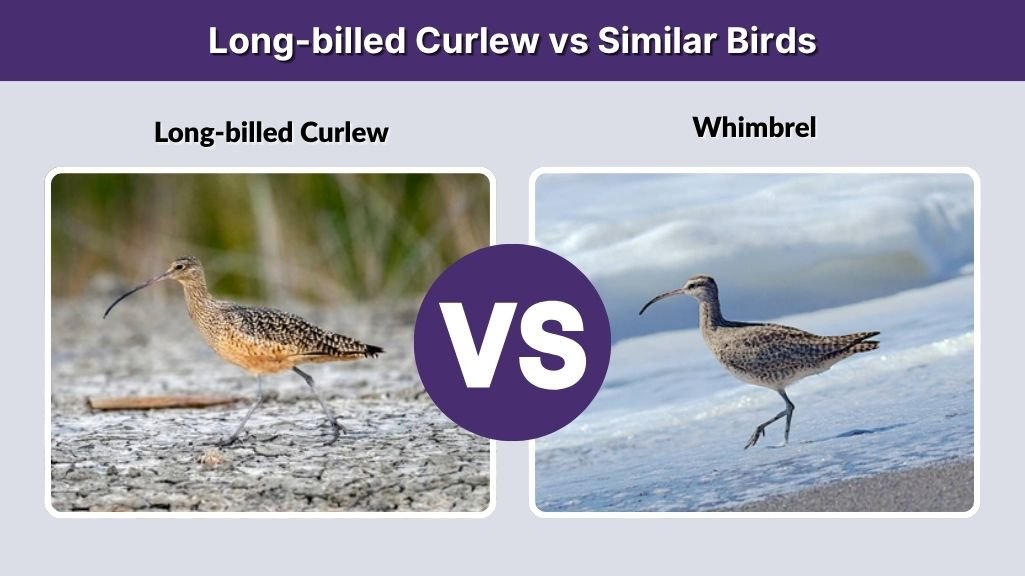
Long-billed Curlews can be confused with Whimbrels or other curlews in their wintering or coastal habitats. Distinguishing features include bill length, body size, plumage coloration, and song. Observing these traits carefully allows for correct identification during migration and winter months.
Comparison Table
| Feature | Long-billed Curlew | Whimbrel | Other Curlews |
| Size | 50–65 cm | 40–50 cm | Varies |
| Bill | Very long, curved | Medium, curved | Varies |
| Plumage | Buffy-brown, streaked | Gray-brown, striped crown | Varies |
| Song | Whistled “cur-lee” | Sharp “peep” | Varies |
| Habitat | Grasslands, coastal marshes | Coastal mudflats | Varies |
Identification Tips
- Long bills are the easiest distinguishing factor
- Buffy-brown streaked plumage confirms species
- Whistled song is unique to Long-billed Curlew
Adaptations and Interesting Facts
The Long-billed Curlew is highly adapted to grassland and coastal environments. Its long bill allows deep probing, while long legs support running and wading. Males produce an extensive repertoire of songs for courtship and territorial defense. These adaptations make it one of North America’s most distinctive shorebirds.
Key Adaptations (List Items)
- Extremely long, downward-curved bill for foraging
- Long legs for wading and running in grasslands
- Wide diet flexibility to exploit seasonal prey
- Large song repertoire for courtship and territory defense
- Uses auditory cues from prairie dogs to detect predators
Fun Facts
- Largest shorebird in North America
- Can live in grasslands, estuaries, and coastal mudflats
- Aggressive territorial behavior during breeding season
Conservation Status
Long-billed Curlews are currently listed as Least Concern, but populations face habitat loss due to agricultural expansion and wetland drainage. Conservation efforts focus on protecting grasslands, monitoring population trends, and preserving breeding and wintering sites.
Threats (List Items)
- Grassland and prairie conversion to agriculture
- Coastal wetland drainage
- Human disturbance during breeding
Conservation Efforts
- Protected grassland preserves
- Wetland restoration projects
- Monitoring by Audubon and Bird Conservancy programs
FAQs
What does a Long-billed Curlew look like?
It is the largest North American shorebird with a long, downward-curved bill, buffy-brown plumage, and long legs. Juveniles are duller with shorter bills.
What does it eat?
Omnivorous: insects, crustaceans, worms, and small mollusks. Diet changes seasonally, with insects favored during breeding and crustaceans in winter.
Where does it breed?
Breeds in grasslands and prairies across central and western U.S. and southern Canada. Nests are ground scrapes concealed in low vegetation.
How do you distinguish it from a Whimbrel?
Long-billed Curlews have longer, more curved bills, larger bodies, buffy-brown streaked plumage, and unique whistled calls compared to Whimbrels.
Is the Long-billed Curlew endangered?
No, it is listed as Least Concern. However, habitat loss and wetland drainage pose localized threats to certain populations.