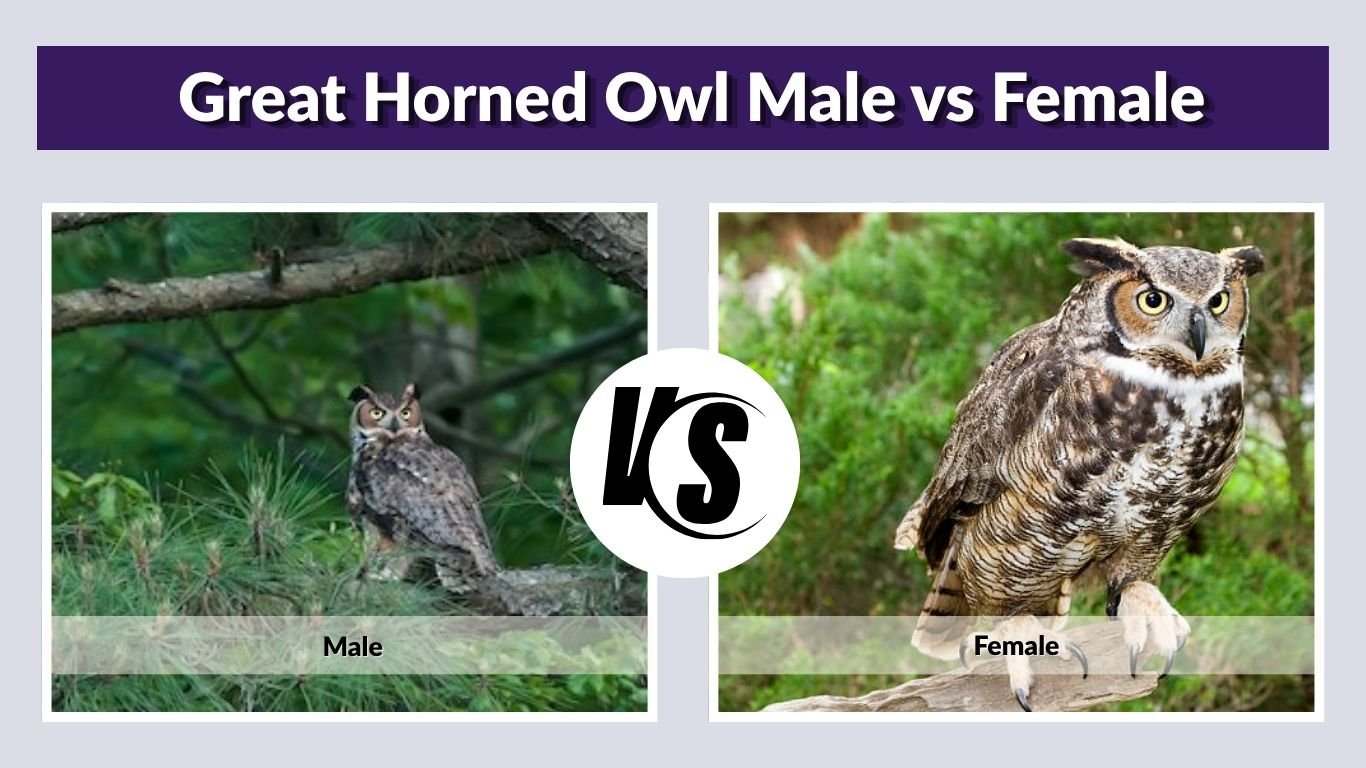
Male and female great horned owls (Bubo virginianus) look remarkably similar. Both have prominent feather tufts, yellow eyes, mottled plumage, barred underparts, and a noticeable white throat patch. The most dependable differences are body size and voice: females are larger and heavier, while males produce deeper hoots. Their roles also differ during breeding, with the female incubating eggs and brooding young while the male supplies most of the food.
Male vs Female Great Horned Owl Differences
Great horned owls display reverse sexual size dimorphism, a common pattern among birds of prey in which females are larger than males. However, size can be difficult to judge unless both members of a pair are visible together.
| Feature | Male great horned owl | Female great horned owl |
| Body size | Smaller and slimmer | Larger and bulkier |
| Average weight | About 1.3 kg or 2.9 pounds | About 1.7 kg or 3.7 pounds |
| Plumage | Mottled brown, gray, buff, and white | Nearly identical to male |
| Main hoot | Lower and deeper | Higher in pitch |
| Incubation | Does not normally incubate | Performs most or all incubation |
| Nesting role | Hunts and delivers food | Incubates and broods young |
| Courtship | Displays, calls, and offers food | Responds to calls and accepts food |
Average measurements vary geographically because great horned owls occupy an enormous range and include populations of different sizes. The weight figures above are broad averages rather than reliable identification measurements for every individual.
Are Female Great Horned Owls Bigger Than Males?
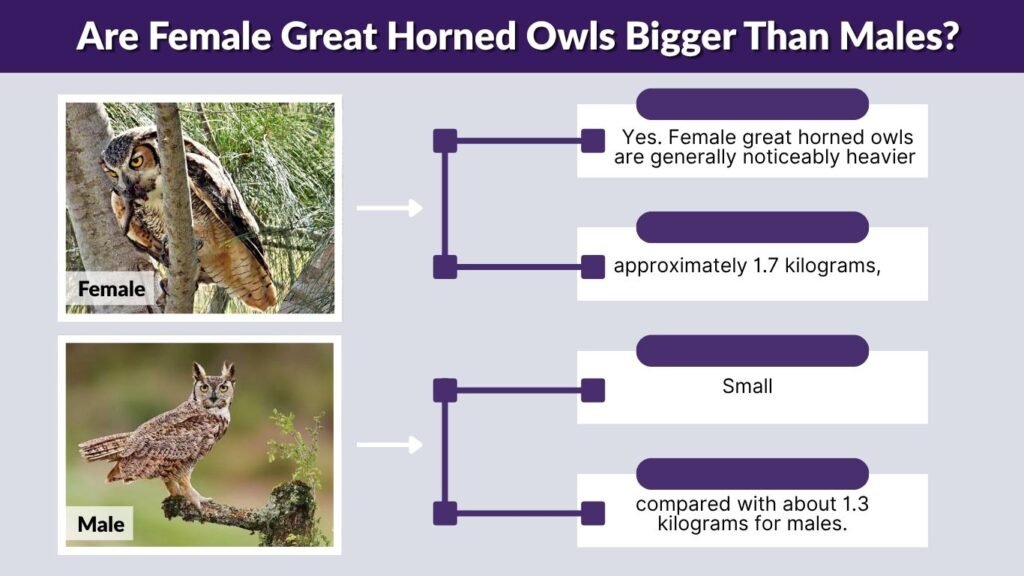
Yes. Female great horned owls are generally noticeably heavier and somewhat larger than males. Animal Diversity Web reports an average female weight of approximately 1.7 kilograms, compared with about 1.3 kilograms for males.
Size and Weight
A great horned owl’s overall length commonly falls between approximately 18 and 25 inches, while wingspan can exceed four feet. These broad species measurements overlap between the sexes, meaning a large male can resemble a small female when viewed alone.
Females usually appear:
- Broader through the body
- Heavier across the chest
- Larger around the head and shoulders
- Thicker-legged and more powerful
- Longer-winged when compared directly with their mate
A direct side-by-side comparison is more useful than estimating an isolated owl’s size from a distance. Camera angle, posture, feathers, and perspective can make one bird appear larger than it really is.
Why Is the Female Larger?
Researchers have proposed several explanations for reverse size dimorphism in raptors. A larger female may have more energy reserves for producing eggs, enduring prolonged incubation, protecting the nest, and keeping chicks warm during cold weather.
The smaller male may gain advantages from greater flight efficiency and agility while making frequent hunting trips. However, the precise evolutionary forces behind size differences in owls remain complex, and no single explanation accounts for every species.
Do Male and Female Great Horned Owls Look Different?
The sexes have essentially the same plumage. Both possess widely spaced “horns,” although these structures are feather tufts rather than actual horns or external ears.
Shared Identification Features
Male and female great horned owls normally have:
- Large yellow eyes
- A reddish-brown, gray, or buff facial disc
- Prominent feather tufts
- A white throat or bib
- Dark horizontal barring across the underparts
- Mottled brown, black, gray, and buff upperparts
- Strong feathered legs and heavy talons
Wildlife agencies describe the sexes as alike in plumage, with body size being their main visible difference. Color is not a dependable way to determine sex because regional variation and individual plumage differences may be greater than differences between males and females.
Can Plumage Color Identify the Male?
No consistent male-only or female-only color pattern exists. One owl may look grayer, browner, paler, or more reddish than another because of geographic variation, age, lighting, feather wear, or individual genetics.
A pale or nearly white great horned owl is therefore not necessarily male. Likewise, a dark and heavily barred individual is not automatically female.
Great Horned Owl Male vs Female Calls
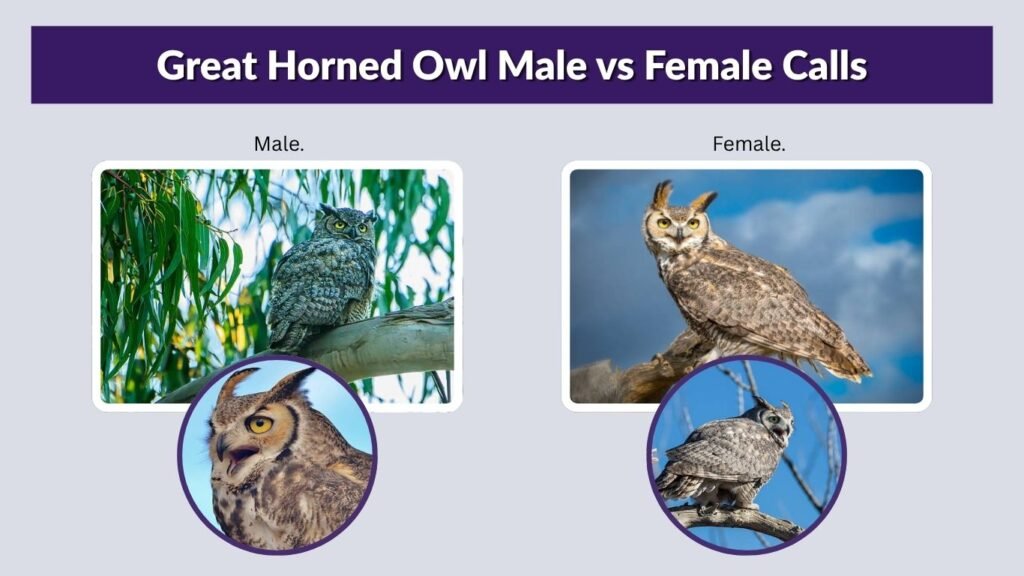
Voice is often the best way to distinguish a male from a female, especially when a bonded pair calls together. Both produce the familiar series of deep, rhythmic hoots, but their pitch differs.
Male Great Horned Owl Call
The male usually has the lower, deeper, more resonant voice. Although he is physically smaller, he has a larger voice box, allowing him to produce deeper notes.
His territorial hooting may be heard during autumn and winter as pairs establish nesting territories. Males also call during courtship and communicate with their mates while hunting or guarding the nest area.
Female Great Horned Owl Call
The female’s hoots follow a similar pattern but sound higher in pitch. Her voice may still seem deep compared with those of many other birds, so the difference is easiest to recognize during a duet.
Breeding pairs commonly exchange alternating hoots. Hearing one deep voice followed by a slightly higher response may indicate that both members of a pair are present.
Both sexes can also produce barks, screams, hisses, whistles, coos, and bill-snapping sounds. Therefore, not every vocalization can be assigned confidently to one sex based on pitch alone.
Male and Female Roles During Nesting
Great horned owl pairs divide reproductive responsibilities. The female concentrates on egg production, incubation, and brooding, while the male concentrates on hunting and food delivery.
Does the Female Incubate the Eggs?
The female performs most or all incubation, remaining on the eggs for roughly a month. Her brood patch allows body heat to pass efficiently to the eggs, which is especially important because great horned owls often nest during cold winter weather.
After hatching, she continues brooding the young until they can regulate their own body temperature. She also tears prey into small pieces and feeds the nestlings directly.
Do Male Great Horned Owls Sit on Eggs?
The male does not normally take regular incubation shifts. His primary responsibility is capturing prey and bringing it to the female. He may perch near the nest, briefly visit it, guard the territory, or occasionally remain beside the young, but these behaviors should not be confused with routine egg incubation.
During early chick development, the male may serve as the family’s main or sole food provider. Once the young need less brooding, the female can leave more frequently and help hunt.
Courtship and Pair Behavior
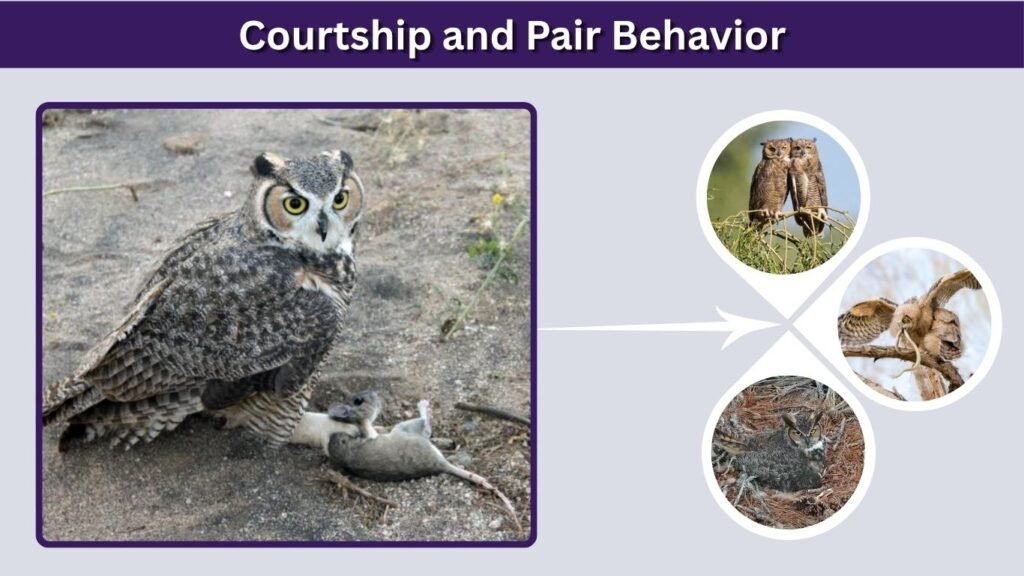
Great horned owls are generally socially monogamous during breeding. Courtship can include hooting duets, bowing, body displays, short display flights, and food presentations from the male to the female.
The two owls may remain within the same territory for extended periods, but they do not necessarily sit together throughout the day. Their cooperation becomes most visible during the breeding season, when the male hunts while the female remains closely associated with the nest.
How to Tell a Male From a Female Great Horned Owl
No single feature provides certainty in every situation. The most reliable identification comes from combining several observations:
- Compare body size: The larger member of a confirmed pair is probably the female.
- Listen to their voices: The deeper hooter is generally the male.
- Observe nesting behavior: The owl continuously incubating is the female.
- Watch food deliveries: The owl bringing most prey during incubation is usually the male.
- Avoid using color alone: Plumage overlaps too extensively between the sexes.
For an isolated owl away from a nest, determining sex may be impossible without measurements, behavioral context, genetic analysis, or comparison with its mate.
FAQs
Which great horned owl is larger, the male or female?
The female is larger and heavier. Females average approximately 1.7 kilograms, while males average around 1.3 kilograms, although actual weights vary among regions and individuals. Size is easiest to judge when a bonded pair is perched together.
Which great horned owl has the deeper call?
The male has the deeper and lower-pitched hoot despite being smaller. The female’s call is recognizably higher. When a pair performs an alternating duet, the difference in pitch is usually easier to hear.
Do male and female great horned owls have different colors?
No dependable sex-specific color difference exists. Males and females share the same general mottled plumage, yellow eyes, white throat, barred underparts, and feather tufts. Regional and individual color variation can occur in either sex.
Does the male great horned owl incubate eggs?
The female handles most or all regular incubation. The male primarily hunts, delivers prey, and guards the nesting territory. He may occasionally appear at or sit near the nest but does not normally replace the female for standard incubation shifts.
Can you identify a great horned owl’s sex from a photograph?
Sometimes, but only when both members of a known pair appear under comparable conditions. A larger bird is likely female, but perspective and posture can be misleading. A photograph of one owl rarely provides enough evidence for certain identification.