
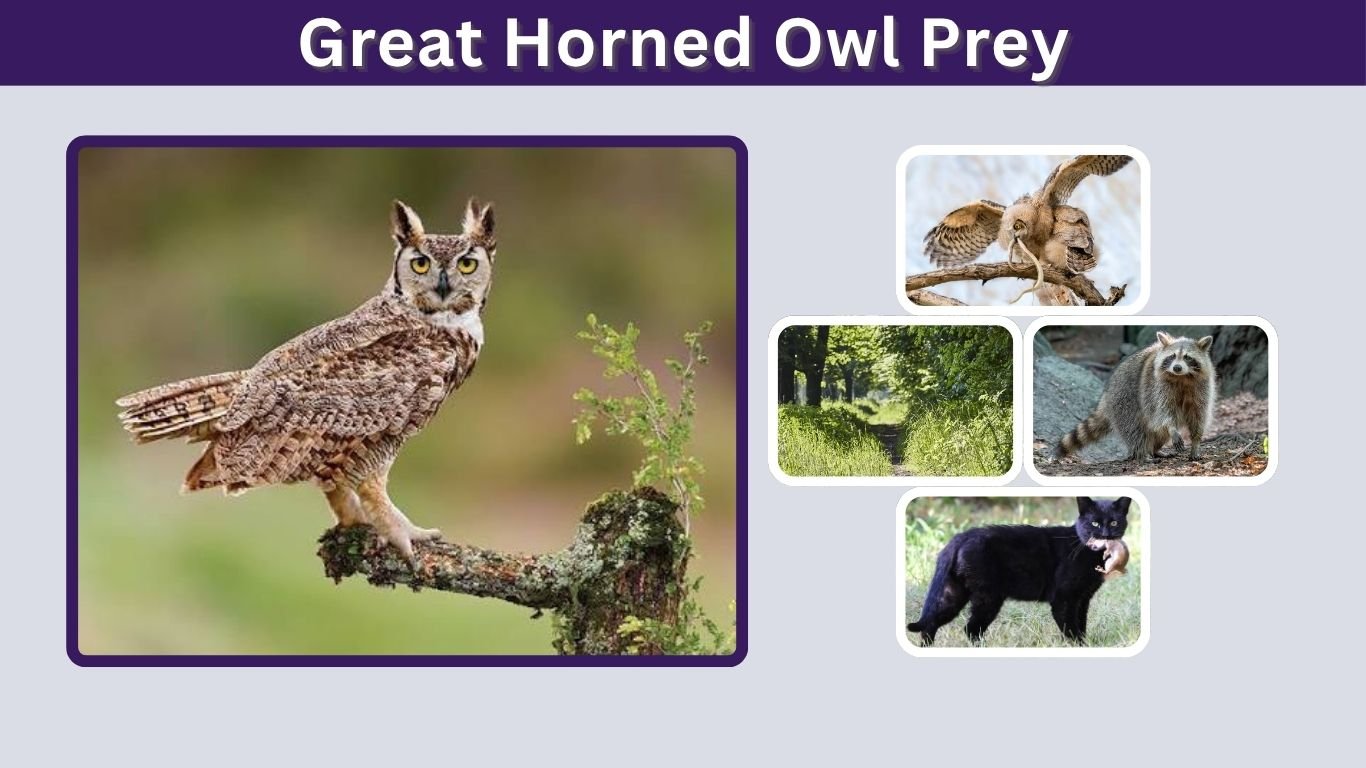
The great horned owl (Bubo virginianus) is one of the most powerful and adaptable predators in the Americas. It hunts everything from insects and mice to rabbits, skunks, waterfowl, and other birds of prey. Most meals consist of mammals and birds available within the owl’s local habitat, but its remarkably varied diet allows it to survive in forests, deserts, wetlands, farmland, and cities. Its quiet flight, sensitive hearing, strong feet, and crushing talons make it a formidable nighttime hunter.
What Do Great Horned Owls Prey On?
Great horned owls are opportunistic carnivores rather than specialized hunters. They usually capture whichever suitable animals are abundant and relatively easy to catch. Mammals make up most of the diet in many regions, although birds can become especially important in wetlands and northern environments.
Great Horned Owl Prey List
Common prey includes:
- Mice, rats, voles, and other rodents
- Rabbits, cottontails, and hares
- Squirrels, chipmunks, gophers, and prairie dogs
- Skunks, opossums, bats, and young raccoons
- Ducks, geese, coots, and other waterbirds
- Crows, pigeons, doves, and songbirds
- Hawks, falcons, ospreys, and smaller owls
- Snakes, lizards, frogs, and salamanders
- Large insects, scorpions, worms, and other invertebrates
- Fish and carrion on uncommon occasions
Although the list is extensive, rodents and rabbit-sized mammals are among the most frequent prey in much of North America. Great horned owls are also among the relatively few predators that regularly kill and eat skunks.
| Prey group | Common examples | Importance in the diet |
| Small mammals | Mice, rats, voles and shrews | Very common |
| Medium mammals | Rabbits, hares, squirrels and skunks | Common |
| Birds | Ducks, crows, pigeons, owls and hawks | Common but regionally variable |
| Reptiles and amphibians | Snakes, lizards and frogs | Occasional |
| Invertebrates | Insects, worms and scorpions | More common when abundant |
| Fish and carrion | Small fish and dead animals | Uncommon |
How Do Great Horned Owls Catch Their Prey?
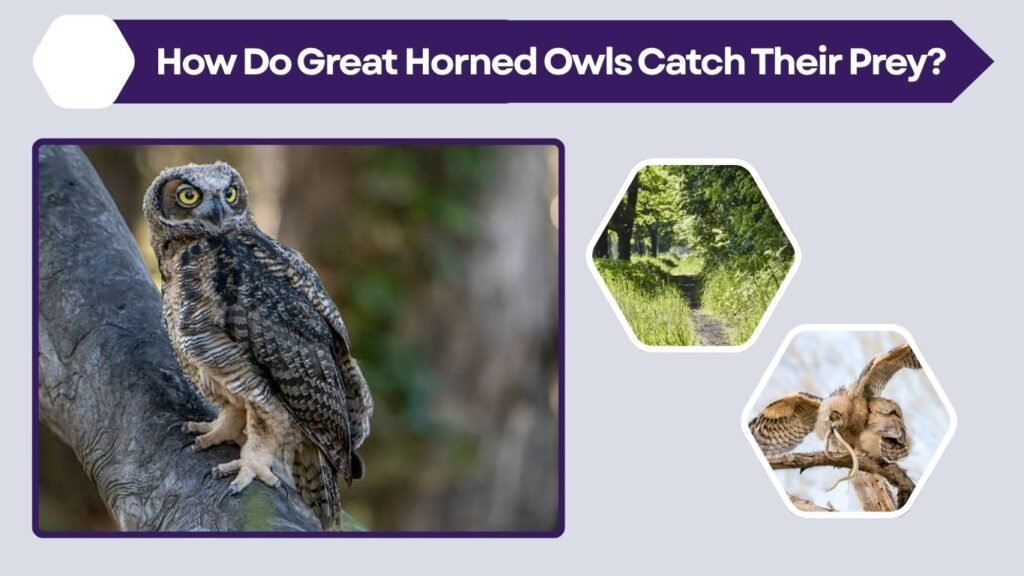
Great horned owls conduct most hunting at night, although they may also hunt around dawn, dusk, or even during daylight. They frequently wait silently on a tree branch, utility pole, fence post, or other elevated perch while watching and listening for movement below.
Finding and Approaching Prey
Large eyes help the owl detect movement in dim light, while its sensitive hearing can locate animals moving through grass, brush, or leaf litter. Specialized wing feathers reduce flight noise, allowing the owl to approach without giving its target much warning.
Capturing and Killing Prey
Once a target is located, the owl swoops down and strikes feet-first. Its long talons close around the animal with tremendous force. Cornell Lab reports that approximately 28 pounds of force may be required to open the owl’s clenched feet. The talons can puncture vital organs, crush the body, or sever the spine of larger prey.
The hooked bill is used mainly to tear apart food after capture rather than to deliver the initial killing blow. Small animals may be swallowed whole, while rabbits, birds, and other large prey are pulled apart into manageable pieces.
What Is the Biggest Prey a Great Horned Owl Can Kill?
Great horned owls usually weigh about two to five-and-a-half pounds, yet they can attack animals as heavy as or heavier than themselves. Documented large prey categories include hares, skunks, geese, porcupines, herons, wild turkeys, and several kinds of raptors.
However, the biggest animal an owl can kill is not necessarily one it can carry away. Large prey may be eaten where it was captured, dragged into cover, or consumed over several visits.
Great Horned Owl Prey Size
The possible prey-size range is enormous. Tiny worms and insects may weigh less than an ounce, while large birds and mammals may exceed five pounds. Average prey size varies considerably between habitats because the owl takes advantage of locally abundant animals.
Large females can overpower heavier prey than smaller males, but an individual owl’s success also depends on the prey’s condition, behavior, defensive ability, and location. A vulnerable young bird or injured rabbit may be much easier to capture than a healthy animal of similar size.
Do Great Horned Owls Prey on Cats?
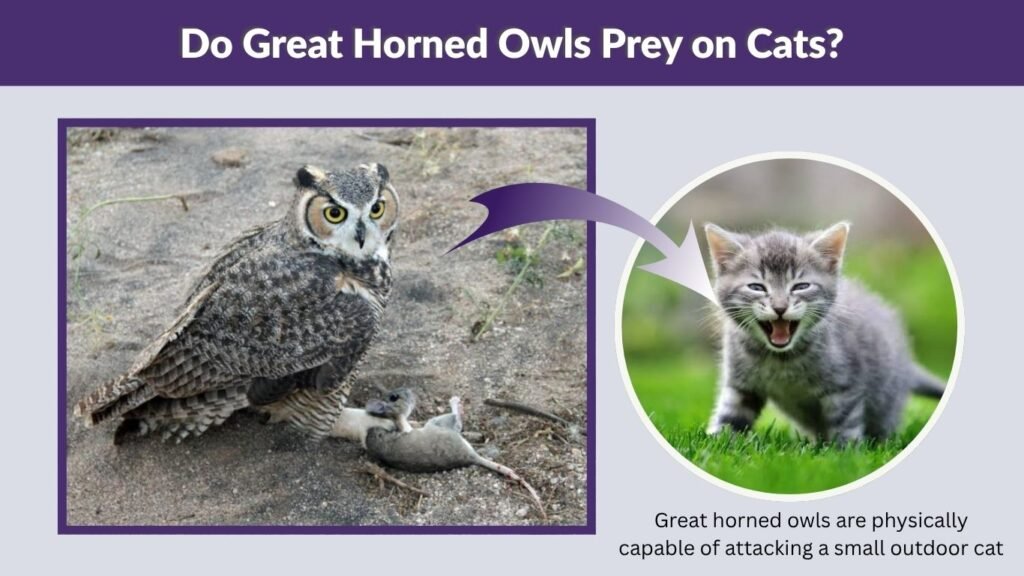
Great horned owls are physically capable of attacking a small outdoor cat, but cats are not a major or preferred part of their normal diet. Rodents, rabbits, squirrels, birds, and other wild animals are generally more typical prey.
The risk is greatest for kittens, very small cats, or unattended pets outside at night. Cornell Lab notes that great horned owls can take prey weighing more than five pounds, although most adult dogs and cats are large enough to be relatively safe from being carried away.
To reduce risk:
- Keep cats indoors, particularly from dusk until dawn.
- Supervise small pets when they are outside.
- Use a roofed outdoor enclosure for kittens and small animals.
- Remove spilled birdseed that attracts rodents near pet areas.
- Do not leave pet food outside overnight.
An owl could injure a pet even when the animal is too heavy to carry, so supervision remains important where large raptors are active.
Do Great Horned Owls Prey on Small Dogs?
Attacks on dogs are uncommon, but an extremely small puppy or toy-breed dog could attract the attention of a large owl. Most dogs are too heavy to be lifted, yet inability to carry the animal does not make an attack impossible.
Owners of very small dogs should accompany them outdoors at night, keep them close on a leash, and avoid leaving them alone in yards where great horned owls regularly hunt. Bright lighting and a covered pet run can provide additional protection.
Do Great Horned Owls Eat Other Owls?
Great horned owls prey on several other owl species. Barred owls, long-eared owls, screech-owls, and smaller raptors may be killed when their territories overlap. The great horned owl is considered the most serious natural predatory threat to the barred owl, which may avoid areas where one is present.
They may also raid nests and capture eggs, nestlings, or adults. This behavior is normal intraguild predation, in which one predator kills another predator that may also compete for food or nesting space.
What Animals Prey on Great Horned Owls?
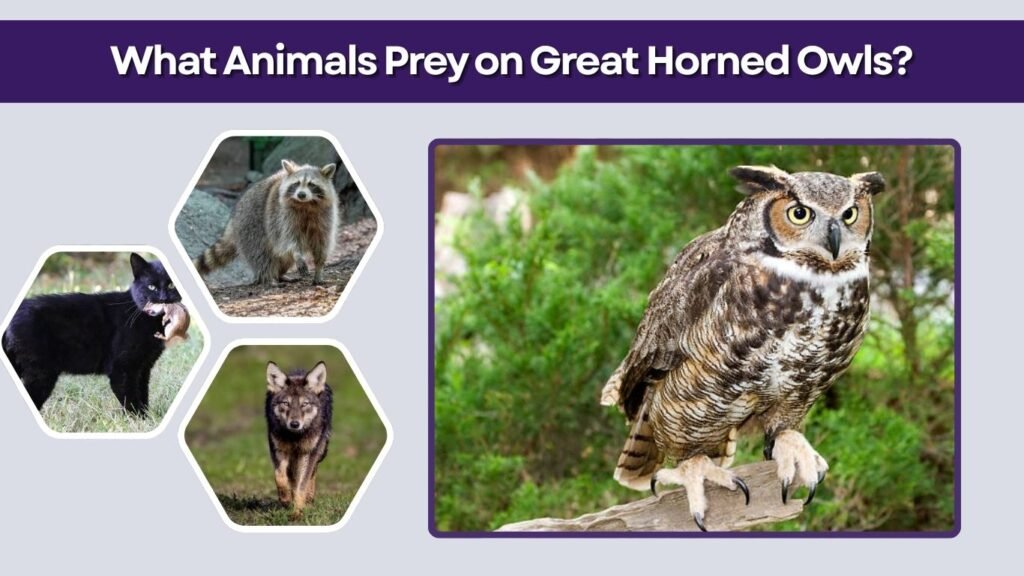
Healthy adult great horned owls have few natural predators. Their large size, defensive behavior, powerful talons, and position near the top of the food chain protect them from most animals. Adults can occasionally be killed during conflicts with eagles, snowy owls, or other great horned owls.
Predators of Eggs and Young Owls
Eggs, nestlings, and newly fledged owlets are more vulnerable. Potential predators include:
- Raccoons
- Opossums
- Foxes
- Coyotes
- Feral cats
- Large snakes
- Eagles and other large raptors
Parent owls defend their nests aggressively, but young birds can be taken when adults are absent or after they leave the nest before becoming strong fliers.
Where Do Great Horned Owls Eat Their Prey?
Small prey may be swallowed at the capture site or carried to a nearby branch. Larger animals are often eaten on the ground or taken to a protected perch. During nesting season, adults carry food to their mate and growing owlets.
Owls cannot digest fur, feathers, teeth, bones, and other hard materials completely. These remains are compressed into pellets and later regurgitated. Examining pellets allows researchers to identify many of the animals eaten by local owls, although pellet analysis may underestimate some prey items.
FAQs
What is the great horned owl’s favorite prey?
There is no single favorite prey throughout its range. Mice, rats, voles, rabbits, and hares are among the most important foods in many locations. The exact diet changes according to habitat, season, and which animals are locally abundant.
Can a great horned owl carry a rabbit?
An owl may carry a small rabbit or young cottontail, but a large adult rabbit can be too heavy for sustained flight. The owl may eat large prey at the capture site, drag it into cover, or return to the carcass later.
How much prey does a great horned owl eat?
The amount varies with the owl’s size, weather, activity, and reproductive stage. Adults feeding young require considerably more food than solitary birds. An owl may eat several small rodents or part of one larger rabbit-sized animal during a feeding period.
Do great horned owls hunt during the day?
Yes. They are primarily nocturnal, but they sometimes hunt during daylight, especially when feeding nestlings, when prey is abundant, or when an opportunity appears. Dawn and dusk are also important hunting periods.
Do great horned owls attack people?
Attacks are rare and usually involve an owl defending a nest or young. People should give nesting owls plenty of space, avoid approaching fledglings, and keep pets away from the area. Their talons can cause serious injuries even though humans are not prey.
