
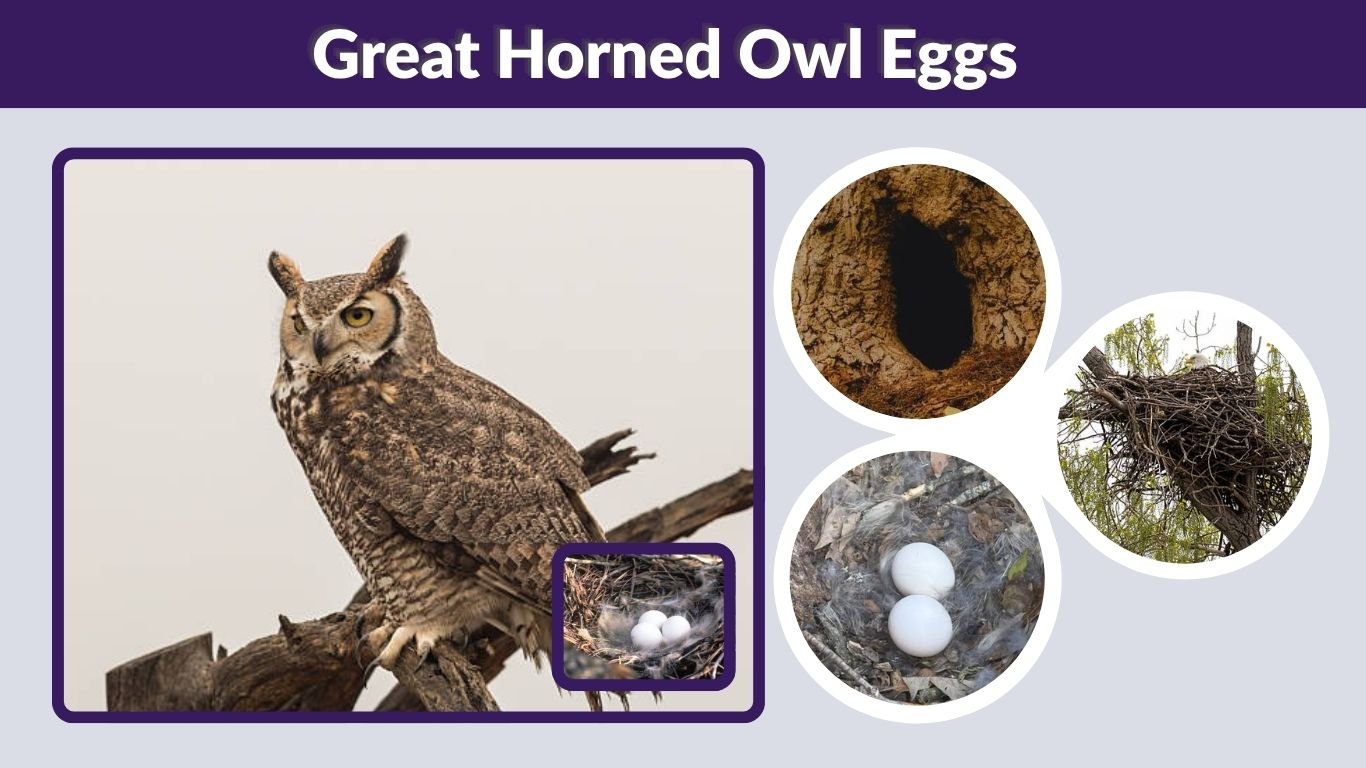
Great horned owl eggs are dull white, almost round, and surprisingly large. A female usually lays two or three eggs in an existing nest, tree cavity, or sheltered ledge during winter or early spring. She keeps them warm for about a month while her mate supplies food and guards the territory. Because the eggs may be laid several days apart, the owlets do not always hatch together. Their unusually early nesting season gives the young months to develop essential flying and hunting skills.
What Do Great Horned Owl Eggs Look Like?
Great horned owl eggs are relatively plain compared with the colorful or heavily patterned eggs of many smaller birds. Their simple appearance helps distinguish them from some hawk, crow, and waterfowl eggs that may be found in similarly large nests.
Egg Color and Shape
A great horned owl egg is:
- Dull or creamy white
- Unmarked, without spots or streaks
- Nearly spherical rather than sharply pointed
- Covered by a slightly rough shell
- Sometimes stained by dirt or nesting material
Fresh eggs may appear bright white, but incubation and contact with the nest can gradually make them look dirty or discolored. Cornell Lab describes the eggs as dull white, nearly spherical, and rough-surfaced.
Great Horned Owl Egg Size
Great horned owl eggs measure approximately:
| Measurement | Typical size |
| Length | 2.1–2.2 inches (5.3–5.6 cm) |
| Width | 1.8–1.9 inches (4.5–4.7 cm) |
| Shape | Broad and nearly round |
| Color | Dull white |
Their large size reflects the substantial development required before an owlet can hatch. Even so, newly hatched chicks remain helpless and depend completely on their parents.
How Many Eggs Do Great Horned Owls Lay?
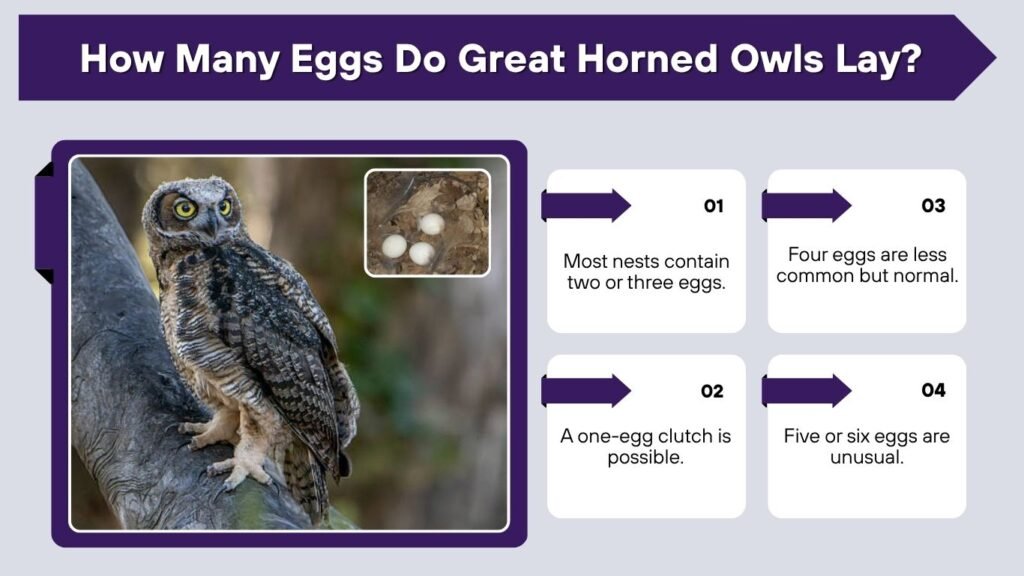
A female great horned owl commonly lays two or three eggs. Cornell Lab gives a typical clutch range of one to four, while Audubon notes that clutches of one to five occur and six are reported only rarely. Food availability, the female’s condition, climate, and location can all influence clutch size.
Typical Clutch Size
- Most nests contain two or three eggs.
- A one-egg clutch is possible.
- Four eggs are less common but normal.
- Five or six eggs are unusual.
- Great horned owls generally raise one brood per year.
Cornell’s NestWatch lists an average clutch of two to three eggs for the species. A pair whose first nesting attempt fails early may occasionally make another attempt, but successful pairs normally produce only one brood in a breeding season.
When Do Great Horned Owls Lay Eggs?
Great horned owls are among the earliest-nesting birds in North America. Some pairs begin breeding while snow still covers the ground and temperatures remain below freezing.
Egg-laying dates vary considerably by region. In southern areas such as Florida, nesting may begin as early as late November. Across many northern and central regions, females usually lay between January and March. In Montana, for example, researchers commonly observe egg-laying from mid-February through early March.
Regional Egg-Laying Season
| Region | Approximate egg-laying period |
| Southern United States | Late November through February |
| Central United States | December through March |
| Northern United States | January through March |
| Southern Canada | February into early spring |
These are broad ranges rather than fixed dates. Latitude, elevation, weather, prey abundance, and the condition of the breeding pair can shift nesting activity by several weeks.
Why Do They Lay Eggs During Winter?
Great horned owlets require a long period of parental care. After leaving the nest, young birds remain near their parents for months while learning to fly, locate prey, and hunt independently. Starting early allows them to practice these survival skills throughout spring and summer before the following winter.
Where Are Great Horned Owl Eggs Laid?
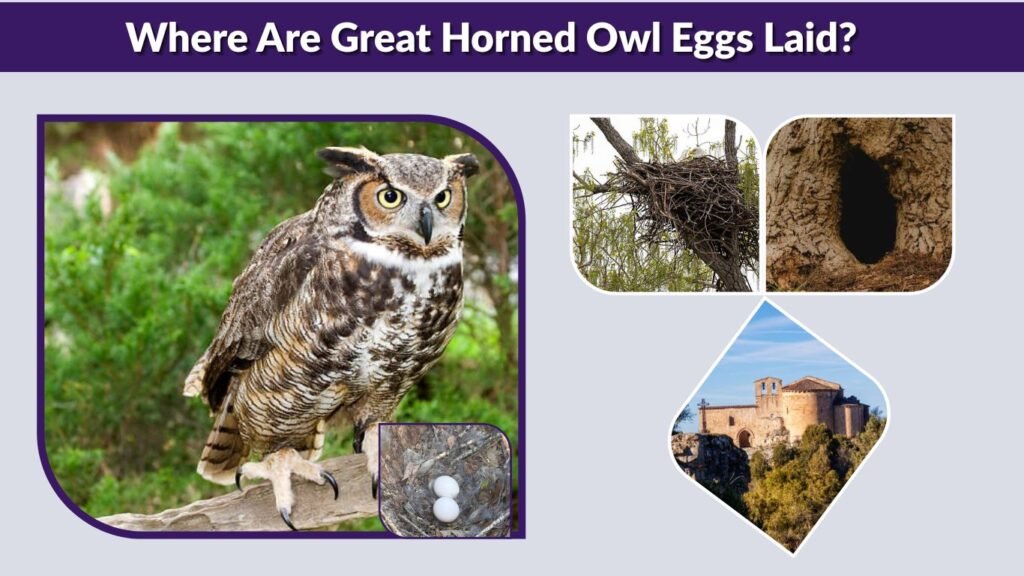
Great horned owls rarely construct an elaborate nest of their own. Instead, they take over available structures or use naturally protected locations.
Common nesting sites include:
- Abandoned hawk, eagle, crow, or heron nests
- Large tree cavities and broken tree trunks
- Cliff ledges and rocky recesses
- Cactus forks in desert habitats
- Abandoned buildings and barns
- Artificial nesting platforms
- Occasionally, sheltered places on the ground
They may add feathers, pellets, bark, or a small amount of plant material, but many eggs are laid in a shallow depression within an existing nest. Their willingness to use different sites helps the species breed in forests, deserts, farmland, parks, and urban areas.
Great Horned Owl Egg Incubation
Great horned owl eggs generally require 30 to 37 days of incubation before hatching. Audubon gives a similar range of approximately 28 to 35 days. Incubation usually begins with the first egg, so eggs laid later may hatch after their older sibling.
Does the Female Sit on the Eggs?
The female performs the incubation. She has a brood patch—an area of exposed, blood-rich skin on her abdomen—that transfers body heat directly to the eggs.
She spends most of the incubation period on the nest, leaving only briefly to stretch, eliminate waste, or receive food. Her dense feathers provide insulation during snow, wind, and freezing temperatures.
Does the Male Incubate the Eggs?
The male does not normally sit on the eggs because he lacks the female’s specialized brood patch. His main responsibilities are hunting, delivering food to the female, guarding the nesting territory, and warning of potential threats.
The male may bring prey to a nearby perch rather than landing directly on the nest. The female can then leave briefly to collect the meal before returning to the eggs.
When Do Great Horned Owl Eggs Hatch?
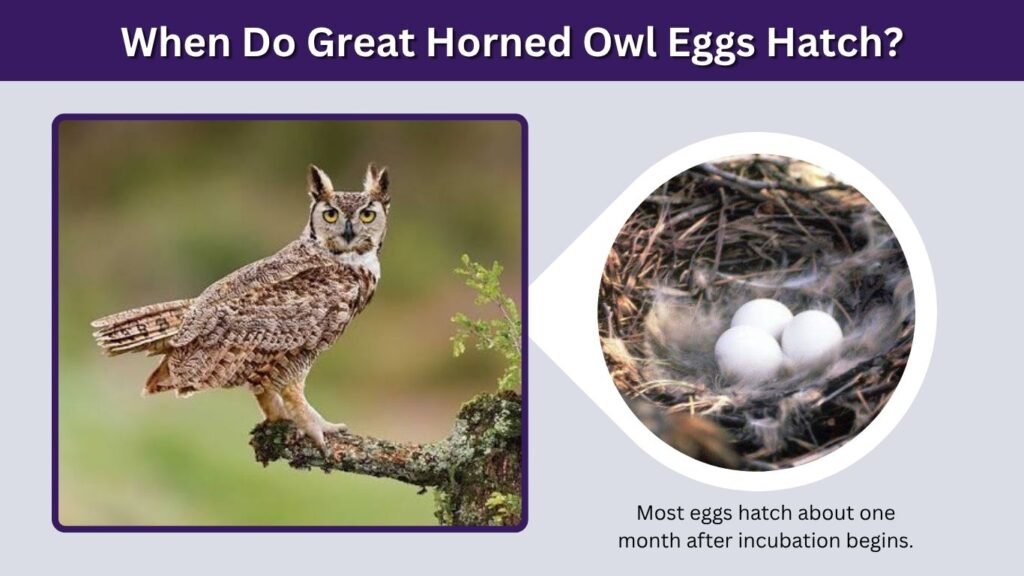
Most eggs hatch about one month after incubation begins. Therefore, eggs laid in January may hatch in February, while eggs laid in February or March usually hatch during March or April.
Eggs are not necessarily laid or hatched simultaneously. In one Cornell-monitored Texas nest in 2026, the female’s second egg arrived just over four days after the first. Such spacing can produce owlets of noticeably different sizes within the same nest.
The Hatching Process
The owlet uses a temporary projection on its bill, called an egg tooth, to crack the shell. The first small opening is known as a pip. The chick then works around the shell until it can push free.
A newly hatched great horned owlet has:
- Closed eyes
- Pink skin
- Sparse white down
- Limited ability to move
- Complete dependence on its parents
The female broods the hatchling closely, while the male continues supplying prey. She tears food into small pieces and feeds it directly to the young.
Do All Great Horned Owl Eggs Hatch?
Not every egg successfully produces an owlet. An egg may fail because it was infertile, the embryo stopped developing, the shell became damaged, the egg cooled for too long, or the nest was disturbed or abandoned.
Eggs and nestlings may also be lost to severe weather, falling nests, raccoons, crows, ravens, or other predators. Parents sometimes continue incubating a nonviable egg beyond the expected hatch date before eventually abandoning it or allowing it to become buried in the nest.
Observing a Great Horned Owl Nest Safely
Great horned owls are strongly protective of their eggs and young. Approaching a nest can cause stress and may place an observer within range of the adults’ powerful talons.
Use binoculars or a camera with a long lens and observe from a substantial distance. Avoid climbing the nest tree, touching eggs, trimming nearby branches, flying a drone over the nest, or repeatedly forcing the female to leave. Cornell’s NestWatch advises minimizing visits during egg-laying and the first days of incubation because exposed eggs can cool quickly.
FAQs
How long do great horned owls sit on their eggs?
The female incubates the eggs for approximately 30 to 37 days. She remains on the nest almost continuously, taking only short breaks. The male hunts and delivers food so that she can devote most of her time to keeping the eggs warm.
What color are great horned owl eggs?
Great horned owl eggs are dull white or creamy white without spots or markings. Their shells have a somewhat rough texture, and the eggs are broad and nearly spherical. They may become stained by dirt, prey remains, or nesting material during incubation.
How big is a great horned owl egg?
An average egg is about 2.1 to 2.2 inches long and 1.8 to 1.9 inches wide. This makes it considerably larger and rounder than a typical chicken egg, although exact measurements vary slightly among individual females.
Do great horned owl eggs hatch at the same time?
Not always. Females may lay their eggs several days apart and often begin incubating with the first egg. As a result, the first-laid egg may hatch before the others, producing siblings of different ages and sizes.
Do great horned owls lay eggs every year?
Most established pairs attempt to nest once each year, but success depends on food, weather, nest availability, and the health of both adults. A pair may skip breeding under poor conditions or make another attempt when an early clutch fails.
