
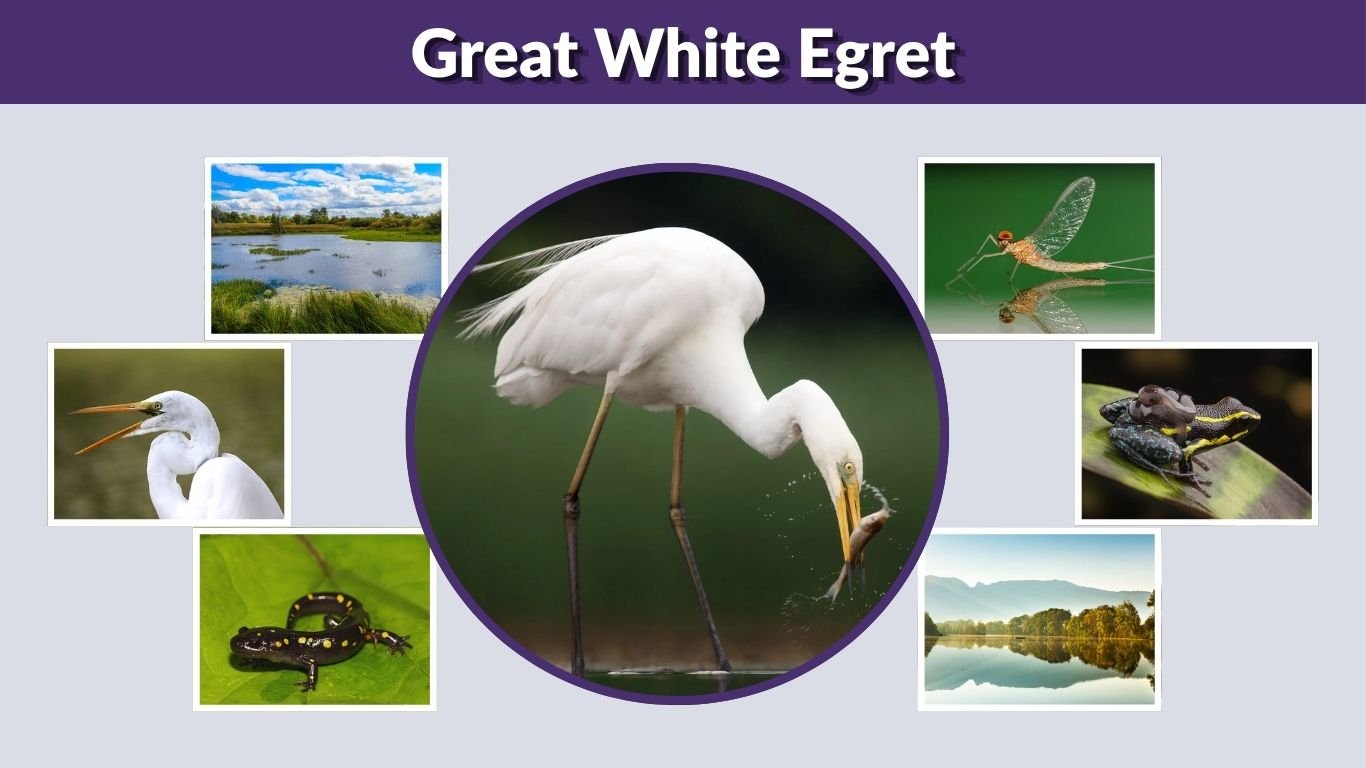
The great white egret is an elegant wetland bird known for its snow-white feathers, long neck, yellow bill, and patient hunting style. Also commonly called the great egret, this widespread member of the heron family lives around marshes, lakes, rivers, estuaries, and coastal lagoons. Although it may resemble other white herons, several physical features make it easy to identify. This guide explains its size, appearance, habitat, diet, breeding behavior, flight, range, call, symbolism, and differences from similar birds.
What Is a Great White Egret?
The name “great white egret” usually refers to the Great Egret, whose scientific name is Ardea alba. It is a large, white member of the heron family and occurs across much of the world.
Depending on the region, people may call this bird the great egret, great white egret, common egret, large egret, or white heron. In Britain and parts of Europe, “Great White Egret” remains a widely used common name.
The bird should not be confused with the Great White Heron of Florida. The Great White Heron is generally considered a white form of the Great Blue Heron, while the Great Egret is a separate species.
Great White Egret Identification
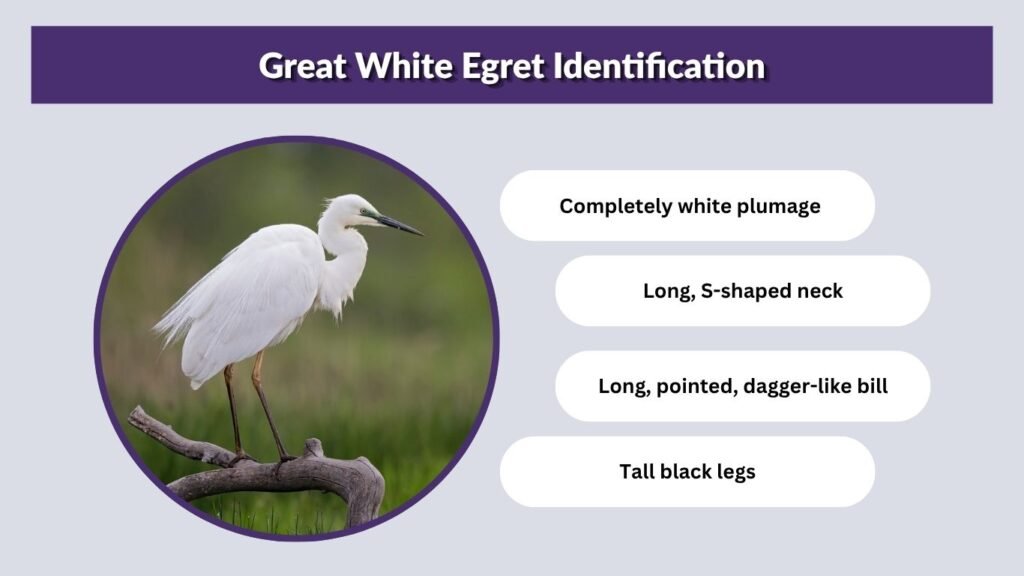
Great white egrets have a distinctive combination of size, shape, and color. Observing the bill, legs, feet, neck, and overall proportions is usually enough to identify an adult.
Size and Body Shape
An adult great egret generally measures about 35 to 41 inches long, with a wingspan of approximately 4 feet 7 inches. It is smaller and more slender than a Great Blue Heron but noticeably larger than a Snowy Egret.
Its main identification features include:
- Completely white plumage
- Long, S-shaped neck
- Long, pointed, dagger-like bill
- Tall black legs
- Dark feet
- Small head compared with its body
- Long legs extending behind the tail during flight
The bird often holds its neck upright while hunting. When resting, it may pull its neck closer to the body.
Bill, Legs and Feet
Outside the breeding season, American Great Egrets normally have a yellow or orange-yellow bill, dark legs, and dark feet. Unlike the Snowy Egret, they do not normally have bright yellow feet.
During the breeding season, the facial skin between the eyes and bill becomes greener. Bill and leg colors can vary somewhat among the bird’s regional subspecies. Great Egrets found in Europe, Asia, Africa, and Australia may show different bill or leg colors during breeding.
Breeding Plumage
Breeding adults develop long, delicate plumes over their backs. These ornamental feathers are called aigrettes and are raised during courtship displays.
Both males and females can develop breeding plumes, so the presence of long feathers does not reliably identify the bird’s sex. Males are usually slightly larger, but the sexes otherwise look very similar.
Juvenile Appearance
Juvenile great white egrets resemble nonbreeding adults. They have white feathers, long dark legs, and a yellowish bill. Young birds may initially look less graceful because their necks, bills, and legs have not reached full adult proportions.
Great White Egret Habitat and Range
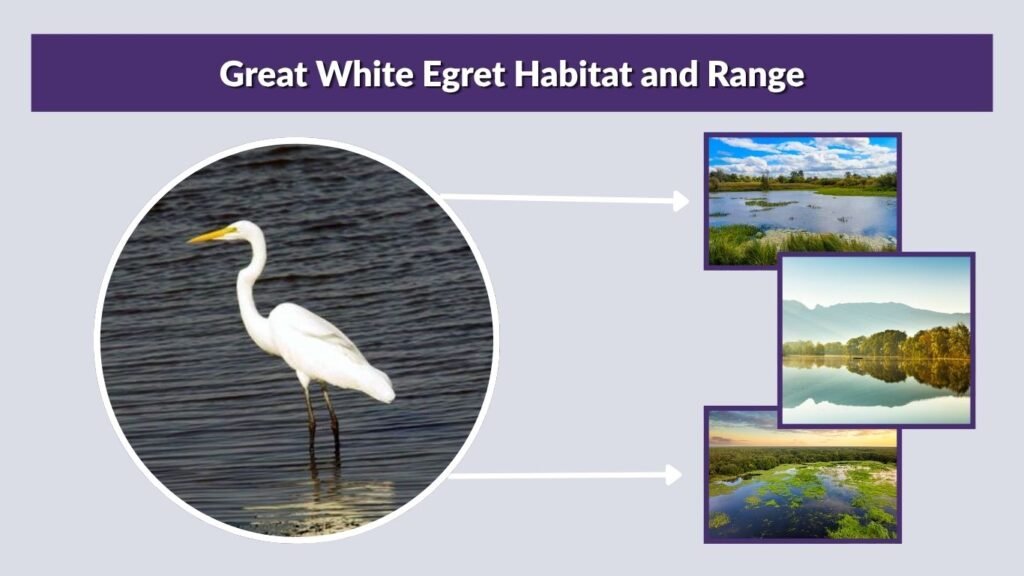
Great white egrets depend heavily on wetlands, although they can also hunt in damp fields and other open areas. They favor places where shallow water provides access to fish and other small animals.
Preferred Habitat
These birds commonly inhabit:
- Freshwater marshes
- Coastal wetlands
- Lakes and ponds
- Slow-moving rivers
- Estuaries and lagoons
- Mangrove swamps
- Mudflats and shorelines
- Flooded fields and rice paddies
Great Egrets usually forage in open, shallow water. They frequently stand near vegetation, shorelines, drainage channels, and exposed mud where prey is concentrated.
Worldwide Distribution
Great Egrets occur on every continent except Antarctica. Different populations live across North America, South America, Europe, Africa, Asia, and Australia.
In North America, they are particularly familiar in Florida, the Gulf Coast, California, and the southeastern United States. They also breed farther north, including areas around the Great Lakes and southern Canada.
The Great White Egret was formerly rare in Britain, but it has expanded its range and can now be observed throughout the year. Breeding was first confirmed in the UK in 2012, and the number of breeding locations has increased.
Do Great White Egrets Migrate?
Some populations migrate while others remain in the same general region year-round. Birds breeding in colder northern areas usually move south before shallow waters freeze.
After nesting, individuals may wander far outside their regular breeding range. This movement explains occasional sightings in places where great egrets are not normally common.
What Do Great White Egrets Eat?

Great white egrets are opportunistic predators. Fish make up much of their diet, but they capture many other animals when available.
Their diet may include:
- Small and medium-sized fish
- Frogs and tadpoles
- Salamanders
- Crayfish and shrimp
- Aquatic insects
- Snakes and small reptiles
- Grasshoppers
- Mice and other small mammals
- Occasionally small birds
The egret normally walks slowly through shallow water or stands motionless while watching for movement. Once prey comes within range, it rapidly thrusts its bill forward.
Some individuals stir the water with a foot to disturb hidden animals. Others temporarily spread their wings, possibly reducing glare or causing prey to move.
Great White Egret Breeding and Nesting
Great white egrets usually nest in colonies with other egrets, herons, ibises, cormorants, and related waterbirds. Their colonies are frequently established near productive feeding areas.
Courtship Behavior
At the beginning of the breeding season, males claim potential nesting territories and perform displays to attract females. Displays may involve:
- Raising the back plumes
- Stretching the neck upward
- Bowing the head
- Shaking or presenting sticks
- Preening the wings
- Producing low calls
Pairs are generally monogamous during a breeding season, although it is uncertain whether the same birds reunite in later years.
Nest and Eggs
Both parents help construct a platform-shaped nest from sticks. Nests are commonly positioned in trees or shrubs above land or water, although some may be placed low in dense marsh vegetation.
A typical clutch contains three or four pale blue-green eggs, though clutch size can vary. Both parents incubate the eggs. The incubation period generally lasts about 23 to 29 days.
The parents feed their chicks by regurgitating partially digested food. Young birds can begin moving around nearby branches after several weeks and usually become capable of flight at approximately six to eight weeks old.
Great White Egret in Flight
A flying great egret retracts its neck into a tight S-shape against its shoulders. Its long legs trail well beyond the short tail.
This posture helps separate it from cranes and storks, which usually fly with their necks extended. The egret’s broad wings produce slow, powerful wingbeats, creating a graceful and buoyant appearance.
When traveling between feeding and nesting areas, great egrets may fly alone or in loose groups. They can also travel considerable distances while searching for productive wetlands.
Great White Egret vs Great White Heron
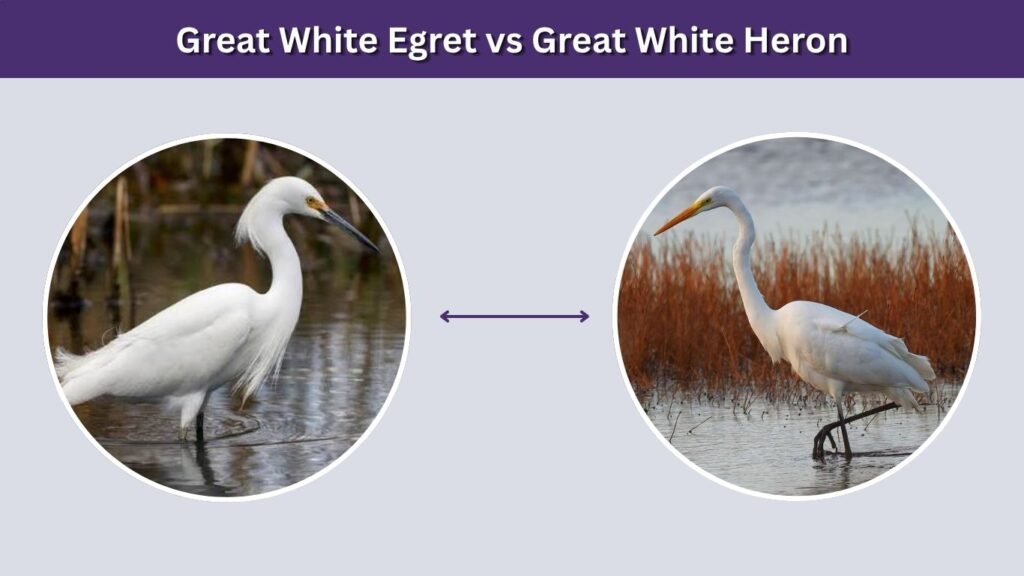
These names sound almost identical, but they usually describe different birds, especially in Florida.
| Feature | Great White Egret | Great White Heron |
| Scientific identity | Ardea alba | White form of Great Blue Heron |
| Overall size | Large | Usually larger and heavier |
| Bill | Long and yellow | Heavier and yellowish |
| Legs | Mostly black or very dark | Pale, yellowish or grayish |
| Body shape | Slender and elegant | More massive and heavy-bodied |
| Main Florida habitat | Freshwater and coastal wetlands | Strongly associated with southern coastal Florida |
| Worldwide range | Widespread | Limited regional distribution |
The legs provide one of the easiest clues. A large white heron with black legs is likely a Great Egret, while an even larger white bird with pale legs in southern Florida may be a Great White Heron.
Great White Egret vs Snowy Egret
The Snowy Egret is another all-white wetland bird, but it is considerably smaller.
| Feature | Great White Egret | Snowy Egret |
| Size | Large | Medium-sized to small |
| Bill | Yellow | Thin and black |
| Legs | Black | Black |
| Feet | Dark | Bright yellow |
| Neck | Long and relatively thick | Shorter and more slender |
| Hunting style | Slow stalking or waiting | Active walking, running and foot stirring |
When the birds stand together, the size difference is obvious. The Great Egret is taller and has a much longer neck and heavier bill.
Great White Egret Call
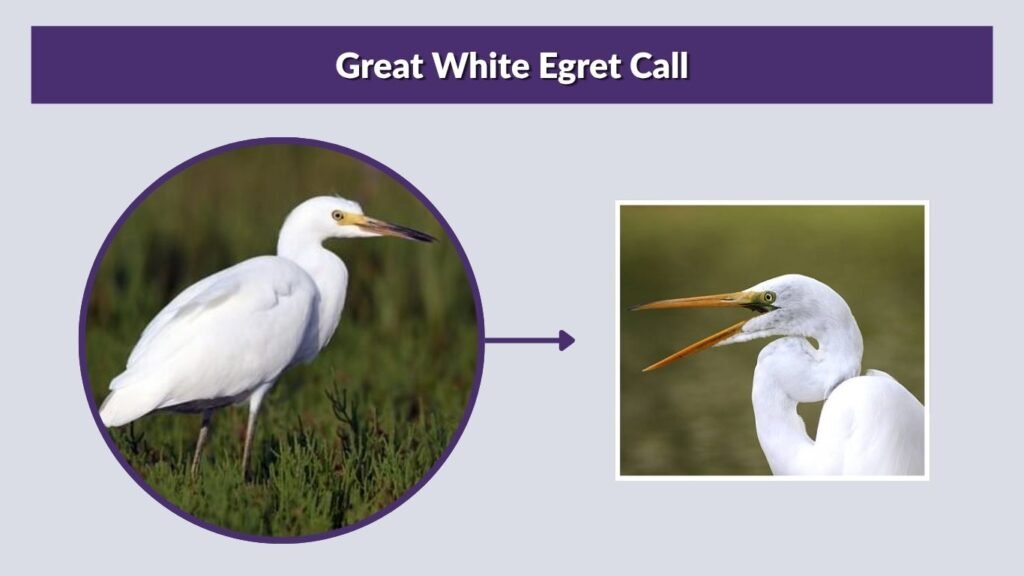
Great white egrets are often quiet while feeding. Their calls are generally low, harsh, and croaking rather than musical.
They may produce a deep “kraak” sound when disturbed or flying away. Around nesting colonies, adults and chicks can become much more vocal, creating a mixture of croaks, squawks, bill snapping, and begging calls.
Great White Egret Symbolism and Spiritual Meaning
The great white egret has inspired symbolic interpretations because of its white plumage, patient behavior, and graceful movements.
It is sometimes associated with:
- Purity and renewal
- Patience and careful timing
- Independence
- Balance and self-control
- Peace and spiritual awareness
- Adaptability during change
These meanings come from cultural and personal traditions rather than scientific evidence. For some observers, seeing an egret represents a reminder to remain calm, watch carefully, and act when the right opportunity appears.
Great White Egret Conservation
Great Egrets were heavily hunted during the late nineteenth and early twentieth centuries because their breeding plumes were used in fashion. Protection of nesting colonies and restrictions on plume hunting allowed populations to recover.
The Great Egret later became a prominent symbol of bird conservation. It is currently considered a species of relatively low global conservation concern, although wetland destruction, water pollution, disturbance of nesting colonies, and changing water levels remain important local threats.
FAQs
Are great white egrets rare?
Great white egrets are not globally rare. They are widespread across several continents and can be locally common around suitable wetlands. However, their abundance varies by location. In parts of northern Europe and the UK, they were historically uncommon but have become increasingly regular.
Do great white egrets have yellow feet?
American Great Egrets generally have black legs and dark feet. A white egret with black legs and bright yellow feet is more likely to be a Snowy Egret in the Americas or a Little Egret in Europe, Asia, Africa, or Australia.
Is a great white egret the same as a white heron?
A great white egret is a type of white heron because egrets belong to the heron family. However, “white heron” is a general description that can refer to several species. In Florida, the name Great White Heron refers to a white form of the Great Blue Heron.
Are great white egrets found in Florida?
Yes. Great Egrets are common and widespread in Florida. They can be observed throughout the year in marshes, ponds, canals, mangroves, estuaries, flooded fields, and coastal wetlands. Florida also supports the separate Great White Heron, which can cause identification confusion.
What does a great white egret look like when flying?
In flight, a Great Egret tucks its long neck against its shoulders while allowing its black legs to trail behind the tail. It flies with broad, steady wingbeats. This tucked-neck posture helps distinguish it from cranes and storks, which generally fly with extended necks.
