
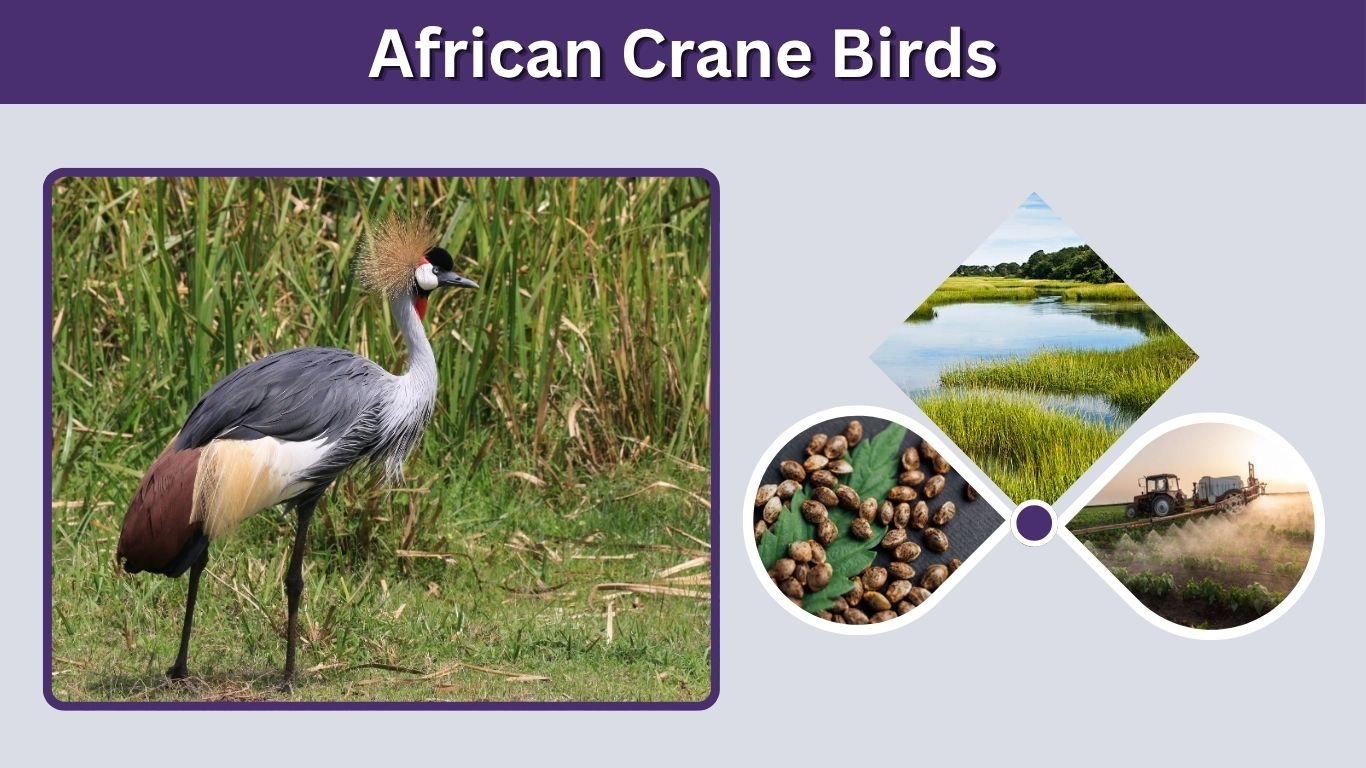
African crane birds are among the continent’s most elegant and recognizable wetland birds. The group includes the Grey Crowned Crane, Black Crowned Crane, Wattled Crane, and South Africa’s national bird, the Blue Crane. Although their colors and preferred habitats differ, all cranes share long legs, extended necks, powerful calls, and elaborate courtship dances. This guide explains the main African crane species, identification features, habitats, food, breeding behavior, cultural importance, and the conservation challenges affecting these remarkable birds across eastern, western, and southern Africa.
What Is an African Crane Bird?
The term “African crane bird” does not refer to a single species. It describes several members of the crane family that live or spend part of the year in Africa. Four threatened species are permanent residents of the continent, while Demoiselle and Eurasian cranes visit parts of northern Africa during the nonbreeding season.
General Characteristics
Cranes are tall, long-legged birds with straight bills, extended necks, broad wings, and short tails. Unlike herons, which often pull their necks into an S-shaped position during flight, cranes normally fly with their necks stretched forward and their legs trailing behind.
Most African cranes use combinations of wetlands, open grasslands, floodplains, farmland, and shallow marshes. Their long legs allow them to walk through vegetation and shallow water while searching for seeds, insects, roots, reptiles, and other small animals.
Cranes Versus Crane-Like Birds
Several African birds are commonly mistaken for cranes. Secretarybirds, storks, herons, egrets, and bustards may have similarly long legs and necks, but they belong to different bird families.
True cranes are especially known for their loud calls and elaborate dances. These displays may include bowing, jumping, running, tossing pieces of vegetation, flapping the wings, and circling a partner.
Main African Crane Bird Species
Africa supports four resident crane species: the Grey Crowned Crane, Black Crowned Crane, Blue Crane, and Wattled Crane. Each occupies a different geographical range and ecological niche. Demoiselle and Eurasian cranes may also appear seasonally in northern Africa, but they breed mainly outside the continent and should be considered migratory visitors rather than resident African cranes.
Four Resident Species
- Grey Crowned Crane: This striking bird has a grey body, white wings, red throat pouch, white cheek patches, and a golden crown. Its range extends from eastern Democratic Republic of Congo, Uganda, and Kenya to southeastern South Africa.
- Black Crowned Crane: Found mainly across the Sahel and parts of West, Central, and East Africa, this species has dark body plumage, white wing patches, colorful cheeks, and a stiff golden crown.
- Blue Crane: This pale blue-grey species is native to southern Africa, with more than 99 percent of its population occurring in South Africa. It is also South Africa’s official national bird.
- Wattled Crane: The tallest African crane has a white neck, grey body, red facial skin, and two feathered wattles beneath its throat. It occurs in several sub-Saharan countries, particularly around large wetlands and floodplains.
Migratory Crane Visitors
Demoiselle Cranes occur across parts of Europe and Asia, but one of their wintering areas reaches northwestern Africa and Sudan. They are smaller than most African resident cranes and can be recognized by their bluish-grey bodies, black breasts, red-orange eyes, and long white feathers behind the eyes.
Eurasian Cranes may also winter in northern and eastern Africa. They have slate-grey bodies, black neck markings, white facial stripes, and small red crown patches.
African Crane Bird Identification
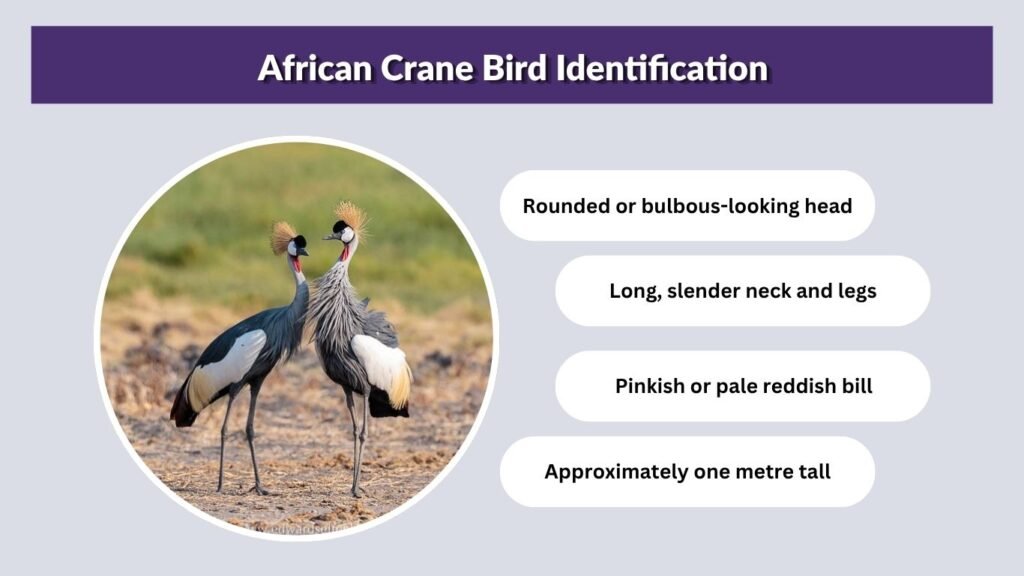
African cranes can usually be separated by plumage color, facial markings, crowns, wattles, and overall size. The Blue Crane has a smooth, elegant appearance, whereas crowned cranes possess unmistakable golden head feathers. Wattled Cranes are substantially taller and have prominent throat wattles that distinguish them from every other African species.
How to Identify a Blue Crane
- Pale blue-grey plumage covering most of the body
- Rounded or bulbous-looking head
- Long, slender neck and legs
- Pinkish or pale reddish bill
- Dark, elongated wing feathers resembling a flowing tail
- Approximately one metre tall
- No golden crown, red head patch, or bare facial skin
The Blue Crane often appears delicate compared with larger crane species. Its long inner wing feathers sweep toward the ground when the bird is standing, creating the illusion of an unusually long tail.
How to Identify Crowned Cranes
- Stiff, golden feathers forming a crown
- White wing patches with brown, gold, or chestnut feathers
- Red throat pouch beneath the bill
- Short, straight grey or black bill
- Long black legs and toes
- Grey body on the Grey Crowned Crane
- Predominantly dark body on the Black Crowned Crane
The Grey Crowned Crane generally has large white cheek patches, while the Black Crowned Crane has more variable red-and-white cheek markings. Juveniles lack the brilliant facial patterns and fully developed golden crowns of adults.
African Crane Bird Habitat and Distribution
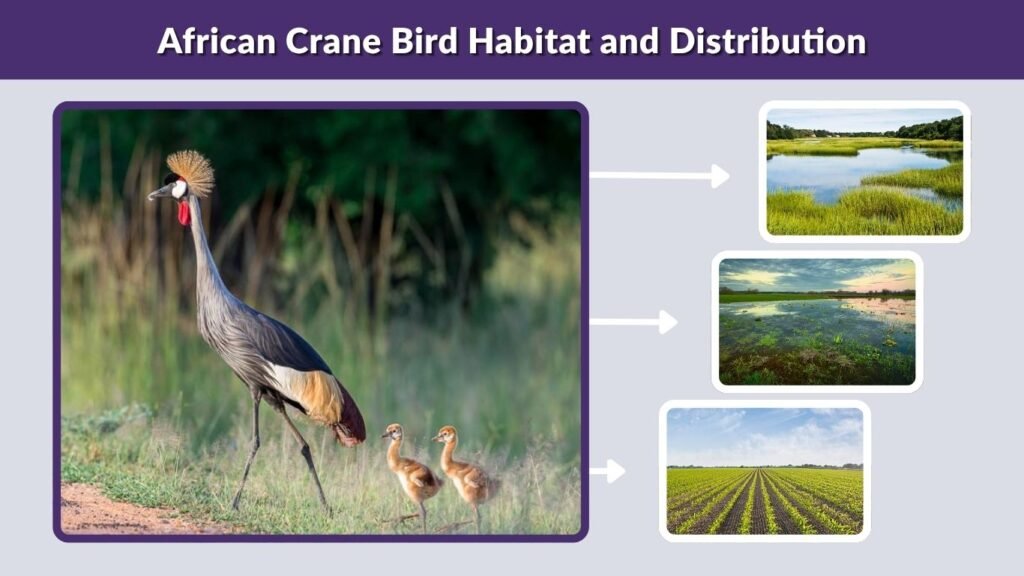
African cranes depend on a mixture of wetlands and open terrestrial habitats. Some species feed in grasslands or farmland but return to shallow wetlands for nesting and nighttime roosting. Their distribution is strongly influenced by water availability, seasonal flooding, vegetation height, agricultural activity, and the condition of breeding areas.
Cranes of Eastern and Western Africa
The Grey Crowned Crane is closely associated with eastern and southern Africa. It uses marshes, wet grasslands, river edges, agricultural fields, and seasonally flooded landscapes. It is especially associated with Uganda, Kenya, and Tanzania, although its wider range reaches southeastern South Africa.
The Black Crowned Crane is better adapted to the drier Sahel region. Populations occur from Senegal and The Gambia eastward through countries such as Chad, Sudan, South Sudan, Ethiopia, and Kenya. It depends on shallow wetlands, floodplains, open savannas, and nearby feeding grounds.
Cranes of Southern Africa
The Blue Crane prefers dry grasslands, low shrublands, Karoo plains, and agricultural landscapes. It may feed far from water, although breeding birds often select quiet ground near wetlands or damp depressions. Most of the global population is concentrated in South Africa, with a small breeding population in northern Namibia.
Wattled Cranes depend more heavily on large, shallow wetlands and floodplains. Important populations occur in Zambia and Botswana, including the Kafue Flats and Okavango Delta. Their survival is closely connected to natural flooding patterns and healthy wetland vegetation.
African Crane Bird Diet and Feeding Behavior
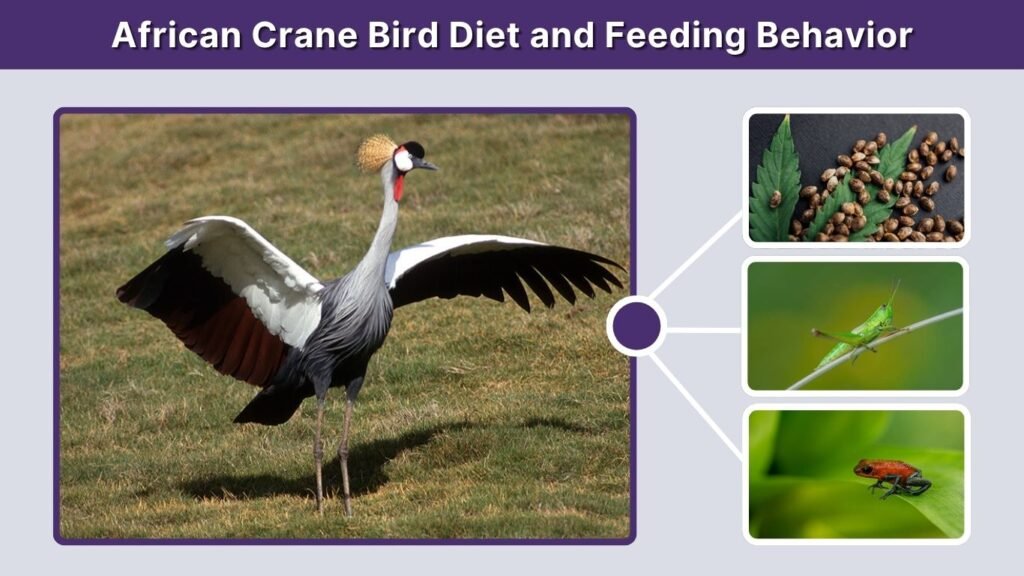
African cranes are omnivores, meaning they eat both plant and animal material. Their exact diet varies according to species, location, rainfall, and season. They may walk slowly while pecking food from the ground, probe soft mud with their bills, or stamp their feet to disturb insects and other small prey hidden in vegetation.
Common Foods
- Grass, sedge, and weed seeds
- Waste grain from agricultural fields
- Roots, bulbs, tubers, and rhizomes
- Beetles, grasshoppers, caterpillars, and other insects
- Frogs and small reptiles
- Snails and other aquatic invertebrates
- Small mammals and occasional fish
- Tender grass tips and young plant shoots
Blue Cranes commonly eat seeds, grain, insects, and small vertebrates. Wattled Cranes rely heavily on underground parts of wetland plants, while Black Crowned Cranes consume grass tips, seeds, insects, amphibians, reptiles, and agricultural crops.
Social and Courtship Behavior
Cranes may gather in flocks outside the breeding season, particularly around productive feeding or roosting areas. Breeding pairs become more territorial and defend suitable nesting habitat from other cranes.
Their dances are used during courtship but are not limited to mating. Adults and young birds may dance during social interactions or periods of excitement. Mated pairs also perform synchronized calls that help maintain their bond and advertise ownership of a territory.
Breeding and Life Cycle
Breeding usually corresponds with rainfall, flooding, and suitable food conditions. Most African cranes form long-lasting pair bonds and cooperate in defending the nesting area. The male and female participate in courtship displays, nest protection, incubation, and the care of their chicks.
Nesting and Eggs
Crowned and Wattled Cranes usually construct nests from grasses, reeds, sedges, and other wetland plants. Nests may be positioned in shallow marshes where surrounding water helps reduce access by terrestrial predators.
Blue Cranes commonly nest on the ground in open grassland, agricultural land, or bare veld, sometimes near water. Their nests may be little more than a shallow depression surrounded by sparse vegetation.
Growth of the Chicks
Crane chicks hatch covered in soft down and can walk shortly after leaving the egg. Their parents guide them to food, protect them from predators, and shelter them during poor weather.
Young cranes gradually develop stronger legs, longer necks, and adult-like feathers. Their facial colors, crowns, and wattles may take longer to develop. Family groups often remain together for several months before juveniles join other nonbreeding cranes.
Conservation of African Crane Birds
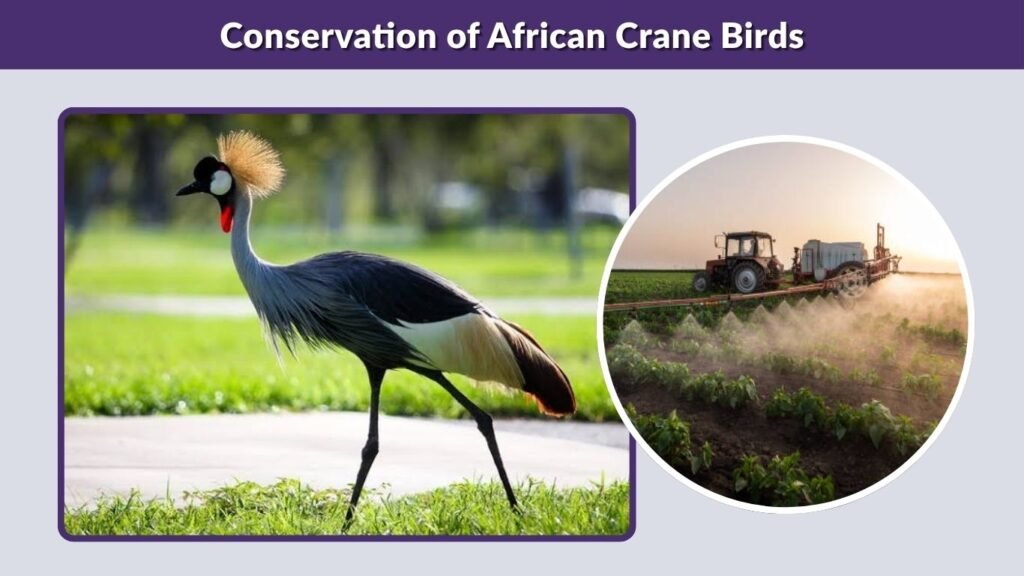
All four resident African crane species face conservation concerns. Wetland drainage, agricultural expansion, disturbance, poisoning, power-line collisions, illegal capture, and changes to natural flood cycles can reduce breeding success or kill adult birds. Protecting cranes therefore requires cooperation among governments, farmers, local communities, conservation groups, and landowners across international boundaries.
Major Threats
The Grey Crowned Crane is classified as Endangered, while the Black Crowned, Blue, and Wattled cranes are internationally classified as Vulnerable. These species are affected by overlapping threats, although their importance differs among regions.
Crowned cranes are sometimes captured for private collections or commercial trade. Wetland conversion also removes nesting sites and forces breeding birds into increasingly disturbed areas. Blue Cranes face collisions with power lines, agricultural changes, poisoning, land conversion, and collection of chicks or eggs.
Why Crane Conservation Matters
Crane conservation protects much more than the birds themselves. Wetlands used by cranes store water, support fisheries, reduce flooding, provide grazing areas, and shelter many other wildlife species.
Grasslands and agricultural landscapes managed responsibly for Blue Cranes can also support insects, mammals, reptiles, and other ground-nesting birds. Crane populations therefore provide useful signs of whether these habitats remain healthy enough to support both wildlife and nearby communities.
FAQs
African cranes frequently raise questions because several species have similar shapes but very different colors, ranges, and habitats. The following answers clarify the identity of South Africa’s national bird, the meaning of “African crowned crane,” the number of resident species, their ability to fly, and whether cranes can safely be kept as pets.
What is the national bird of South Africa?
The Blue Crane is the national bird of South Africa. It has pale blue-grey feathers, a long neck, slender legs, and flowing dark wing plumes. Its geographical range is almost entirely restricted to South Africa, although a small population also occurs in Namibia.
Is the African crowned crane one species?
The name may refer to either the Grey Crowned Crane or the Black Crowned Crane. Both have stiff golden head feathers, but the Grey Crowned Crane has a lighter grey body, while the Black Crowned Crane has much darker body plumage.
How many resident crane species live in Africa?
Four threatened crane species are resident in Africa: the Grey Crowned Crane, Black Crowned Crane, Blue Crane, and Wattled Crane. Demoiselle and Eurasian cranes also visit parts of Africa during their seasonal migrations.
Can African crowned cranes fly?
Yes. Grey and Black Crowned Cranes are strong flying birds. They use their broad wings to travel between feeding, breeding, and roosting locations. Crowned cranes are also unusual because their long hind toes allow them to perch in trees more effectively than most other cranes.
Can African crane birds be kept as pets?
African cranes are wild birds with complex dietary, social, spatial, and breeding requirements. Several species are threatened and protected by national or international regulations. Capturing or purchasing wild cranes can support illegal wildlife trade, so they should be observed responsibly in their natural habitats or accredited conservation facilities.
