
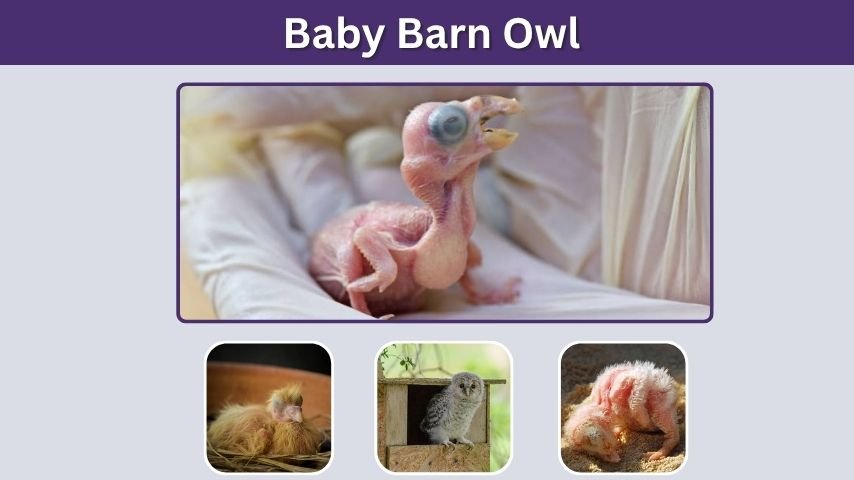
A baby barn owl is one of the most unusual-looking young birds in the owl world. With its white down, long face, hissing calls, and sometimes “alien-like” appearance, it often surprises people who see one for the first time. Baby barn owls, also called owlets, grow quickly inside dark nest sites such as barns, tree cavities, nest boxes, and quiet buildings. Understanding their sounds, food, behavior, and rescue needs helps people observe them safely.
What Is a Baby Barn Owl Called?
A baby barn owl is usually called an owlet. Like other young owls, it hatches from an egg and depends completely on its parents during the early stage of life. Barn owl chicks are not born looking like adult owls. They start life small, weak, and covered in soft white down.
Baby Barn Owl Meaning
The term “baby barn owl” simply refers to a young barn owl before it becomes fully grown. In bird terms, it may be called a chick, nestling, fledgling, or owlet depending on its age and development stage.
A very young owlet stays in the nest and cannot fly. As it grows, it becomes stronger, stands more confidently, develops feathers, and begins testing its wings. Once it leaves the nest area but still depends on its parents, it is often called a fledgling.
Common Names for Baby Barn Owls
- Baby barn owl
- Barn owl chick
- Barn owl owlet
- Young barn owl
- Barn owl nestling
- Barn owl fledgling
What Does a Baby Barn Owl Look Like?
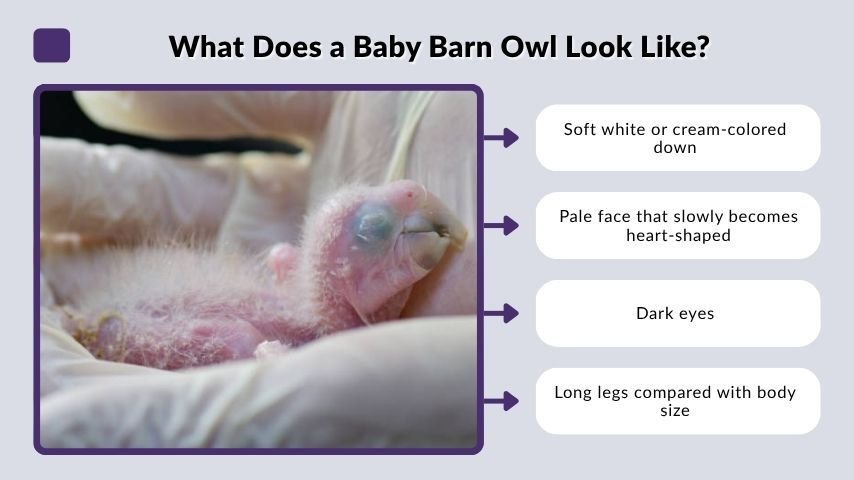
Baby barn owls look very different from adult barn owls. Adults have a heart-shaped face, pale body, golden-brown wings, and a smooth appearance. Young owlets look fluffier, paler, and sometimes awkward while they are growing.
Newly hatched barn owls are mostly covered in soft white down. Their eyes may not be fully open at first, and their bodies look fragile. As they grow, their face becomes longer, their legs stronger, and their flight feathers begin to appear.
Baby Barn Owl Identification
- Soft white or cream-colored down
- Pale face that slowly becomes heart-shaped
- Dark eyes
- Long legs compared with body size
- Hooked beak
- Fluffy body before feathers grow fully
- Hissing or screeching sound when disturbed
Baby barn owls may look “scary” or “alien” to some people because they have long faces, dark eyes, and thin bodies under fluffy feathers. This appearance is normal and does not mean the bird is sick.
Baby Barn Owl vs Adult Barn Owl
| Feature | Baby Barn Owl | Adult Barn Owl |
| Body covering | Soft white down | Smooth feathers |
| Face shape | Developing heart shape | Clear heart-shaped face |
| Flying ability | Cannot fly at first | Strong silent flight |
| Sound | Hissing, begging, screeching | Raspy screech, hiss, calls |
| Food source | Fed by parents | Hunts small mammals |
Baby Barn Owl Habitat
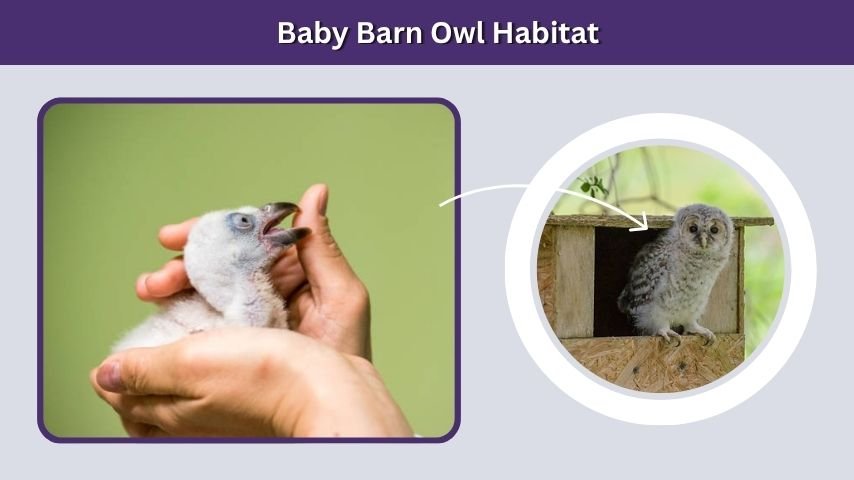
Baby barn owls are usually found where adult barn owls nest. Barn owls prefer quiet, hidden places that give protection from weather and predators. They do not build complex stick nests like some birds. Instead, they often use existing cavities, old buildings, nest boxes, barns, hollow trees, and similar sheltered spaces.
Barn owls are often linked with open countryside because they hunt over grasslands, meadows, field edges, farms, and marshy areas. Cornell Lab notes that American barn owls mostly hunt in open fields and meadows at night.
Where Baby Barn Owls Are Found
Baby barn owls may be found in:
- Barns and old farm buildings
- Church towers or quiet roof spaces
- Hollow trees
- Nest boxes
- Cliffs or cavities
- Abandoned structures
- Quiet attics or wall spaces
Their nest site is usually close to good hunting areas. Adult barn owls need regular access to small mammals such as mice, rats, voles, and shrews to feed their young.
Baby Barn Owl Food
Baby barn owls eat the same type of prey that adult barn owls bring to the nest. Their diet is mostly made up of small mammals. The Barn Owl Trust explains that wild barn owls commonly eat small mammals such as field voles, common shrews, and wood mice in Britain. Cornell Lab also lists rats, mice, voles, lemmings, shrews, bats, rabbits, and occasional birds as prey for American barn owls.
What Do Baby Barn Owls Eat?
- Mice
- Voles
- Rats
- Shrews
- Small birds sometimes
- Other small animals, depending on region
The parents usually tear food into smaller pieces when the chicks are very young. As the baby barn owls grow, they can swallow larger prey items. Owls often swallow prey whole or in large pieces, and later produce pellets made of undigested fur and bones.
How Parents Feed Baby Barn Owls
Adult barn owls hunt mostly at night. They return to the nest with prey and feed the chicks. In a good hunting season, the nest may contain extra prey stored for later. Cornell Lab notes that nesting barn owls may store many prey items at the nest site while feeding young.
Baby barn owls beg for food with rough, hissing, or screeching sounds. These calls may sound strange to humans, especially at night.
Baby Barn Owl Sounds
One of the most searched questions is: what does a baby barn owl sound like? Baby barn owls do not make the classic “hoot” many people expect from owls. Barn owls are famous for raspy, eerie sounds rather than soft hooting.
Baby barn owl sounds may include hissing, screeching, snoring-like begging calls, clicking, and defensive noises. The Barn Owl Trust describes young barn owls as able to hiss and click their tongues as they grow.
Why Baby Barn Owls Hiss
A baby barn owl may hiss when it feels afraid or threatened. This sound is a warning. It may happen if a person gets too close to the nest, touches the bird, or surprises it.
Hissing does not always mean the owlet is attacking. It is often a defensive behavior. The bird is trying to look and sound more dangerous than it really is.
Baby Barn Owl Sounds at Night
At night, baby barn owls may become louder because the parents are hunting and returning with food. The owlets may call when they are hungry or when they hear adults nearby.
These sounds can be disturbing if the nest is inside a building, attic, or barn. However, the noise is usually part of normal nesting behavior.
Baby Barn Owl Growth Stages
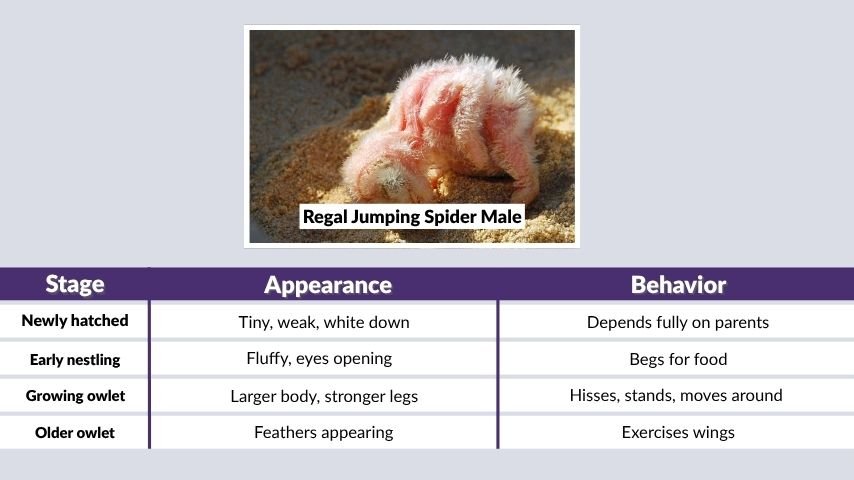
Baby barn owls change quickly during the first weeks of life. They begin as helpless chicks, then grow into fluffy owlets, and later become young birds ready to leave the nest.
Their growth speed depends on food supply, weather, nest safety, and overall health. When food is plentiful, young barn owls usually develop better and have a higher chance of survival.
Baby Barn Owl Development Table
| Stage | Appearance | Behavior |
| Newly hatched | Tiny, weak, white down | Depends fully on parents |
| Early nestling | Fluffy, eyes opening | Begs for food |
| Growing owlet | Larger body, stronger legs | Hisses, stands, moves around |
| Older owlet | Feathers appearing | Exercises wings |
| Fledgling | More adult-like | Leaves nest area but still depends on parents |
When Do Baby Barn Owls Learn to Fly?
Baby barn owls do not fly immediately after leaving the egg. They need time to develop strong wings and flight feathers. Older owlets may flap their wings, climb around the nest site, and move awkwardly before true flight.
Even after fledging, young barn owls may still depend on their parents while they improve hunting skills.
Baby Barn Owl Behavior
Baby barn owl behavior can look strange if you are not familiar with owlets. They may stand tall, sway, hiss, click, scream, sleep deeply, or stare silently. These behaviors are usually normal.
Young barn owls may also appear clumsy. They can run, jump, and pounce before they fly well. According to the Barn Owl Trust, young barn owls can run, jump, pounce, hiss, and click their tongues as they develop.
Common Baby Barn Owl Behaviors
- Hissing when scared
- Begging loudly for food
- Standing upright
- Sleeping for long periods
- Stretching wings
- Moving around the nest
- Clicking the beak or tongue
- Pouncing during play or practice
Why Baby Barn Owls Look “Alien”
Many people search for “alien baby barn owl” because young barn owls can look unusual. Their pale down, long face, dark eyes, and thin body can make them look very different from typical baby birds.
This is normal. As they grow feathers and develop the adult heart-shaped face, they begin to look more like the barn owls people recognize.
What to Do If You Find a Baby Barn Owl
Finding a baby barn owl on the ground can be worrying. However, you should not immediately assume it is abandoned. The safest action depends on whether the bird is injured, healthy, very young, or already fledging.
The Barn Owl Trust says that if a young barn owl is fit and healthy, it should be returned to the nest unless there is a good reason not to do so. The RSPCA also advises that baby birds of prey found on the ground usually need help, except in some cases such as tawny owlets.
Safe First Steps
- Keep people, dogs, and cats away
- Do not feed the owl random food
- Do not give water by force
- Check from a distance for injury
- Contact a licensed wildlife rehabilitator
- Return it to the nest only if advised and safe
- Use gloves if handling is absolutely necessary
A baby barn owl should not be kept as a pet. Wild owls need expert care, proper food, and legal protection in many places.
When the Baby Barn Owl Needs Help
A baby barn owl likely needs help if it is bleeding, weak, cold, covered in flies, attacked by a cat or dog, unable to stand, or in immediate danger. It also needs help if the nest cannot be found and the bird is too young to survive outside it.
In these cases, contact a wildlife rescue center, licensed rehabilitator, or local animal welfare authority.
Can You Keep a Baby Barn Owl as a Pet?
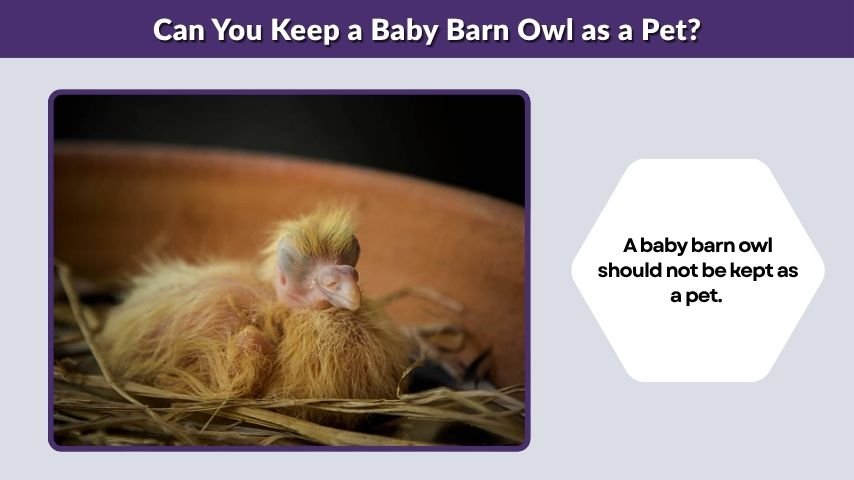
A baby barn owl should not be kept as a pet. Barn owls are wild birds of prey, not domestic animals. They need whole prey diets, flight space, expert handling, and proper permits in many countries.
Keeping one without training or permission can harm the bird and may be illegal. Even if a baby barn owl looks cute, it can become stressed around people and may not learn the survival skills needed for the wild.
Why Barn Owls Are Not Good Pets
Barn owls are nocturnal hunters. They are active at night, produce pellets, need specialist food, and can become stressed in small cages. They also have sharp talons and strong beaks.
A rescued owlet should always go to trained wildlife experts so it can recover and, if possible, return to the wild.
Baby Barn Owl Pictures and Identification Tips
Pictures of baby barn owls are helpful because their appearance changes a lot as they grow. A newly hatched chick looks very different from an older owlet that is almost ready to fly.
When identifying a baby barn owl, look for the pale down, long face, dark eyes, and developing heart-shaped facial disk. Also consider where it was found. A young owl found in a barn, nest box, roof cavity, or farm building may be a barn owl owlet.
Photo ID Checklist
- Is the bird pale or white and fluffy?
- Does it have a long, narrow face?
- Are the eyes dark?
- Is the face becoming heart-shaped?
- Was it found near a barn, nest box, or open field habitat?
- Does it hiss or make raspy sounds instead of hooting?
FAQs
What is a baby barn owl called?
A baby barn owl is commonly called an owlet. It may also be called a chick, nestling, or fledgling depending on its age and stage of development.
What does a baby barn owl sound like?
A baby barn owl may hiss, screech, click, or make rough begging calls. It does not usually make the classic hooting sound that many people expect from owls.
What do baby barn owls eat?
Baby barn owls eat small mammals brought by their parents, especially mice, voles, rats, and shrews. Very young owlets depend completely on adults for food.
Why do baby barn owls look scary?
Baby barn owls can look scary or alien-like because they have pale down, dark eyes, long faces, and awkward growing bodies. This is normal and changes as they mature.
What should I do if I find a baby barn owl on the ground?
Keep it safe from pets and people, do not feed it random food, and contact a licensed wildlife rehabilitator or local rescue center. If it is healthy, experts may advise returning it to the nest.
