
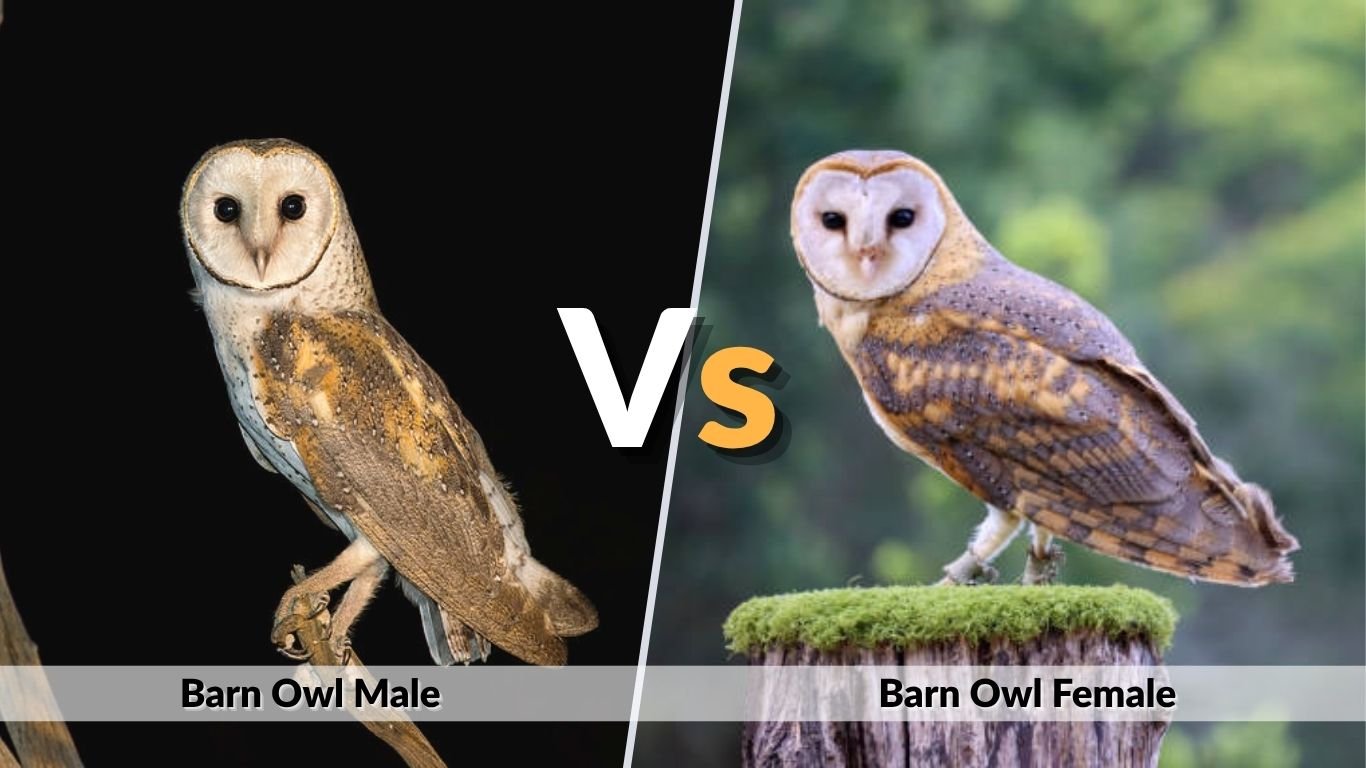
Telling a male barn owl from a female barn owl is possible, but it is not always easy. Unlike some birds, barn owls do not have bold male-and-female color differences. In general, male barn owls are usually paler, whiter underneath, and slightly smaller. Female barn owls are usually darker, more speckled, and slightly larger. However, plumage varies by individual and region, so size and color should be used as clues, not perfect proof.
Barn Owl Male vs Female: Quick Comparison
Male and female barn owls look very similar at first glance. The best clues are breast spots, body color, facial disc color, and size. Females are often darker and more spotted, while males are usually whiter with fewer markings.
| Feature | Male Barn Owl | Female Barn Owl |
| Size | Usually slightly smaller | Usually slightly larger |
| Underside | Often whiter or paler | Often buff, tan, or darker |
| Chest spots | Fewer or lighter spots | More and darker spots |
| Facial rim | Usually paler | Often darker brown rim |
| Throat | Often white | Often buff or brownish |
| Field ID difficulty | Hard unless seen clearly | Hard unless seen clearly |
| Nesting role | Brings food during early nesting | Incubates eggs and broods young |
The easiest visual clue is the underside. A very white barn owl with few chest spots is more likely to be male. A darker, warmer-colored barn owl with many black spots on the chest, flanks, or underwings is more likely to be female.
Male Barn Owl Identification
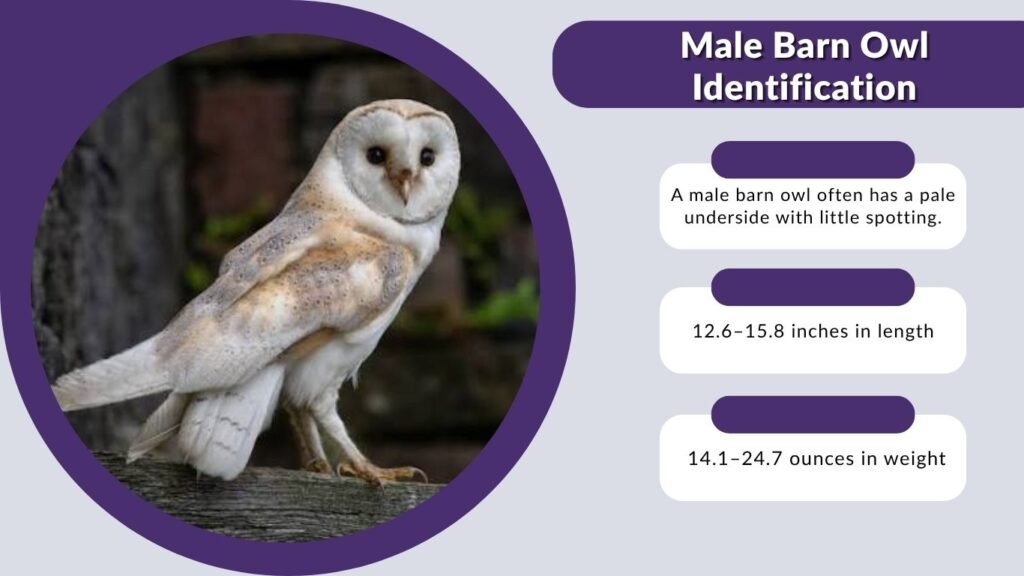
Male barn owls are usually paler than females. Many males have a white face, white throat, and mostly white underparts. Their chests may have fewer spots, and their overall appearance may look cleaner or brighter.
Male Barn Owl Color
A male barn owl often has a pale underside with little spotting. In some individuals, the breast and belly can look almost pure white. This is especially noticeable when a male is perched beside a darker female.
However, not every pale barn owl is male. Barn owls vary naturally from whitish to reddish-brown, and both sexes can show different plumage patterns. A pale female or a darker male is possible, so color alone is not always enough.
Male Barn Owl Size
Male barn owls are typically a little smaller than females. Cornell gives measurements for American Barn Owls as 12.6–15.8 inches in length, 14.1–24.7 ounces in weight, and 39.4–49.2 inches in wingspan for both sexes combined.
Animal Diversity Web reports that male barn owls may average around 470 grams, while females may average around 570 grams. This means females are often heavier, but the difference may be hard to judge in the field unless both birds are side by side.
Female Barn Owl Identification
Female barn owls are usually darker, warmer-toned, and more heavily marked than males. They often have more black spots on the chest, belly, flanks, and underwings.
Female Barn Owl Spots
Spots are one of the best clues for identifying a female barn owl. Females commonly have more and larger dark spots on their plumage, especially on the underside. Research on barn owl plumage notes that males are lighter on average, while females are more spotted, although both sexes can show different patterns.
If you see a barn owl with a buff chest, darker facial rim, and many small black speckles, it is more likely female. This clue is most useful when the owl is perched, photographed clearly, or seen in good light.
Female Barn Owl Size
Female barn owls are usually slightly larger and heavier than males. This is called reversed sexual size dimorphism, which means the female is larger than the male. The difference is real but not always obvious from a quick look.
Size is easier to compare when a pair is sitting together. If one bird looks larger, darker, and more speckled, that bird is often the female. If one bird looks smaller, whiter, and less spotted, that bird is often the male.
Barn Owl Male vs Female Size
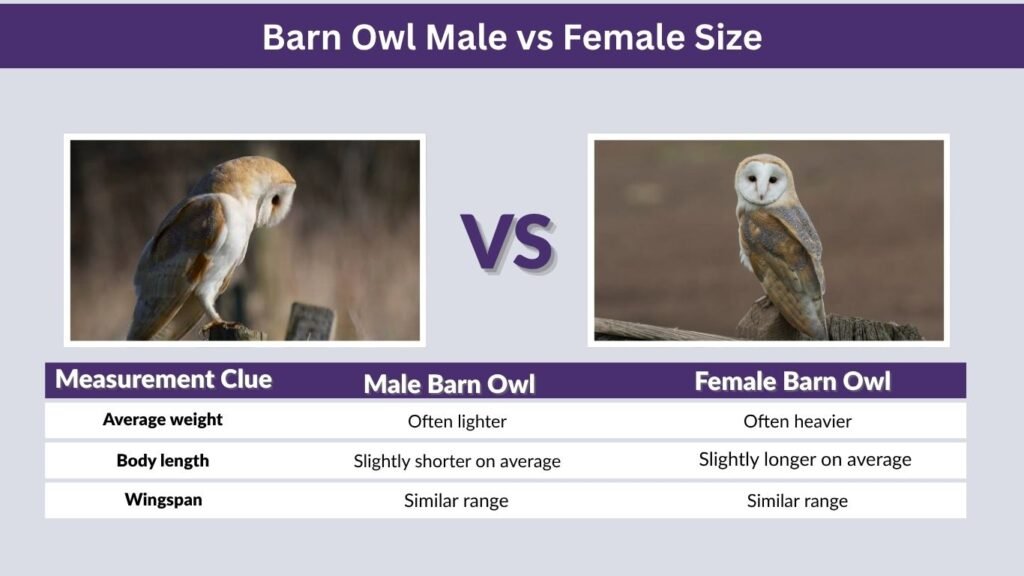
Barn owl male vs female size is one of the most searched questions, but size is not the easiest field mark. The difference is usually small, and posture can make one bird look larger or smaller than it really is.
| Measurement Clue | Male Barn Owl | Female Barn Owl |
| Average weight | Often lighter | Often heavier |
| Body length | Slightly shorter on average | Slightly longer on average |
| Wingspan | Similar range | Similar range |
| Field usefulness | Limited alone | Better with color clues |
| Best comparison | Side-by-side pair | Side-by-side pair |
A perched female may look broader or heavier, especially during breeding season. But a fluffed-up male in cold weather can look large too. For casual birdwatchers, plumage is usually more helpful than size.
Barn Owl Male vs Female Color
Color is often the best visible difference between male and female barn owls. Males are generally paler, and females are generally darker. The Barn Owl Trust says male barn owls are generally paler and females darker, but individuals can be very variable. In the UK, about 90% can usually be sexed by feather appearance.
Male Color Pattern
Male barn owls often show:
- Whiter underside
- Fewer black spots
- Paler facial rim
- White or pale throat
- Cleaner-looking chest
- Lighter overall appearance
Female Color Pattern
Female barn owls often show:
- Darker buff or tan underside
- More black spotting
- Darker facial disc rim
- Buff or brownish throat
- Heavier underwing markings
- More patterned appearance
These are general rules. A very dark male or pale female can still happen, especially across different barn owl populations.
Western Barn Owl Male vs Female
The phrase “western barn owl male vs female” usually refers to the Western Barn Owl, often treated as Tyto alba in Europe, Africa, and parts of Asia. The same basic sexing clues apply: males are often paler, while females are usually darker and more spotted.
However, regional variation matters. Some barn owl populations are naturally darker than others. The BTO notes that some individuals can look washed out, while others are darker and more strongly patterned; it also mentions that darker continental forms may appear in Britain.
So, when identifying a Western Barn Owl, compare the bird with local barn owl color patterns, not only with photos from another country.
Behavior Differences Between Male and Female Barn Owls
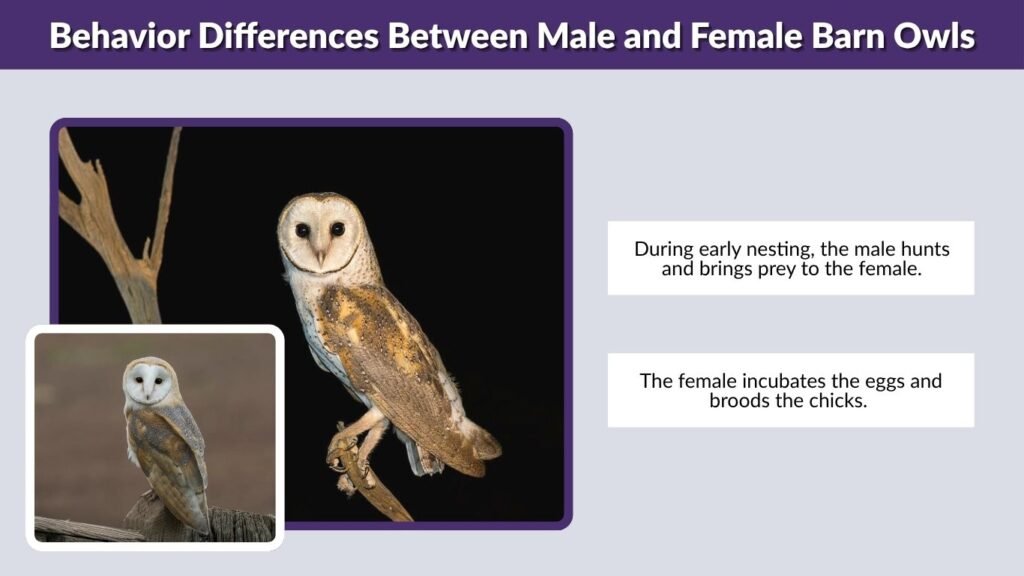
Male and female barn owls also have different roles during nesting. The female does all the incubation, while the male provides food until the young are around three weeks old. This is one of the clearest behavioral differences during breeding season.
Male Role During Nesting
During early nesting, the male hunts and brings prey to the female. He may deliver mice, voles, shrews, or other small animals to the nest. This feeding role is very important because the female stays with the eggs and young chicks.
Female Role During Nesting
The female incubates the eggs and broods the chicks. Barn owls begin incubation as soon as the first egg is laid, so the chicks hatch at different times. The age gap between the oldest and youngest nestlings can be as much as three weeks.
These nesting roles can help identify a pair if you are watching a nest box with care and from a safe distance.
Can You Tell Male and Female Barn Owls by Call?
Calls may help in some situations, but they are not the easiest way for beginners to separate male and female barn owls. Barn owls do not make the classic hooting sound of many owls. They often make harsh screeches, hisses, and other calls.
During breeding season, behavior around the nest is more useful than sound alone. A bird repeatedly bringing prey may be the male, while a bird staying inside the nest with eggs or young is likely the female.
Why Sexing Barn Owls Can Be Difficult
Sexing barn owls is not always exact because their plumage is variable. Research shows that barn owls can range from white to reddish-brown and may have many, few, or no black spots on the belly and chest.
Lighting can also confuse identification. A female may look pale in bright light, while a male may look darker in shadow. Wet feathers, age, feather wear, regional variation, and camera exposure can all change how the owl appears.
For the most accurate sexing, researchers may use close examination, measurements, breeding behavior, or genetic testing. For normal birdwatching, the best approach is to combine clues: size, color, spots, facial rim, and nesting behavior.
FAQs
How can you tell if a barn owl is male or female?
Look at the underside, chest spots, facial rim, and size. Males are usually paler and less spotted. Females are usually darker, more speckled, and slightly larger. However, appearance can vary, so these are clues rather than perfect rules.
Are female barn owls bigger than males?
Yes, female barn owls are usually slightly bigger and heavier than males. Some sources report females averaging around 570 grams and males around 470 grams, but size can overlap.
Are male barn owls white?
Male barn owls are often whiter than females, especially on the underside. Many males have almost pure white underparts with fewer spots, but not every white-looking barn owl is male.
Do female barn owls have more spots?
Yes, females usually have more and larger black spots on the chest, belly, flanks, or underwings. This is one of the best visual clues for identifying a female barn owl.
Is it easy to identify barn owl male vs female?
It can be difficult, especially from far away. Male and female barn owls look similar, and plumage varies. Identification is easiest when a male and female are side by side or when you can observe nesting behavior.
