
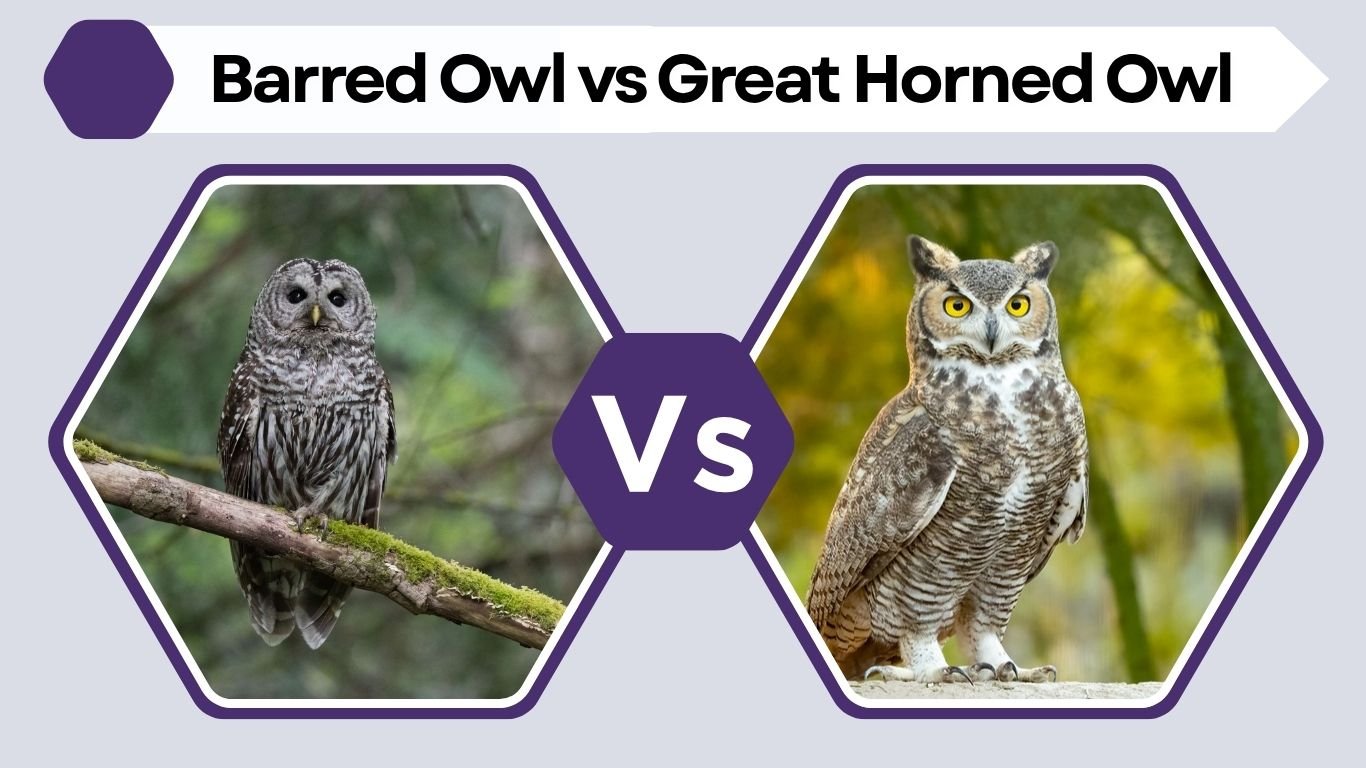
The barred owl and great horned owl are two of the most familiar large owls in North America, but they are easy to separate once you know what to look for. The barred owl has dark eyes, a rounded head, and a famous “Who cooks for you?” call. The great horned owl has large ear tufts, yellow eyes, a deeper hoot, and a much more powerful hunting style. Both are impressive nocturnal predators, but the great horned owl is usually larger, stronger, and more aggressive.
Barred Owl vs Great Horned Owl: Quick Comparison
Barred owls and great horned owls can live in overlapping areas, especially in wooded regions. However, they differ in head shape, eye color, voice, habitat preference, and hunting behavior. The great horned owl is more adaptable and predatory, while the barred owl is more closely tied to mature forests, wooded swamps, and areas near water.
| Feature | Barred Owl | Great Horned Owl |
|---|---|---|
| Scientific name | Strix varia | Bubo virginianus |
| Head shape | Round head, no ear tufts | Large head with ear tufts |
| Eye color | Dark brown to black | Yellow |
| Main call | “Who cooks for you?” rhythm | Deep, low hoots |
| Body pattern | Brown-and-white bars and streaks | Mottled brown-gray with white throat |
| Typical habitat | Old forests, wooded swamps | Forests, deserts, cities, grasslands |
| Hunting style | Quiet forest hunter | Powerful generalist predator |
| Strength | Strong owl | Stronger and more aggressive |
| Main prey | Small mammals, birds, frogs, reptiles | Mammals, birds, skunks, rabbits, raptors |
The easiest field marks are the eyes and head. A barred owl has dark eyes and no ear tufts. A great horned owl has yellow eyes and obvious feather tufts.
Barred Owl Identification
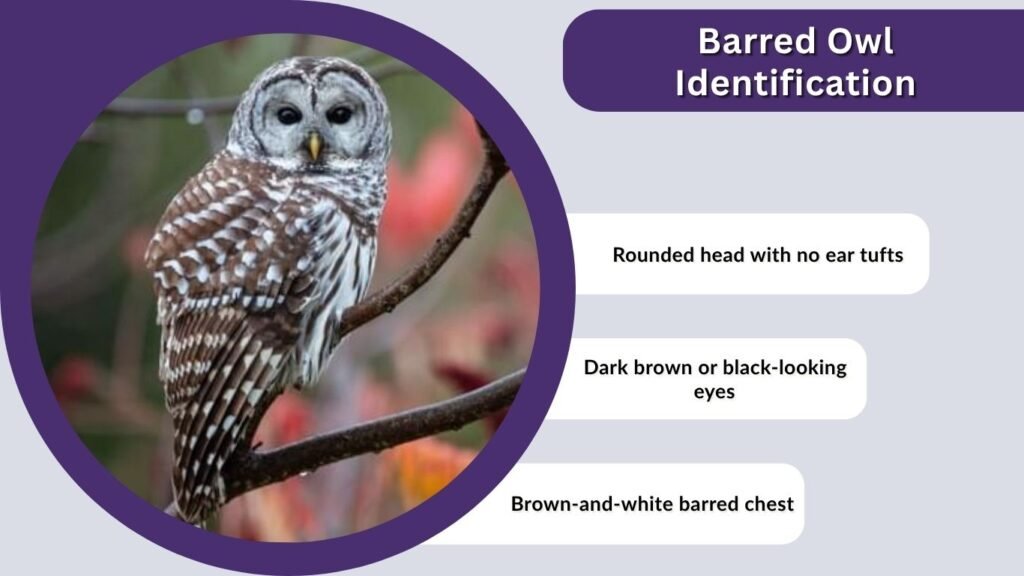
The barred owl is a large, round-headed owl with a soft, almost gentle appearance. It has no ear tufts, and its dark eyes make it look very different from many other North American owls. Its plumage is brown and white, with horizontal barring on the upper chest and vertical streaking on the belly. Audubon describes barred owls as large, round-headed owls with dark eyes and no ear tufts, marked with bars on the chest and streaks on the belly.
Key Identification Marks
- Rounded head with no ear tufts
- Dark brown or black-looking eyes
- Brown-and-white barred chest
- Vertical streaks on the belly
- Pale facial disk
- Large body but softer shape than a great horned owl
- Often seen in forests, wooded wetlands, and treed swamps
Barred owls often perch quietly during the day. Their camouflage helps them blend into tree bark and shaded forest branches.
Barred Owl Size
Barred owls are large, but they are usually smaller and lighter than great horned owls. Audubon lists the barred owl at about 17–20 inches long, with a wingspan of about 3 feet 3 inches to 3 feet 7 inches and a weight of about 16–37 ounces.
They may look bulky because of their feathers, but their body mass is generally less than that of a great horned owl.
Great Horned Owl Identification
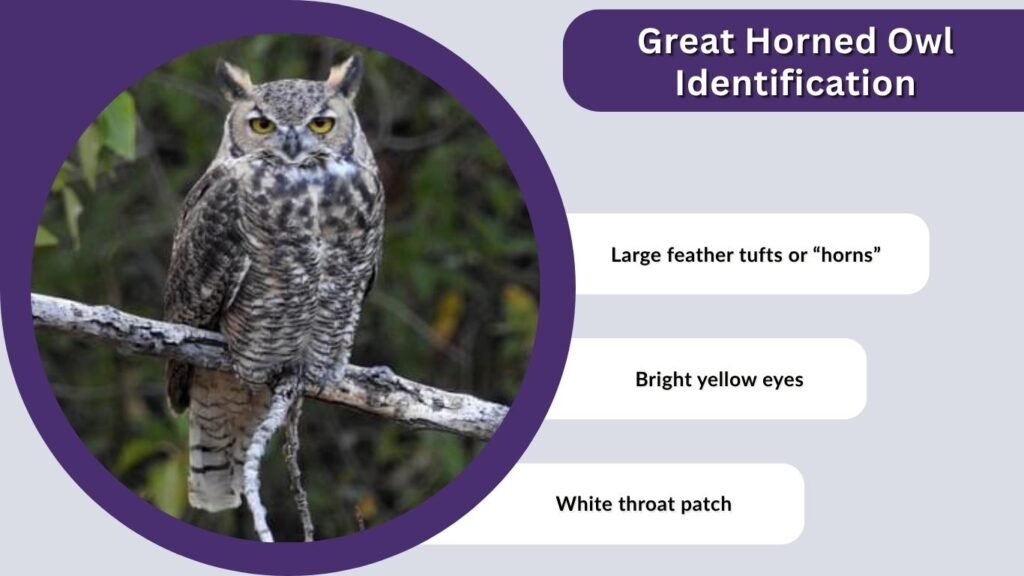
The great horned owl is one of the most powerful and widespread owls in the Americas. It has a bold, fierce look because of its large yellow eyes, heavy body, strong talons, and feather tufts that look like horns. These “horns” are not real horns or ears. They are feather tufts used in display and camouflage.
Key Identification Marks
- Large feather tufts or “horns”
- Bright yellow eyes
- White throat patch
- Mottled brown, gray, and rusty plumage
- Heavy body and large head
- Deep hooting call
- Strong talons and powerful build
Audubon describes the great horned owl as a large owl with conspicuous ear tufts, a white throat, and horizontal bars on the belly. Its listed size is 18–24 inches long, with a wingspan of 3 feet 4 inches to 4 feet 9 inches and a weight of 32–88 ounces.
Great Horned Owl Size
The great horned owl is usually bigger, heavier, and stronger than the barred owl. Some female great horned owls can be especially large. Like many birds of prey, females are usually larger than males.
This size advantage matters in direct encounters. A great horned owl can overpower many animals that a barred owl would avoid.
Barred Owl vs Great Horned Owl Size
The size difference is one of the most important comparison points. Both are large owls, but the great horned owl has more mass, a broader wingspan range, and stronger feet.
| Measurement | Barred Owl | Great Horned Owl |
|---|---|---|
| Length | 17–20 in | 18–24 in |
| Wingspan | 3 ft 3 in–3 ft 7 in | 3 ft 4 in–4 ft 9 in |
| Weight | 16–37 oz | 32–88 oz |
| Overall build | Large but rounded | Heavier and more powerful |
A big barred owl may overlap in length with a small great horned owl, but the great horned owl is usually heavier and more muscular.
Barred Owl vs Great Horned Owl Call
The call is often the easiest way to identify these owls at night. You may hear them long before you see them.
Barred Owl Call
The barred owl’s most famous call sounds like: “Who cooks for you? Who cooks for you-all?” Cornell Lab describes this call as a classic sound of old forests and treed swamps.
Barred owls also make other sounds, including cackles, hoots, screams, and monkey-like calls. Their vocal range can be surprisingly loud and strange, especially when a pair is calling together.
Great Horned Owl Call
The great horned owl has a deeper, lower, more powerful hoot. It is often written as a series of low notes, something like “hoo-h’HOO-hoo-hoo.” The sound is slower and heavier than the barred owl’s call.
The great horned owl’s call is less musical than the barred owl’s famous rhythm. It sounds more serious, deep, and resonant.
Barred Owl vs Great Horned Owl Habitat
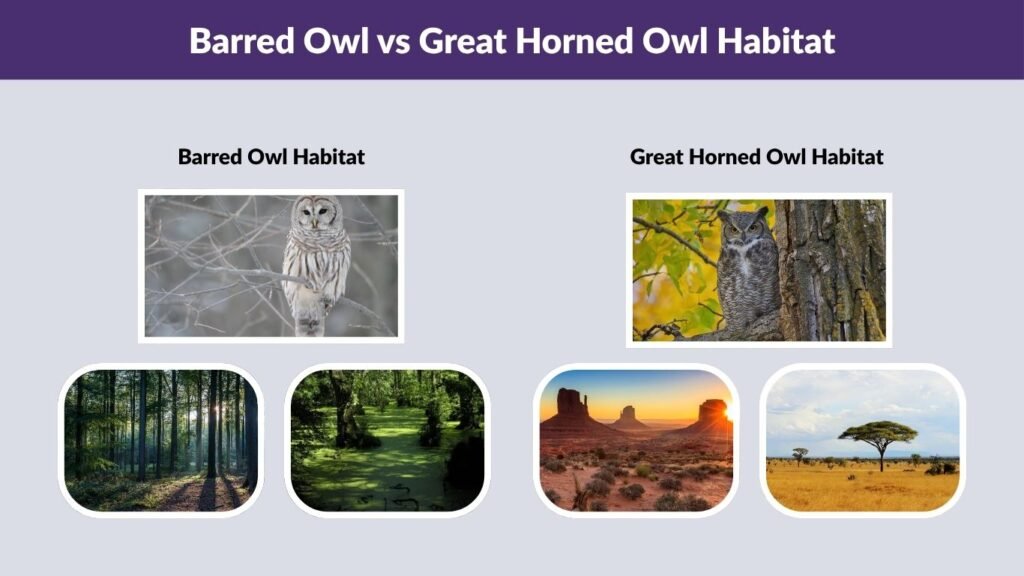
Barred owls and great horned owls both use wooded areas, but their habitat preferences are not exactly the same.
Barred Owl Habitat
Barred owls are strongly associated with mature forests, wooded swamps, bottomlands, and areas near water. They like dense tree cover, where they can perch quietly and hunt under the canopy. Cornell describes the barred owl’s call as a classic sound of old forests and treed swamps, which matches its strong woodland connection.
Barred owls are often found in eastern North America but have expanded into the Pacific Northwest and California.
Great Horned Owl Habitat
Great horned owls are extremely adaptable. They live in forests, deserts, wetlands, grasslands, suburbs, parks, farms, and cities. Audubon California notes that great horned owls can occupy many habitats, including woodlands, open grasslands, riparian areas, and urban environments.
This adaptability is one reason great horned owls are so successful.
Barred Owl vs Great Horned Owl Diet
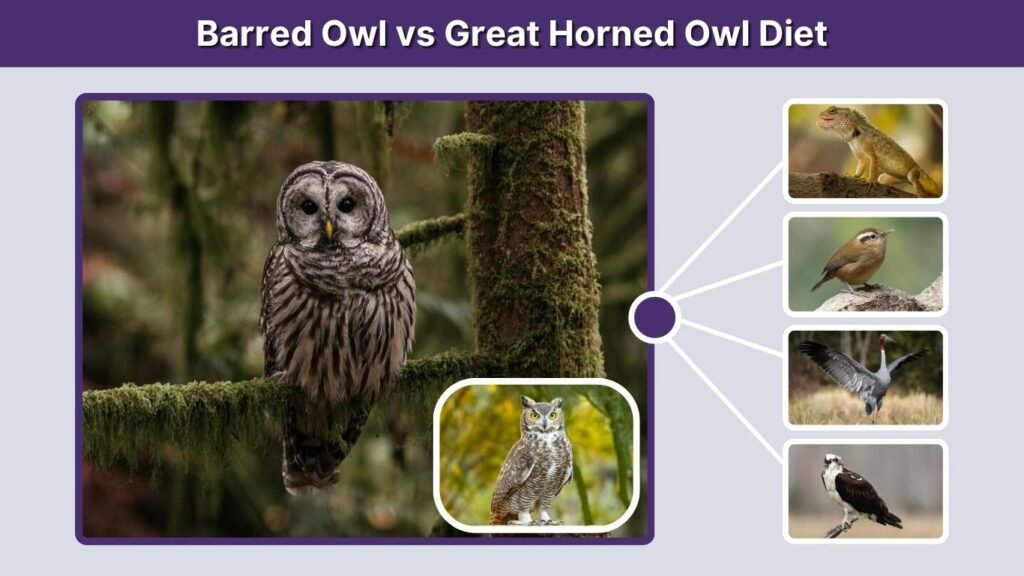
Both owls are carnivores, but the great horned owl has a broader and more powerful diet.
What Barred Owls Eat
Barred owls eat small mammals, birds, amphibians, reptiles, fish, and invertebrates. They commonly hunt mice, voles, squirrels, frogs, snakes, small birds, crayfish, and insects. They usually hunt from a perch, dropping down silently when prey moves below.
Barred owls are skilled forest hunters, but they usually take smaller prey than great horned owls.
What Great Horned Owls Eat
Great horned owls are among the most powerful owl predators in North America. Cornell says they have the most diverse diet of all North American raptors, with prey ranging from small rodents and scorpions to hares, skunks, geese, and raptors.
They can also take large birds, including ospreys, peregrine falcons, prairie falcons, and other owls. Cornell also notes that their clenched talons require 28 pounds of force to open.
Do Great Horned Owls Eat Barred Owls?
Yes, great horned owls can prey on barred owls. This is one of the most important differences between the two species. The barred owl is a large predator, but the great horned owl is even more powerful and can be a threat to other raptors.
Great horned owls may kill barred owls because of food, territory, or predator competition. A barred owl may avoid an area if a great horned owl is nearby.
This does not mean great horned owls hunt barred owls every day. However, when the two overlap, the barred owl is usually the more vulnerable species.
Great Horned Owl vs Barred Owl: Who Would Win?
In a direct fight, a great horned owl would usually have the advantage. It is generally heavier, stronger, more aggressive, and equipped with extremely powerful talons. A barred owl is not weak, but it is not built like a great horned owl.
The great horned owl’s advantages include:
- Larger body size
- Heavier weight
- Stronger feet and talons
- More aggressive hunting behavior
- Ability to kill other raptors
- More flexible diet and habitat use
In nature, animals usually avoid unnecessary fights. A barred owl would likely try to avoid a serious conflict rather than battle a great horned owl.
Great Horned Owl Male vs Female
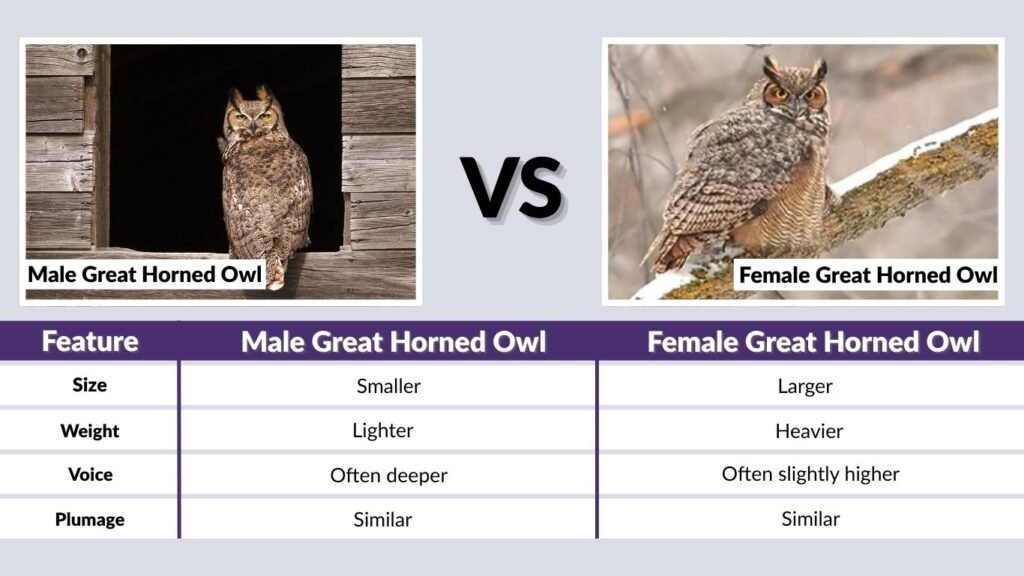
Many people also search for great horned owl male vs female because males and females look similar. The main difference is size and voice.
Female great horned owls are usually larger than males. Males are usually smaller but may have a deeper voice. In many owl species, the female is heavier because she needs more body mass for egg production and nesting.
Male vs Female Great Horned Owl Differences
| Feature | Male Great Horned Owl | Female Great Horned Owl |
|---|---|---|
| Size | Smaller | Larger |
| Weight | Lighter | Heavier |
| Voice | Often deeper | Often slightly higher |
| Plumage | Similar | Similar |
| Role | Hunts and defends territory | Incubates eggs and broods young |
You usually cannot identify male vs female great horned owls from color alone.
Great Horned Owl vs Other Owls and Raptors
The keyword list also includes many related searches about great horned owls compared with other birds. Here is a short overview.
Great Horned Owl vs Barn Owl
A barn owl has a white, heart-shaped face and a slimmer body. A great horned owl is larger, darker, stronger, and has ear tufts. Barn owls mainly hunt small rodents, while great horned owls can take much larger prey.
Great Horned Owl vs Long-Eared Owl
Long-eared owls also have ear tufts, but they are slimmer and smaller. Great horned owls are heavier, broader, and more powerful. Long-eared owls look more delicate and usually hunt smaller prey.
Great Horned Owl vs Eurasian Eagle-Owl
The Eurasian eagle-owl is generally larger than the great horned owl. Both are powerful Bubo owls with ear tufts and orange-yellow eyes. The eagle-owl is found across parts of Europe and Asia, while the great horned owl is native to the Americas.
Great Horned Owl vs Bald Eagle
A bald eagle is much larger in wingspan and is active during the day, while the great horned owl is mostly nocturnal. In a direct conflict, the outcome would depend on size, surprise, and location. Great horned owls may attack nests at night, but bald eagles are much bigger overall.
Barred Owl vs Great Horned Owl Feather
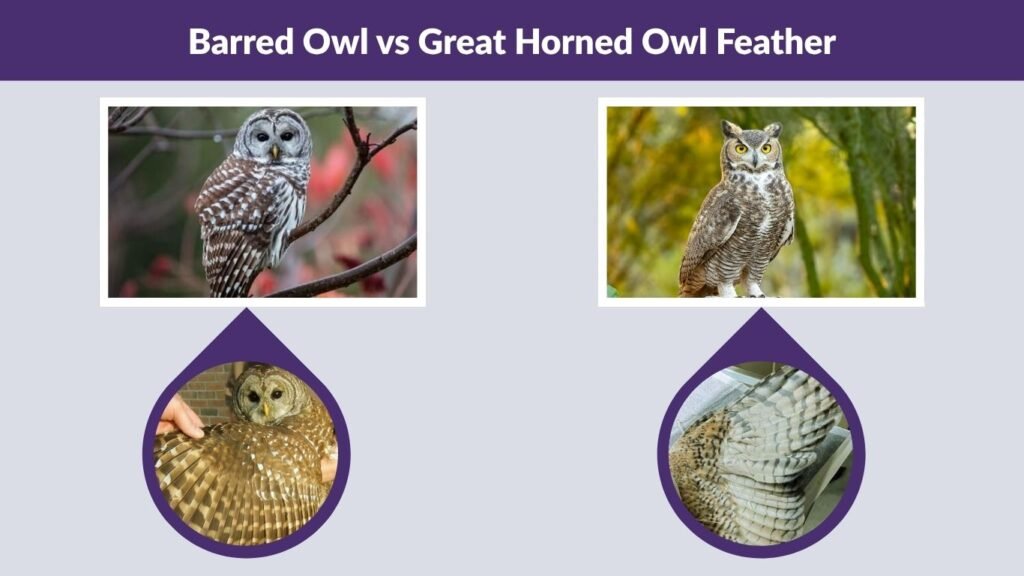
Barred owl feathers and great horned owl feathers can look similar because both are brownish and patterned for camouflage. However, barred owl feathers often show cleaner brown-and-white barring, while great horned owl feathers can appear more mottled, gray-brown, rusty, or heavily marked.
You should not collect owl feathers in many countries, including the United States, because native bird feathers are often legally protected. A photo is safer than keeping a feather.
How to Identify Them in the Wild
If you see or hear a large owl, focus on four things: head shape, eye color, call, and habitat.
Field Identification Checklist
- Ear tufts present? Great horned owl
- No ear tufts and round head? Barred owl
- Yellow eyes? Great horned owl
- Dark eyes? Barred owl
- “Who cooks for you?” call? Barred owl
- Deep, low hoots? Great horned owl
- Dense swampy forest? Often barred owl
- Open, urban, desert, or mixed habitat? Often great horned owl
These clues are usually enough for a strong identification.
FAQs
Is a barred owl bigger than a great horned owl?
No, the great horned owl is usually bigger and heavier than the barred owl. A barred owl is still a large owl, but the great horned owl has a stronger body, wider wingspan range, and more powerful talons.
How can you tell a barred owl from a great horned owl?
Look at the head and eyes. A barred owl has a round head with no ear tufts and dark eyes. A great horned owl has obvious feather tufts, yellow eyes, a white throat patch, and a heavier body.
Do great horned owls eat barred owls?
Yes, great horned owls can prey on barred owls. They are powerful predators that sometimes kill other raptors and owls. Barred owls may avoid areas where great horned owls are active.
What is the difference between a barred owl call and a great horned owl call?
A barred owl gives the famous “Who cooks for you? Who cooks for you-all?” call. A great horned owl gives deeper, slower, lower hoots. The barred owl sounds more rhythmic, while the great horned owl sounds deeper and heavier.
Who would win, barred owl or great horned owl?
A great horned owl would usually win because it is heavier, stronger, and more aggressive. Barred owls are capable predators, but great horned owls have stronger talons and are known to attack other large birds and owls.
