
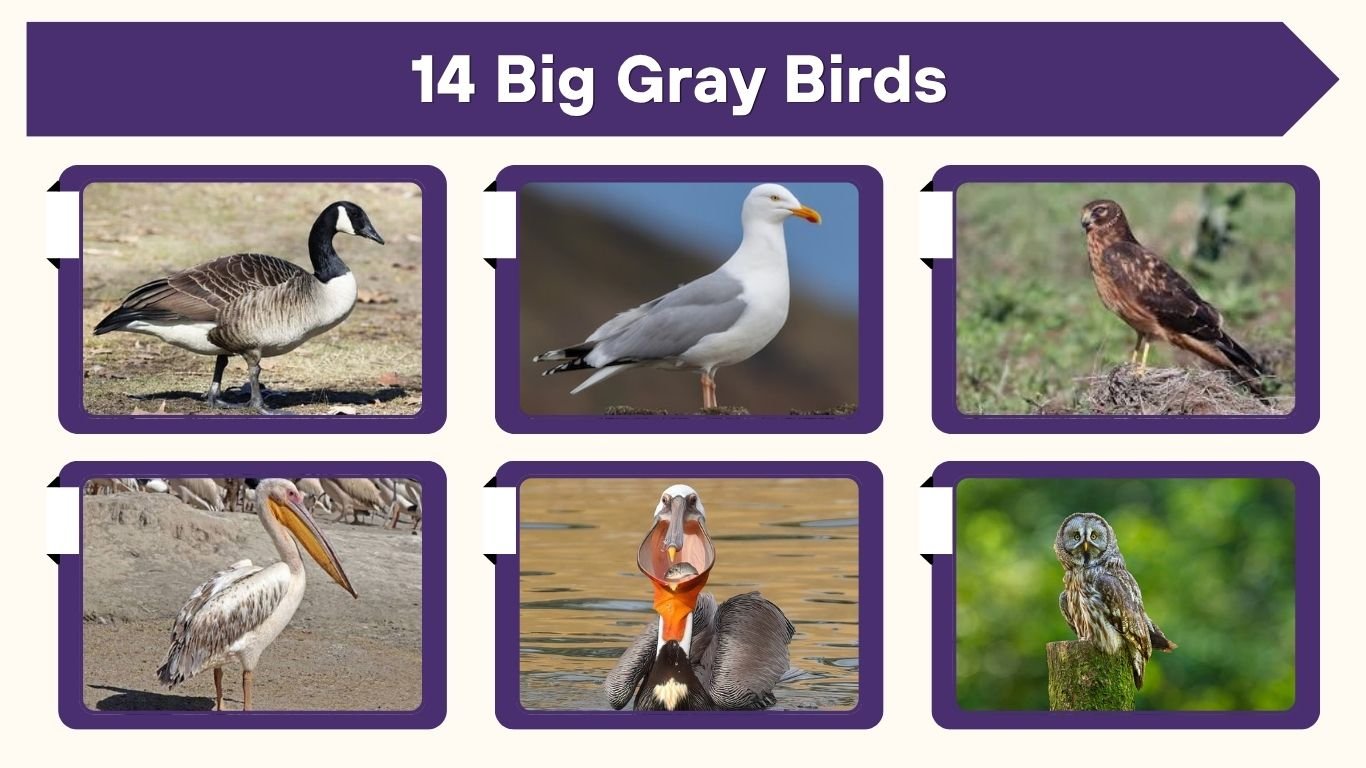
Big gray birds come in many shapes, from long-legged water birds to powerful raptors and heavy-bodied ground birds. Some have long beaks, white heads, red faces, or broad gray-and-white wings. Species such as the Great Blue Heron, Sandhill Crane, and Brown Pelican are particularly noticeable in Florida and other parts of North America. This guide explores 14 big gray birds, including their appearance, size, habitat, diet, and identifying features.
1. Great Blue Heron
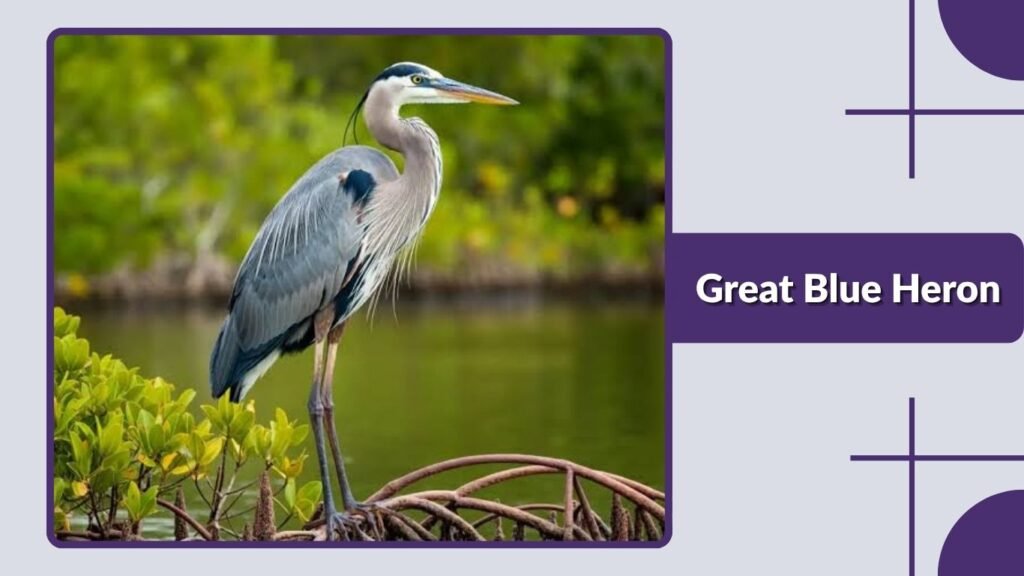
The Great Blue Heron is a big gray water bird commonly found across North America. Its long legs, extended neck, and dagger-shaped bill make it easy to recognize around lakes, rivers, marshes, and coastlines. It is especially common in Florida, Georgia, Ohio, Michigan, and other states with abundant wetlands.
Identification
- Blue-gray body feathers
- Long, pointed yellowish beak
- White face with a black stripe above the eye
- Extremely long legs and an S-shaped neck
- Broad wings with dark flight feathers
Size and Appearance
A Great Blue Heron can stand around 3–4.5 feet tall and have a wingspan approaching 6.5 feet. This big gray bird with a long beak and long legs may appear knee-high to an adult person. Despite its large appearance, it usually weighs only 4–6 pounds.
Habitat and Distribution
Great Blue Herons inhabit freshwater and saltwater environments, including ponds, swamps, rivers, mangroves, and coastal shores. They are frequently seen as big gray birds in Florida, Michigan, Minnesota, Ohio, Tennessee, and Wisconsin.
Diet and Behavior
Great Blue Herons primarily eat fish but also capture frogs, snakes, crayfish, insects, and small mammals. They often stand motionless in shallow water before striking prey with their powerful beaks. In flight, they pull their necks into a tight S-shape.
2. Sandhill Crane
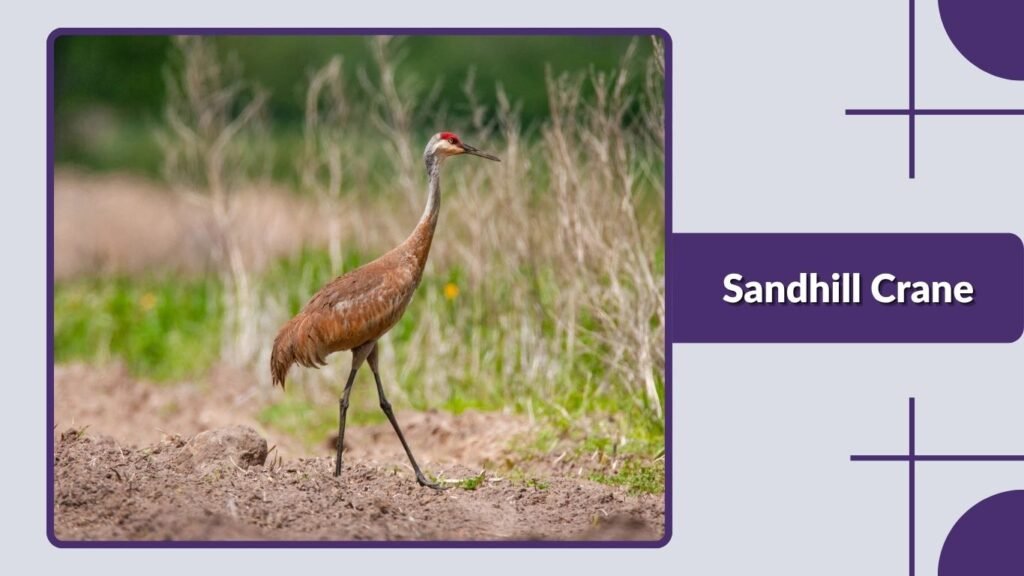
The Sandhill Crane is a tall, lanky, gray bird known for its loud, rolling call and energetic courtship dance. It is frequently observed in open wetlands, grasslands, agricultural fields, and residential areas. These big gray birds are particularly familiar sights in Florida and parts of the central United States.
Identification
- Gray body with long legs and neck
- Distinctive red patch on the forehead
- Straight, pointed, dark-colored beak
- Rust-colored staining sometimes visible on the feathers
- Bushy feathers covering the upper tail
Size and Appearance
Sandhill Cranes generally stand 3–4 feet tall and have wingspans of 5–7 feet. Someone searching for a big gray bird with a red head or a big gray bird about knee-high may be describing this species. Adults usually weigh between 7 and 14 pounds.
Habitat and Distribution
These cranes live around freshwater marshes, wet meadows, prairies, and grain fields. They occur in Florida, Georgia, Michigan, Minnesota, Wisconsin, Wyoming, and many western and central states. Some populations migrate long distances, while Florida Sandhill Cranes remain year-round residents.
Diet and Behavior
Sandhill Cranes eat seeds, grains, berries, insects, frogs, snakes, and small mammals. They frequently forage in pairs or family groups. Their elaborate dances include bowing, jumping, wing flapping, and tossing vegetation into the air.
3. Great Gray Owl
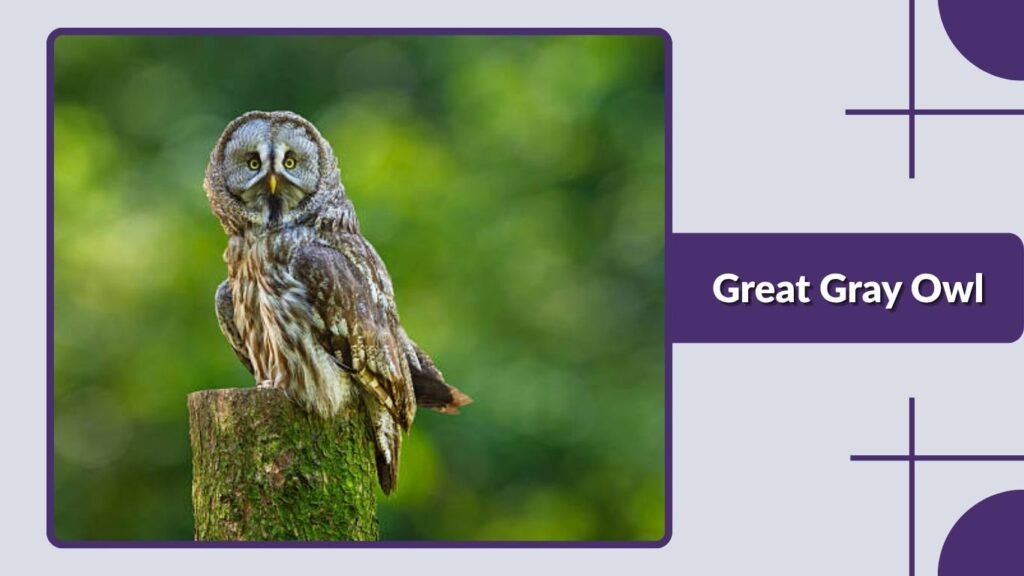
The Great Gray Owl is a large gray bird with a rounded head, broad wings, and a remarkably long tail. Although it appears massive, much of its size comes from thick feathers. Its oversized facial discs and intense yellow eyes give it one of the most distinctive appearances among North American owls.
Identification
- Silvery-gray plumage with darker streaks
- Huge, rounded facial discs
- Bright yellow eyes
- White bow-tie-shaped marking below the bill
- Long tail and broad, rounded wings
Size and Appearance
The Great Gray Owl can measure 24–33 inches long and have a wingspan of up to 5 feet. Females are typically larger than males. This gray bird with big eyes looks powerful, but it usually weighs only 2–4 pounds and is lighter than several smaller-looking owl species.
Habitat and Distribution
Great Gray Owls inhabit northern coniferous forests, wooded bogs, and meadows. In the United States, they may be found in Minnesota, Wyoming, Montana, Idaho, California, and parts of the Pacific Northwest. They prefer forests located near open hunting grounds.
Diet and Behavior
Small mammals make up most of the owl’s diet, particularly voles, mice, shrews, and pocket gophers. Its excellent hearing allows it to detect prey moving beneath deep snow. It can plunge through the snow’s surface and seize hidden animals with its sharp talons.
4. Shoebill
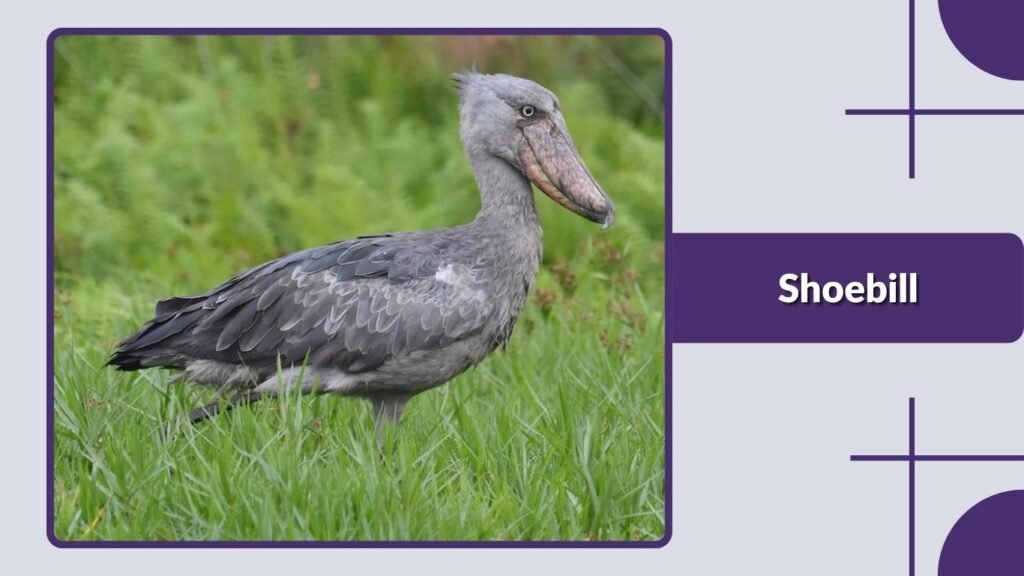
The Shoebill is a huge blue-gray bird famous for its oversized, shoe-shaped beak. Its prehistoric appearance, long legs, and motionless hunting style make it unlike almost any other bird. Shoebills are native to tropical East Africa and inhabit remote freshwater swamps with dense floating vegetation.
Identification
- Blue-gray body feathers
- Enormous shoe-shaped bill
- Pale yellow or grayish eyes
- Long, dark legs
- Small feathered crest on the back of the head
Size and Appearance
A Shoebill typically stands 3.5–5 feet tall and has a wingspan of approximately 7.5–8.5 feet. It can weigh between 9 and 15 pounds. Its massive bill may measure about 9 inches long, making it an obvious answer when identifying a big gray bird with a big beak.
Habitat and Distribution
Shoebills live in freshwater swamps and marshes across countries such as Uganda, Zambia, South Sudan, and the Democratic Republic of the Congo. They favor wetlands containing papyrus, reeds, and floating vegetation, where fish can reach oxygen-rich water near the surface.
Diet and Behavior
Shoebills primarily hunt lungfish, catfish, and tilapia. They may also eat frogs, water snakes, turtles, and young crocodiles. The bird waits silently before lunging forward and grabbing prey with its powerful hooked beak.
5. Wood Stork
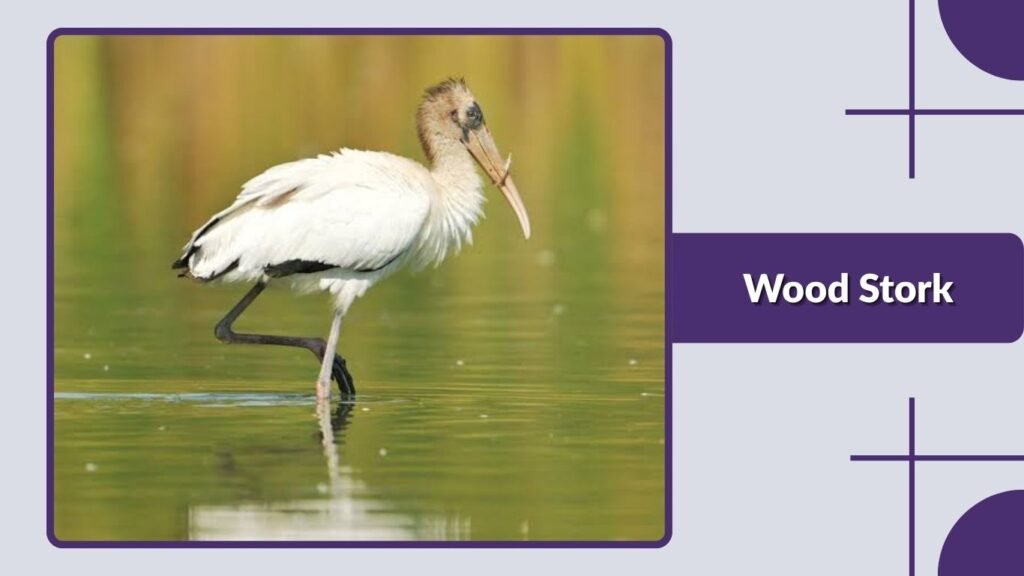
The Wood Stork is a large white, black, and gray water bird found mainly in wetlands of the southeastern United States. Its featherless head and heavy beak give it an unusual appearance. People who notice a big gray bird with no feathers on its head in Florida may have seen a Wood Stork.
Identification
- White body with black flight feathers
- Dark gray, featherless head and neck
- Long, thick, downward-curved beak
- Long blackish legs
- Broad wings with a black trailing edge
Size and Appearance
Adult Wood Storks stand approximately 33–45 inches tall and have wingspans reaching 5–5.5 feet. They typically weigh 5–7 pounds. Young birds have yellowish bills and partially feathered heads, while adults develop darker, rough-looking bare skin.
Habitat and Distribution
Wood Storks inhabit swamps, marshes, mangroves, ponds, and flooded forests. They are particularly common in Florida but also occur in Georgia, South Carolina, Mississippi, and other Gulf Coast areas. They often gather near shallow water where fish become concentrated.
Diet and Behavior
Wood Storks mainly eat small fish, although they also consume frogs, crayfish, insects, and other aquatic animals. They hunt by holding an open bill underwater and snapping it shut when prey touches it. Groups often nest together in trees above wetlands.
6. Brown Pelican
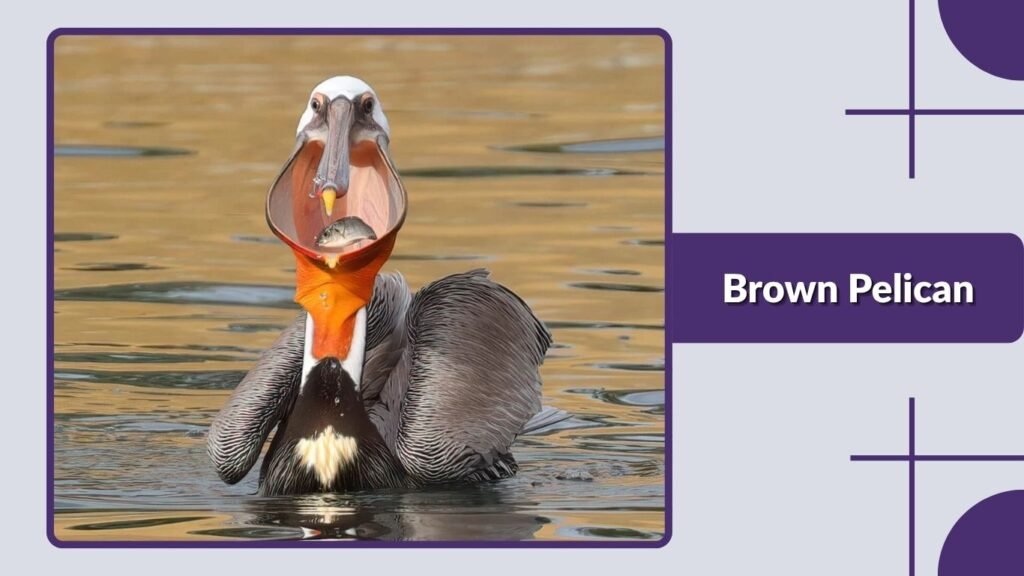
The Brown Pelican is a big gray and brown coastal bird with a remarkably long beak and expandable throat pouch. It is frequently seen around Florida’s beaches, docks, bays, and fishing piers. Its habit of diving headfirst into the water makes it especially easy to recognize.
Identification
- Gray-brown body and broad wings
- Large bill with an expandable throat pouch
- White or yellowish head in adults
- Dark belly and short legs
- Long neck often folded into an S-shape
Size and Appearance
Brown Pelicans measure around 39–54 inches long and have wingspans of approximately 6.5–7.5 feet. Adults generally weigh 4.5–11 pounds. This large gray bird with a big beak may appear bulky when resting but looks graceful while gliding over the ocean.
Habitat and Distribution
Brown Pelicans inhabit warm coastal environments throughout the Americas. In the United States, they are commonly found in Florida, Georgia, Texas, Louisiana, Mississippi, and along the Pacific Coast. They use beaches, estuaries, mangroves, islands, and sheltered bays.
Diet and Behavior
Fish make up most of the Brown Pelican’s diet. It spots prey from the air before plunging into the water and capturing fish in its throat pouch. Brown Pelicans also follow fishing boats and sometimes gather near piers in search of discarded catch.
7. American White Pelican
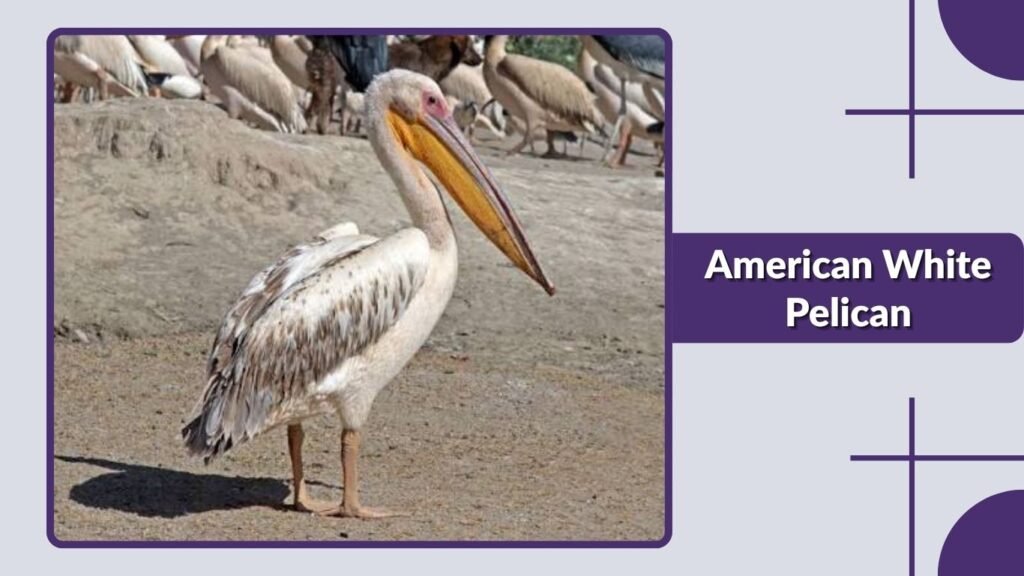
The American White Pelican is one of North America’s largest water birds. It has a massive orange beak, white plumage, and black flight feathers. Juveniles may look grayer than adults, so they can sometimes be described as big white and gray birds near lakes, rivers, or coastal wetlands.
Identification
- Mostly white body
- Large orange or yellowish-orange bill
- Expandable throat pouch
- Black flight feathers visible in flight
- Short orange legs and webbed feet
Size and Appearance
American White Pelicans measure approximately 50–65 inches long and may have wingspans reaching 9 feet. They commonly weigh 10–20 pounds. Unlike Brown Pelicans, they rarely dive from the air. Their enormous size and broad wings are impressive when they soar overhead.
Habitat and Distribution
These pelicans breed around shallow inland lakes and wetlands in western and central North America. During winter, many migrate to Florida, Texas, Mississippi, California, and the Gulf Coast. They may also rest on sandbars, islands, reservoirs, and quiet shorelines.
Diet and Behavior
American White Pelicans mainly eat small fish, crayfish, and salamanders. They often hunt cooperatively, swimming together in a curved formation to drive fish into shallow water. They then scoop up the concentrated prey using their large bills and throat pouches.
8. Limpkin
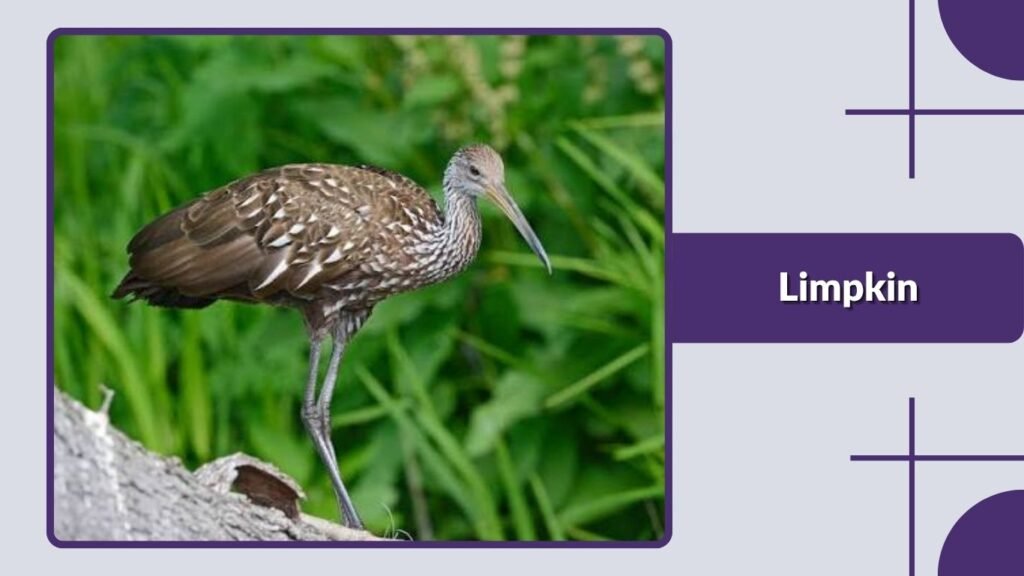
The Limpkin is a large, lanky wetland bird with a grayish-brown body and numerous white markings. It is best known for its loud, haunting calls, which are frequently heard at night. This species is especially common in Florida’s freshwater marshes, lakes, canals, and wooded swamps.
Identification
- Gray-brown or chocolate-brown plumage
- White streaks and spots across the body
- Long neck and legs
- Long, slightly curved yellowish bill
- Broad wings and a relatively short tail
Size and Appearance
A Limpkin measures around 25–29 inches long and has a wingspan of roughly 40–42 inches. It weighs about 2–3 pounds. Its long neck, slender body, and rusty gray pattern can make it look like a smaller crane or an unusually large rail.
Habitat and Distribution
In the United States, Limpkins are most closely associated with Florida, although individuals increasingly appear in Georgia and other southeastern states. They inhabit freshwater marshes, forested swamps, lake margins, canals, and slow-moving rivers where aquatic snails are plentiful.
Diet and Behavior
Limpkins primarily eat apple snails, using their curved bills to remove the soft bodies from their shells. They also consume mussels, crayfish, frogs, insects, and small reptiles. Limpkins usually walk slowly through shallow water while searching among aquatic plants for food.
9. California Condor
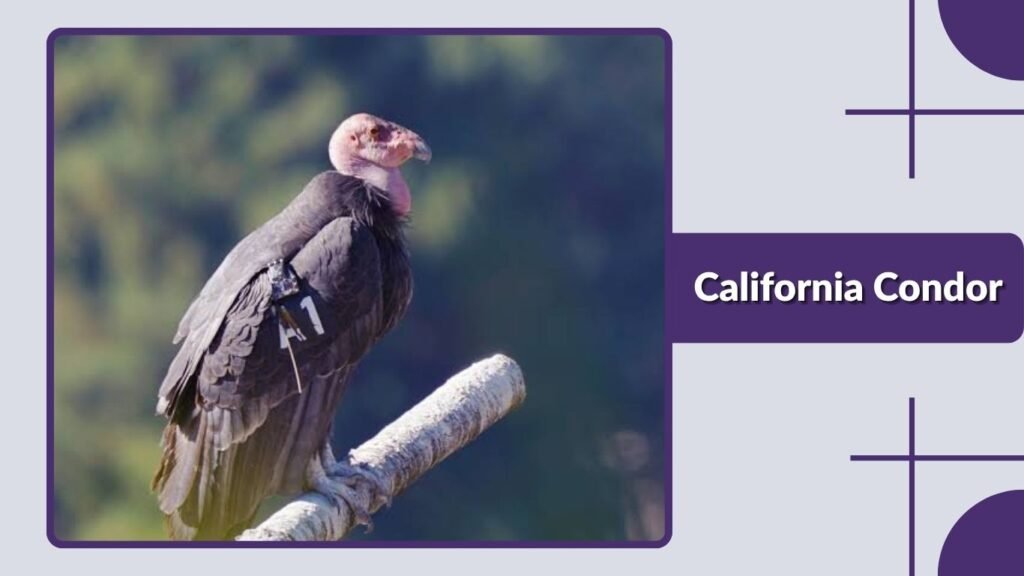
The California Condor is an enormous dark gray and black bird with a featherless head and broad wings. It is the largest flying land bird in North America. Although adults are mostly black, their pale wing patches and grayish body tones may cause distant observers to describe them as big gray birds.
Identification
- Mostly black or dark gray plumage
- Bare orange, pink, or reddish head
- Large pale patches beneath the wings
- Heavy hooked beak
- Extremely broad wings with finger-like tips
Size and Appearance
California Condors measure approximately 44–55 inches long and have wingspans reaching 9–10 feet. Adults commonly weigh 17–25 pounds. A person searching for a big gray bird with an orange head or a big black bird with a gray face may be describing a condor.
Habitat and Distribution
California Condors inhabit rocky mountains, deep canyons, shrublands, and open grasslands. Wild populations occur in California, Arizona, Utah, and Baja California. They roost and nest on high cliffs or in caves that provide protection and easy access to rising air currents.
Diet and Behavior
California Condors are scavengers that feed on the carcasses of deer, cattle, marine mammals, and other large animals. They use their excellent eyesight to locate food while soaring. Their bare heads help them remain cleaner when feeding inside animal carcasses.
10. Wild Turkey
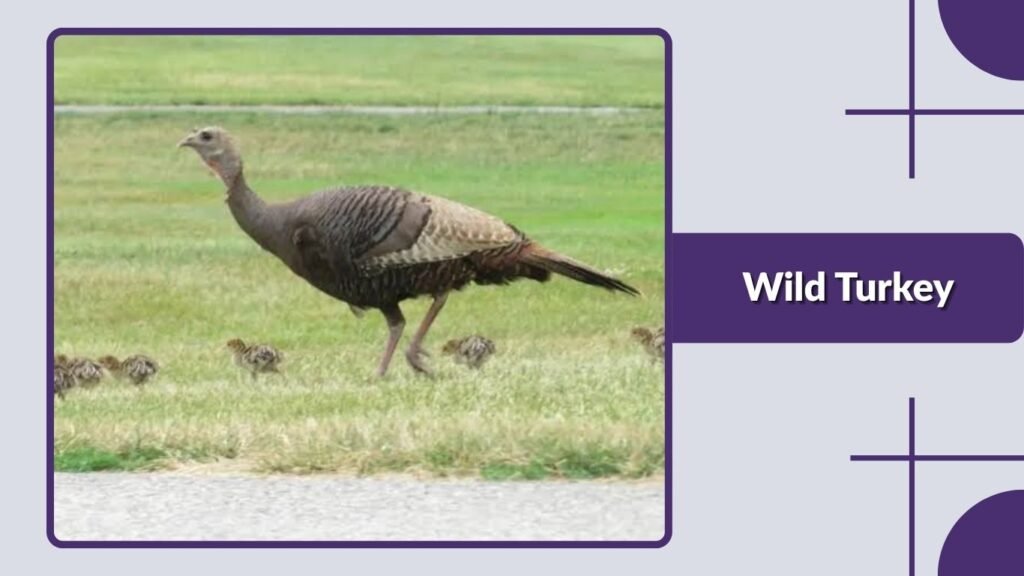
The Wild Turkey is a large, heavy-bodied bird native to North America. Females and young birds often appear gray-brown, while adult males have darker, iridescent feathers and brightly colored bare heads. A big gray bird with a red head seen walking through fields or woodland may be a Wild Turkey.
Identification
- Large, rounded gray-brown or dark body
- Small, featherless red or bluish head
- Long, powerful legs
- Broad, fan-shaped tail
- Iridescent feathers on adult males
Size and Appearance
Wild Turkeys measure approximately 36–48 inches long. Large males can weigh more than 20 pounds, while females are smaller and usually weigh 8–12 pounds. Their broad bodies sometimes lead people to describe them as big, fat gray birds or gray birds as big as chickens.
Habitat and Distribution
Wild Turkeys inhabit forests, open woodlands, agricultural fields, and suburban areas. They are widespread across Ohio, Michigan, Minnesota, Tennessee, Georgia, Kansas, Oklahoma, and many other states. They need trees for nighttime roosting and open ground for feeding.
Diet and Behavior
Wild Turkeys eat acorns, seeds, berries, grasses, insects, and small reptiles. They usually search for food by scratching through leaves. Although they spend much of their time walking, they can fly quickly for short distances, especially when escaping danger or reaching a roost.
11. Gray Hawk
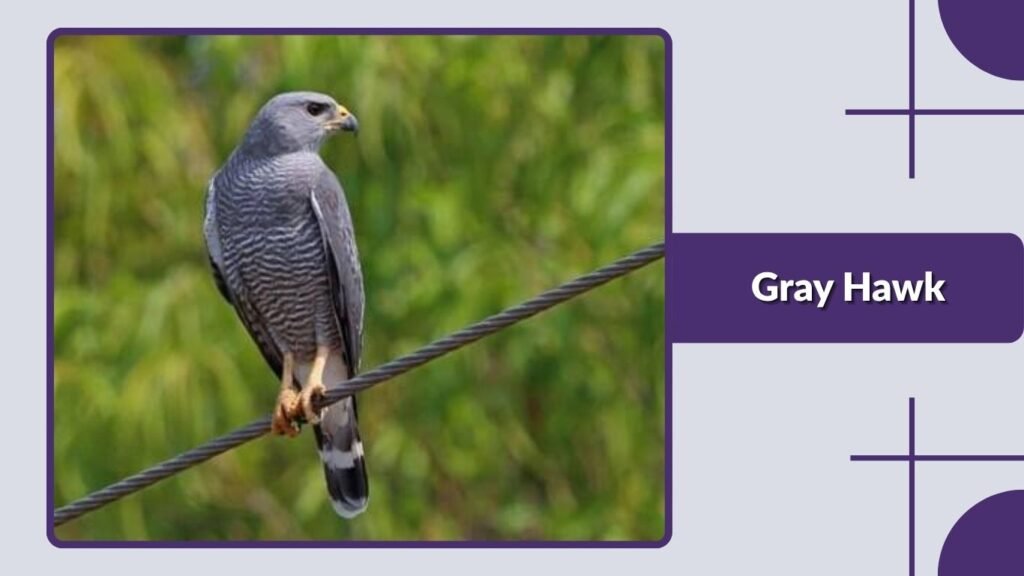
The Gray Hawk is a medium-sized blue-gray bird of prey with broad wings and a long, striped tail. Its size, hooked beak, and hunting behavior may cause observers to describe it as a bird that is blue-gray and big like a hawk—which is precisely what it is.
Identification
- Pale gray body in adults
- Fine gray-and-white barring underneath
- Long black tail with white bands
- Yellow legs and eyes
- Short, strongly hooked beak
Size and Appearance
Adult Gray Hawks measure around 18–24 inches long and have wingspans of approximately 35–40 inches. Females are generally larger than males. Juveniles look different from adults, displaying brown upperparts and heavily streaked cream-colored underparts.
Habitat and Distribution
In the United States, Gray Hawks are primarily found in southern Arizona, New Mexico, and Texas. They inhabit riverside woodlands, mesquite forests, thorny scrub, and areas containing cottonwood or willow trees. Their wider range extends through Mexico and Central America.
Diet and Behavior
Gray Hawks primarily hunt lizards, but they also capture snakes, rodents, frogs, and small birds. They often watch for prey from an exposed branch before dropping quickly toward the ground. Their rounded wings allow them to maneuver effectively through woodland habitats.
12. Northern Harrier
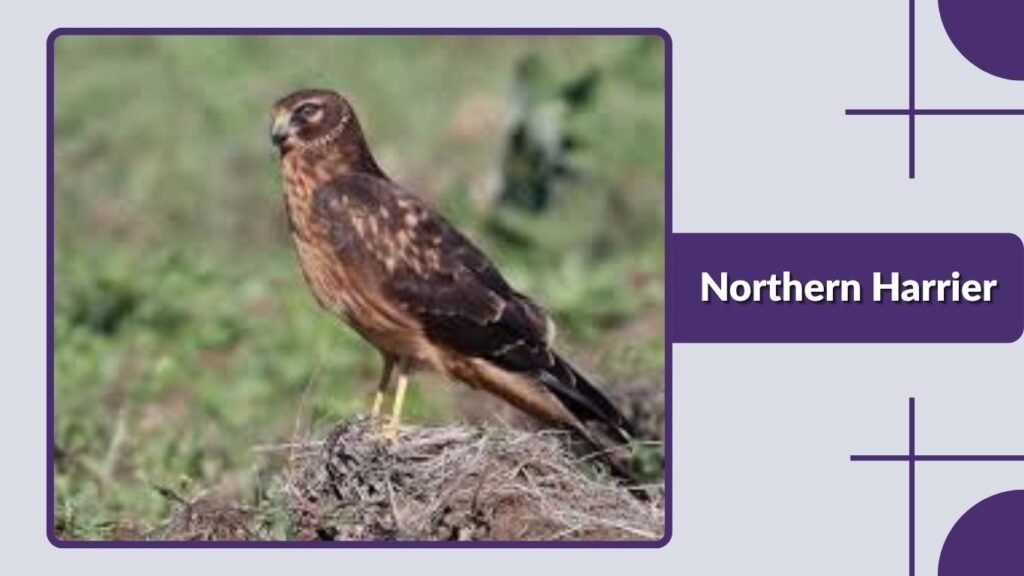
The Northern Harrier is a slender hawk that flies low over marshes, grasslands, and agricultural fields. Adult males are mostly pale gray, while females and young birds are brown. Its long wings, narrow body, and owl-like face distinguish it from most other North American hawks.
Identification
- Pale blue-gray plumage on adult males
- White rump patch visible during flight
- Long, narrow wings
- Long tail with dark bands
- Owl-like facial disc
Size and Appearance
Northern Harriers measure approximately 18–20 inches long and have wingspans of 38–48 inches. Females are noticeably larger and heavier than males. An adult male may be identified as a gray bird with big black wing tips when it passes overhead.
Habitat and Distribution
Northern Harriers occupy marshes, grasslands, prairies, tundra, and cultivated fields. They can be observed in Connecticut, Minnesota, Wisconsin, Michigan, Ohio, Kansas, and many other states. Some northern populations migrate south during winter, while others remain year-round.
Diet and Behavior
Northern Harriers eat voles, mice, small birds, reptiles, and amphibians. They glide only a few feet above vegetation while searching for movement. Unlike most hawks, they use both sharp eyesight and excellent hearing to locate prey hidden in tall grass.
13. Herring Gull
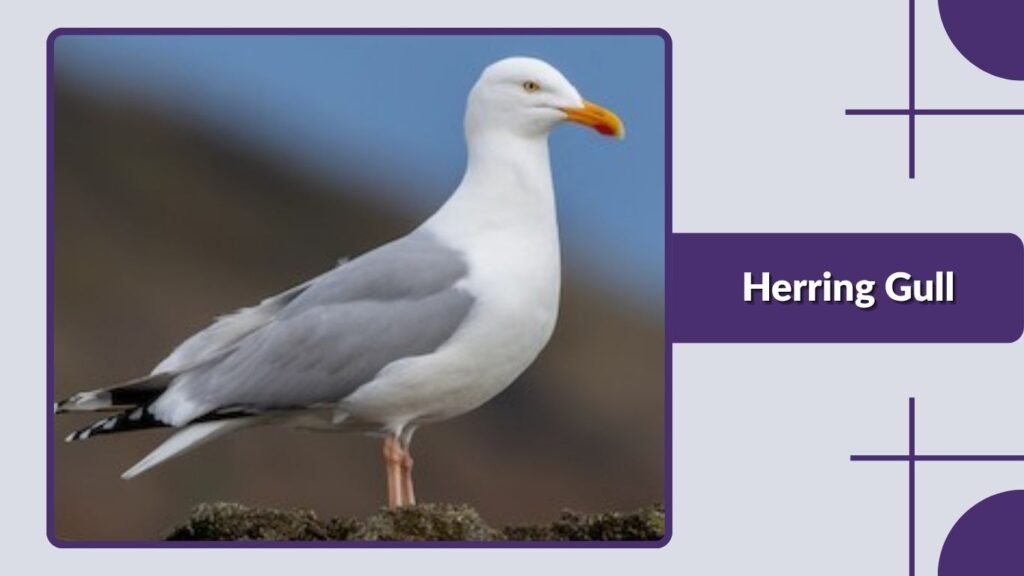
The Herring Gull is a large gray and white bird commonly seen around coasts, lakes, rivers, cities, and garbage disposal sites. Adults have pale gray backs, white heads, and powerful yellow bills. Their adaptable behavior allows them to survive in both natural and urban environments.
Identification
- White head, neck, and underparts
- Pale gray back and upper wings
- Yellow bill with a red spot
- Pink legs and webbed feet
- Black wingtips with white markings
Size and Appearance
Herring Gulls measure around 22–26 inches long and have wingspans of approximately 4.5–5 feet. Adults typically weigh 1.8–3.6 pounds. Someone searching for a big gray and white bird or a big white bird with gray patches may be describing this familiar gull.
Habitat and Distribution
Herring Gulls live along ocean coastlines, large inland lakes, rivers, islands, and reservoirs. They are commonly observed in Illinois, Michigan, Minnesota, Ohio, Wisconsin, and the northeastern United States. They also visit parking lots, fishing ports, landfills, and urban rooftops.
Diet and Behavior
These opportunistic birds eat fish, crabs, mollusks, insects, eggs, small animals, and human food scraps. They may steal food from other birds or drop hard-shelled prey onto rocks. Herring Gulls are intelligent birds capable of adapting their feeding strategies to local conditions.
14. Canada Goose
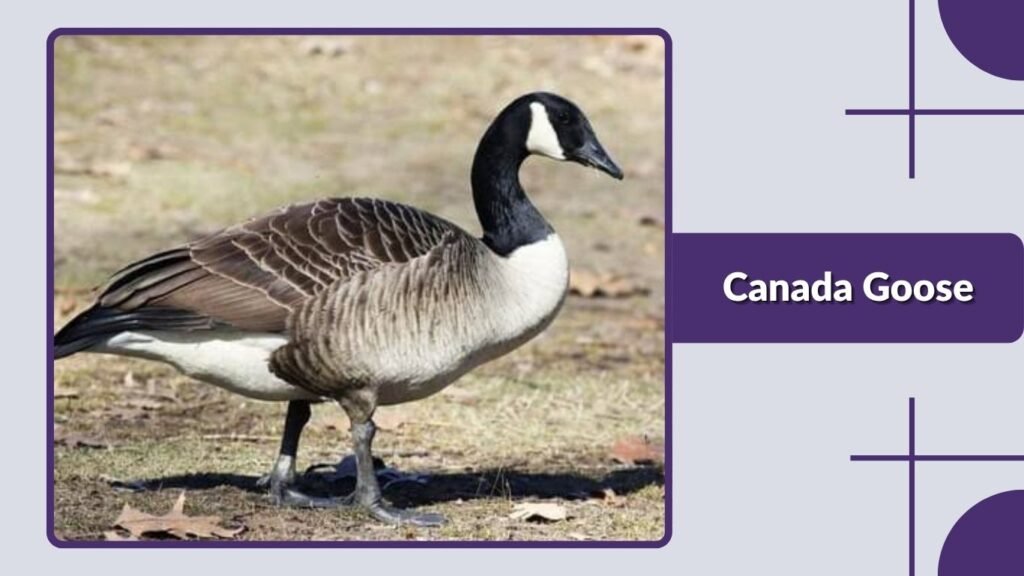
The Canada Goose is a large water bird with a gray-brown body, black head, and distinctive white cheek patches. Its heavy build, long neck, and broad wings make it highly recognizable. It is common around lakes, rivers, parks, golf courses, and agricultural fields throughout North America.
Identification
- Gray-brown body with a pale breast
- Black head and long black neck
- Bold white cheek patch
- Wide, flat black bill
- Black tail with a white patch underneath
Size and Appearance
Canada Geese measure approximately 30–45 inches long and have wingspans ranging from 4.2–5.6 feet. Depending on the subspecies, they may weigh 6–14 pounds or more. From a distance, the bird may look like a big black bird with a gray body.
Habitat and Distribution
Canada Geese inhabit freshwater lakes, rivers, wetlands, reservoirs, lawns, and farmland. They are widespread in Michigan, Minnesota, Ohio, Illinois, Wisconsin, Tennessee, and many other states. Some populations migrate seasonally, while urban and suburban groups may remain throughout the year.
Diet and Behavior
Canada Geese primarily eat grass, aquatic plants, seeds, berries, and agricultural grains. They often graze in large groups on open lawns. During migration, families fly in V-shaped formations, which reduce wind resistance and help the flock conserve energy.
