
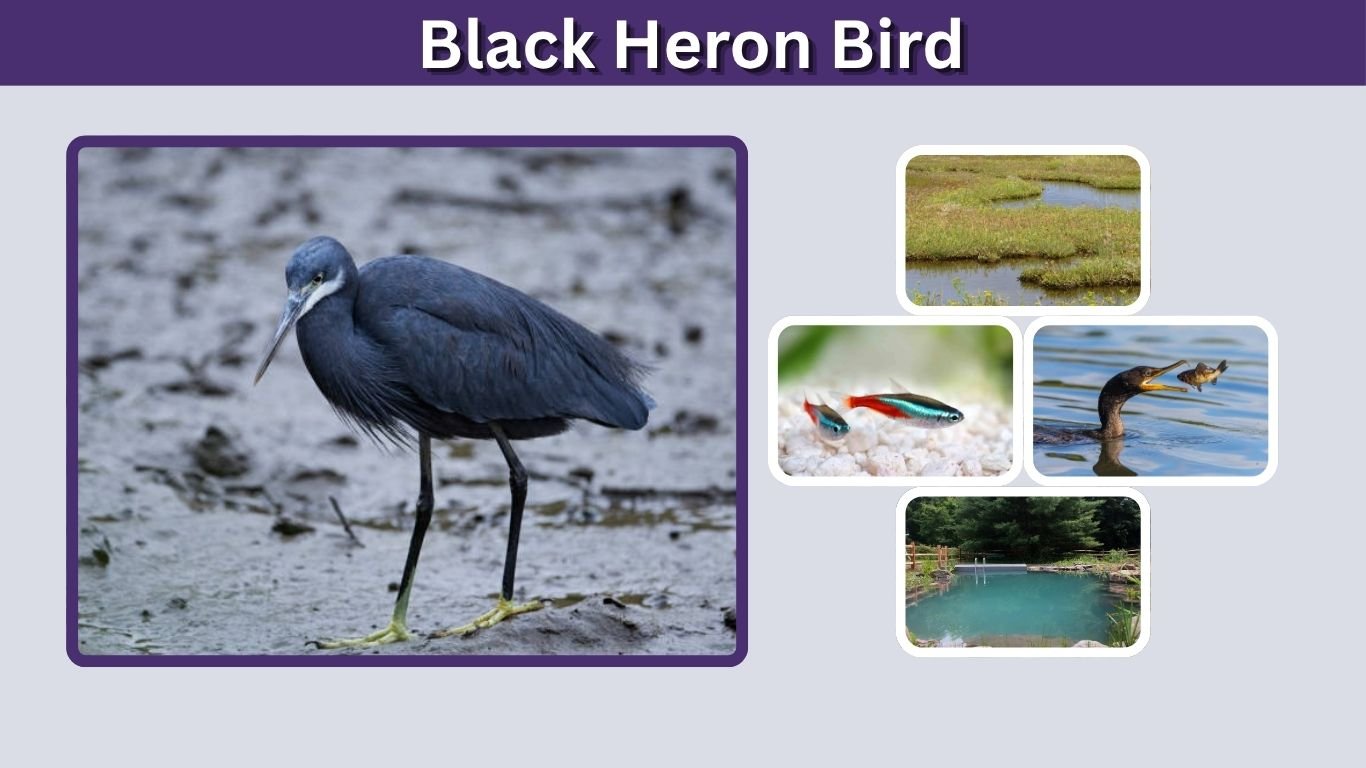
The Black Heron is a medium-sized African wading bird famous for hunting beneath an umbrella formed by its own wings. Its scientific name is Egretta ardesiaca, and it belongs to the heron and egret family, Ardeidae. With nearly all-black plumage, yellow feet, and an unusual feeding technique, it is one of the easiest herons to recognize when seen clearly.
What Is a Black Heron?
The Black Heron, sometimes called the Black Egret, is a true heron species native to sub-Saharan Africa and Madagascar. It inhabits wetlands containing shallow water, where it searches for small aquatic animals. Males and females look similar, and the species does not have recognized geographic subspecies.
| Feature | Description |
| Scientific name | Egretta ardesiaca |
| Family | Ardeidae |
| Length | Approximately 42–66 cm |
| Weight | Approximately 270–390 g |
| Plumage | Black or dark slate-black |
| Feet | Bright yellow |
| Main food | Small fish |
| Native range | Sub-Saharan Africa and Madagascar |
Black Heron Identification
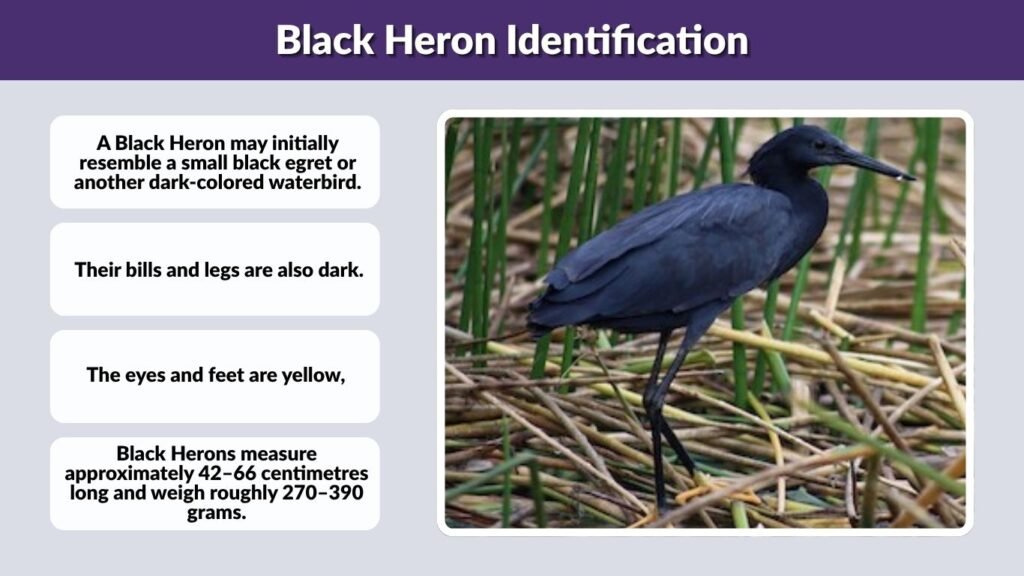
A Black Heron may initially resemble a small black egret or another dark-colored waterbird. However, its plumage, feet, shape, and hunting behavior provide several useful identification clues.
Color and Markings
Adult Black Herons are covered almost entirely in black or very dark slate-colored feathers. Their bills and legs are also dark, creating a nearly uniform appearance. The eyes and feet are yellow, with the bright feet providing the strongest color contrast.
During the breeding period, adults develop longer plumes on the head, neck, and back. Juveniles are also dark but lack the long decorative plumes seen on breeding adults. Males and females cannot normally be separated by plumage alone.
Size and Body Shape
Black Herons measure approximately 42–66 centimetres long and weigh roughly 270–390 grams. They have relatively compact bodies, slender pointed bills, and shorter-looking necks than many larger herons. The neck is often drawn close to the shoulders, giving a resting bird a hunched appearance.
Black Heron in Flight
In flight, the Black Heron folds its neck backward in the typical heron posture. Its broad, rounded wings appear uniformly dark, while the yellow feet may extend beyond the tail and become visible at close range.
Like other herons, it flies with steady wingbeats rather than holding its neck straight ahead. In comparison, cranes, storks, cormorants, and ibises usually fly with their necks extended.
Why Is It Called the Umbrella Bird?
The Black Heron is sometimes informally described as an umbrella bird because of its remarkable hunting method. This behavior is more accurately known as canopy feeding.
How Umbrella Hunting Works
While standing in shallow water, the heron spreads both wings forward and curves them around its head. The feathers meet above and around the bird, creating a dark circular canopy over the water. It then watches the shaded area and strikes at prey with its bill.
Researchers believe the canopy may help by:
- Reducing glare from the water
- Improving the bird’s view of underwater prey
- Attracting fish toward the shade
- Preventing prey from detecting the bird’s head
- Creating a controlled hunting area
Its broad flight feathers and body plumes appear especially suited to closing gaps in the canopy. The bird may hunt alone, in small groups, or in larger feeding gatherings.
Where Do Black Herons Live?
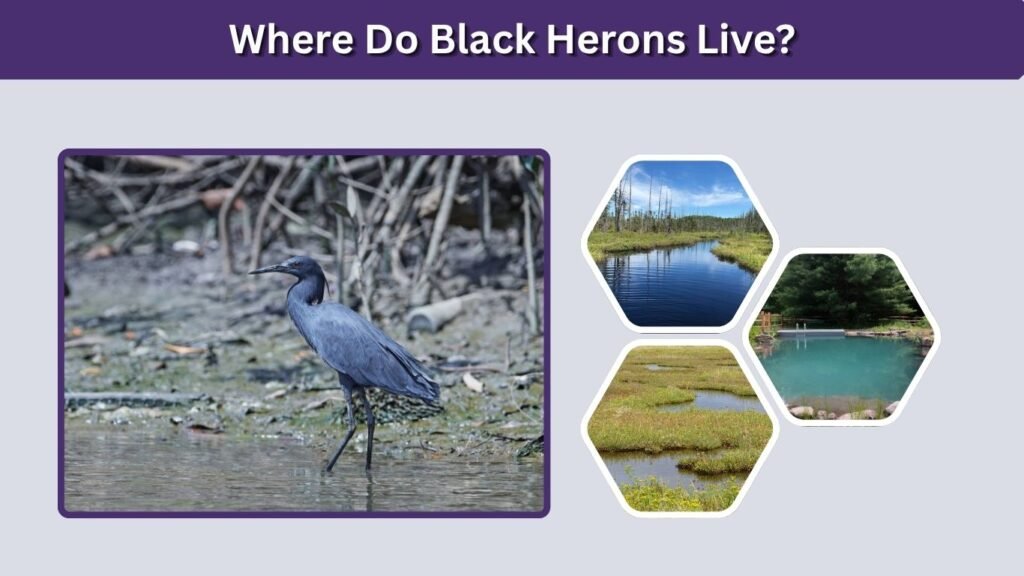
Black Herons occur across parts of Africa south of the Sahara, from Senegal and Ethiopia southward to South Africa. They are also native to Madagascar. Their distribution can be patchy because they depend on suitable areas of shallow water.
Preferred Habitat
The species uses numerous freshwater, brackish, and coastal habitats, including:
- Shallow lakes
- Marshes
- Ponds and pools
- Streams
- Lagoons
- Estuaries
- Mangrove areas
- Reservoirs
- Irrigation canals
- Aquaculture ponds
- Seasonally flooded grasslands
Black Herons prefer shallow water where they can stand and form their feeding canopy. They may move locally or over longer distances as wetlands dry out or refill following seasonal rainfall.
Are Black Herons Found in the USA or UK?
The true Black Heron is an African and Madagascan species rather than a regular native bird of the United States or United Kingdom. Therefore, an apparently black, heron-like bird seen in North America or Britain is more likely to be a different species.
Possible lookalikes include the Black-crowned Night-Heron, dark juvenile herons, cormorants, anhingas, ibises, and birds seen in poor lighting. Location, bill shape, posture, leg color, and plumage pattern should all be considered before identification.
What Do Black Herons Eat?
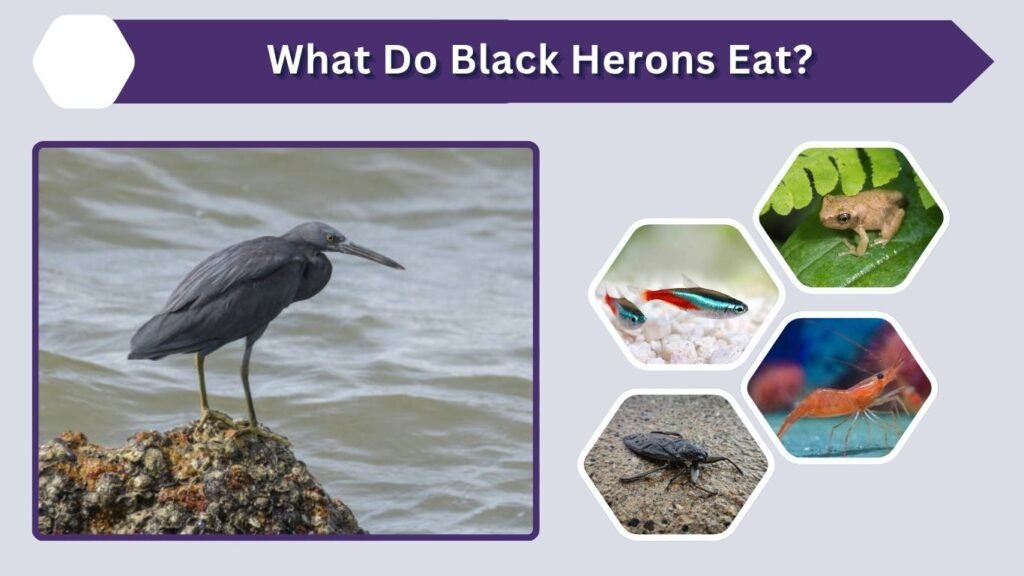
Black Herons primarily eat small fish, but they are opportunistic wetland predators. They also consume crustaceans, aquatic insects, and amphibians when those animals are available.
Their diet may include:
- Small freshwater fish
- Fish fry
- Tadpoles
- Small frogs
- Aquatic insect larvae
- Adult water insects
- Shrimp
- Crabs
- Other small crustaceans
The bird usually searches for food in shallow, open water during daylight or around dusk. Its umbrella technique allows it to feed effectively in bright conditions that might otherwise create strong reflections on the water.
Black Heron Breeding and Nesting
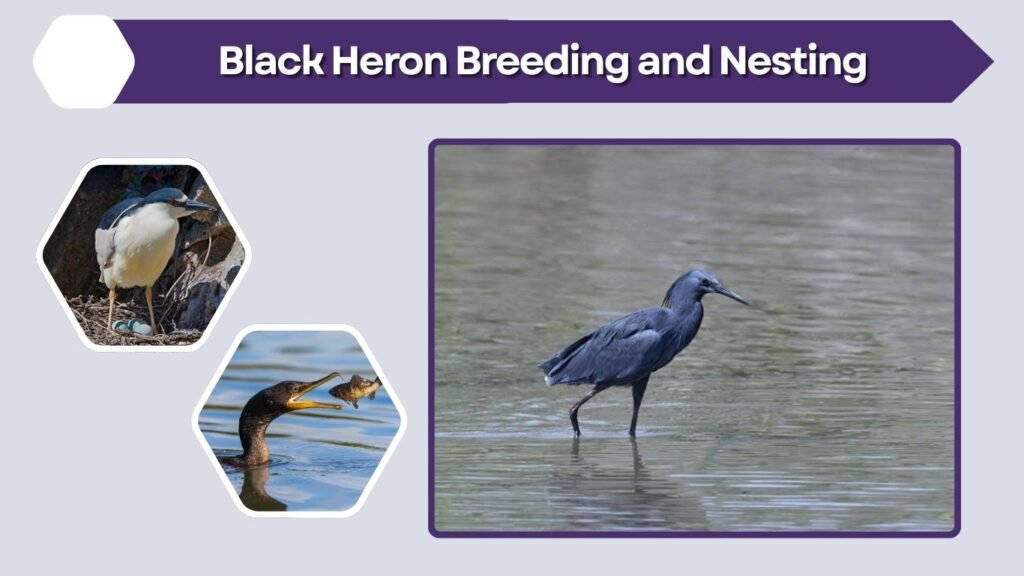
Black Herons may breed in colonies, sometimes alongside other herons, egrets, cormorants, or waterbirds. Nesting often occurs in trees, shrubs, reedbeds, or vegetation close to water.
Nest and Eggs
The nest is generally a platform constructed from sticks, twigs, reeds, grass, and leafy branches. Females commonly lay between two and four eggs, although nesting timing varies according to region and local water conditions.
Breeding colonies can be vulnerable to human disturbance and predators. Repeated disturbance may cause adults to leave nesting areas or force colonies into less suitable locations.
Young Black Herons
Young birds hatch with dark gray down and may have a contrasting pale crest. As they develop, they acquire black juvenile plumage but initially lack the elongated ornamental feathers of adults. Their feet retain the yellow coloration that helps distinguish the species.
Black Heron vs Black-Crowned Night-Heron
The Black Heron and Black-crowned Night-Heron are different species despite their similar names.
| Feature | Black Heron | Black-crowned Night-Heron |
| Scientific name | Egretta ardesiaca | Nycticorax nycticorax |
| Adult color | Almost completely black | Gray wings and body with black crown and back |
| Legs | Dark with yellow feet | Yellowish legs |
| Shape | Slim, egret-like | Stocky and thick-necked |
| Feeding time | Often daytime or dusk | Commonly evening and night |
| Special behavior | Forms a wing umbrella | Usually waits or stalks normally |
| Main range | Africa and Madagascar | Widespread across several continents |
Adult Black-crowned Night-Herons have pale gray wings and underparts, a black cap and back, a heavy bill, and a compact body. Juveniles are brown and heavily streaked rather than uniformly black.
Black Heron vs Black-Headed Heron
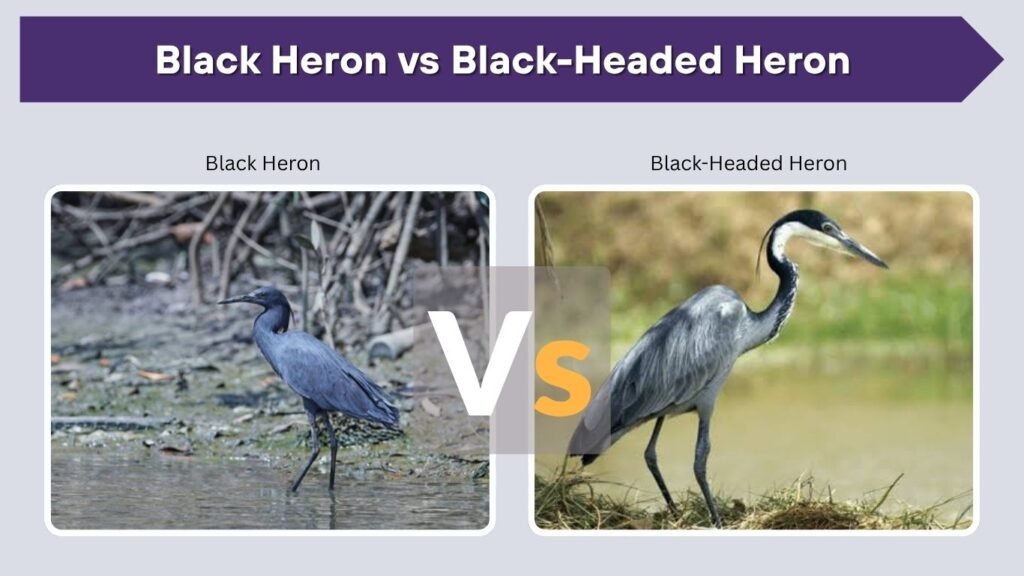
The Black-headed Heron is another African species that may be confused by name. However, it is a much larger gray heron with a dark head and neck rather than an entirely black body.
The Black-headed Heron has the scientific name Ardea melanocephala. It often searches for prey in grasslands as well as wetlands, whereas the Black Heron is especially associated with shallow-water canopy feeding.
Conservation Status
The Black Heron is currently classified as Least Concern globally, but its population is considered poorly studied. The estimated global population is approximately 16,700–66,700 individuals, and evidence from southern Africa suggests that numbers may be declining in some areas.
Important threats include:
- Wetland destruction
- Declining freshwater quality
- Changes to natural water levels
- Disturbance at breeding colonies
- Human activity around nest sites
- Predation within colonies
- Loss of shallow feeding habitat
Protecting wetlands, nesting colonies, and seasonally flooded feeding areas is important for the species’ long-term survival.
FAQs
Why does the Black Heron make an umbrella?
It spreads its wings around its body to shade the water while hunting. The canopy may reduce glare, improve underwater visibility, conceal the bird, and attract fish into the darker area. The heron then quickly catches prey with its pointed bill.
Is the Black Heron completely black?
Its plumage, bill, and legs are predominantly black or dark slate-colored. However, its eyes and feet are yellow. Breeding adults may also show long ornamental plumes on the head, neck, and back.
What is the scientific name of the Black Heron?
The Black Heron’s scientific name is Egretta ardesiaca. It belongs to the Ardeidae family, which includes herons, egrets, night-herons, and bitterns.
Is a Black-crowned Night-Heron a Black Heron?
No. The Black-crowned Night-Heron is a separate species with gray wings, pale underparts, a black crown, and a black back. The true Black Heron has almost entirely dark plumage and is famous for umbrella feeding.
What does a Black Heron eat?
Its primary food is small fish. It also captures tadpoles, frogs, aquatic insects, shrimp, crabs, and other small wetland animals. Most prey is taken from shallow water beneath or near the bird’s wing canopy.
