
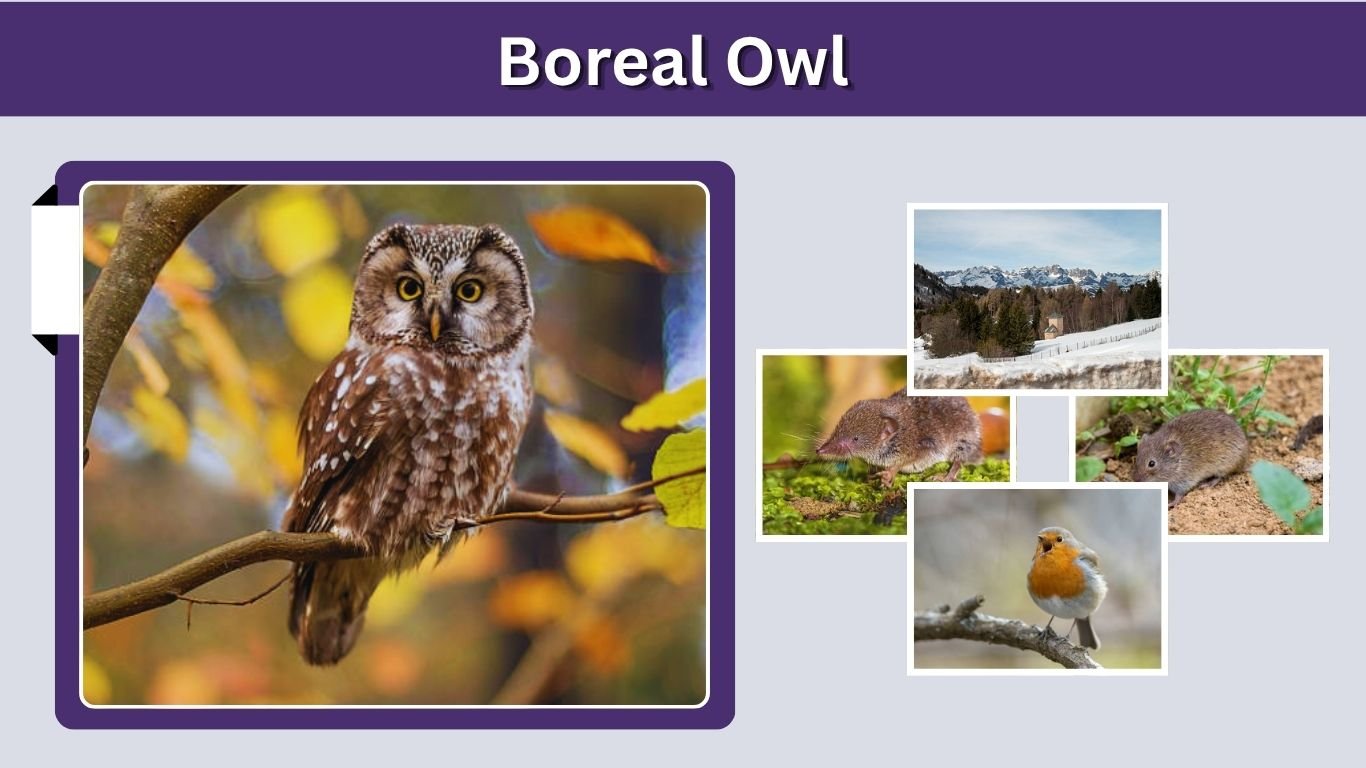
The Boreal Owl is a small, secretive owl of northern coniferous forests. Recognized by its square head, bright yellow eyes, pale facial disc, and spotted brown plumage, it spends much of the day hidden near tree trunks. Its scientific name is Aegolius funereus, and it is also called Tengmalm’s Owl in Europe. Although widely distributed, its nocturnal habits and remote habitat make it difficult to observe.
Boreal Owl Quick Facts
Boreal Owls are compact woodland hunters adapted to cold forests. They are larger than Northern Saw-whet Owls but considerably smaller than Barred Owls.
| Feature | Boreal Owl |
| Scientific name | Aegolius funereus |
| Family | Strigidae |
| Length | 8.3–11 inches |
| Weight | 3.3–7.6 ounces |
| Wingspan | 21.6–24.4 inches |
| Eye color | Bright yellow |
| Main habitat | Boreal and subalpine forests |
| Primary food | Voles, mice and shrews |
| Nest type | Natural cavity, woodpecker hole or nest box |
| Clutch size | 2–9 eggs |
| Conservation status | Least Concern |
Cornell Lab measurements place the species at approximately 8.3–11 inches long, with a wingspan of 21.6–24.4 inches. Females are normally larger and heavier than males.
Boreal Owl Identification
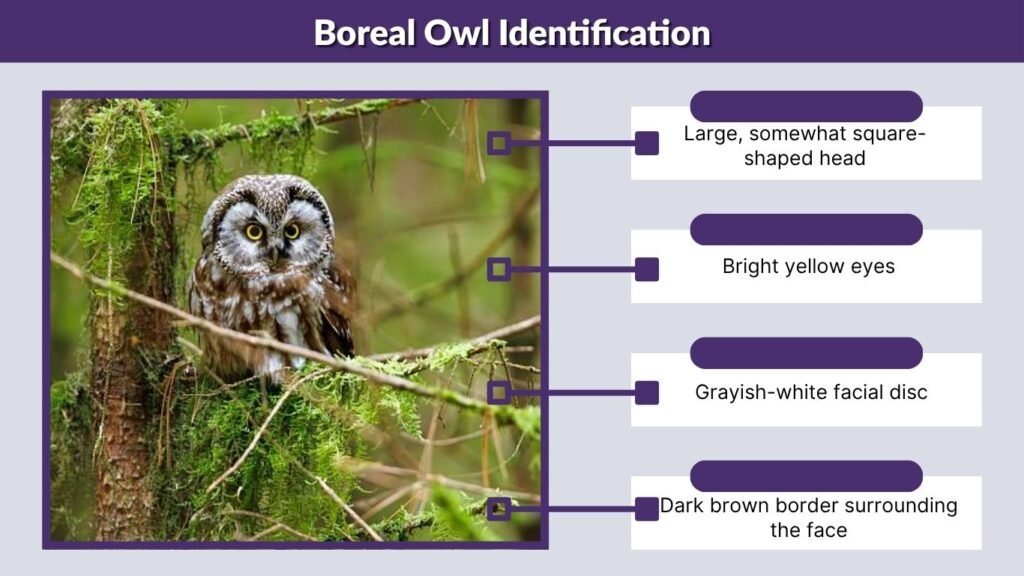
The Boreal Owl’s compact shape and distinctive facial pattern help separate it from other small forest owls. However, it usually remains motionless and well hidden during daylight.
Key Characteristics
- Large, somewhat square-shaped head
- Bright yellow eyes
- Grayish-white facial disc
- Dark brown border surrounding the face
- Brown back covered with white spots
- White underparts with brown vertical streaks
- Short tail and stocky body
- No visible ear tufts
- Yellowish bill
- Fully feathered legs and feet
Adults have tiny white spots across the crown and larger white markings on the back and wings. Their pale face is surrounded by a dark border that creates an alert, wide-eyed appearance.
Are There Black Boreal Owls?
There is no separate species known as the black Boreal Owl. The phrase usually refers to a particularly dark individual or a juvenile. Young Boreal Owls can be dark chocolate-brown underneath and lack the extensive white crown and back spotting seen on adults. They may also show pale eyebrows and a light-colored bill.
How Big Is a Boreal Owl?
A Boreal Owl is roughly robin-sized, although its rounded feathers and large head can make it appear bigger. Females tend to be noticeably heavier than males.
Male and Female Size
Male Boreal Owls generally measure 8.3–9.4 inches long and weigh about 3.7–5.3 ounces. Females commonly measure 8.7–10.2 inches and weigh approximately 5.3–7.4 ounces. Their wingspan usually ranges from about 21 to 24 inches.
The larger female can incubate eggs and protect the nest, while the smaller male is agile enough to deliver numerous small prey animals during the nesting period.
Boreal Owl Call and Sounds
The Boreal Owl is more often detected by sound than sight. Males become particularly vocal during late winter and spring when establishing territories and attracting mates.
Male Boreal Owl Call
The male’s primary song is a rapid series of 8–20 low, whistled toots. The notes gradually become louder and may sound like water dripping quickly, a distant engine, or a soft bouncing ball.
Males sing frequently before finding a mate. Calling normally decreases significantly after the female begins nesting. North American Boreal Owls generally produce a slower song containing more notes than European birds.
Female and Juvenile Sounds
Male, female and juvenile Boreal Owls can produce a short “kip” or “kew” call throughout the year. Other sounds may include squeals, raspy notes and defensive bill-snapping when the bird feels threatened.
Boreal Owl Habitat and Range
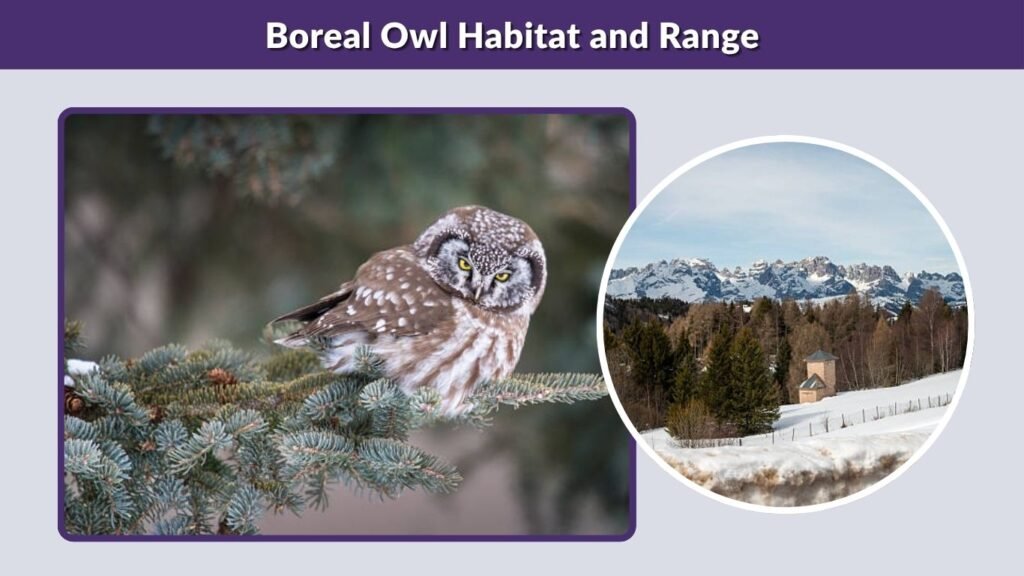
Boreal Owls are closely associated with cool northern forests. They need suitable hunting areas as well as trees containing cavities large enough for nesting.
Where Do Boreal Owls Live?
The species has a broad circumpolar range extending across northern North America, Europe and Asia. In North America, it occurs from Alaska across Canada and reaches parts of the northern United States. Separate populations live in high-elevation mountain forests farther south.
Boreal Owls are found in forests containing:
- Spruce
- Fir
- Aspen
- Birch
- Poplar
- Mixed coniferous and deciduous trees
In western North America, they usually inhabit high-elevation spruce-fir forests. Northern populations may live at much lower elevations where cold boreal conditions are widespread.
Boreal Owl Irruptions
Boreal Owls do not undertake predictable long-distance migrations. However, they are nomadic and may move south or leave their usual range when rodents become scarce. These irregular winter movements are known as irruptions.
During an irruption, Boreal Owls may appear in Minnesota, Wisconsin, New England and other areas where they are rarely encountered in ordinary years.
What Do Boreal Owls Eat?
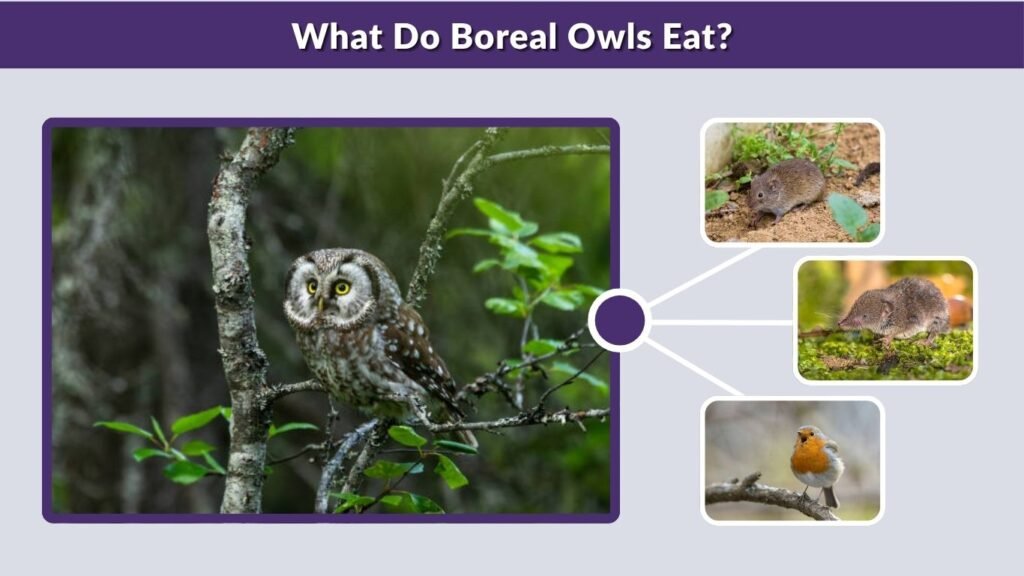
Boreal Owls are mainly small-mammal specialists. Their survival and breeding success can be strongly affected by changes in rodent populations.
Common Foods
Their diet includes:
- Voles
- Deer mice
- Shrews
- Small rats
- Young squirrels
- Small birds
- Large insects
The owl normally watches from a low or exposed perch before gliding toward prey and capturing it with its talons. It relies heavily on sensitive hearing and can sometimes plunge through soft snow to catch an animal moving underneath.
Boreal Owls hunt mainly at night. In the far north, however, they may hunt during daylight in summer because the sun remains above the horizon for long periods.
Boreal Owls Nesting and Reproduction
Boreal Owls do not construct traditional stick nests. They depend on existing tree cavities, making older forests and standing dead trees especially important.
Nest Sites and Nest Boxes
The species commonly nests in abandoned woodpecker holes, natural hollows and appropriately designed nest boxes. A male may advertise several possible cavities within his territory, after which the female selects one.
Nest boxes can provide breeding sites where natural cavities are limited. They should be placed in suitable mixed or coniferous woodland rather than exposed gardens or treeless areas.
Eggs and Young
A female usually lays 2–9 dull-white eggs and produces one brood during a North American breeding season. Incubation lasts approximately 26–32 days, while young remain in the cavity for about 27–36 days after hatching.
Newly hatched chicks have closed eyes and soft white down. Juveniles become dark brown as their feathers develop, later gaining the white spots and streaked underparts of adults.
Boreal Owl Adaptations
Living in cold, snowy forests requires specialized physical and behavioral traits.
Adaptations for Survival
- Feathered legs: Help protect the legs and feet from cold temperatures.
- Soft flight feathers: Reduce sound while approaching prey.
- Large facial disc: Directs faint sounds toward the ears.
- Excellent night vision: Helps locate movement under low light.
- Sensitive hearing: Allows the owl to detect rodents beneath vegetation or snow.
- Spotted plumage: Provides camouflage against bark, branches and lichens.
- Sit-and-wait hunting: Conserves energy during cold weather.
The owl also chooses sheltered daytime roosts, usually sitting close to a tree trunk approximately 15–20 feet above the ground.
Boreal Owl vs Northern Saw-Whet Owl
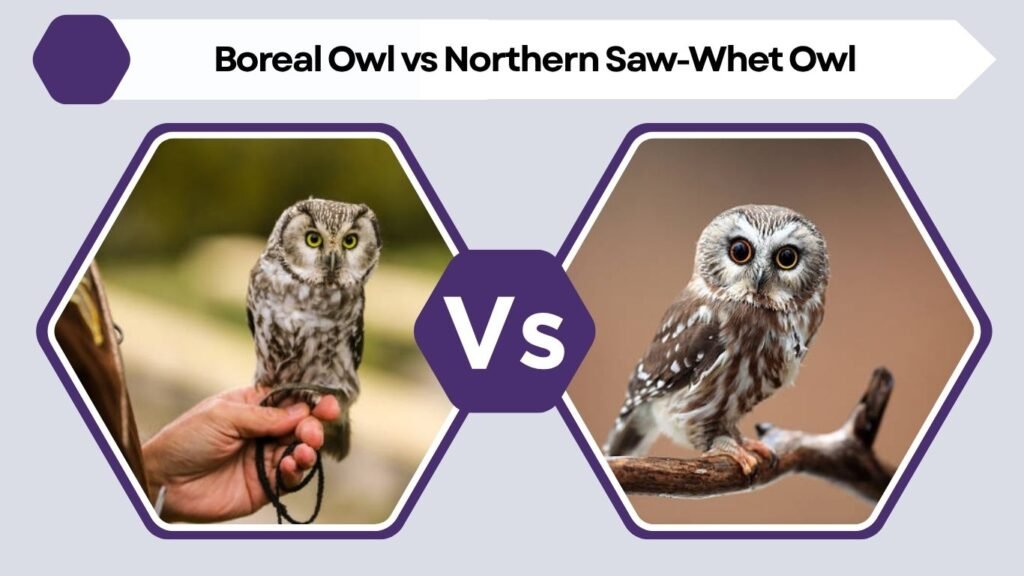
These two small owls are easily confused because both have yellow eyes, rounded heads and spotted brown plumage.
| Difference | Boreal Owl | Northern Saw-whet Owl |
| Typical length | 8.3–11 inches | About 7–8.5 inches |
| Head shape | Large and square | Rounded |
| Face | Pale with strong dark border | Pale with softer brown markings |
| Bill | Yellowish | Dark |
| Underparts | Dark vertical streaks | Reddish-brown streaks |
| Habitat | Northern boreal and subalpine forest | Wider variety of coniferous and mixed forests |
| Call | Short series that grows louder | Long, even series of repeated whistles |
The Boreal Owl is generally larger, grayer and more heavily marked around the face. The Northern Saw-whet Owl has a smaller, rounder head and warmer reddish streaks across its white chest.
Predators and Threats
Great Horned Owls, Northern Goshawks, martens and other forest predators may prey on Boreal Owls, eggs or nestlings. Natural cavity shortages can also reduce nesting opportunities.
The species is currently categorized as Least Concern, but its nocturnal habits and remote distribution make population trends difficult to measure. Loss of nesting and foraging habitat remains an important concern, particularly for isolated mountain populations.
FAQs
Is a Boreal Owl rare?
Boreal Owls have a wide global distribution, but they are rarely seen because they are nocturnal, quiet and strongly associated with remote northern forests. They may appear more frequently in southern areas during winter irruptions.
Is a Boreal Owl the same as Tengmalm’s Owl?
Yes. Boreal Owl is the name commonly used in North America, while Tengmalm’s Owl is widely used in Europe. Both names refer to the species Aegolius funereus.
Do Boreal Owls migrate?
They are generally considered residents rather than regular migrants. However, individuals may wander significant distances when prey becomes scarce, producing occasional movements beyond their normal range.
Can Boreal Owls use nest boxes?
Yes. Boreal Owls readily use properly sized nest boxes installed in suitable forest habitat. Boxes can be particularly valuable in younger forests where large natural tree cavities are limited.
Are Boreal Owls active during the day?
They are primarily nocturnal and usually rest against tree trunks during daylight. In far northern summers, they may hunt while it is still light because true nighttime may be brief or absent.
