
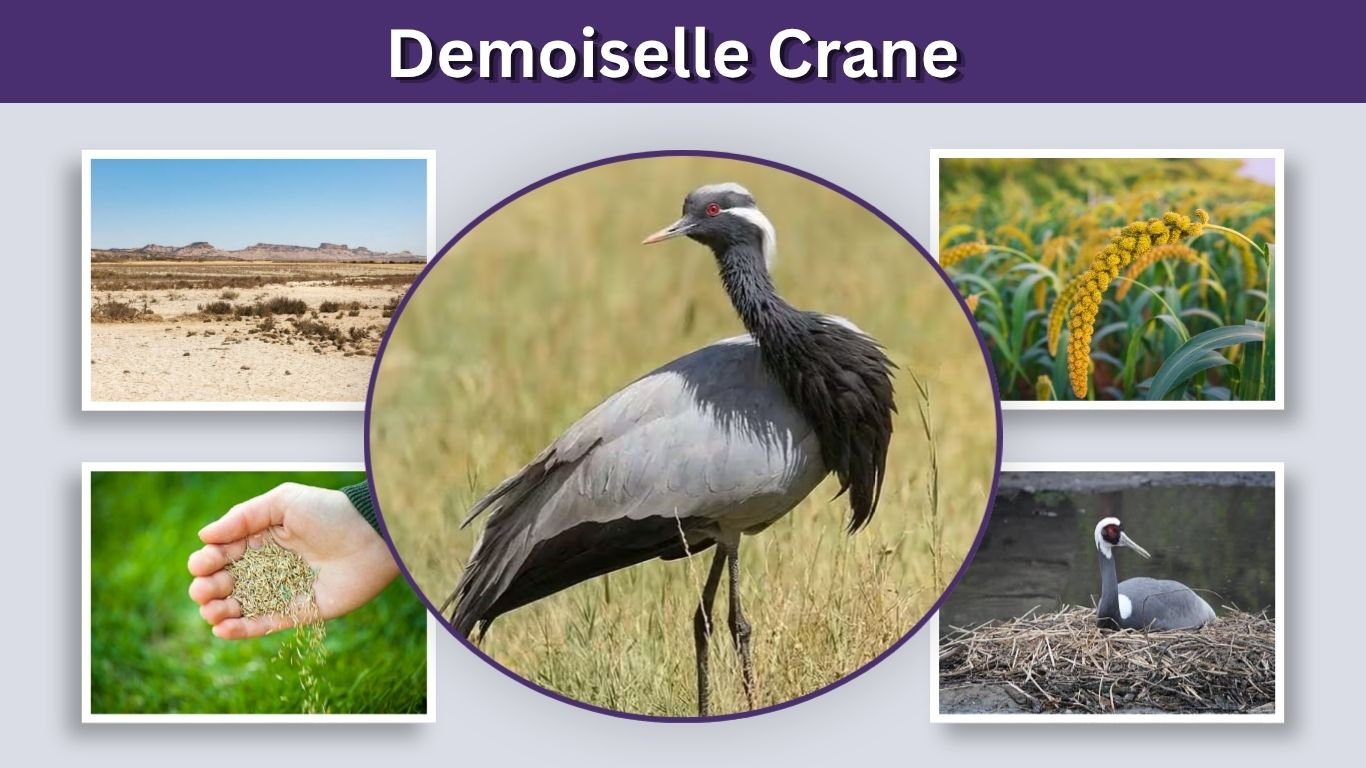
The Demoiselle Crane (Anthropoides virgo) is a graceful migratory bird recognized by its blue-grey body, black neck, red-orange eyes, and long white feathers extending behind the head. It is the smallest crane species, but it completes remarkable long-distance journeys between breeding grounds in Eurasia and wintering areas in India, Pakistan, and Africa. Demoiselle Cranes prefer open plains, steppes, semi-deserts, and agricultural fields rather than the deep wetlands used by many other cranes.
Demoiselle Crane Quick Facts
Demoiselle Cranes belong to the crane family Gruidae. Some older references and taxonomic systems use the scientific name Grus virgo, but Anthropoides virgo is widely used by current crane and bird databases.
| Feature | Description |
| Scientific name | Anthropoides virgo |
| Alternative name | Grus virgo |
| Family | Gruidae |
| Height | About 89–90 cm |
| Weight | Approximately 2–3 kg |
| Wingspan | Around 150–170 cm |
| Diet | Omnivorous |
| Habitat | Steppes, plains, grasslands and semi-deserts |
| Activity | Mainly active during the day |
| Typical clutch | Two eggs |
| Conservation status | Least Concern |
| Population trend | Decreasing |
At about three feet tall, the Demoiselle Crane is considerably smaller and lighter than species such as the Common, Sarus, or Red-crowned Crane. Its population is estimated at approximately 170,000–220,000 individuals.
What Does a Demoiselle Crane Look Like?
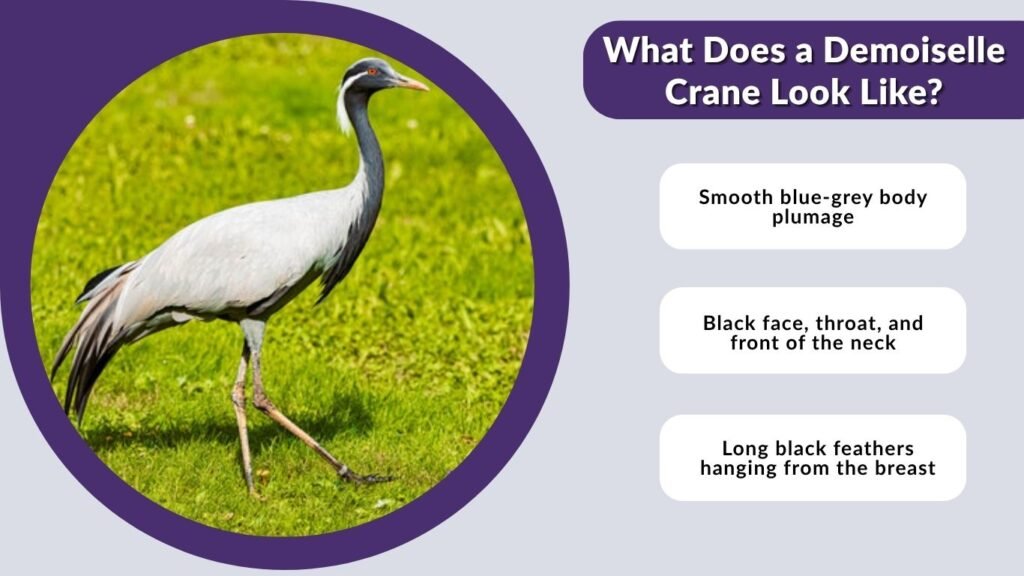
The Demoiselle Crane has a slender body, long legs, broad wings, and a fully feathered head. Its elegant appearance inspired its name: “demoiselle” is a French word traditionally meaning a young lady.
Identification Features
- Smooth blue-grey body plumage
- Black face, throat, and front of the neck
- Long black feathers hanging from the breast
- White feather plumes extending behind each eye
- Bright reddish-orange eyes
- Short, pale yellowish or grey bill
- Long black legs and toes
- Dark flight feathers visible when the wings open
- Neck extended straight during flight
Males and females look almost identical, although males are usually slightly larger. Juveniles are paler grey, with shorter head plumes and less distinct black neck feathers.
Demoiselle Crane Adaptations
Demoiselle Cranes have shorter toes and bills than many wetland cranes. These features help them walk, run, and collect food efficiently in dry grasslands, steppes, pastures, and cultivated fields.
Their grey plumage provides camouflage in dusty plains and dry vegetation. Broad wings support long-distance migration, while their powerful respiratory system allows some populations to travel through extremely high mountain regions.
Where Do Demoiselle Cranes Live?
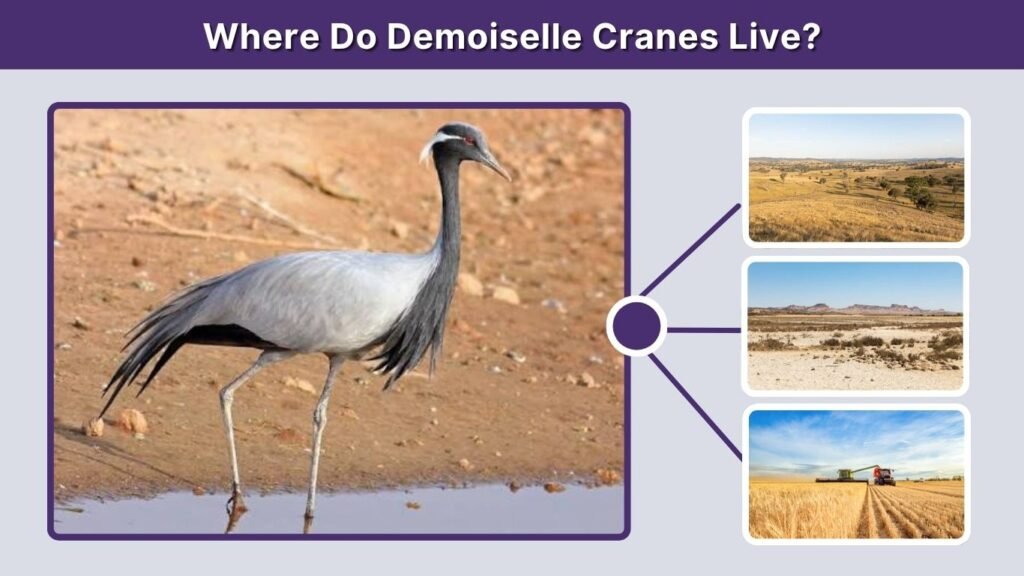
Demoiselle Cranes have an extensive but uneven distribution across Europe, Asia, and Africa. Their principal breeding range stretches from areas near the Black Sea through Kazakhstan, southern Russia, Mongolia, and northern China.
There are six main populations occurring across more than 47 countries. The largest populations are found in Central and East Asia, while small remnant breeding populations remain near the Black Sea and in Turkey.
Preferred Habitat
Unlike cranes that depend heavily on marshes, Demoiselle Cranes prefer open, relatively dry landscapes with good visibility.
Common habitats include:
- Dry grasslands
- Temperate steppes
- Semi-deserts
- Open savannas
- Agricultural fields
- Pastures
- High plateaus
- River valleys
- Plains near lakes or streams
They can occupy dry environments as long as drinking water and safe roosting areas are available nearby. During winter, large flocks use farmland, grasslands, desert wetlands, and river-edge habitats.
Demoiselle Crane Migration
Demoiselle Cranes are among the world’s most impressive migratory birds. Many breed across Central and East Asia before flying south to India and nearby countries for winter. Other populations migrate toward northeastern Africa.
Migration to India
Cranes from Mongolia, China, Kazakhstan, and surrounding regions travel toward northwestern India during autumn. Some northeastern populations cross the Himalayas during their southbound journey, although migration routes differ among populations.
Tracking research shows that some birds use a loop migration. They may cross the Himalayas while travelling south but take a longer route around the western side of the mountain system when returning north in spring. This route can provide more suitable feeding habitat during the return journey.
They usually travel in large, noisy flocks and may fly in lines or V-shaped formations. Their migration exposes them to storms, exhaustion, power lines, hunting, and attacks by predators.
Demoiselle Cranes at Khichan
Khichan village in Rajasthan is one of India’s most famous winter gathering places for Demoiselle Cranes, locally called kurjan. Tens of thousands may gather around the village’s feeding grounds, ponds, and surrounding desert.
Residents traditionally provide grain inside protected feeding areas known as chugga ghars. The birds generally arrive during the cooler part of the year and remain until around March. Khichan Wetland was designated a Ramsar Site in 2025, recognizing its international importance.
What Do Demoiselle Cranes Eat?

Demoiselle Cranes are omnivores, although plant foods make up a large portion of their diet. They usually forage during the morning and afternoon by walking slowly and picking food from the ground.
Common Foods
Their diet includes:
- Grass seeds
- Cereal grains
- Wheat and millet
- Peanuts and beans
- Leaves and shoots
- Berries and other fruits
- Beetles and grasshoppers
- Worms and snails
- Small lizards
- Small rodents
- Other small animals
Agricultural fields provide waste grain after harvesting, making them important winter feeding sites. However, feeding in farmland can occasionally cause conflict when cranes consume recently planted seeds or young crops.
Demoiselle Crane Dance and Behavior
Demoiselle Cranes are highly social outside the breeding season. They gather in large flocks at feeding and roosting locations but become territorial when nesting.
Courtship Dance
Their dance includes bowing, running, jumping, spreading the wings, tossing grass, and making short flights. Although dancing is strongly associated with courtship, adults and juveniles may perform it throughout the year.
Dancing helps strengthen pair bonds, communicate excitement, and develop coordination. Established pairs frequently remain together across multiple breeding seasons.
Call and Sound
Demoiselle Cranes produce loud, far-carrying calls during migration and social activity. A pair may perform a coordinated unison call to strengthen its bond and announce ownership of a breeding territory.
They also produce a soft, purring contact call to maintain communication and a short, sharp guard call when danger is detected.
Demoiselle Crane Nesting, Eggs and Chicks
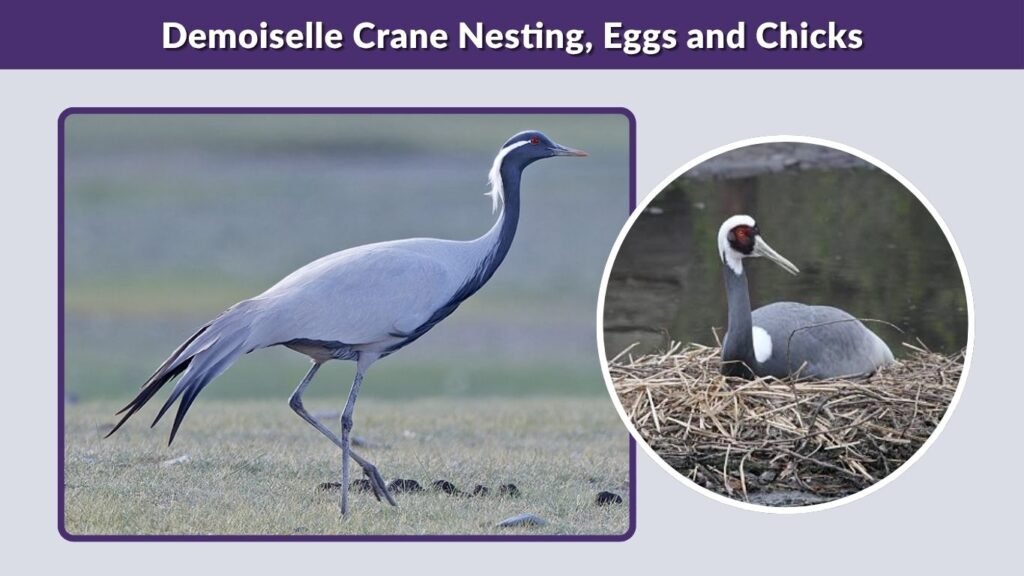
The breeding season generally occurs during spring and early summer. Pairs establish territories in open grasslands, steppes, or agricultural landscapes close to water.
Nest and Eggs
The nest is usually a simple depression on the ground containing a few stones, grasses, or twigs. Its open location allows the adults to watch for approaching predators.
A female normally lays two yellowish-green or brownish eggs marked with darker spots. Both parents incubate the eggs, although the female may perform more of the incubation. Hatching occurs after approximately 27–29 days.
The chicks hatch covered with down and can walk soon afterward. Both parents guide, feed, and defend them. Young cranes usually begin flying at around 55–60 days but may remain with their parents through their first migration.
Lifespan and Predators
The average lifespan of wild Demoiselle Cranes is not well documented. Birds maintained under professional care commonly live for several decades, and exceptional captive individuals have survived much longer.
Eggs and chicks are vulnerable to foxes, domestic dogs, and other ground predators. Large birds of prey may attack young, injured, or exhausted cranes. Adults rely on vigilance, group behavior, running, and flight to avoid danger.
Conservation Status
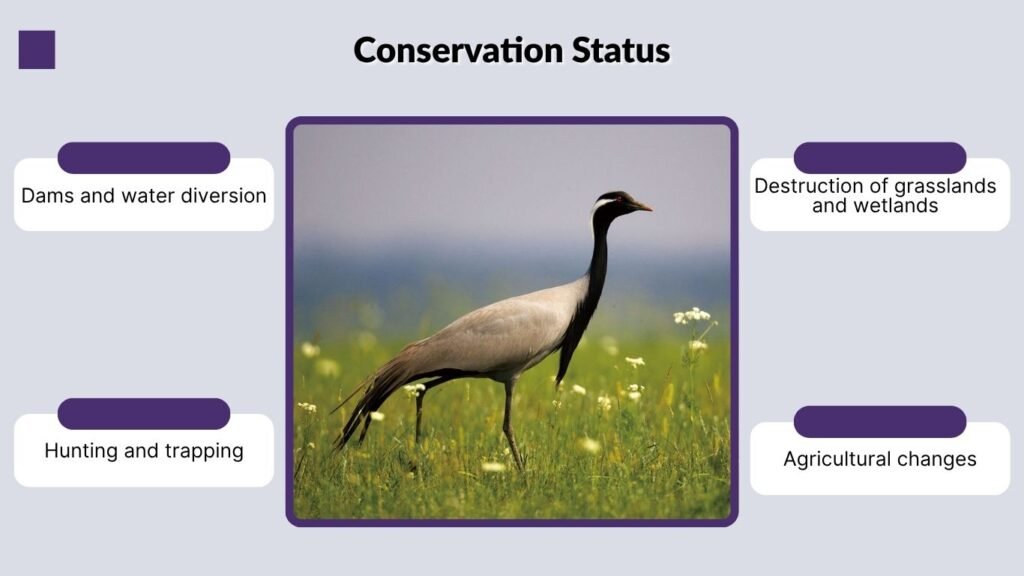
The Demoiselle Crane is globally classified as Least Concern, but its overall population trend is decreasing. It is also included in CITES Appendix II and the Convention on Migratory Species Appendix II.
Major threats include:
- Destruction of grasslands and wetlands
- Desertification and prolonged drought
- Agricultural changes
- Dams and water diversion
- Disturbance around nests and roosts
- Collisions with power lines
- Hunting and trapping
- Poisoning from agricultural chemicals
- Capture for the wildlife trade
Protecting breeding grounds, migration stopovers, winter feeding areas, and traditional gathering sites such as Khichan is essential for maintaining healthy populations.
Can Demoiselle Cranes Be Kept as Pets?
Demoiselle Cranes are unsuitable as ordinary household pets. They are large, social, migratory birds requiring extensive open space, companionship, specialized nutrition, and carefully managed housing.
Wild capture and international trade are regulated in many countries. These cranes should only be maintained by properly licensed zoological, conservation, or specialist avicultural facilities.
FAQs
How do you pronounce Demoiselle Crane?
“Demoiselle” is commonly pronounced approximately dem-wah-ZELL. The name comes from French and refers to the bird’s graceful, elegant appearance and long decorative feathers.
Why do Demoiselle Cranes migrate to India?
They travel south to escape the severe winters of Central and East Asia. India provides warmer temperatures, open fields, water sources, waste grain, and protected gathering areas where the cranes can feed and roost.
Can Demoiselle Cranes fly over the Himalayas?
Some populations cross parts of the Himalayan mountain system during southbound migration. Tracking studies show that certain birds take a different, longer route around the mountains when returning north in spring.
What is the difference between male and female Demoiselle Cranes?
Both sexes have nearly identical grey, black, and white plumage. Males are generally slightly larger, but accurately distinguishing the sexes by appearance alone is difficult without comparing a bonded pair.
Is the Demoiselle Crane endangered?
It is currently classified as Least Concern globally, meaning it is not considered endangered. However, its population is decreasing, and several smaller regional populations face serious threats from habitat loss, hunting, disturbance, and environmental change.
