
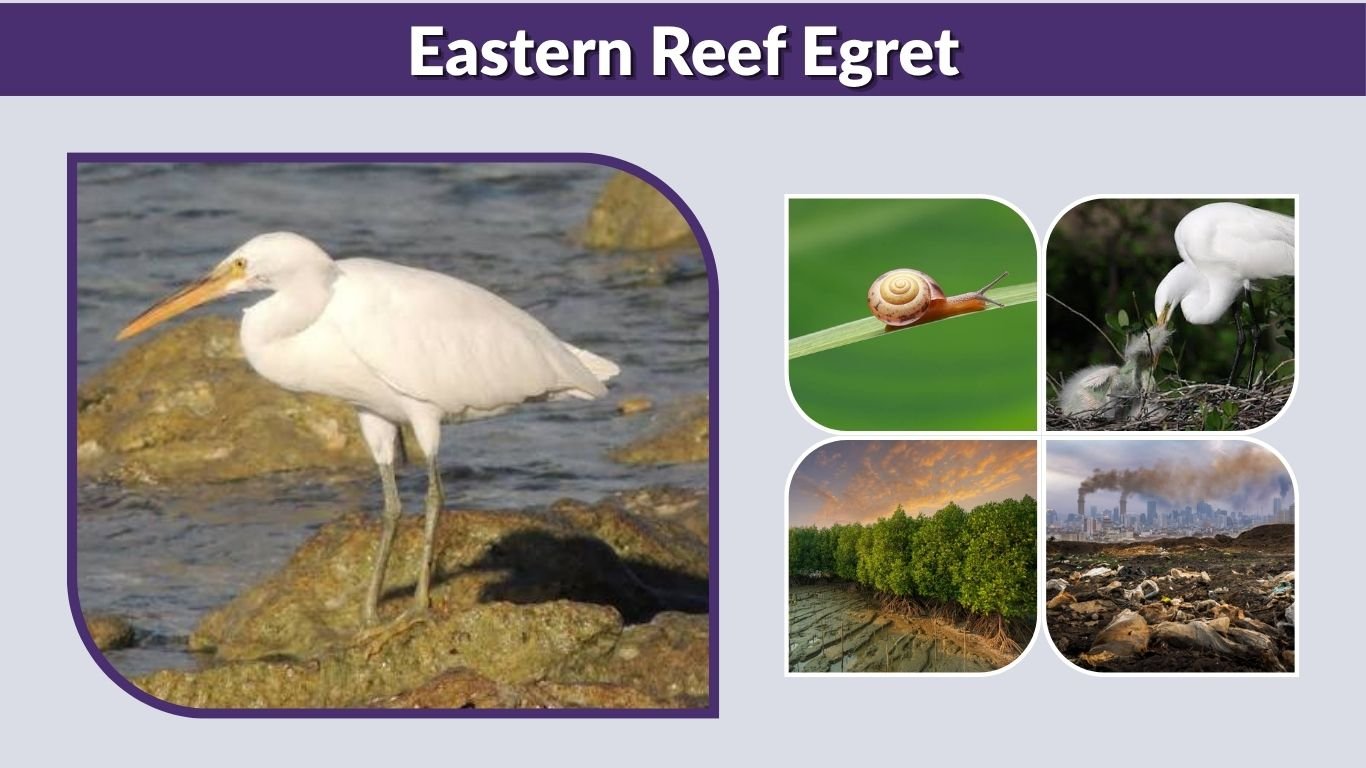
The Eastern Reef Egret is a medium-sized coastal heron recognized for its unusual dark and white color forms. It spends most of its life around rocky shorelines, coral reefs, tidal pools, mangroves, and estuaries. Rather than wading through deep freshwater wetlands, this patient hunter follows the changing tide in search of fish, crabs, and other marine prey. Its scientific name is Egretta sacra, and it is also widely called the Pacific Reef Heron or Eastern Reef Heron.
Eastern Reef Egret Quick Facts
The Eastern Reef Egret belongs to the heron and egret family, Ardeidae. It is specially adapted to coastal environments and is rarely encountered far from saltwater.
| Feature | Description |
|---|---|
| Common name | Eastern Reef Egret |
| Other names | Pacific Reef Heron, Eastern Reef Heron |
| Scientific name | Egretta sacra |
| Family | Ardeidae |
| Length | Approximately 57–66 cm |
| Weight | Around 400 grams |
| Wingspan | Up to approximately 110 cm |
| Color | Dark gray or white |
| Diet | Fish, crabs, shrimp, insects, and mollusks |
| Habitat | Rocky coasts, reefs, mangroves, and estuaries |
| Conservation status | Least Concern |
Size and Physical Appearance
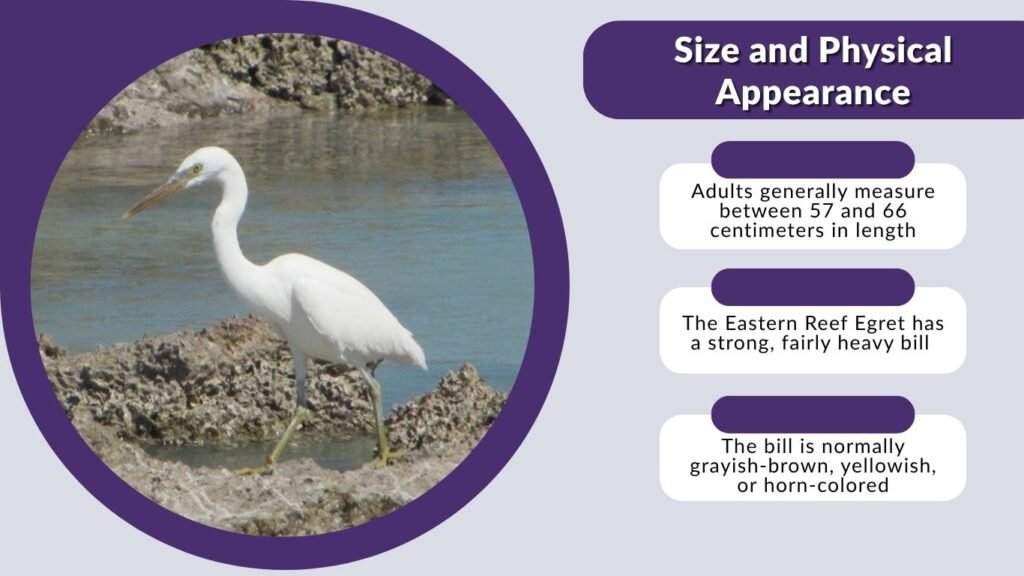
The Eastern Reef Egret has a compact yet sturdy body compared with many long-legged wetland herons. Adults generally measure between 57 and 66 centimeters in length. Their relatively short legs help them move confidently across rocks, coral platforms, and uneven coastal surfaces.
Two Distinct Color Forms
One of the bird’s most interesting characteristics is that it occurs in two main color morphs:
- Dark morph: Plumage is predominantly charcoal gray or dark slate-gray. A narrow white streak may appear on the throat.
- White morph: Plumage is almost completely white, making the bird resemble certain other white egrets.
- Intermediate birds: A small number may display mixed gray-and-white plumage.
- Young birds: Juveniles are generally duller and may have brownish tones in their feathers.
The dark and white birds are not separate species. They can live in the same region and may even form breeding pairs with each other.
Bill, Legs, and Eyes
The Eastern Reef Egret has a strong, fairly heavy bill that is well suited to catching slippery prey and handling crustaceans. The bill is normally grayish-brown, yellowish, or horn-colored, although its appearance can change during breeding.
Its legs are comparatively short and usually greenish-yellow, gray-green, or yellow. The feet provide a firm grip while the bird searches among wet rocks. Adults also possess yellow or golden-yellow eyes that stand out clearly against the dark morph’s plumage.
Breeding Plumage
During the breeding season, adult birds develop decorative plumes on the head, neck, chest, and back. The bill and legs can become brighter and more yellow. Males and females look very similar, so distinguishing the sexes by appearance alone is extremely difficult.
Distribution and Natural Range
Eastern Reef Egrets have an extensive distribution across coastal southern and eastern Asia, Australia, New Zealand, and many Pacific islands. Their range includes shorelines from parts of India and Southeast Asia eastward through Indonesia, Japan, New Guinea, Australia, Polynesia, and Micronesia.
In Australia, they occur along much of the coastline and on numerous offshore islands. New Zealand represents approximately the southern edge of the species’ regular range. Birds there are primarily dark morphs and are more numerous in northern coastal areas.
Most Eastern Reef Egrets remain within their coastal territories throughout the year. However, young birds may disperse, and some populations make local movements in response to food availability, weather, tides, and breeding conditions.
Habitat of the Eastern Reef Egret
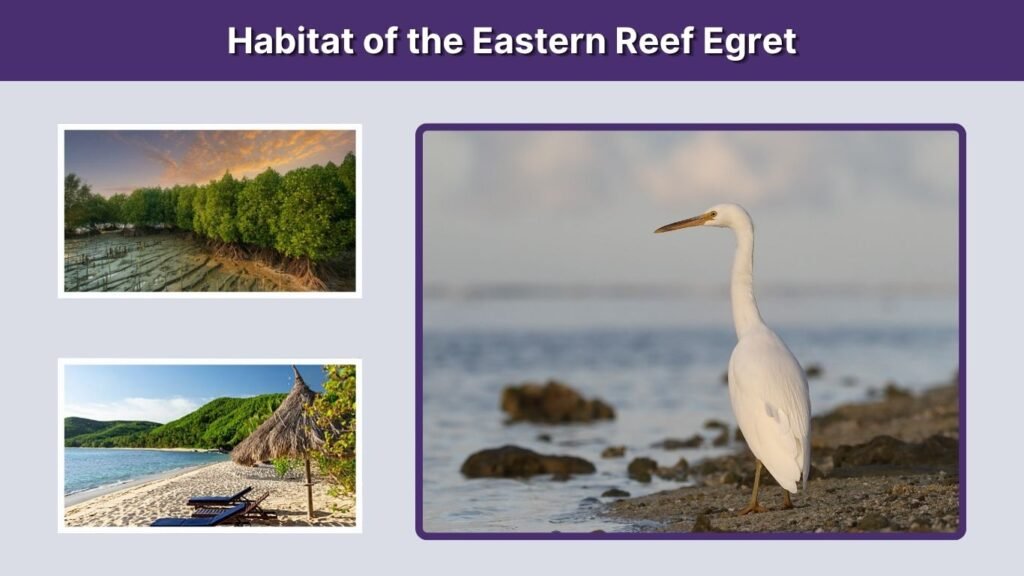
The Eastern Reef Egret is strongly connected to marine and intertidal habitats. Its dependence on the coast is one of the most useful clues for identification.
It may be found around:
- Rocky shorelines and exposed reefs
- Coral platforms and shallow lagoons
- Tidal pools and coastal channels
- Mangrove forests
- Estuaries and mudflats
- Sheltered bays and harbors
- Sandy beaches with shallow water
- Small coastal and offshore islands
Rocky shores offer excellent feeding opportunities because fish, crabs, mollusks, and other animals become trapped in pools as the tide falls. The dark morph’s slate-colored feathers may help it blend into shadowed rocks, while white birds can be less noticeable against bright sand, surf, or sunlit water.
Unlike many other herons, the Eastern Reef Egret is seldom seen around inland rivers, ponds, or freshwater marshes. An egret with the correct appearance but located far inland is more likely to be a different species.
Diet and Feeding Behavior
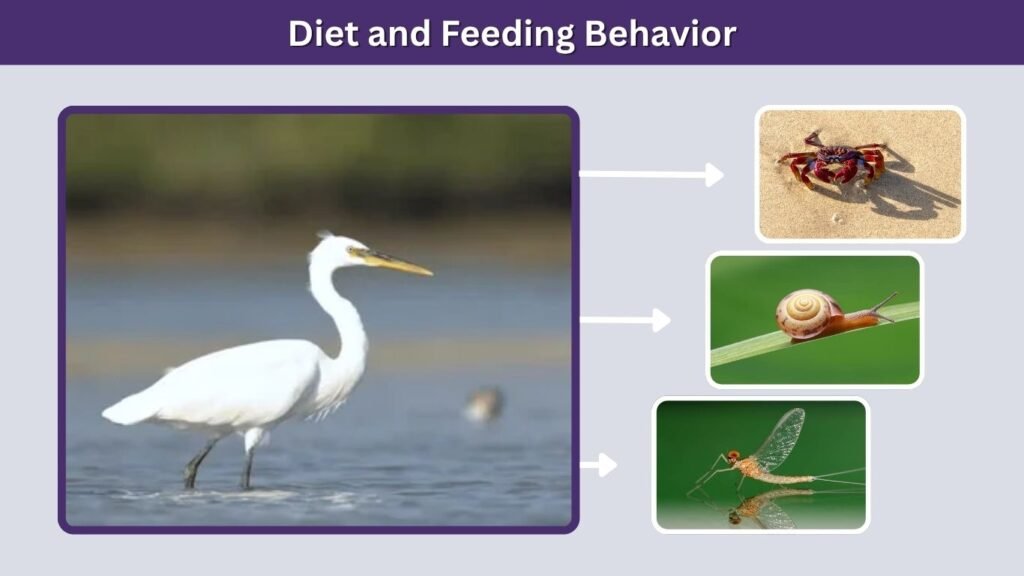
Eastern Reef Egrets are carnivorous birds that obtain most of their food from shallow saltwater and exposed intertidal areas. Their diet varies according to location, season, tide, and prey availability.
What Do Eastern Reef Egrets Eat?
| Food type | Common examples |
|---|---|
| Fish | Small reef and tidal-pool fish |
| Crustaceans | Crabs, shrimp, and prawns |
| Mollusks | Small snails and other soft-bodied species |
| Marine animals | Worms and small intertidal creatures |
| Insects | Coastal and aquatic insects |
| Other food | Occasionally food stolen from seabirds |
Small fish and crustaceans form a significant portion of the diet. The bird may also enter nesting seabird colonies and steal fish brought back by adult terns to feed their chicks.
Hunting Techniques
The Eastern Reef Egret uses several hunting methods. It often stands completely motionless beside a pool, watching for movement beneath the surface. When prey approaches, the bird rapidly extends its neck and strikes with its pointed bill.
At other times, it walks slowly through shallow water or across rocks. It may crouch low, lean forward, stir the water with its feet, or use its wings to create shade. Shading the water can reduce glare and may encourage fish to move into a position where they are easier to catch.
These egrets can hunt during both the day and night. Their feeding schedule is often influenced more by the tide than by the time of day. Low tide exposes pools and feeding flats, while a rising tide pushes fish and crustaceans into shallower areas.
Behavior and Communication
Eastern Reef Egrets are frequently seen alone, especially while feeding. An individual may defend a productive stretch of shoreline from other egrets. Nevertheless, several birds can gather in places where food is abundant.
The species usually walks with a slightly hunched posture. When flying, it pulls its head back toward its shoulders, bends its neck into an S-shape, and extends its legs behind the body. Its flight is direct, with broad, steady wingbeats, and it generally stays low over the shoreline.
This egret is not especially vocal. Its most familiar sound is a rough, harsh croak, often given when disturbed, during disputes, or near a nest. If approached too closely, it normally flies to another rock, tree, or section of coast.
Nesting and Reproduction
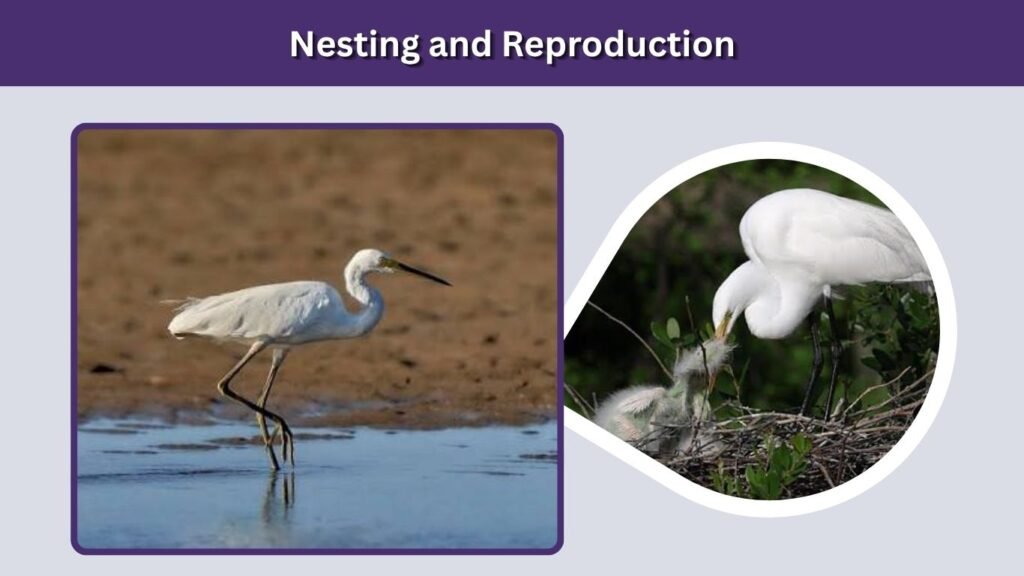
The timing of the breeding season varies considerably across the species’ large range. In warm tropical areas, nesting may occur during different parts of the year when weather and food conditions are suitable.
Courtship and Pair Formation
Breeding adults use display postures and their newly developed plumes to communicate. A male may select or begin preparing a nest site before a pair bond is fully formed. Courtship behavior can include stretching the neck, calling, raising the feathers, and presenting nest material.
Eastern Reef Egrets generally nest as solitary pairs or in small, loosely organized colonies. They may also breed near other coastal waterbirds.
Nest Location
Nest sites vary according to the available landscape. Common locations include:
- Rock ledges and coastal caves
- Crevices among cliffs or boulders
- Mangroves and low coastal trees
- Shrubs and palms on islands
- Sheltered areas on human-made structures
The nest is typically a loose, shallow platform constructed from sticks, twigs, grasses, and other plant material. A sheltered site protects the eggs and chicks from strong coastal winds, waves, intense sun, and certain predators.
Eggs and Chicks
A typical clutch contains two or three pale greenish-blue eggs, though clutch size can vary. Both parents participate in incubation and chick care. Incubation lasts approximately four weeks.
After hatching, the chicks remain dependent on their parents for several weeks. Adults feed them by regurgitating partly digested fish and other prey. Young birds gradually leave the immediate nest area before they are fully independent, but their parents may continue guarding and feeding them during this period.
How to Identify an Eastern Reef Egret
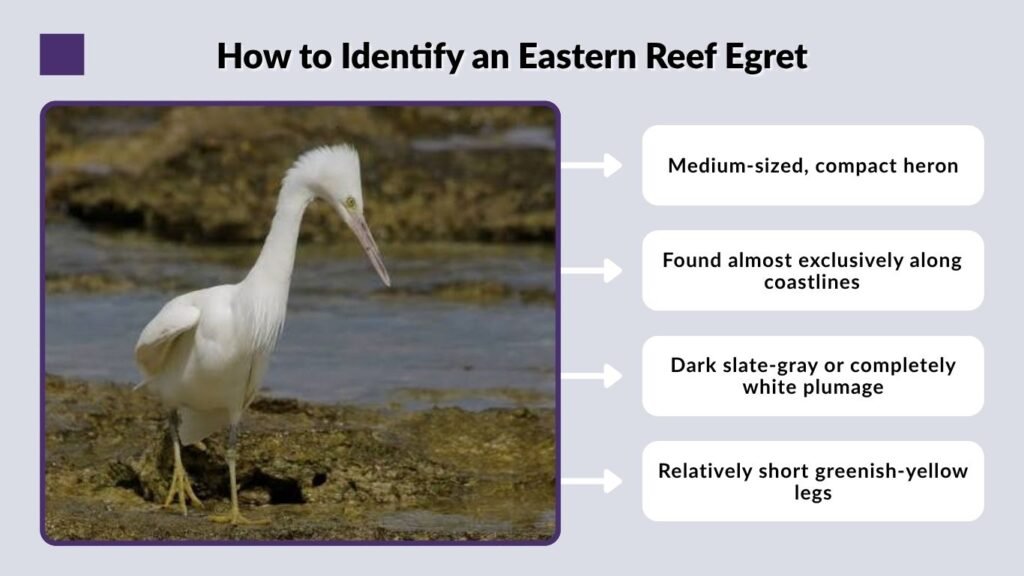
Habitat should be considered alongside plumage when identifying this species. A dark, uniformly colored heron moving across marine rocks is often easier to recognize than a white-morph individual.
Identification Features
- Medium-sized, compact heron
- Found almost exclusively along coastlines
- Dark slate-gray or completely white plumage
- Relatively short greenish-yellow legs
- Heavy grayish or yellowish bill
- Yellow eyes
- Slightly hunched posture when standing
- Head and neck pulled back during flight
- Patient stalking behavior around rocks and tidal pools
Similar Birds
A dark Eastern Reef Egret can be confused with a White-faced Heron. However, the White-faced Heron normally has a paler gray body, a noticeable white face, longer-looking legs, and a more upright posture. It also uses freshwater wetlands, fields, and other inland environments.
The white morph may resemble a Little Egret or other small white herons. The Eastern Reef Egret usually appears heavier and shorter-legged, has a stronger bill, and remains closely associated with rocky marine shores. Observing the bird’s habitat, proportions, leg color, and feeding behavior can help confirm its identity. New Zealand Birds Online provides a useful comparison of reef herons and similar coastal species.
Adaptations for Coastal Life
The Eastern Reef Egret possesses several features that allow it to thrive in an environment shaped by waves, tides, salt, and slippery surfaces.
Its short, strong legs provide balance on rocks, while its long toes help distribute its weight. The powerful bill can capture both fast-moving fish and hard-bodied prey such as crabs. Its flexible neck supplies the speed needed for sudden strikes.
The bird’s patient hunting style also conserves energy. Instead of continuously chasing prey, it can wait until a fish enters striking distance. Moreover, its willingness to feed at night lets it take advantage of favorable tides regardless of daylight.
Conservation Status and Threats
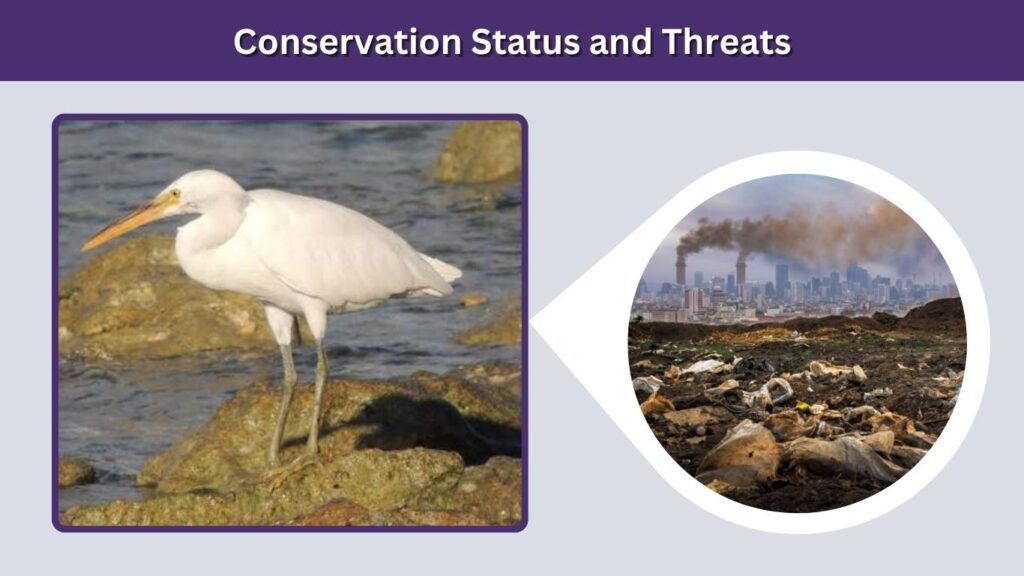
The Eastern Reef Egret has a very large geographical range and is presently classified as a species of Least Concern. It remains widely distributed, although local numbers vary considerably. BirdLife International monitors its status under the name Pacific Reef-egret.
Potential local threats include coastal development, disturbance around nesting sites, mangrove destruction, pollution, entanglement in fishing gear, and the loss of productive tidal habitat. Rising sea levels and more intense storms may also affect low-lying nesting islands and intertidal feeding grounds.
Protecting mangroves, rocky foreshores, estuaries, reefs, and offshore breeding sites benefits this egret along with numerous other coastal species.
FAQs
Is the Eastern Reef Egret the same as the Pacific Reef Heron?
Yes. Eastern Reef Egret, Pacific Reef Heron, and Eastern Reef Heron are commonly used names for Egretta sacra. The preferred common name differs among regions and bird authorities, but all three names generally refer to the same coastal species.
Why are some Eastern Reef Egrets white and others gray?
The species naturally occurs in dark and white color morphs. This difference is not caused by sex, age, or season. The precise ecological advantage remains uncertain, although each form may receive better camouflage under particular coastal conditions.
Where does the Eastern Reef Egret sleep?
It usually rests on sheltered rocks, in mangroves, on coastal trees, or on other secure perches close to feeding areas. A roost site must provide protection from waves, harsh weather, ground predators, and excessive human disturbance.
Do Eastern Reef Egrets live in freshwater habitats?
They are overwhelmingly coastal birds associated with reefs, tidal pools, mangroves, estuaries, and beaches. They may occasionally enter brackish areas, but they are rarely found at inland freshwater wetlands. Their strong connection to saltwater helps separate them from similar herons.
Are Eastern Reef Egrets endangered?
No. The species is currently classified as Least Concern because it has an extensive range. However, individual populations can be affected by habitat destruction, pollution, coastal construction, human disturbance, and damage to nesting sites.
