
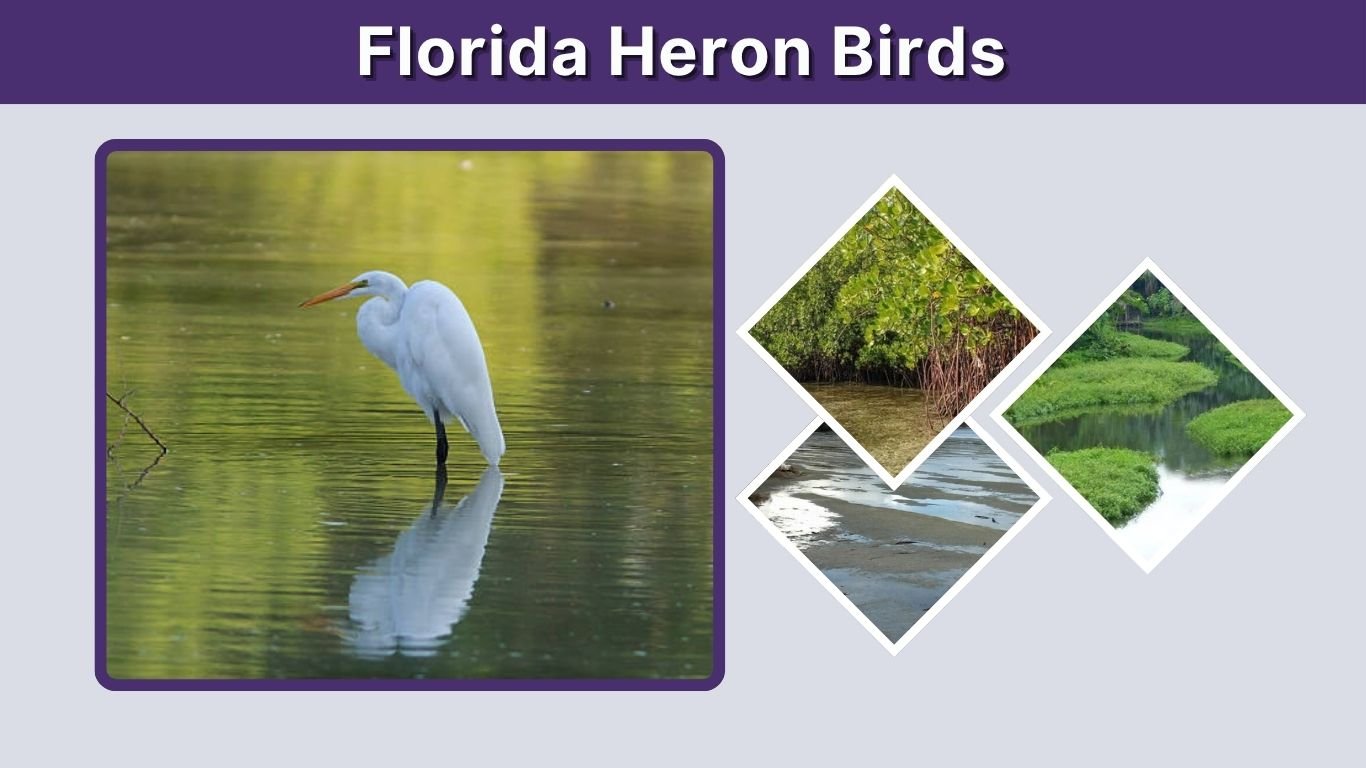
Florida’s marshes, mangroves, ponds, canals, lakes, and coastal flats support an impressive variety of herons. Some are tall and blue-gray, while others are small, dark, white, or brown. The Great Blue Heron is the most noticeable, but birdwatchers may also encounter Little Blue, Tricolored, Green, Black-crowned, and Yellow-crowned Night Herons. Learning their size, colors, bill shape, and feeding behavior makes identification much easier.
Common Heron Birds in Florida
Florida’s varied freshwater and coastal wetlands provide feeding and nesting habitat for several members of the heron family.
| Heron | Main identification feature | Typical Florida habitat |
| Great Blue Heron | Very large, blue-gray body | Almost any wetland |
| Little Blue Heron | Dark blue body and purple neck | Marshes, ponds and estuaries |
| Tricolored Heron | Blue-gray body with white belly | Coastal marshes and lagoons |
| Green Heron | Small, dark and compact | Vegetated pond and canal edges |
| Black-crowned Night Heron | Gray body and black crown | Ponds, mangroves and roosts |
| Yellow-crowned Night Heron | Black-and-white face | Coastal wetlands and wet lawns |
| Great White Heron | Large, entirely white form | Mainly South Florida and the Keys |
Florida wildlife records include Great Blue, Little Blue, Tricolored, Green, and night herons among the state’s breeding waterbirds.
1. Great Blue Heron
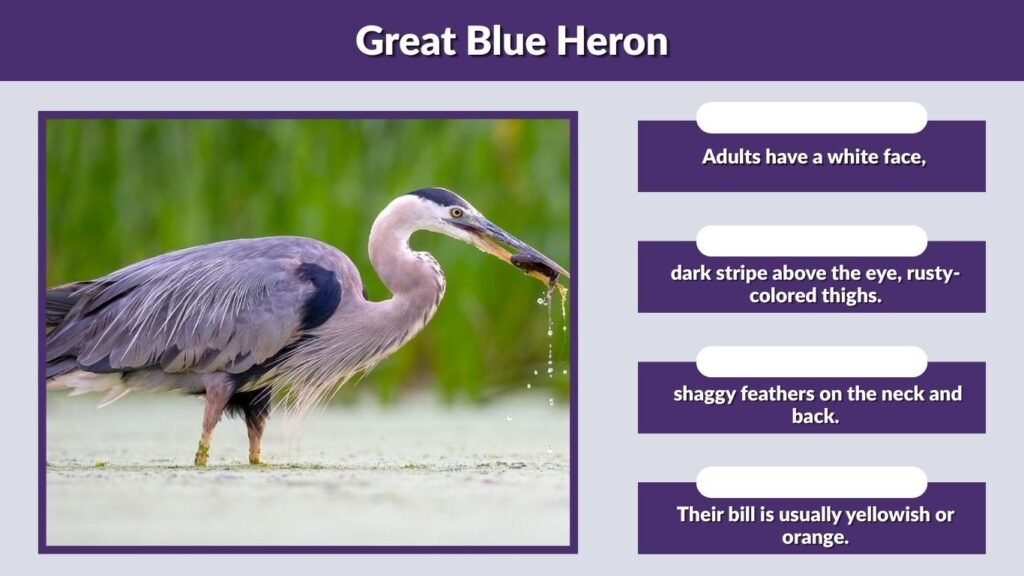
The Great Blue Heron is the largest heron regularly seen in Florida. It has long legs, a thick dagger-shaped bill, a blue-gray body, and a long neck that often forms an S shape.
Identification
Adults have a white face, dark stripe above the eye, rusty-colored thighs, and shaggy feathers on the neck and back. Their bill is usually yellowish or orange. When flying, the bird folds its neck against its body while allowing its legs to trail behind the tail.
Great Blue Herons often stand motionless in shallow water before striking quickly at fish. They also eat frogs, snakes, insects, small mammals, and other animals that they can capture.
Great White Heron
The Great White Heron is not generally treated as a completely separate species. It is a white form of the Great Blue Heron associated mainly with South Florida, the Florida Keys, and nearby Caribbean areas.
It has an entirely white body, a heavy yellow bill, and pale legs. This separates it from the Great Egret, which normally has black legs and a more slender body. Florida also has an intermediate form known as Wurdemann’s Heron, which generally has a white head and a blue-gray body.
2. Little Blue Heron
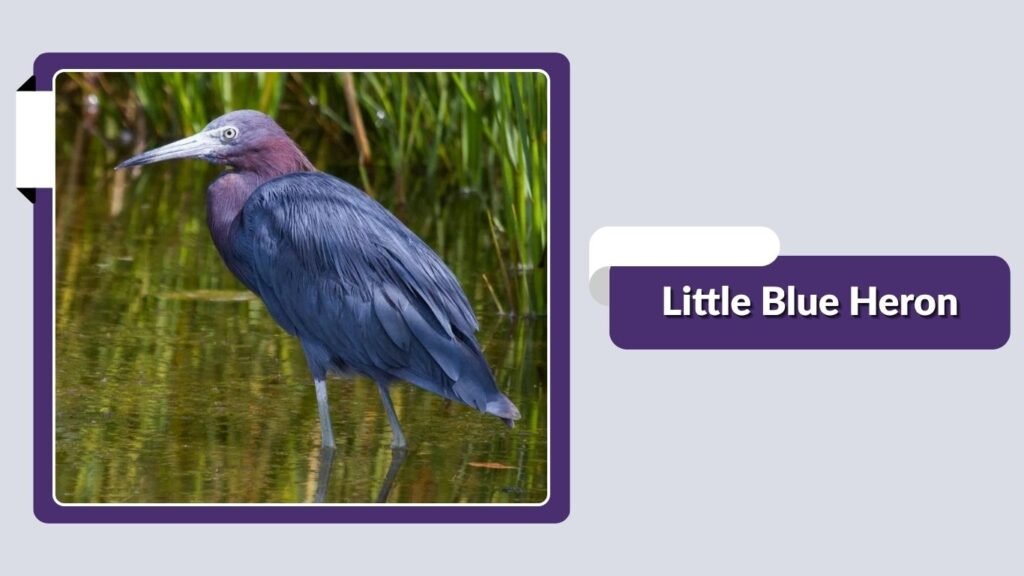
The Little Blue Heron is much smaller and more compact than the Great Blue Heron. Adults have a dark slate-blue body, a rich purple or maroon head and neck, greenish legs, and a two-toned bill that is pale blue near the face and black at the tip.
Why Are Some Little Blue Herons White?
Young Little Blue Herons are almost entirely white during their first year. As they mature, they develop patches of blue feathers, creating a white-and-blue appearance sometimes called pied plumage. Eventually, they become completely dark.
Young Little Blue Herons can resemble Snowy Egrets. However, juvenile Little Blues generally have greenish legs and darker feet, while Snowy Egrets have black legs with noticeably yellow feet.
Little Blue Herons forage slowly in shallow freshwater or brackish wetlands, capturing small fish, frogs, crustaceans, and aquatic insects.
3. Tricolored Heron
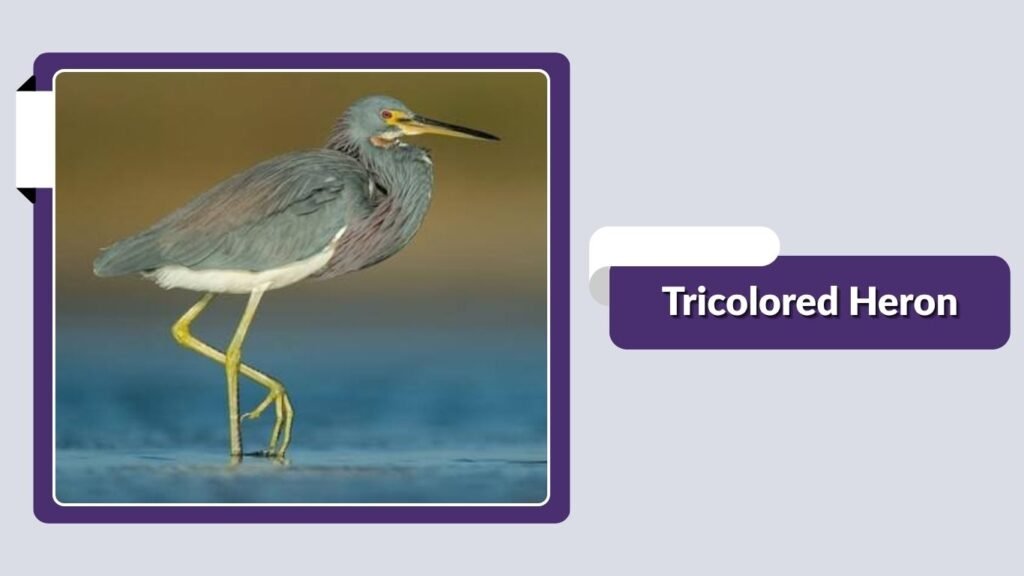
The Tricolored Heron is a slender, medium-sized bird with blue-gray wings, a purple or reddish neck, and a bright white belly. A white stripe running down the front of the neck is another useful identification feature.
The “Dancing” Florida Heron
A Tricolored Heron may appear to dance while hunting. Instead of remaining still, it frequently runs through shallow water, turns sharply, flaps its wings, and chases small fish.
This active hunting style distinguishes it from the slower Great Blue and Little Blue Herons. Tricolored Herons are particularly associated with coastal lagoons, salt marshes, mangroves, estuaries, and brackish wetlands, although they also visit freshwater canals and lake edges.
4. Green Heron
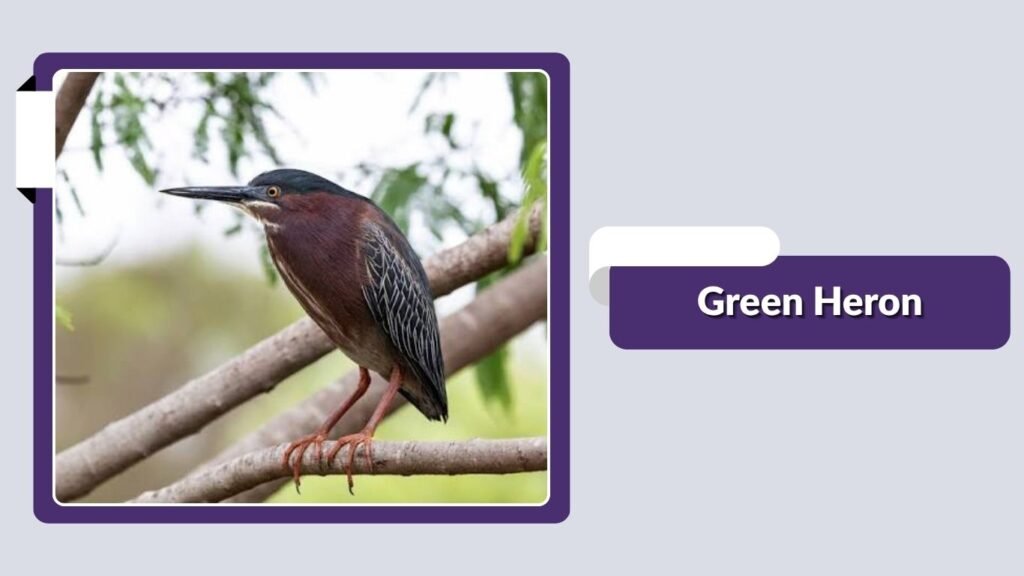
The Green Heron is a small, stocky bird that frequently hides among branches, reeds, and thick plants near water. Despite its name, it is not bright green.
Adults have a dark greenish-black cap and back, a chestnut-colored neck, a thick pointed bill, and yellowish legs. Juveniles are browner, with pale streaks on the neck and spots on the wings.
A Tool-Using Heron
Green Herons sometimes place insects, feathers, bread, or other small objects on the water as bait. When a fish approaches, the bird strikes. This makes the Green Heron one of the relatively few bird species known to use tools while feeding.
In Florida, Green Herons can be found along ponds, canals, lakes, marshes, mangrove edges, and wooded streams. Some populations remain in southern states throughout the year.
5. Night Herons in Florida
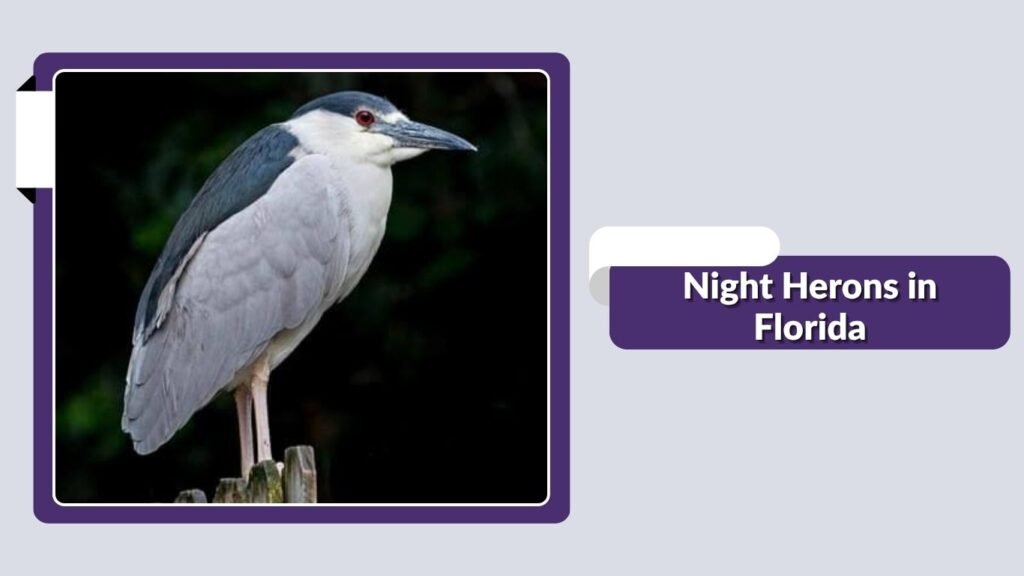
Florida supports both the Black-crowned and Yellow-crowned Night Heron. These birds are shorter, heavier, and more compact than typical long-necked herons.
Black-Crowned Night Heron
Adult Black-crowned Night Herons have pale gray bodies, black backs and crowns, red eyes, thick dark bills, and relatively short yellow legs. They commonly rest in shaded trees during the day and fly toward feeding areas around evening.
Juveniles are brown with pale spots and streaks, making them look very different from adults. Their harsh, barking flight calls are often heard after sunset.
Yellow-Crowned Night Heron
The Yellow-crowned Night Heron has a purple-gray body, a bold black-and-white face, red eyes, a thick black bill, and a pale yellow crown. Juveniles are brown and streaked, with smaller wing spots and a heavier bill than young Black-crowned Night Herons.
Yellow-crowned Night Herons are strongly associated with crabs and crayfish. They may hunt in mangroves, tidal areas, drainage channels, wet lawns, and residential neighborhoods near water during either day or night.
Heron-Like Birds in Florida
Not every long-legged Florida waterbird is a heron. Several unrelated species have similar silhouettes.
Egrets
Great Egrets and Snowy Egrets belong to the same family as herons. Great Egrets are tall and white with yellow bills and black legs. Snowy Egrets are smaller, with thin black bills, black legs, and yellow feet.
Ibises and Wood Storks
White Ibises have curved orange-red bills, while Wood Storks have heavy downward-curving bills and bare dark heads. Herons generally have straight, pointed bills.
Sandhill Cranes
A large gray bird with a red forehead is likely a Sandhill Crane rather than a heron. Cranes fly with their necks stretched forward, whereas herons normally retract their necks into an S-shaped position.
Anhingas and Cormorants
Dark birds swimming with long necks may be Anhingas or cormorants. These birds frequently dive underwater and perch with their wings spread to dry.
Where to See Herons in Florida
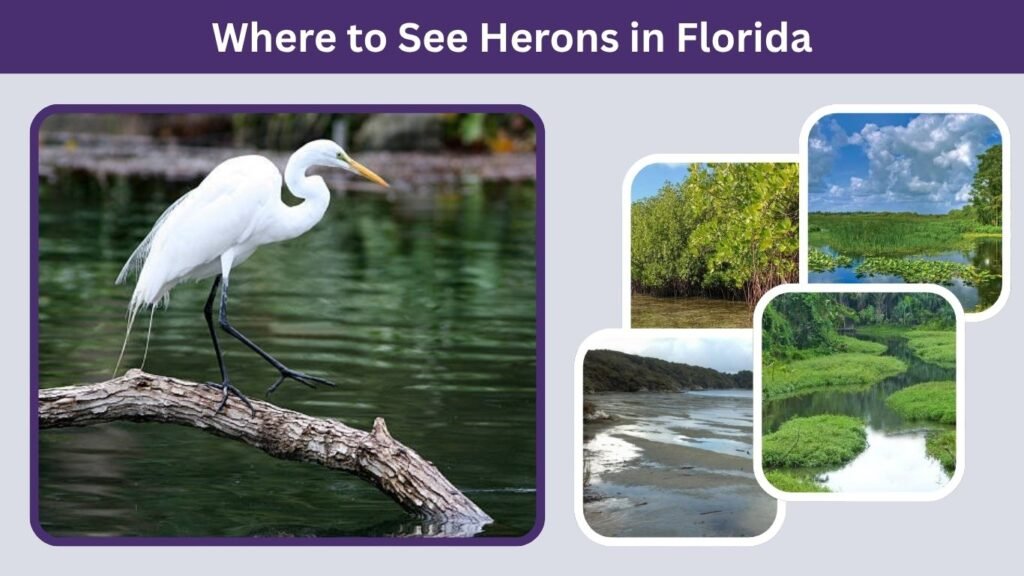
Herons can be observed throughout Florida wherever shallow water provides fish, frogs, insects, or crustaceans.
Productive locations include:
- Everglades wetlands
- Coastal mangroves
- Wildlife refuges
- Freshwater marshes
- Urban ponds and canals
- Estuaries and tidal flats
- Lake and river shorelines
- Wetland boardwalks
- Stormwater ponds
- Beaches near tidal lagoons
Early morning and late afternoon usually provide good viewing conditions. Night herons are especially active around dusk, while Great Blue, Little Blue, and Tricolored Herons commonly feed throughout the day.
Nesting and Conservation
Many Florida herons build stick nests in trees or shrubs, often forming mixed colonies with egrets, ibises, and other waterbirds. Coastal colonies frequently occur on mangrove islands that offer protection from land predators.
People should remain well away from nesting colonies. Frightened adults may leave eggs and chicks exposed to heat, weather, or predators. Boaters and photographers should obey posted closures and avoid approaching birds that begin calling, stretching their necks, or leaving their nests.
FAQs
What is the most common large blue heron in Florida?
The Great Blue Heron is Florida’s most recognizable large blue-gray heron. It has extremely long legs, an S-shaped neck, a heavy yellowish bill, and a dark stripe above the eye. It occurs in freshwater and coastal habitats across the state.
What is the small blue heron in Florida?
The Little Blue Heron is a compact, dark blue-gray bird with a purple neck and two-toned bill. The Tricolored Heron is another possibility, but it has a slimmer body, a white belly, and a white line down its neck.
What is the white heron found in the Florida Keys?
A very large white heron in the Florida Keys may be a Great White Heron, the white form of the Great Blue Heron. Great Egrets also occur there but have slimmer bills and black rather than pale legs.
Are Florida herons dangerous?
Herons normally avoid people and are not aggressive under ordinary circumstances. However, their sharp bills can cause serious injury when a bird is trapped or handled. Injured herons should be left for a licensed wildlife rehabilitator to manage.
Do Florida herons stay throughout the year?
Several species can be seen in Florida year-round, although their local abundance changes with migration, rainfall, nesting activity, and water levels. Florida’s warm climate and extensive wetlands provide suitable feeding habitat during every season.