
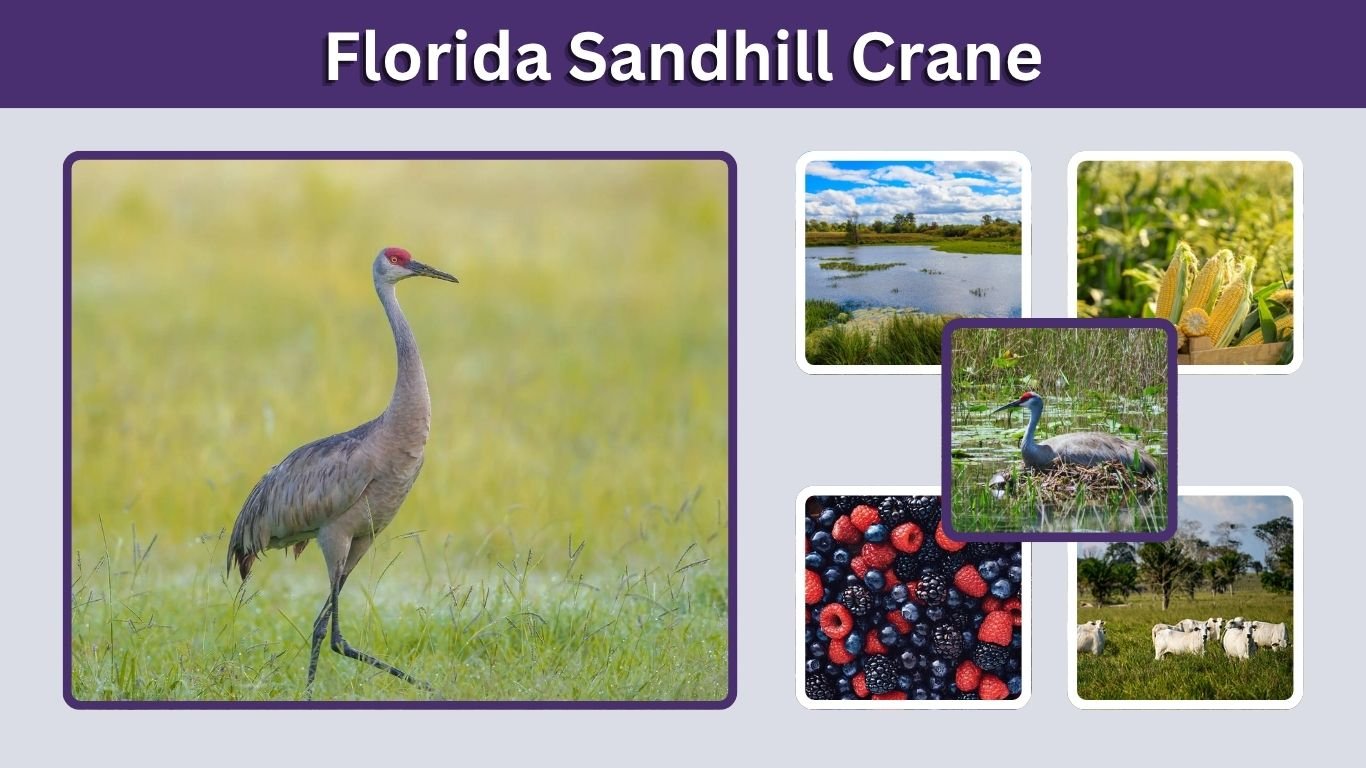
The Florida sandhill crane is a tall, gray bird known for its red crown, rolling trumpet call, and energetic courtship dance. Unlike migratory sandhill cranes that visit Florida during winter, the Florida subspecies remains in the state throughout the year. These cranes inhabit marshes, prairies, pastures, golf courses, and suburban communities. They are legally protected, and intentionally feeding, harming, or harassing them is prohibited in Florida.
What Is a Florida Sandhill Crane?
The Florida sandhill crane is a nonmigratory subspecies of the sandhill crane. Its scientific name is Antigone canadensis pratensis, though older resources may use Grus canadensis pratensis.
Approximately 4,600 Florida sandhill cranes remain. Their range extends from southeastern Georgia through peninsular Florida to the Everglades. Florida classifies the subspecies as State-designated Threatened because of its limited population and continued habitat loss.
Florida also receives about 25,000 migratory greater sandhill cranes each winter. These larger cranes generally arrive during November and December and leave during March and April.
Florida Sandhill Crane Identification
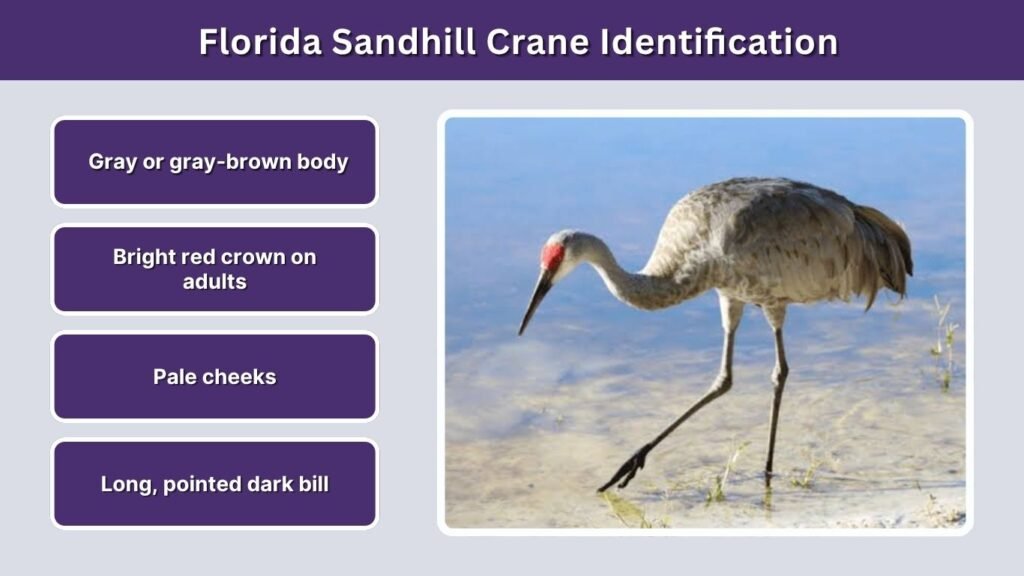
Florida sandhill cranes are large, long-legged birds with gray plumage and a distinctive patch of bare red skin on the crown.
Key Identification Features
- Gray or gray-brown body
- Bright red crown on adults
- Pale cheeks
- Long, pointed dark bill
- Long black legs
- Broad, rounded wings
- Drooping rear feathers resembling a bustle
- Neck held straight during flight
Their feathers may develop rusty-brown staining when cranes rub iron-rich mud onto their bodies. Juveniles are mostly brown or cinnamon-colored and do not initially have the bright red crown seen on adults.
Florida Sandhill Crane Height and Wingspan
An adult Florida sandhill crane can stand approximately 47 inches, or nearly four feet tall. Its wingspan may reach about 79 inches, or approximately 6.5 feet.
| Measurement | Typical figure |
| Standing height | About 47 inches |
| Wingspan | About 79 inches |
| Body length | Around 47 inches |
| General weight | Approximately 7.5–11 pounds |
| Typical clutch | Two eggs |
Males are normally larger than females, but both sexes have nearly identical coloration. Their sex usually cannot be determined reliably from appearance alone.
Where Do Florida Sandhill Cranes Live?
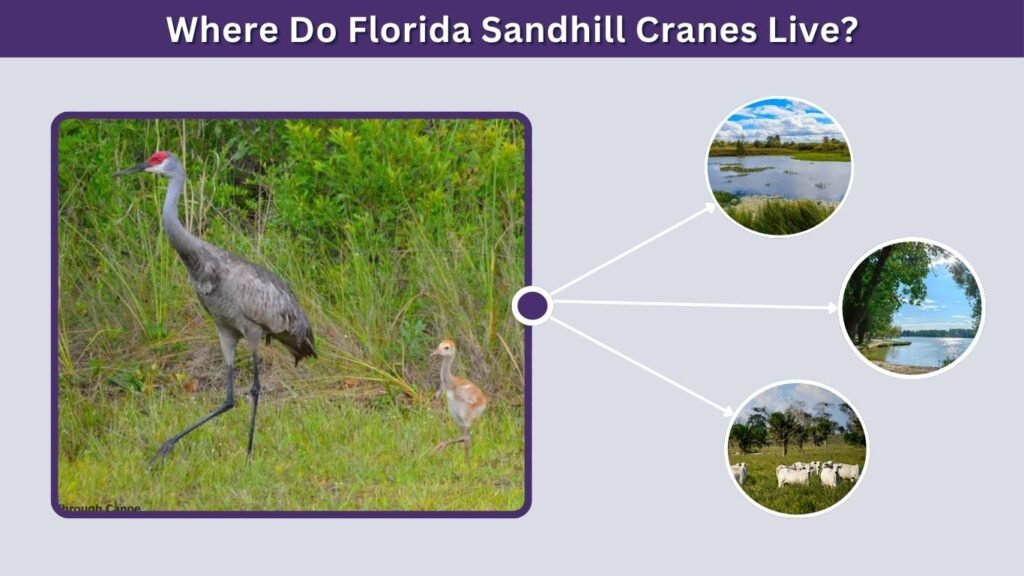
Florida sandhill cranes occur mainly throughout peninsular Florida, from the Everglades north toward the Okefenokee Swamp. Particularly important populations occur in the Kissimmee and DeSoto prairie regions.
Florida Sandhill Crane Habitat
These cranes require both wetlands and open uplands. Important habitats include:
- Freshwater marshes
- Wet prairies
- Shallow ponds
- Lake margins
- Pastures and ranchland
- Dry prairies
- Golf courses
- Suburban lawns
- Agricultural fields
Wetlands provide nesting, roosting, and feeding areas. Nearby uplands with short vegetation give cranes space to forage, rest, and watch for predators. The loss of either habitat type can make an area unsuitable.
Human development has pushed more cranes into neighborhoods, golf courses, airports, and other urban environments containing mowed grass and artificial ponds.
What Do Florida Sandhill Cranes Eat?
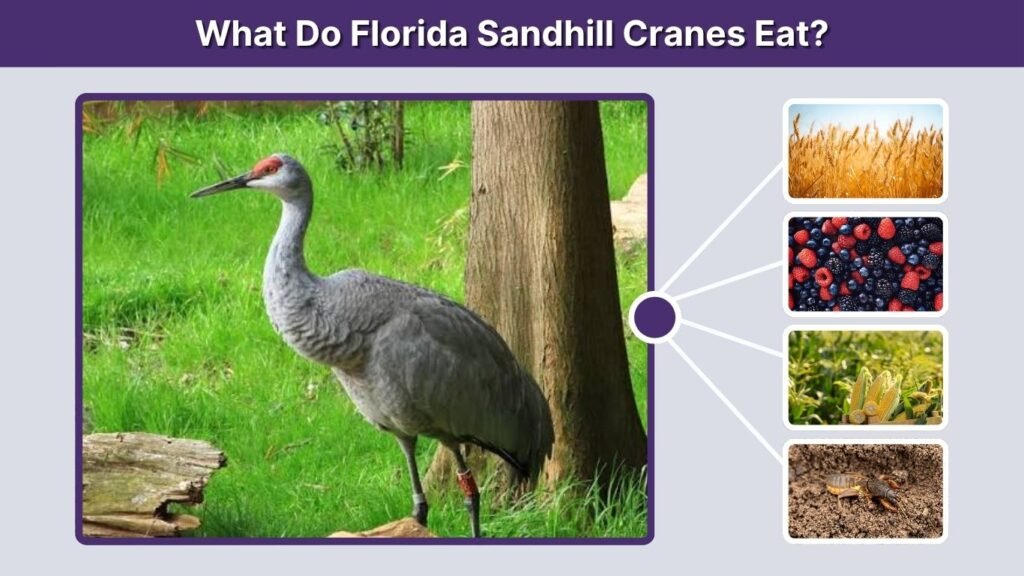
Florida sandhill cranes are omnivores. They eat plant material and small animals while walking through wetlands, fields, and lawns.
Florida Sandhill Crane Diet
Their natural foods include:
- Seeds and grains
- Berries and acorns
- Plant roots and tubers
- Corn and peanuts
- Earthworms
- Mole crickets
- Beetle grubs
- Snails and crayfish
- Frogs and lizards
- Small snakes
- Mice and other small mammals
- Occasionally small birds
They usually collect food from the ground or probe soft soil with their bills. Unlike great blue herons, sandhill cranes do not normally stand in deep water waiting to spear fish.
Is It Illegal to Feed Sandhill Cranes in Florida?
Yes. Intentionally feeding sandhill cranes has been illegal in Florida since 2002 under Florida Administrative Code 68A-4.001(6). The rule also applies when people deliberately place food where cranes can obtain it.
Why Feeding Is Harmful
Regular feeding may cause cranes to:
- Lose their natural fear of people
- Approach people and demand food
- Peck or behave defensively
- Walk across dangerous roads
- Become dependent on nutritionally poor food
- Damage windows, screens, or vehicles
- Gather in unsuitable urban areas
- Face greater risks from pets and power lines
Spilled birdseed, accessible pet food, and unsecured garbage can unintentionally attract cranes. Bird feeders should be designed and positioned to minimize seed falling onto the ground.
The FWC does not advertise one universal fixed fine for every feeding violation. Penalties can depend on the circumstances and enforcement action, so claims of a single guaranteed fine should be treated cautiously.
Are Sandhill Cranes Protected in Florida?
Florida sandhill cranes are protected under Florida law as a State-designated Threatened subspecies. Sandhill cranes are also covered by the federal Migratory Bird Treaty Act, which prohibits unauthorized killing, capturing, selling, trading, or transporting protected migratory birds.
It is illegal to intentionally:
- Shoot or kill a crane
- Injure or capture one
- Destroy an active nest
- Take eggs or chicks
- Strike cranes with objects
- Keep an injured crane without authorization
- Harass cranes in prohibited circumstances
Can You Hunt Sandhill Cranes in Florida?
No recreational sandhill crane hunting season is provided in Florida’s 2026–2027 migratory bird regulations, and FWC states that sandhill cranes may not be harmed. Therefore, hunters cannot legally shoot Florida sandhill cranes or migratory greater sandhill cranes while they are in Florida.
Hunting opportunities in certain other states do not make crane hunting legal in Florida.
Are Florida Sandhill Cranes Aggressive?
Sandhill cranes generally avoid serious conflict, but they are large, territorial birds capable of defending themselves. A crane may spread its wings, hiss, peck, charge, or kick when protecting its nest, mate, or flightless chicks.
Cranes accustomed to receiving food are more likely to approach people closely. The FWC reports rare cases of habituated cranes pecking people, which is another reason feeding is prohibited.
Keep children and pets away from cranes, especially during nesting season. Do not corner, chase, touch, or attempt to hand-feed them.
Nesting and Mating Season in Florida
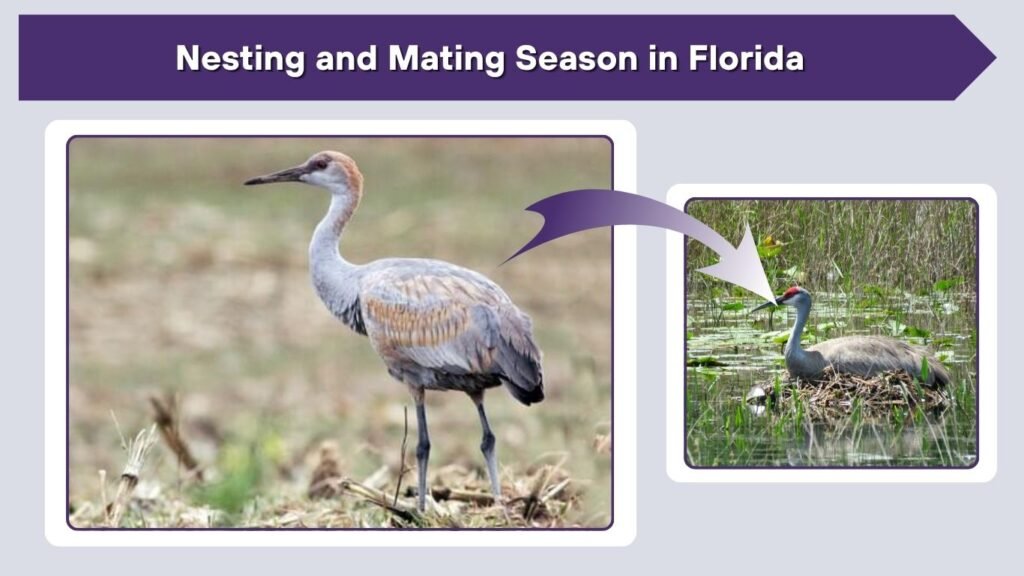
Florida sandhill cranes breed primarily during winter and spring, though FWC records indicate nesting activity can extend from January through August. For conflict-management purposes, FWC identifies December 1 through May 1 as the main breeding season.
Nest and Eggs
Both adults construct a mound from grasses, moss, sticks, and wetland vegetation. The nest is normally placed in shallow water, which helps protect it from terrestrial predators.
The female usually lays two eggs. Both parents share incubation for approximately 32 days.
Florida Sandhill Crane Chicks
Crane chicks are called colts because their long legs make them resemble young horses. They hatch covered in cinnamon-colored down and can leave the nest within approximately 24 hours.
The parents feed, guide, and protect their colts. Although two eggs are commonly laid, both young do not always survive. Juveniles may remain with their parents for about ten months.
People should remain at least 400 feet away from active crane nests and adults accompanying flightless young. Mowing, landscaping, tree trimming, and other disruptive activities should be avoided within that distance.
Do Florida Sandhill Cranes Migrate?
Florida sandhill cranes are permanent residents and normally remain within Florida and southeastern Georgia throughout the year.
However, larger migratory greater sandhill cranes arrive in Florida for winter. This explains why crane numbers increase sharply during late fall and decrease again during spring.
| Feature | Florida sandhill crane | Greater sandhill crane |
| Seasonal pattern | Nonmigratory resident | Migratory winter visitor |
| Relative size | Intermediate | Larger and heavier |
| Florida presence | All year | Mainly winter |
| Breeding area | Florida and southeastern Georgia | Great Lakes and northern regions |
| State status | Threatened subspecies | Winter visitor |
Because their plumage is nearly identical, size, location, season, and behavior are more useful than color when separating the two.
Florida Sandhill Crane Lifespan
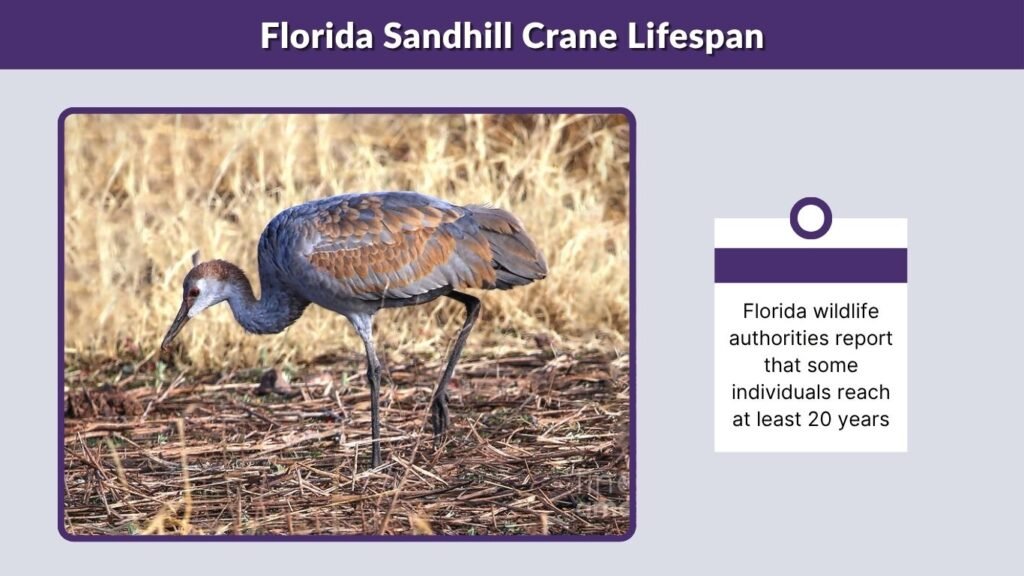
Sandhill cranes are long-lived birds. Florida wildlife authorities report that some individuals reach at least 20 years, while the oldest documented sandhill crane lived for more than 37 years.
Their major threats include:
- Wetland drainage
- Loss of open prairie
- Road collisions
- Power-line strikes
- Pesticide poisoning
- Predation on chicks
- Disturbance near nests
- Illegal feeding and habituation
Habitat loss caused by roads, shopping centers, subdivisions, and agricultural conversion remains the primary long-term threat to the Florida population.
What to Do If You Find an Injured Crane
Do not attempt to capture, treat, or keep an injured sandhill crane. Its bill, wings, and feet can cause injury, and possessing protected wildlife without authorization may violate state and federal law.
Note the exact location, keep people and pets away, and contact a licensed Florida wildlife rehabilitator. When a rehabilitator cannot be reached, contact the appropriate FWC regional office or use the FWC Wildlife Alert system.
FAQs
Are sandhill cranes native to Florida?
Yes. The Florida sandhill crane is a native, nonmigratory subspecies that lives and breeds in Florida throughout the year. Migratory greater sandhill cranes also visit the state during winter.
Where do sandhill cranes sleep in Florida?
They usually roost in shallow ponds, marshes, or lake margins. Standing water gives the birds greater protection because approaching predators create movement and noise that can alert them.
When do Florida sandhill cranes lay eggs?
Egg laying occurs mainly during late winter and spring, although nesting can extend beyond that period. A female typically lays two eggs in a vegetation mound constructed in shallow water.
Why are Florida sandhill cranes protected?
Their population is relatively small, and they have lost substantial wetland and prairie habitat to development and agriculture. Their slow reproduction also means populations cannot replace losses quickly.
What should you do when a crane approaches you?
Do not feed or touch it. Secure food, keep pets and children back, and slowly create distance. A crane that repeatedly approaches people has probably been fed and has lost some of its natural caution.
