
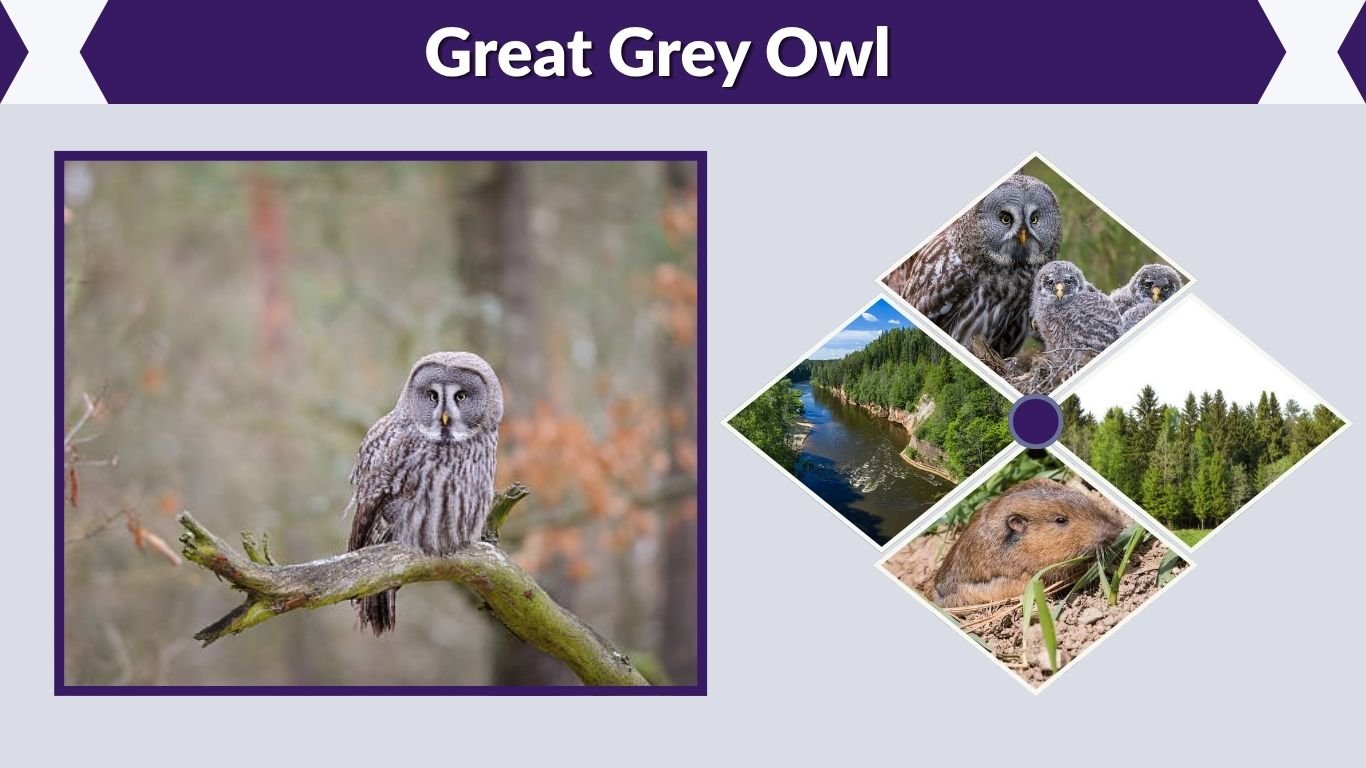
The great grey owl is a tall, elusive bird of prey known for its enormous round face, silvery plumage, piercing yellow eyes and almost silent flight. Its scientific name is Strix nebulosa, and it lives mainly in the cold forests of the Northern Hemisphere. Although it appears massive, much of its impressive size comes from thick feathers rather than body weight. Great grey owls are skilled rodent hunters that can locate prey hidden beneath deep snow using extraordinarily sensitive hearing.
Great Grey Owl Identification
The great grey owl has a distinctive appearance that makes an adult relatively easy to recognise. It possesses a large, rounded head without visible ear tufts and one of the biggest facial discs of any owl.
Its plumage is primarily silver-grey, brown and white. Fine streaks and bars cover the feathers, providing excellent camouflage against tree bark. A white patch beneath the bill resembles a bow tie and usually has a dark centre.
Important identification features include:
- A huge circular facial disc
- Bright yellow eyes
- A small yellow bill
- No external ear tufts
- Silvery-grey, brown and white plumage
- A long tail and broad wings
- White markings around the neck
- Heavily feathered legs and feet
The facial disc contains dark concentric rings that direct sound toward the ears. Its eyes may look small compared with the size of its face, but they give the owl an intense expression.
Juvenile great grey owls have softer, fluffier plumage and less sharply defined facial patterns. As they mature, their feathers become more similar to those of an adult.
Great Grey Owl Size
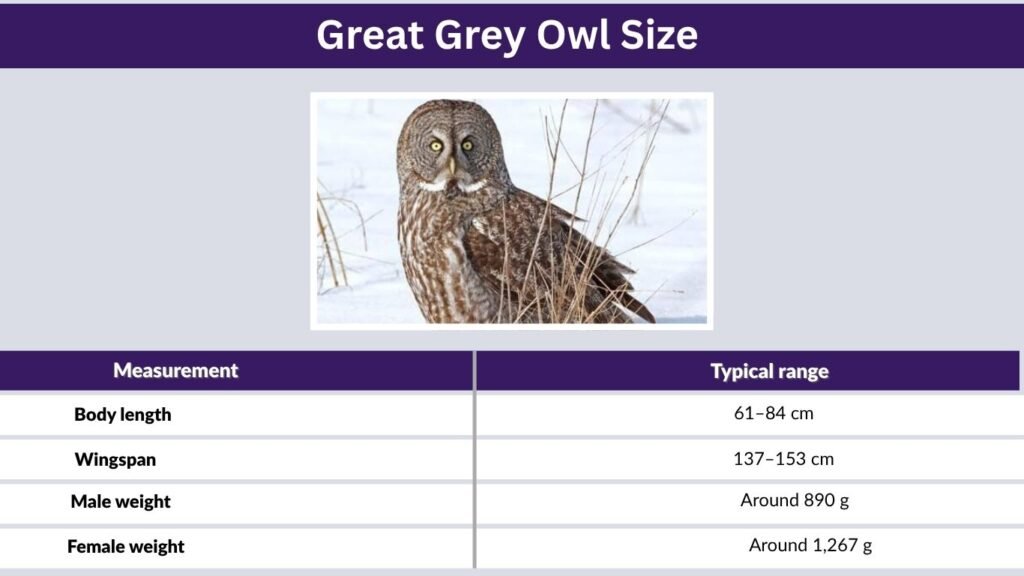
The great grey owl is one of the tallest owl species in the world. Adults are approximately 61–84 centimetres, or 24–33 inches, long. Their wingspan generally measures about 137–153 centimetres, equivalent to roughly 54–60 inches. Females are normally larger and heavier than males.
| Measurement | Typical range |
|---|---|
| Body length | 61–84 cm |
| Wingspan | 137–153 cm |
| Male weight | Around 890 g |
| Female weight | Around 1,267 g |
Despite its height and broad appearance, the great grey owl is not exceptionally heavy. Its body beneath the feathers is considerably smaller than it appears. A great horned owl may look shorter but can weigh substantially more.
The great grey owl is larger in length than a great horned owl and a barred owl. However, it is still smaller than a bald eagle. Its long feathers, broad wings and enormous facial disc create most of its apparent bulk.
Great Grey Owl Next to a Human
When perched beside an adult human, a great grey owl may reach approximately knee height. Its large head and dense feathers can make it look much bigger, especially when it fluffs its plumage.
The owl’s wingspan can be similar to the height of a shorter adult person. However, comparisons should be viewed carefully because posture, feather position, sex and camera perspective can make an individual appear larger or smaller.
Great Grey Owl Range
Great grey owls occur across the northern parts of North America, Europe and Asia. Their global distribution follows the broad belt of boreal forest that circles much of the Northern Hemisphere.
In North America, they occur primarily in:
- Alaska
- Much of Canada
- The northern Rocky Mountains
- Minnesota
- Parts of the Pacific Northwest
- Scattered western mountain regions
In Europe and Asia, their range includes areas of Scandinavia, Finland, Russia, Mongolia and northern Asia.
Most populations are resident rather than long-distance migrants. However, great grey owls sometimes travel south or move to lower elevations when rodent populations decline. This irregular movement is known as an irruption.
Irruptions can bring unusually large numbers into places such as northern Minnesota, where birdwatchers may see owls hunting along roads, forest clearings and open fields. These movements are usually driven by food availability rather than a predictable annual migration.
Great Grey Owl Habitat
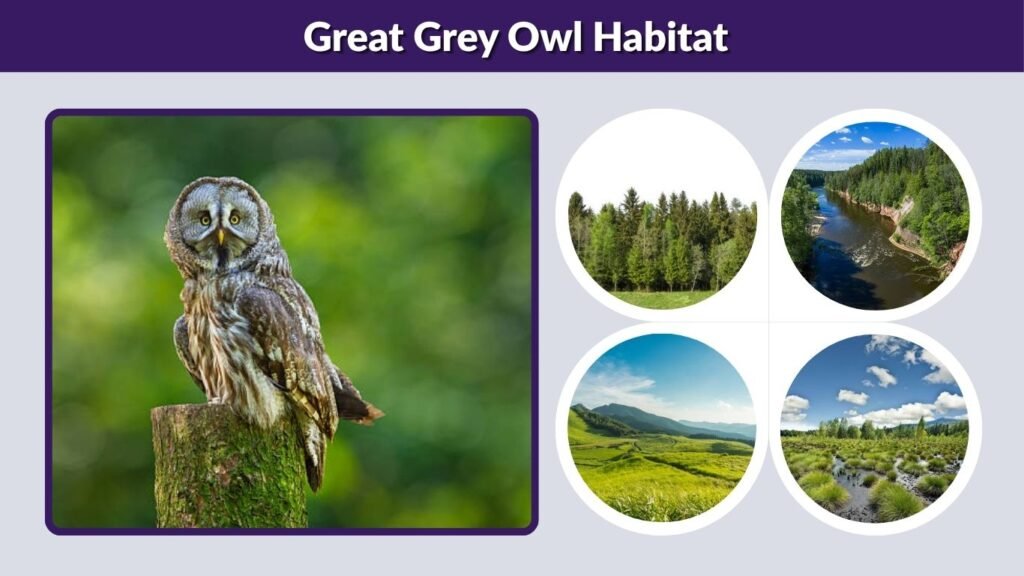
The great grey owl is strongly associated with boreal and coniferous forests. It requires a combination of wooded nesting sites and nearby open hunting grounds.
Common habitats include:
- Dense evergreen forests
- Mixed coniferous and deciduous woodlands
- Mountain forests
- Bogs and muskegs
- Meadows and clearings
- Forest burns
- Marshy forest edges
- Open areas near mature trees
Dense woodland provides shelter, nesting places and protected roosts. Open meadows, bogs and clearings support voles and other small mammals that form the owl’s main food supply.
The species often perches on a low branch at the edge of an opening while listening for prey. Mature forests are particularly important because they offer old nests, broken tree trunks and large structures suitable for breeding.
What Do Great Grey Owls Eat?
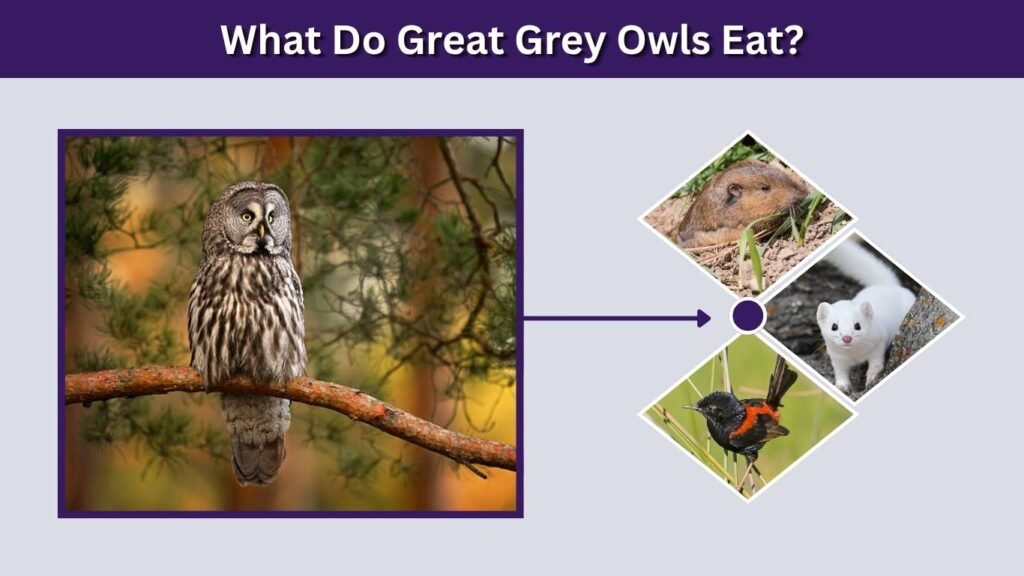
Great grey owls are carnivores that feed mainly on small mammals. Voles are their most important prey in many regions, but their exact diet changes with location and availability.
Their food may include:
- Voles
- Mice
- Pocket gophers
- Shrews
- Lemmings
- Small squirrels
- Weasels
- Moles
- Small birds
- Frogs
These owls usually hunt from a low perch overlooking an open area. They remain still while watching and listening for movement. Once prey is detected, the owl glides forward and drops feet-first onto it.
Great grey owls swallow small prey whole. They later regurgitate compact pellets containing indigestible fur, bones, teeth and claws. Scientists can examine these pellets to study the owl’s diet.
Although the birds may hunt at night, they are also active around dawn and dusk. They sometimes hunt during daylight, particularly in winter or when they must provide frequent meals for growing chicks.
Hunting Beneath the Snow
One of the great grey owl’s most remarkable abilities is hunting animals hidden beneath snow. It can hear voles moving through tunnels without seeing them.
The enormous facial disc collects faint sound waves and directs them toward asymmetrically positioned ears. Because the ears sit at slightly different heights, the owl can compare the timing and intensity of sounds to locate prey with remarkable accuracy.
After detecting a rodent, the owl flies toward the sound and dives into the snow with its legs extended. Its long legs can penetrate the snow and capture prey hidden well below the surface. Great grey owls can even break through a hard surface crust during an attack.
Soft-edged flight feathers reduce turbulence and sound, allowing the owl to approach quietly. This silent flight also makes it easier for the bird to continue hearing its target during the final approach.
Great Grey Owl Call and Sounds
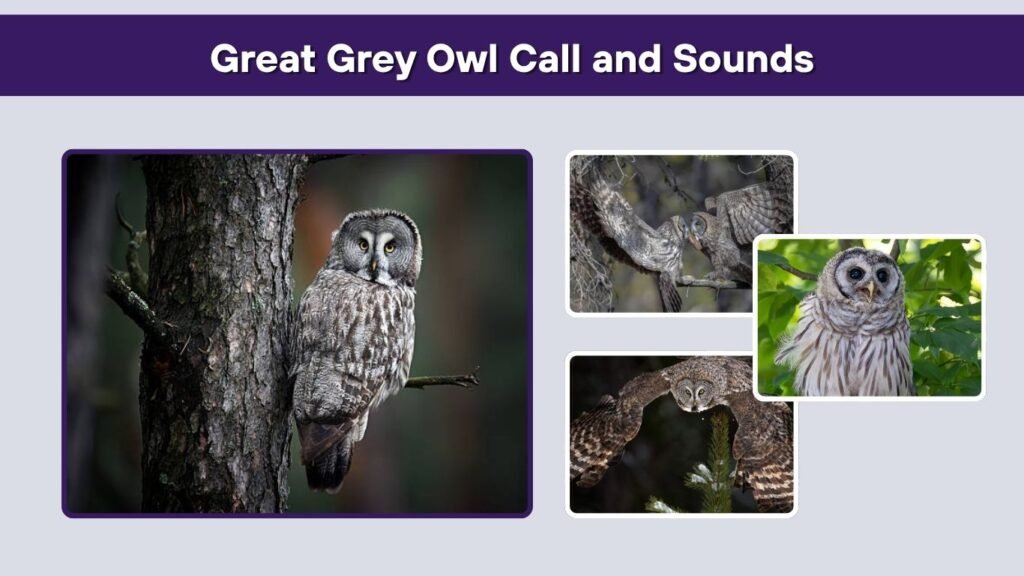
The male great grey owl’s song is a series of low, deep hoots. These notes are usually evenly spaced and may carry over a considerable distance through quiet forest.
Calls are used for:
- Attracting a mate
- Defending territory
- Communicating between paired adults
- Warning intruders
- Begging by chicks and juveniles
The typical territorial call sounds like several soft, resonant hoots delivered one after another. Females may produce similar calls, although their voices and rhythms can differ.
Adults also make clicking, barking or growling noises when alarmed. Young owls use high-pitched begging calls to encourage their parents to bring food. Vocal activity often increases before and during the nesting season. Recordings of several songs and calls are available through the Cornell Lab’s Macaulay Library.
Nesting and Reproduction
Great grey owls do not usually construct elaborate nests of their own. They frequently use structures built by other large birds, including hawks and ravens. They may also nest on broken tree trunks, natural platforms or human-made nesting platforms.
A suitable nest must be large enough to hold the female and her developing chicks. Nesting habitat is generally close to open hunting areas where the male can find sufficient rodents.
Eggs and Incubation
The female commonly lays two to five white eggs. Clutch size is closely connected to food availability, and females may produce more eggs during years when voles are abundant.
The female performs the incubation, which lasts approximately 28–36 days. During this period, the male catches prey and delivers food to her.
After the eggs hatch, the female remains near the nest to guard and warm the chicks. The male continues supplying most of the food during the early weeks.
Baby Great Grey Owls
Newly hatched chicks are covered with pale down and depend completely on their parents. Their eyes remain closed initially, and they cannot regulate their temperature effectively.
Young great grey owls may leave the nest before they can fly properly. This behaviour is called branching. A chick may climb around branches or sit on the ground while its parents continue feeding and defending it.
Finding a young owl on the forest floor does not always mean it has been abandoned. Unless it is visibly injured or in immediate danger, it should generally be left alone. The parents are often watching from nearby.
Great Grey Owl Flight and Adaptations
A great grey owl flies using slow, deep wingbeats mixed with smooth gliding. Its broad wings provide lift at low speeds, allowing it to manoeuvre quietly above meadows and between trees.
Several adaptations make it a highly effective predator:
- Large facial disc: Collects and concentrates sound.
- Asymmetrical ears: Help determine the vertical and horizontal location of prey.
- Silent feathers: Reduce noise during flight.
- Long legs: Reach prey beneath vegetation or snow.
- Powerful talons: Grip and kill small mammals.
- Camouflaged plumage: Blends with trunks and forest shadows.
- Flexible neck: Allows the owl to scan a wide area while remaining perched.
Its eyes are fixed within their sockets, so it cannot move them from side to side like a human. Instead, the owl turns its head to change its field of view.
Great Grey Owl Lifespan
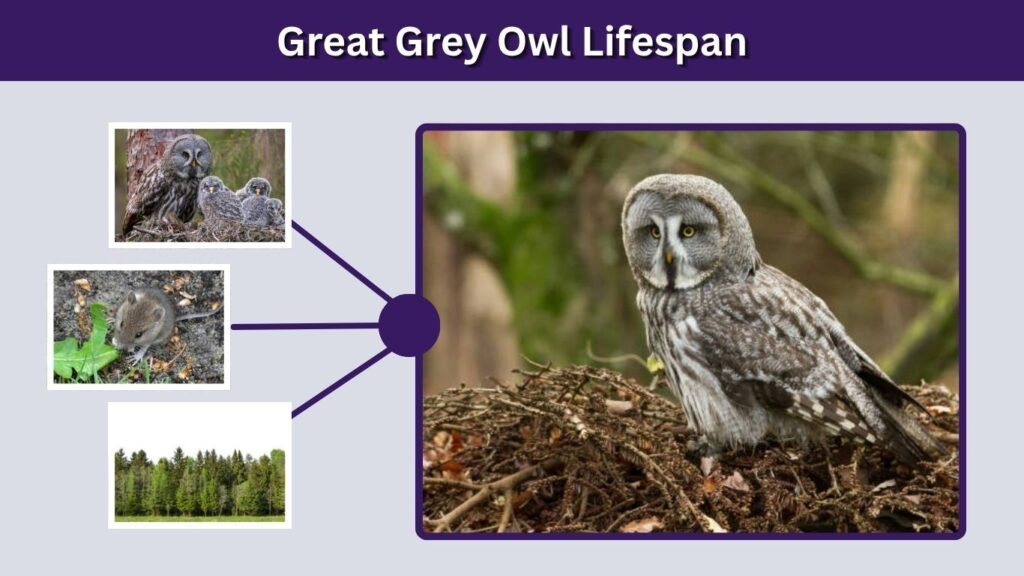
A great grey owl can potentially live for more than a decade in the wild, although many young birds do not survive their first years. Food shortages, severe winters, collisions and predators can all shorten their lives.
Adults face threats from great horned owls, golden eagles and other large predators. Eggs and chicks may be taken by ravens, mammals and climbing predators. Human-related dangers include vehicle strikes, habitat loss and accidental collisions with fences or power lines.
Are Great Grey Owls Endangered?
The great grey owl is widely distributed across the Northern Hemisphere and is not considered globally endangered. However, populations are naturally sparse, and the bird can be rare at a local level.
Its dependence on mature forests, suitable nesting platforms and rodent-rich openings makes it vulnerable to habitat alteration. Forest management that removes old nests, dead trees or open hunting areas may reduce the suitability of an area.
Protecting connected mature forest and meadow habitats is therefore important, even where the species is not globally threatened.
Interesting Great Grey Owl Facts
- Its scientific name is Strix nebulosa.
- It is among the tallest owls in the world.
- Much of its impressive size consists of feathers.
- Females are larger than males.
- It has no visible ear tufts.
- Voles form a major part of its diet.
- It can capture rodents hidden beneath snow.
- It often uses nests built by hawks or ravens.
- It may hunt during both daylight and darkness.
- Food shortages can cause southward irruptions.
- Its enormous face helps direct sound toward its ears.
- The species is sometimes called the great gray owl in American English.
FAQs
How big is a great grey owl?
A great grey owl is approximately 61–84 centimetres long and has a wingspan of about 137–153 centimetres. Females are generally larger than males. Despite its tall, bulky appearance, it is relatively lightweight because much of its apparent size comes from thick plumage.
Where do great grey owls live?
Great grey owls inhabit boreal and mountain forests across North America, Europe and Asia. They prefer dense woods for nesting and roosting combined with meadows, bogs, burns or clearings where they can hunt voles and other small mammals.
Are great grey owls nocturnal?
Great grey owls are active at night and around dawn and dusk, but they are not exclusively nocturnal. They may hunt during daylight in winter, in northern regions with long summer days, or while feeding chicks during the breeding season.
Do great grey owls migrate?
Most great grey owls remain within the same general region throughout the year. However, they may move southward or descend to lower elevations when prey becomes scarce. These irregular, food-driven movements are known as irruptions.
What does a great grey owl sound like?
The male’s main call consists of several low, resonant hoots repeated at regular intervals. Great grey owls also make barking, clicking and growling sounds. Chicks and juveniles produce high-pitched begging calls when requesting food from their parents.
