
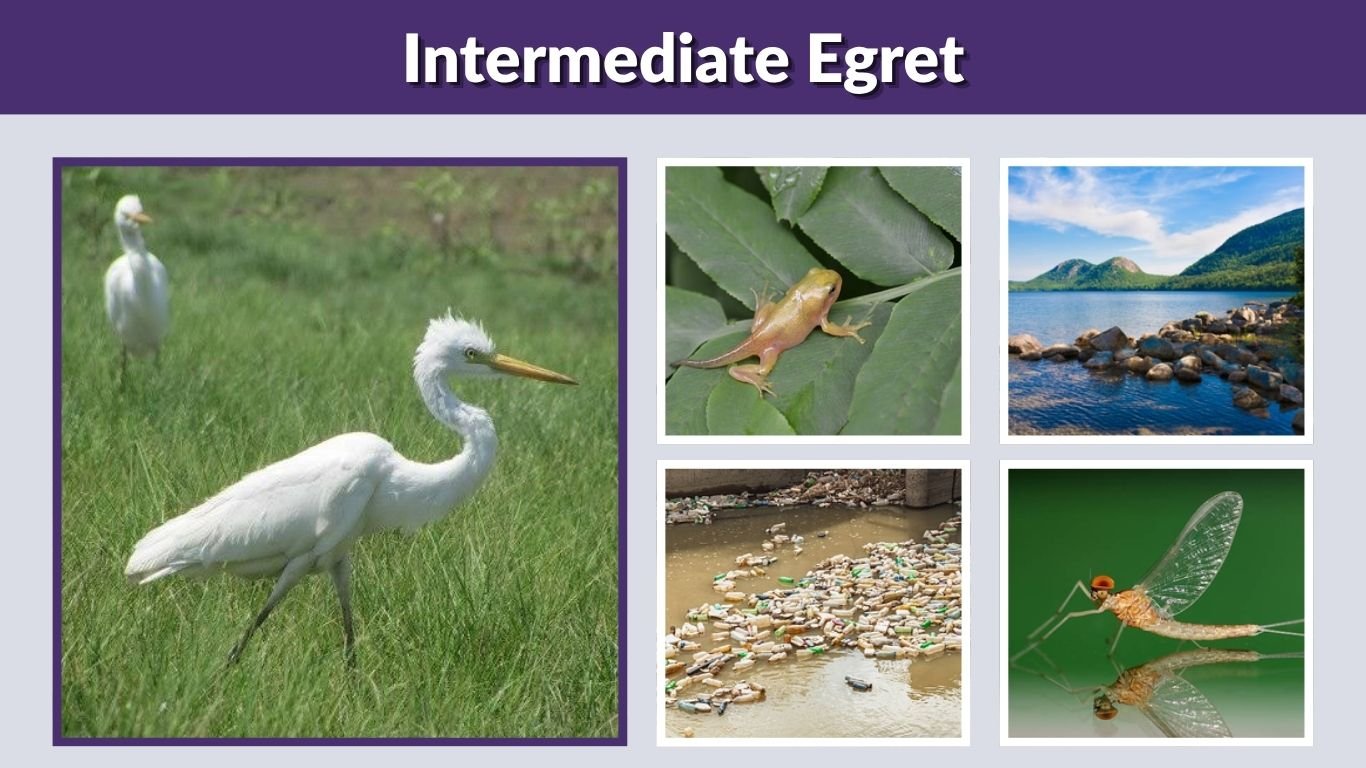
The Intermediate Egret is an elegant white heron found throughout southern and eastern Asia. As its name suggests, its size falls between the smaller Little Egret and the much larger Great Egret. It usually inhabits marshes, shallow lakes, flooded fields, rice paddies, and riverbanks, where it hunts fish, frogs, insects, and crustaceans. Although identifying white egrets can be challenging, the Intermediate Egret’s medium size, compact neck, yellow bill, dark legs, and distinctive facial structure provide several useful clues.
Intermediate Egret Overview
The Intermediate Egret is also called the Medium Egret or Median Egret. Its scientific name is Ardea intermedia, although older references may place it in the genera Egretta or Mesophoyx.
The name was once applied to a wider species complex covering Asia, Africa, and Australasia. Several modern classifications now recognize the African Yellow-billed Egret and Australasian Plumed Egret as separate species. Under this treatment, the Intermediate Egret refers primarily to the Asian bird.
| Feature | Description |
|---|---|
| Common name | Intermediate Egret |
| Other names | Medium Egret or Median Egret |
| Scientific name | Ardea intermedia |
| Family | Ardeidae |
| Length | Approximately 56–72 cm |
| Wingspan | Approximately 105–115 cm |
| Weight | Usually around 400–500 g |
| Plumage | Entirely white |
| Bill | Yellow outside the breeding season |
| Legs | Dark gray to black |
| Diet | Fish, frogs, insects, and crustaceans |
| Habitat | Marshes, lakes, rice fields, and flooded grasslands |
| Nest | Platform of sticks in trees, shrubs, or reeds |
| Conservation status | Least Concern |
Intermediate Egret Identification
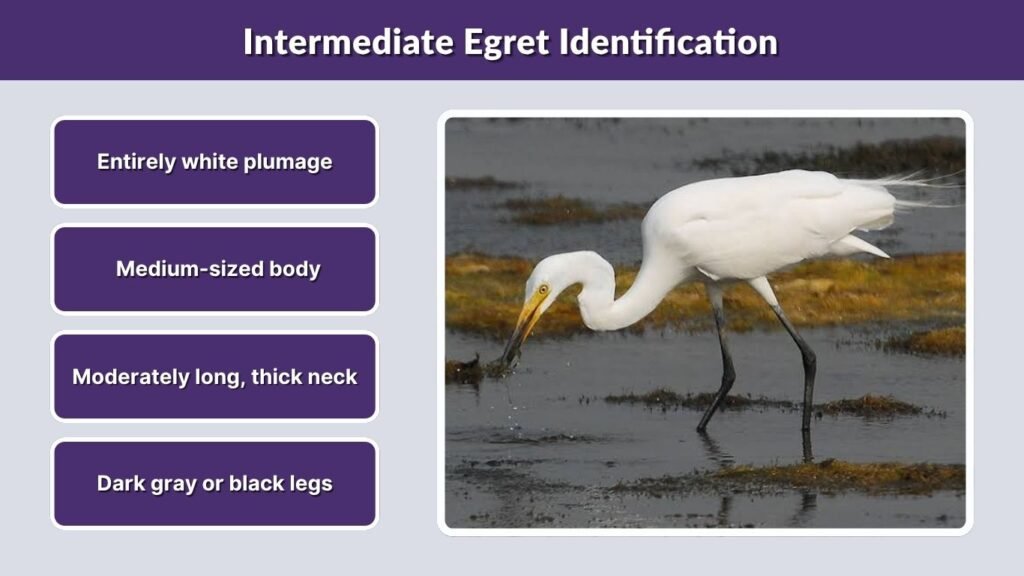
The Intermediate Egret has a medium-sized, compact body covered in completely white plumage. Its neck is moderately long but often appears thick and rounded when retracted. The bird has a yellow bill, yellow eyes, and dark legs during most of the year.
It lacks the yellow feet of the Little Egret and is considerably smaller and shorter-necked than the Great Egret. However, judging size can be difficult when the bird is alone, making its bill and facial structure particularly important.
Key Identification Features
- Entirely white plumage
- Medium-sized body
- Moderately long, thick neck
- Yellow or yellow-orange bill in nonbreeding condition
- Dark gray or black legs
- Dark feet that match the legs
- Relatively short, thick-based bill
- Rounded head
- Shorter gape line than the Great Egret
- Slow, deliberate feeding behavior
- Neck folded into an S shape during flight
The gape line is the line where the upper and lower parts of the bill meet. On an Intermediate Egret, this line usually ends beneath or close to the rear of the eye. On a Great Egret, it extends noticeably behind the eye.
Male and female Intermediate Egrets look alike. Males may average slightly larger, but their size ranges overlap too much to identify the sexes reliably in the field.
Intermediate Egret Size
The Intermediate Egret generally measures 56–72 cm, or approximately 22–28 inches, from bill to tail. Its wingspan is usually around 105–115 cm, or 41–45 inches. Most adults weigh approximately 400–500 grams.
Its size is closer to that of the smaller white egrets than to the Great Egret. Nevertheless, it has a heavier body, thicker neck, and larger head than a Little Egret.
The bird’s posture can make size estimation difficult. A hunting Intermediate Egret may fully extend its neck, while a resting bird retracts its neck and appears much shorter. Comparing it with nearby egrets, ducks, or other familiar birds is often more reliable than estimating its size alone.
Color and Breeding Plumage
Intermediate Egrets are predominantly white throughout their lives. Unlike Cattle Egrets, they do not develop orange or golden patches across the head, breast, and back.
Nonbreeding Adults
Outside the breeding season, an adult typically has a yellow or yellow-orange bill. Its eyes and the bare skin between the bill and eyes are yellowish. The legs and feet are normally dark gray or black.
The yellow bill contrasts clearly with the white face. However, mud, shadows, and lighting can temporarily make the bill appear darker than it really is.
Breeding Adults
During the breeding season, adults develop long, loose ornamental feathers on the chest and back. These delicate white plumes extend beyond the tail and create a soft, shaggy appearance.
The bill may become reddish, orange, or partly black, depending on breeding stage and geographic population. The bare facial skin can turn greenish, while the upper legs may become yellowish, pinkish, or reddish. These bright colors are usually most intense during courtship and may fade after egg-laying begins.
Juvenile Intermediate Egrets
Juveniles resemble nonbreeding adults but generally have less intense bare-part colors. They lack the long decorative plumes of breeding adults. Their bill may appear dull yellow, and their legs remain dark.
Intermediate Egret Habitat
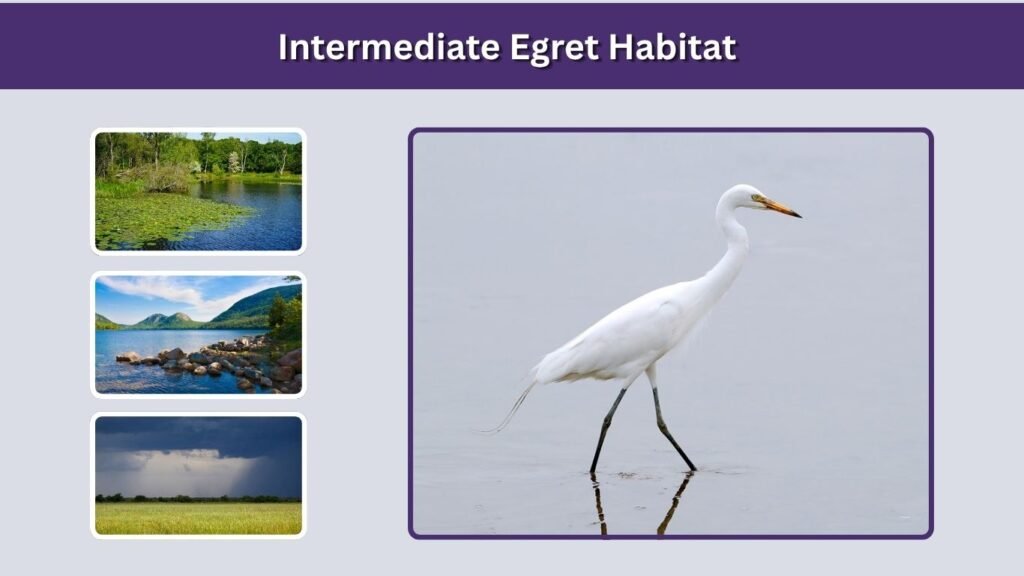
Intermediate Egrets occupy freshwater wetlands and occasionally use brackish or coastal environments. They prefer shallow, open water with abundant fish, amphibians, and aquatic invertebrates.
Common habitats include:
- Freshwater marshes
- Shallow lakes and ponds
- Riverbanks
- Floodplains
- Rice paddies
- Irrigation channels
- Flooded agricultural fields
- Wet grasslands
- Reservoir edges
- Swamps
- Mangroves and estuaries
- Seasonally flooded areas
Rice fields are especially valuable because their shallow water can support fish, frogs, insects, and crustaceans. When water levels become unsuitable or wetlands begin to dry, the birds may move to another feeding area.
Intermediate Egrets often feed alone, but several individuals may gather where prey is concentrated. They may also join mixed groups containing Little Egrets, Great Egrets, Cattle Egrets, pond herons, and other waterbirds.
Where Do Intermediate Egrets Live?
The Intermediate Egret occurs mainly across southern and eastern Asia. Its distribution extends from the Indian subcontinent through southern China, Korea, Japan, and Southeast Asia.
It can be found in Bangladesh, India, Nepal, Sri Lanka, Pakistan, Myanmar, Thailand, Malaysia, Indonesia, Vietnam, Cambodia, and several neighboring countries. Northern populations may migrate south during winter, while many tropical populations remain in the same general region throughout the year.
Even resident birds make local movements in response to rainfall and water levels. Seasonal flooding can create temporary feeding areas, while drought may force birds to travel considerable distances in search of suitable wetlands.
What Do Intermediate Egrets Eat?
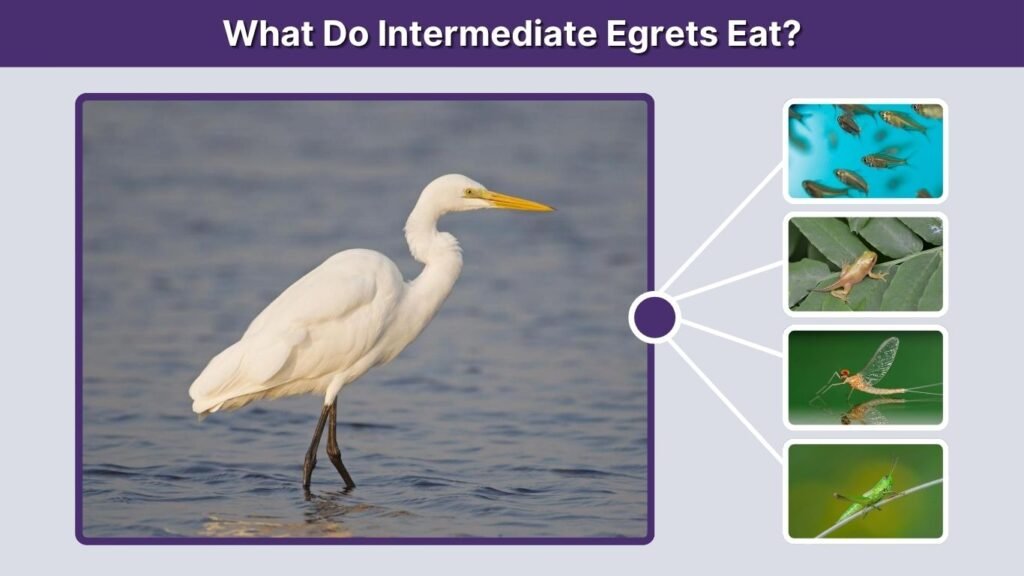
Intermediate Egrets are carnivorous hunters that consume small animals found in shallow water, wet soil, and vegetation. Fish and frogs are important foods, but their diet changes according to habitat and prey availability.
Common Foods
- Small fish
- Frogs and tadpoles
- Aquatic insects
- Grasshoppers
- Beetles
- Dragonflies and their larvae
- Crabs
- Shrimp
- Crayfish
- Mollusks
- Spiders
- Small reptiles
- Occasionally small rodents
The bird normally swallows its prey whole. It may reposition a fish so that the head enters first, reducing the chance of fins or scales becoming caught in its throat.
Hunting and Feeding Behavior
The Intermediate Egret hunts methodically in shallow water. It often stands completely still, watching for movement below the surface. When prey comes within range, it extends its neck and strikes rapidly with its pointed bill.
It also walks slowly through wetlands, pausing between steps to inspect the water. This patient style differs from the more energetic behavior of the Little Egret, which frequently runs, turns, and stirs the water with its feet.
An Intermediate Egret may defend a productive feeding spot from other birds. However, it can tolerate nearby egrets when prey is abundant. It normally feeds during daylight and returns to a communal roost in the evening.
The species is generally quiet while feeding. It may produce a harsh croak when alarmed, taking flight, or interacting with other birds near a nesting colony.
Intermediate Egret Nesting
Intermediate Egrets usually breed in colonies, often alongside other herons, egrets, ibises, spoonbills, and cormorants. Colony sites are commonly located in trees, shrubs, bamboo, reed beds, or other dense vegetation near water.
Courtship and Nest Building
During courtship, adults display their long back and breast plumes. A male may stretch his neck, raise his feathers, point his bill upward, and perform special movements to attract a female.
The nest is a shallow platform constructed from sticks, reeds, and wetland plants. Both adults participate, although one partner may collect materials while the other arranges them.
Nests located over water or on wetland islands receive some protection from snakes, mammals, and other ground predators. However, eggs and chicks remain vulnerable to monitor lizards, birds of prey, crows, severe weather, and disturbance.
Eggs and Incubation
The female typically lays two to four smooth, pale blue-green eggs. In some regions, clutch size may range from two to five eggs, depending on habitat conditions and food availability.
Both parents incubate the eggs. Hatching generally occurs after approximately 24–27 days. Because incubation may begin before the final egg is laid, the eggs can hatch at different times.
Chicks and Fledging
Newly hatched chicks are covered with pale down and depend completely on their parents. Both adults protect the nest and provide food. Young chicks initially take regurgitated food from the nest floor, while older chicks receive it directly from a parent’s bill.
Competition between siblings can become intense, particularly when food is limited. Older chicks may be larger and more successful at obtaining meals.
The young begin leaving the center of the nest and climbing onto nearby branches as they develop. They normally fledge at around five or six weeks old but may continue returning to the colony for food.
Intermediate Egret vs. Little Egret
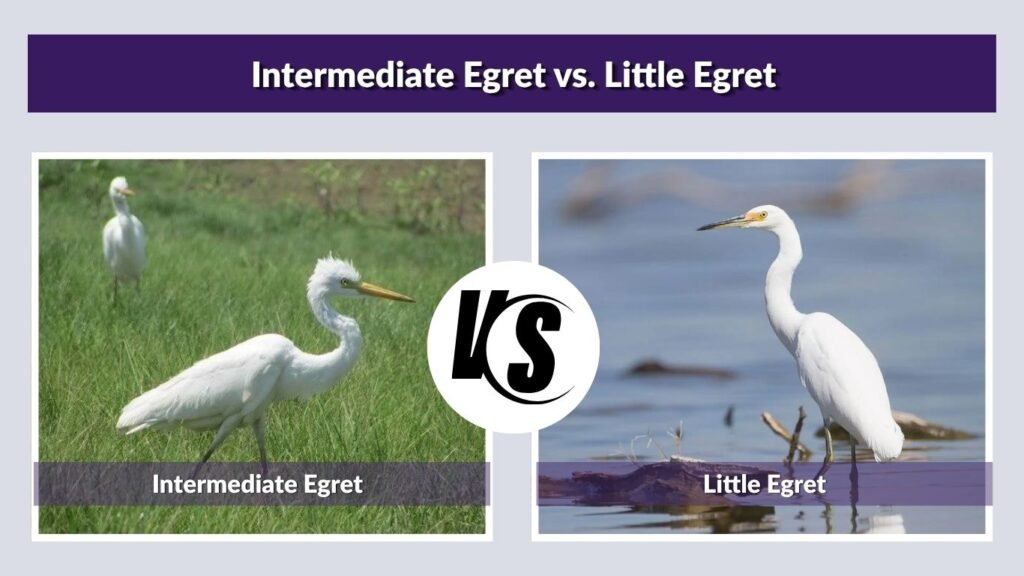
| Feature | Intermediate Egret | Little Egret |
|---|---|---|
| Size | Medium-sized and heavier | Smaller and more slender |
| Bill | Usually yellow | Black |
| Legs | Dark | Black |
| Feet | Dark | Usually bright yellow |
| Neck | Thicker and moderately long | Thin and more flexible |
| Feeding behavior | Slow and patient | Active, often running |
| Breeding plumes | Long plumes on back and breast | Plumes on head, back, and breast |
The bill and feet provide the quickest distinction. A white egret with a yellow bill and dark feet is more likely to be an Intermediate Egret than a Little Egret.
Intermediate Egret vs. Great Egret
| Feature | Intermediate Egret | Great Egret |
|---|---|---|
| Body size | Medium | Large |
| Neck | Shorter and thicker | Very long and slender |
| Bill | Shorter and thicker-based | Long and dagger-shaped |
| Gape line | Ends near the back of the eye | Extends behind the eye |
| Head shape | Rounded | Long and narrow |
| Breeding plumes | Chest and back | Mainly long back plumes |
| Feeding posture | More compact | Taller and more elongated |
A useful identification clue is the gape line, especially when size cannot be judged. The Intermediate Egret also tends to have a more compact, rounded profile than the long-necked Great Egret.
Conservation Status and Threats
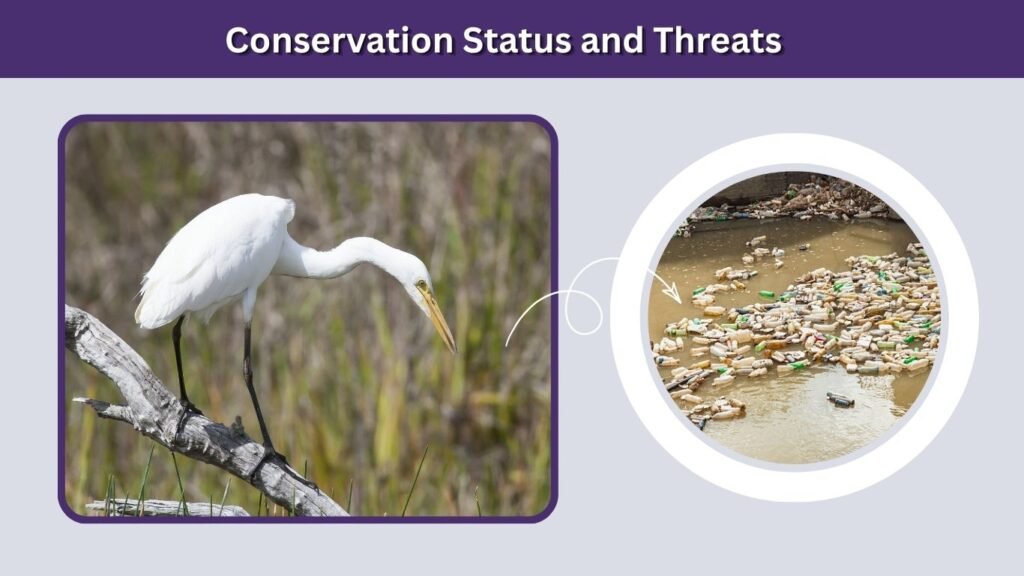
The Intermediate Egret is globally categorized as Least Concern because of its extensive range. However, local populations may decline when wetlands are drained, polluted, converted to farmland, or disturbed during breeding.
Pesticides can reduce insect prey and contaminate wetland food chains. Changes to river flow, drought, and the loss of shallow feeding areas can also affect the species. Protecting freshwater marshes, flooded grasslands, rice-field ecosystems, and nesting trees helps conserve this egret and many other waterbirds.
FAQs
Why is it called the Intermediate Egret?
It receives its name from its intermediate body size. It is larger than the Little Egret and Cattle Egret but smaller than the Great Egret. Its proportions and feeding behavior also fall between those of smaller and larger white egrets.
Does the Intermediate Egret have yellow feet?
No. Its legs and feet are usually dark gray or black. A Little Egret generally has black legs with contrasting yellow feet. Foot color is therefore useful when distinguishing these two white egrets.
Do Intermediate Egrets migrate?
Some northern populations migrate to warmer regions during winter. Tropical populations are usually resident but may move locally in response to rainfall, flooding, drought, or changes in food availability.
What does an Intermediate Egret eat?
Its diet consists mainly of small fish, frogs, tadpoles, insects, crustaceans, spiders, mollusks, and occasionally small reptiles or rodents. It captures prey by standing still or walking slowly through shallow water before striking with its bill.
How many eggs does an Intermediate Egret lay?
A female usually lays two to four pale blue-green eggs in a stick-platform nest. Both parents incubate the eggs for approximately 24–27 days and work together to feed and protect the chicks.
