
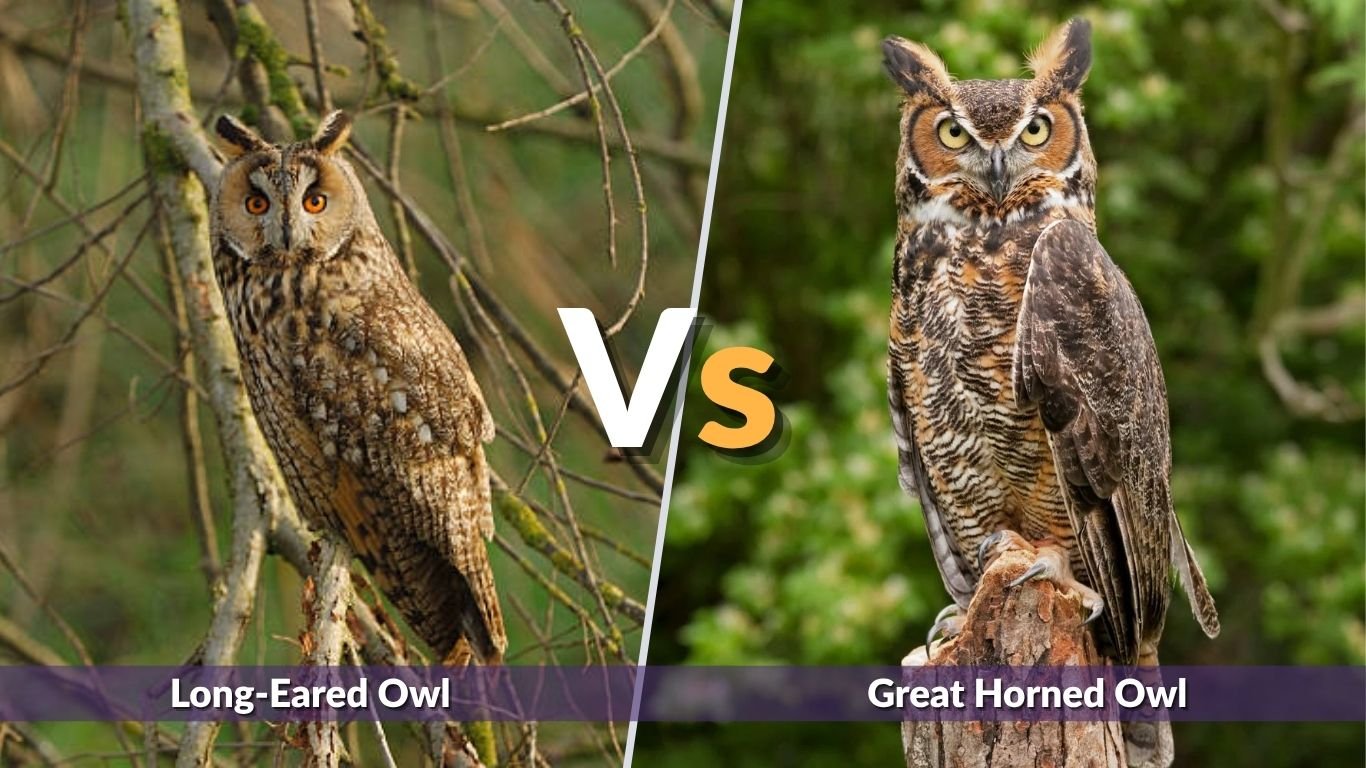
Long-eared owls and great horned owls can look surprisingly similar because both have yellow eyes, mottled brown plumage, and prominent feather tufts. However, the great horned owl is considerably larger, heavier, and more powerful, while the long-eared owl has a slender body, narrower face, and longer upright tufts. Their calls, belly markings, habitats, hunting behavior, and daytime roosting habits also provide useful identification clues.
Long-Eared Owl vs Great Horned Owl: Quick Comparison
Although both species are nocturnal birds of prey, they differ noticeably in body shape and behavior. A long-eared owl often resembles a slim, stretched version of a great horned owl. The great horned owl has a broad chest, large feet, and massive head, whereas the long-eared owl appears narrow and lightweight.
| Feature | Long-Eared Owl | Great Horned Owl |
| Scientific name | Asio otus | Bubo virginianus |
| Body shape | Slender and narrow | Large, thick-bodied and powerful |
| Length | 13.8–15.8 inches | 18.1–24.8 inches |
| Wingspan | 35.4–39.4 inches | 39.8–57.1 inches |
| Weight | 7.8–15.3 ounces | 32.1–88.2 ounces |
| Ear tufts | Long, narrow and usually upright | Thick, widely spaced and hornlike |
| Facial appearance | Narrow with dark eye patches | Broad with a noticeable white throat |
| Underparts | Mainly vertical streaking | Strong horizontal barring |
| Typical call | Repeated single hoots | Deep four- or five-note hooting pattern |
| Preferred habitat | Dense trees beside open hunting fields | Forests, deserts, wetlands, suburbs and parks |
Cornell Lab measurements show that even the heaviest long-eared owls weigh less than half as much as many great horned owls.
Long-Eared Owl vs Great Horned Owl Size and Body Shape
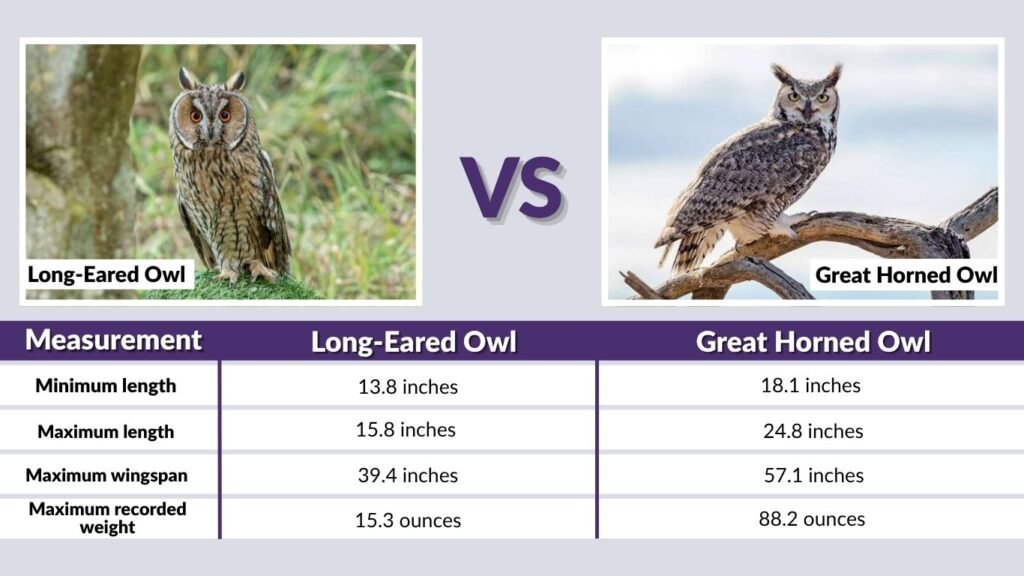
Size is usually the most dependable difference when the two owls are seen clearly. The long-eared owl is approximately crow-sized, while the great horned owl is a large owl that may appear slightly bigger than a red-tailed hawk.
Long-Eared Owl Size
Long-eared owls generally measure 13.8–15.8 inches long, weigh 7.8–15.3 ounces, and have a wingspan of 35.4–39.4 inches. Their long wings, narrow body, and elongated facial disk create a slim appearance. When alarmed, they may compress their feathers and stretch vertically, making themselves look even thinner.
Great Horned Owl Size
Great horned owls measure approximately 18.1–24.8 inches long and weigh 32.1–88.2 ounces. Their wingspan can reach 57.1 inches. They have broad, rounded wings, a thick chest, a large head, powerful feet, and substantial talons.
| Measurement | Long-Eared Owl | Great Horned Owl |
| Minimum length | 13.8 inches | 18.1 inches |
| Maximum length | 15.8 inches | 24.8 inches |
| Maximum wingspan | 39.4 inches | 57.1 inches |
| Maximum recorded weight in listed range | 15.3 ounces | 88.2 ounces |
Long-Eared Owl vs Great Horned Owl Appearance and Identification
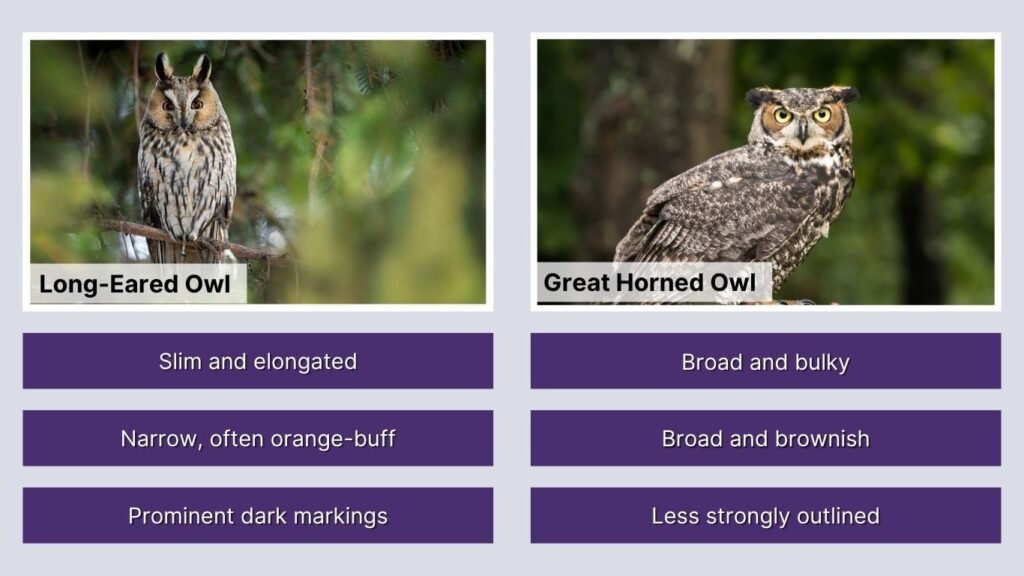
Both owls have feather tufts rather than external ears. These tufts may help with communication and camouflage, but they do not determine how well the birds hear.
Ear Tufts and Head Shape
Long-eared owls usually display thin, closely positioned tufts that point almost directly upward. Their head looks narrow or rectangular, and their facial disk is long and vertically shaped.
Great horned owls have heavier, hornlike tufts positioned farther apart. Their head appears broader and more rounded. However, both species can lower their tufts, so identification should never depend on the “ears” alone.
Face, Throat and Eyes
A long-eared owl has a buff or orange-toned facial disk, dark markings around the eyes, and two pale vertical lines between them. Its yellow eyes often look closely set within the narrow face.
A great horned owl has a broad reddish-brown or gray-brown face with yellow eyes. One of its best field marks is the clearly defined white throat patch, which may become especially noticeable when the owl calls.
Plumage and Belly Markings
The long-eared owl has intricate brown, black and buff patterning. Its breast and belly are covered primarily with dark vertical streaks.
The great horned owl is usually mottled gray-brown with bold horizontal barring across much of the underparts. Color varies geographically, with some individuals appearing dark brown and others pale gray.
| Field Mark | Long-Eared Owl | Great Horned Owl |
| Overall build | Slim and elongated | Broad and bulky |
| Facial disk | Narrow, often orange-buff | Broad and brownish |
| Eye surroundings | Prominent dark markings | Less strongly outlined |
| White throat patch | Usually not prominent | Distinctive and noticeable |
| Belly pattern | Mostly vertical streaks | Mostly horizontal bars |
| Ear tufts | Long and closely spaced | Thick and widely spaced |
Long-Eared Owl vs Great Horned Owl Calls
Listening is often more useful than searching for these well-camouflaged birds. Both species hoot, but their rhythms are very different.
Long-Eared Owl Sounds
Male long-eared owls produce a long sequence of individual “whoo” notes during the breeding season. The notes are separated by approximately two to four seconds, and a series may contain ten to more than 200 hoots.
Females produce higher-pitched nest calls sometimes compared to the bleating of a lamb. Long-eared owls can also bark, squeal, whistle and make catlike mewing sounds. They remain relatively quiet during much of the year.
Great Horned Owl Sounds
The classic great horned owl call is a deep, resonant series of approximately four or five hoots. Mated birds sometimes perform a duet. The female’s voice is normally higher in pitch, while the smaller male produces a deeper call because he has a larger voice box.
Habitat and Roosting Behavior
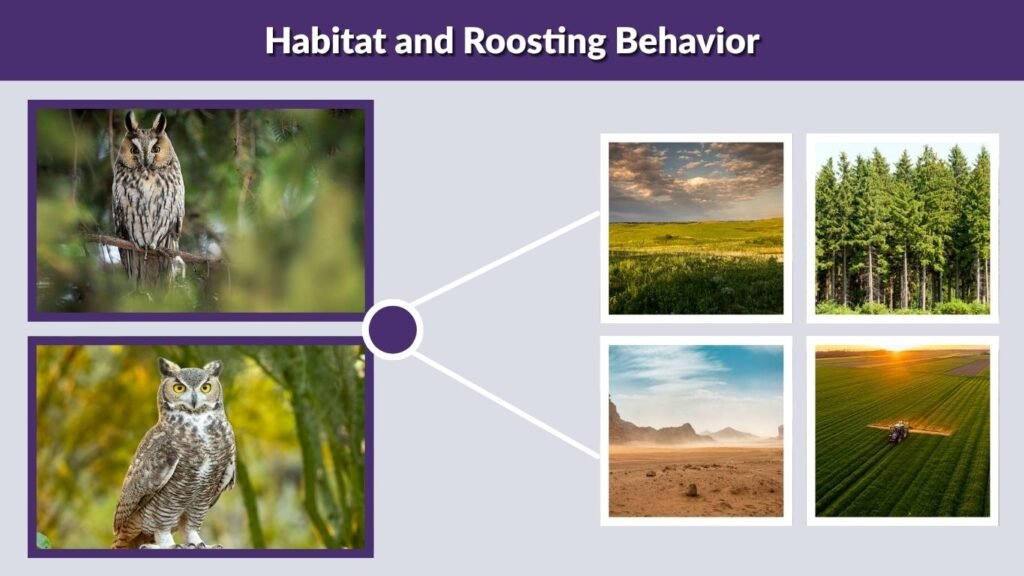
Habitat provides another strong identification clue. Long-eared owls need both sheltered trees for roosting and open land for hunting. Great horned owls tolerate a much wider variety of environments.
Where Long-Eared Owls Live
Long-eared owls favor dense pine stands, shelterbelts, windbreaks and thick woodland edges near grasslands or shrublands. During daylight, they hide close to tree trunks where their streaked feathers blend with branches and bark.
Several long-eared owls may share a communal winter roost. They commonly hunt by flying low over open fields after complete darkness.
Where Great Horned Owls Live
Great horned owls occupy deciduous forests, coniferous woods, swamps, deserts, agricultural areas, tundra edges, parks and suburban neighborhoods. Their ability to live around people makes them much more likely to be noticed in backyards and cities.
Long-Eared Owl vs Great Horned Owl Diet and Hunting Power
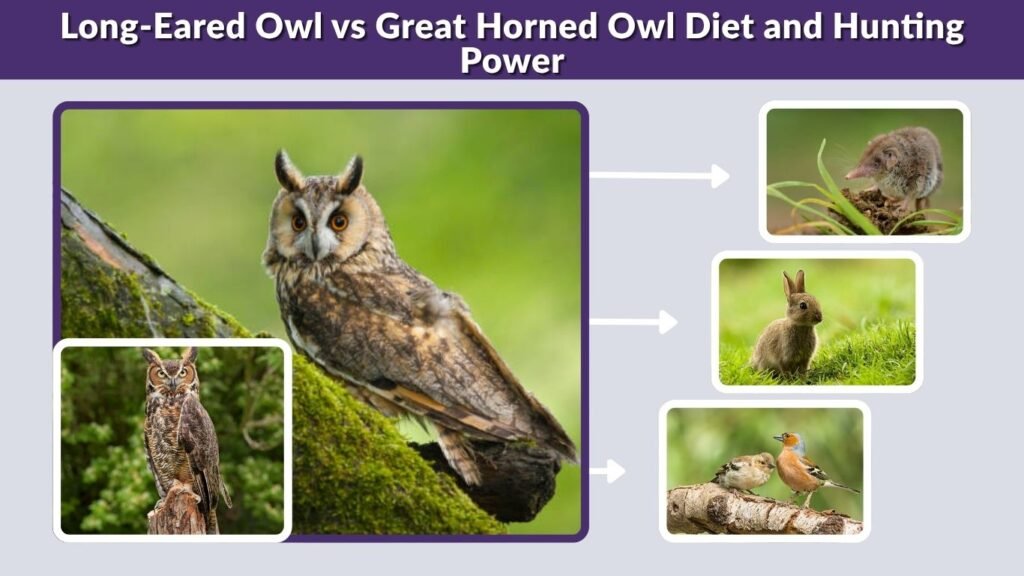
Both species hunt primarily at night and depend heavily on their hearing. Nevertheless, the difference in body size gives them very different predatory abilities.
Long-eared owls specialize mainly in small mammals such as voles, mice, shrews, pocket gophers and small rats. They usually patrol low over fields before dropping onto prey.
Great horned owls have a much broader diet. Their powerful feet allow them to capture rodents, rabbits, birds, reptiles, amphibians and other animals. They can kill prey considerably larger than anything a long-eared owl normally attempts to catch.
Juvenile Great Horned Owl vs Juvenile Long-Eared Owl
Young owls can be harder to identify because their ear tufts and adult patterns may not be fully developed.
Juvenile long-eared owls are fluffy and often show a prominent dark V-shaped marking between their eyes. Their body remains relatively slim, and their developing facial disk looks narrow.
Juvenile great horned owls are substantially larger, with thick legs, oversized feet and a broad head. Young birds may have soft gray or whitish down, but their large body and heavy talons usually distinguish them from young long-eared owls.
Long-Eared Owl Male vs Female
Male and female long-eared owls look very similar, so visual identification is difficult. Females are generally larger and may appear darker or more richly colored, while males may look slightly paler. These differences vary and are unreliable without direct comparison.
Voice is a more useful clue during breeding season. The male gives deep, repeated advertising hoots, while the female’s nest call is higher, rougher and more bleating in quality.
Long-Eared Owl vs Short-Eared Owl
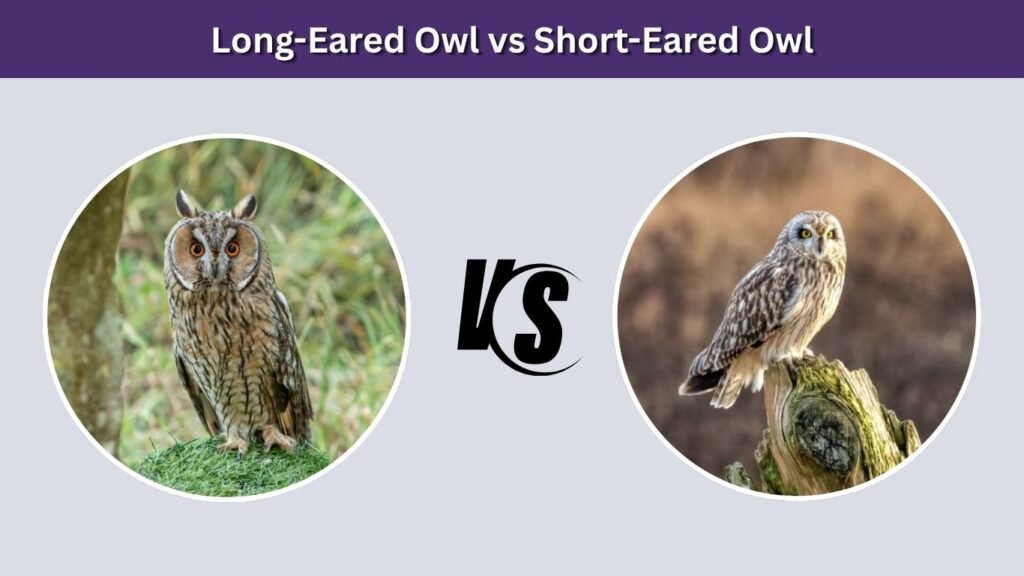
The short-eared owl is closer in size to the long-eared owl than the great horned owl is. However, short-eared owls have rounded heads with tiny tufts that are normally difficult to see. They are paler underneath and frequently hunt over marshes and grasslands during daylight or around dusk.
Long-eared owls have obvious upright tufts, darker plumage, stronger belly streaking and a greater preference for hunting after nightfall.
FAQs
Which is bigger, a long-eared owl or a great horned owl?
The great horned owl is much bigger. It can reach almost 25 inches long and weigh more than five pounds. A long-eared owl rarely exceeds 16 inches or approximately one pound, giving it a noticeably thinner and lighter appearance.
Do long-eared owls and great horned owls have real ears?
Their visible “ears” are only feather tufts. The actual ear openings are hidden beneath feathers on the sides of the head. Both species can raise or lower their tufts, so the tufts may not always be visible.
Can great horned owls prey on long-eared owls?
Yes. Great horned owls are powerful predators capable of killing other birds of prey, including smaller owl species. Long-eared owls may therefore avoid areas where great horned owls are particularly active.
Which owl is more commonly seen?
Great horned owls are generally easier to encounter because they occupy many habitats, including parks, farms and suburbs. Long-eared owls are secretive, spend daylight hours inside dense vegetation, and may remain unnoticed even where they are present.
What is the easiest way to tell them apart?
Look first at size and body shape. A great horned owl is large, broad and heavy, with a white throat and barred belly. A long-eared owl is much smaller and slimmer, with closely spaced tufts, dark eye markings and vertical streaking.