
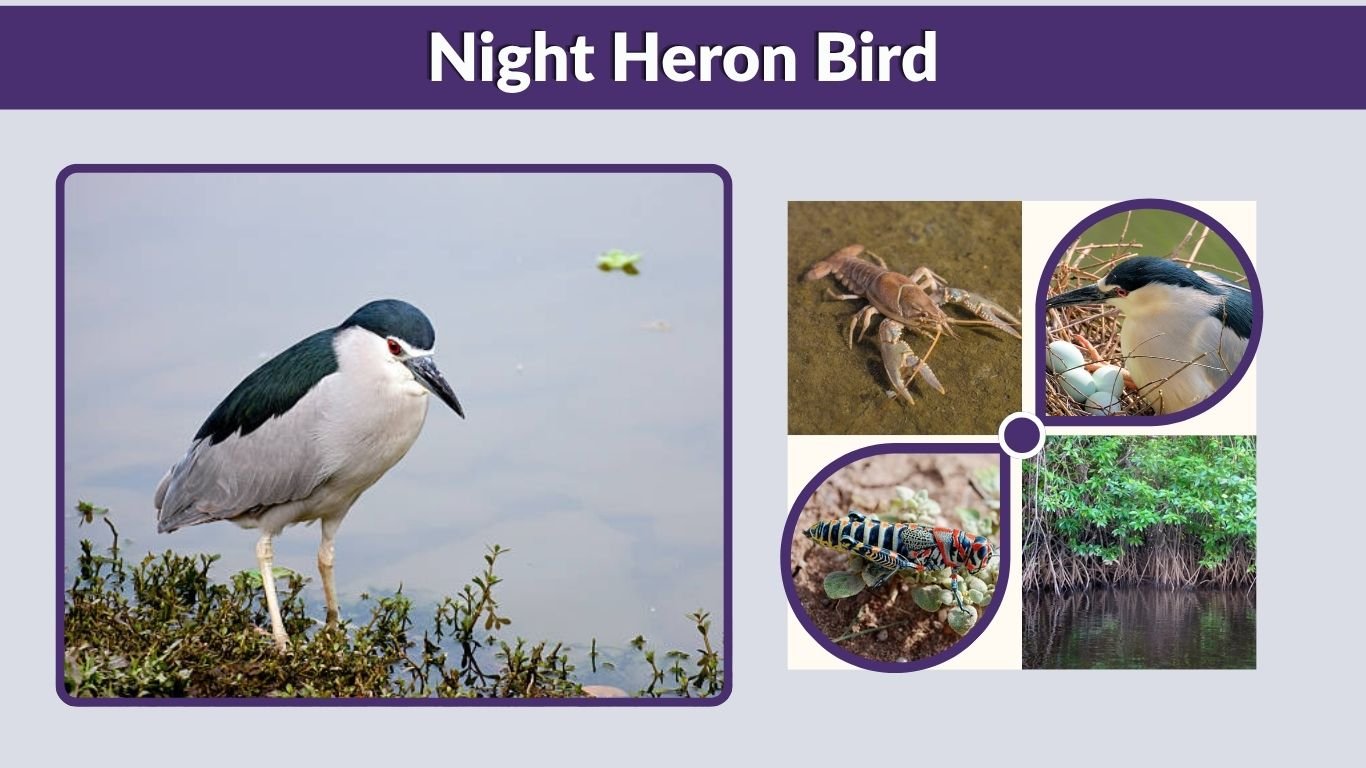
Night herons are compact, thick-billed members of the heron family that usually become most active around dusk, at night, and early in the morning. Unlike tall, slender herons that slowly stalk prey in open water, night herons often spend the day resting in trees or dense vegetation before flying to wetlands to feed. The Black-crowned Night Heron and Yellow-crowned Night Heron are the two species most frequently encountered in North America.
What Is a Night Heron?
“Night heron” refers to several related medium-sized wading birds. They belong to the family Ardeidae, which also includes egrets, bitterns, and larger herons.
Night herons typically have:
- Compact, hunched bodies
- Shorter necks than many other herons
- Thick, pointed bills
- Broad, rounded wings
- Relatively short legs
- Large eyes suited to dim conditions
- Harsh, croaking flight calls
Although their name emphasizes nighttime activity, they are not exclusively nocturnal. Adults may feed during daylight when raising young, and Yellow-crowned Night Herons regularly forage during both day and night.
Black-Crowned Night Heron
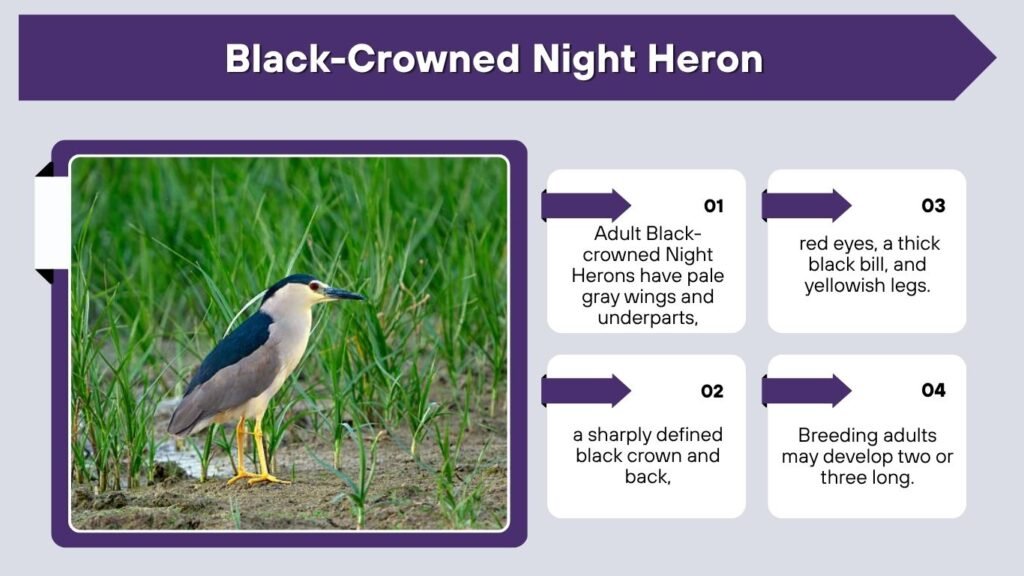
The Black-crowned Night Heron, scientifically named Nycticorax nycticorax, is one of the world’s most widespread heron species. It occupies freshwater, saltwater, and brackish wetlands and can live near both remote marshes and busy cities.
Identification
Adult Black-crowned Night Herons have pale gray wings and underparts, a sharply defined black crown and back, red eyes, a thick black bill, and yellowish legs. Breeding adults may develop two or three long white plumes extending from the back of the head.
Their short neck and stocky body distinguish them from Great Blue Herons and other long-necked waders. When resting, the bird often appears hunched, with its head pulled close to its shoulders.
Juvenile Appearance
A juvenile Black-crowned Night Heron looks very different from an adult. Young birds are mostly brown with pale streaks and white or buff spots across the wings. Their eyes are usually yellow or orange rather than deep red.
Juveniles can be confused with young Yellow-crowned Night Herons. Black-crowned juveniles tend to have larger pale wing spots and a somewhat shorter, thicker bill, although individual differences can make identification difficult.
Yellow-Crowned Night Heron
The Yellow-crowned Night Heron, Nyctanassa violacea, is a gray wading bird strongly associated with coastal marshes, mangroves, tidal creeks, wooded wetlands, and locations containing abundant crabs or crayfish.
Identification
Adults have smooth gray bodies, black heads, bold white cheek patches, red or orange eyes, and a pale yellow or creamy crown. Long yellowish-white plumes extend behind the head during the breeding season. The legs may appear yellow, orange, or reddish, depending on age and breeding condition.
Compared with the Black-crowned species, the Yellow-crowned Night Heron has longer legs, a more upright posture, a heavier bill, and a stronger black-and-white facial pattern.
Black-Crowned vs Yellow-Crowned Night Heron
Although the two birds share similar names and habitats, adults are relatively easy to distinguish.
| Feature | Black-crowned Night Heron | Yellow-crowned Night Heron |
| Scientific name | Nycticorax nycticorax | Nyctanassa violacea |
| Adult crown | Solid black | Pale yellow or creamy |
| Face | Mostly pale | Bold black and white |
| Back | Black | Gray |
| Body shape | Short and stocky | Taller and more upright |
| Main food | Fish and varied aquatic prey | Crabs and crayfish |
| Typical activity | Mostly evening and night | Day or night |
The Yellow-crowned species is especially adapted for capturing crustaceans, while the Black-crowned species has a broader and more opportunistic diet.
Where Do Night Herons Live?
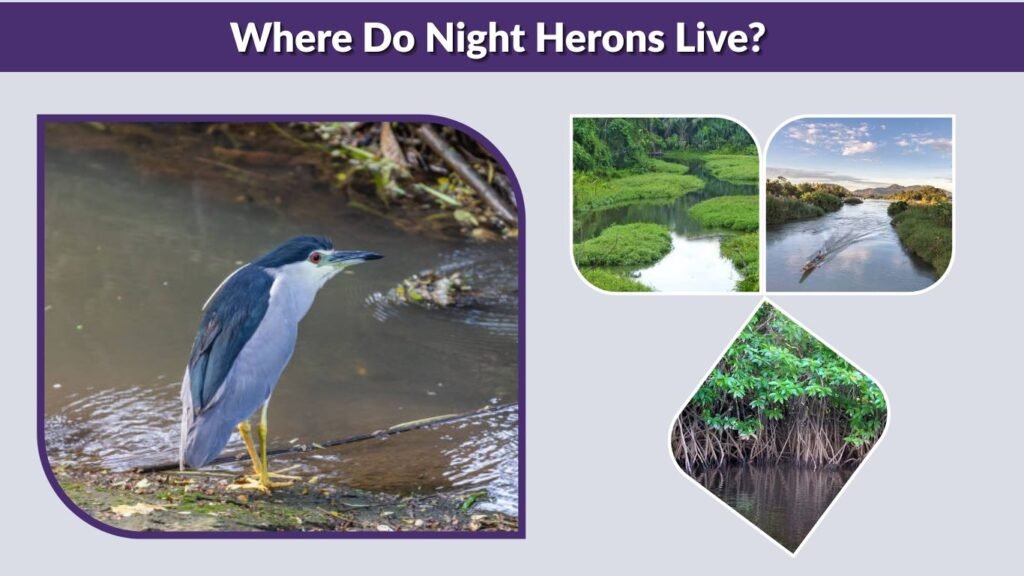
Night herons occupy wetlands that provide both feeding water and sheltered places for daytime roosting.
Common habitats include:
- Freshwater marshes
- Mangrove swamps
- Rivers and streams
- Lakes and ponds
- Coastal lagoons
- Tidal mudflats
- Estuaries
- Reservoirs
- Irrigation canals
- Flooded agricultural fields
- Urban parks near water
Black-crowned Night Herons have an exceptionally broad global distribution. In North America, they occur in many inland and coastal regions and may spend winter in southern or coastal parts of their range.
Yellow-crowned Night Herons are particularly common in warm coastal areas, including the southeastern United States and Gulf Coast. They may also move into inland towns and cities where streams, ponds, crayfish, and suitable nesting trees are available.
What Do Night Heron Birds Eat?
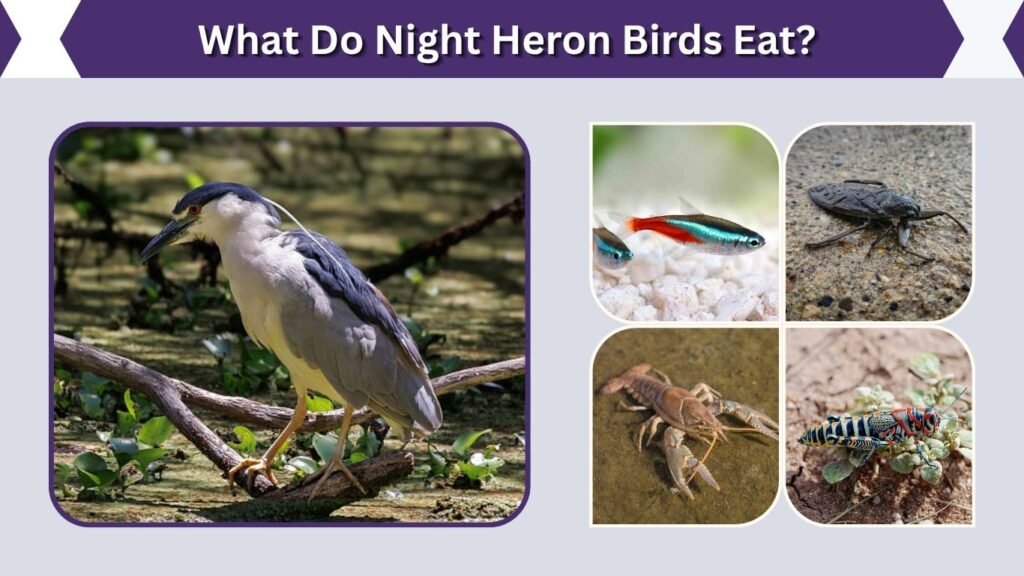
Night herons are predators that capture animals from shallow water, muddy shorelines, wet grass, and occasionally dry ground.
Black-Crowned Night Heron Diet
The Black-crowned Night Heron eats an unusually wide variety of prey, including:
- Fish
- Frogs and tadpoles
- Crayfish
- Insects
- Earthworms
- Leeches
- Clams and mussels
- Small snakes and lizards
- Turtles
- Rodents
- Bird eggs and young birds
It may stand motionless near the water, slowly stalk prey, or make a sudden strike with its bill.
Yellow-Crowned Night Heron Diet
Yellow-crowned Night Herons specialize in crustaceans. Crabs and crayfish form a major part of their diet, although they also eat fish, insects, snails, frogs, and other small animals.
The bird may lunge at a crab, shake it apart, remove its legs, or swallow smaller prey whole. Its strong bill is well suited to handling hard-shelled animals.
Night Heron Bird Call and Sound
Night herons are not known for musical songs. Their most familiar sounds are loud, rough flight calls that may be heard after dark.
Black-Crowned Night Heron Call
The Black-crowned Night Heron commonly gives a sharp, barking “wok” or “quak” while flying between roosting and feeding locations. Around nests, adults also produce guttural and raspy calls when communicating with their partners or young.
Yellow-Crowned Night Heron Call
The Yellow-crowned Night Heron gives a harsh, descending “skow” or squawking call. It may vocalize while flying, when disturbed, or during breeding interactions.
Hearing a loud croak over a wetland shortly after sunset is often the first sign that a night heron is nearby.
Night Heron Nest and Baby Birds
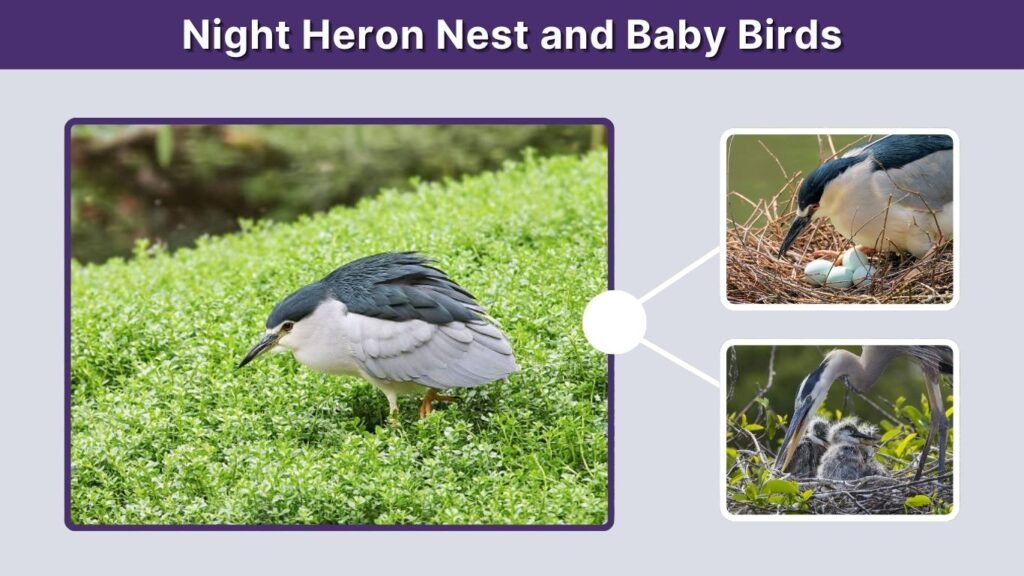
Night herons build platforms from sticks and place them in trees, shrubs, mangroves, reedbeds, or other vegetation near water. Black-crowned Night Herons commonly form colonies that may contain hundreds of nests and often share breeding areas with egrets, ibises, and other herons.
Yellow-crowned Night Herons may nest alone or in colonies of several hundred pairs. Their nests sometimes occur surprisingly close to homes, roads, parks, and other developed areas.
Baby night herons hatch softly and remain dependent on their parents. As they grow, they climb around nearby branches before becoming capable of strong flight. Parents deliver regurgitated fish, crustaceans, and other prey to the young.
Is There a Blue Night Heron?
“Blue night heron” is not the standard English name of a recognized North American species. The term may be used informally for a Black-crowned Night Heron because its gray feathers can appear blue in certain lighting.
A dark blue-gray bird beside water could also be a Little Blue Heron, Tricolored Heron, Green Heron, or Yellow-crowned Night Heron. Body shape, leg color, bill size, head markings, and location are more reliable than apparent color alone.
When Is the Best Time to See Night Herons?
The best time to search for Black-crowned Night Herons is shortly before sunset, when they begin leaving daytime roosts. Watch for stocky silhouettes flying over marshes, rivers, ponds, or shorelines. During the day, inspect shaded branches and thick vegetation along the water’s edge.
Yellow-crowned Night Herons can be active throughout the day. Tidal mudflats, mangrove edges, crab-rich shorelines, drainage channels, and wet lawns are productive places to look.
FAQs
Why are they called night herons?
They receive their name from their tendency to feed during dusk, nighttime, and early morning. Black-crowned Night Herons are particularly nocturnal, although both major North American species may also hunt during daylight.
Are night herons rare?
Their abundance depends on the species and location. Black-crowned Night Herons are widespread, but their secretive behavior and nighttime activity can make them seem uncommon. Yellow-crowned Night Herons are locally common in suitable warm, crab-rich wetlands.
Are night herons dangerous?
Night herons normally avoid people and are not dangerous. However, they have strong, pointed bills and may defend themselves if captured, cornered, or handled. Wild birds should always be observed from a respectful distance.
Do night herons live in Florida?
Both Black-crowned and Yellow-crowned Night Herons occur in Florida. Wetlands, mangroves, estuaries, ponds, canals, and coastal habitats provide abundant feeding and nesting opportunities.
What is the difference between a heron and a night heron?
Night herons are members of the heron family, but they generally have stockier bodies, shorter necks, heavier bills, and more nocturnal habits than familiar long-legged species such as the Great Blue Heron.
