

The Northern Cardinal is one of the most familiar backyard birds in North America, known for its bright red male, warm brown female, and clear whistled songs. During nesting season, cardinals become even more interesting as they build hidden cup-shaped nests in shrubs, vines, and dense plants. Understanding their nesting habits helps bird lovers protect nests, avoid disturbance, and create a safer backyard habitat.
What Does a Northern Cardinal Nest Look Like?
A Northern Cardinal nest is usually a small, open cup built with twigs, bark strips, grasses, leaves, and other plant materials. It is not a hanging nest or a cavity nest. Instead, the female places it in thick vegetation where leaves and branches help hide it from predators.
The outside of the nest is often rough and loose, while the inside is softer and more carefully lined. Cardinals usually build nests that are strong enough for eggs and chicks, but they are not always reused after the young leave.
Nest Size and Shape
A typical Northern Cardinal nest is compact, cup-shaped, and hidden in low to medium-height vegetation. It may look messy from the outside, but the inside is shaped to hold the eggs safely.
Common features include:
- Shape: Open cup
- Outer materials: Twigs, bark, dry leaves, stems, and vines
- Inner lining: Grass, fine roots, pine needles, and soft plant fibers
- Average location height: Often 3 to 10 feet above the ground
- Nest style: Open nest, not a cavity or birdhouse nest
Because the nest is open, it depends heavily on cover. Dense shrubs, thorny bushes, evergreen plants, and tangled vines can give the nest better protection from predators and bad weather.
Nest Materials Used by Cardinals
Female cardinals do most of the nest building. The male may stay nearby, guard the area, or bring food, but the female usually chooses the site and shapes the nest.
She may use small twigs, dry grasses, rootlets, bark strips, leaves, weed stems, pine needles, and sometimes hair-like plant fibers. These materials help create both a firm outer structure and a softer inner cup.
Backyard cardinals may also use small natural materials found near gardens, hedges, brush piles, and woodland edges. However, people should avoid offering dryer lint, plastic string, or long threads because they can become dangerous for birds and chicks.
Where Do Northern Cardinals Build Their Nests?

Northern Cardinals usually nest in dense shrubs, small trees, vines, thickets, and overgrown edges. They prefer places where the nest is not easy to see. This is why many cardinal nests are found in hedges, honeysuckle, grapevine tangles, dogwood, rose bushes, cedar, holly, and other thick plants.
They do not usually nest in open tree branches like some larger birds. Their nesting style depends on privacy and cover rather than height.
Common Nesting Places
Northern Cardinals may nest in many backyard and natural habitats, especially where dense plant cover is available.
Common nesting sites include:
- Thick shrubs and hedges
- Evergreen trees and bushes
- Tangled vines such as honeysuckle or grapevine
- Rose bushes and thorny plants
- Small trees with dense branches
- Woodland edges
- Brushy fields
- Overgrown garden borders
- Backyard landscaping with heavy cover
Cardinals often choose nesting sites close to food sources. A yard with shrubs, seed-producing plants, insects, and water may attract nesting pairs. However, they still need a quiet and protected area to feel safe enough to raise young.
Do Northern Cardinals Nest in Birdhouses?
Northern Cardinals usually do not nest in birdhouses. They are open-cup nesters, not cavity-nesting birds. Birdhouses are more attractive to species such as bluebirds, chickadees, wrens, and some woodpeckers.
A cardinal may visit a birdhouse area if food or shelter is nearby, but it is unlikely to build a nest inside a standard nest box. If you want to help cardinals nest, planting dense native shrubs is usually much better than adding a birdhouse.
A platform-style nesting shelf may occasionally attract some open-nesting birds, but cardinals still prefer natural cover. For cardinals, the best “nesting box” is usually a thick shrub, vine, or hedge.
Northern Cardinal Nesting Season
Northern Cardinal nesting season usually begins in spring and can continue into late summer, depending on the region and climate. In warmer areas, nesting may begin earlier. In cooler northern areas, it may start later.
Cardinals can raise more than one brood in a single season. This means a pair may nest, raise babies, and then start again with a new nest.
When Do Northern Cardinals Nest?
The exact timing depends on location, weather, food supply, and daylight length. In many areas, nesting activity begins around March or April and may continue through August.
A general seasonal pattern looks like this:
| Nesting Stage | Usual Timing | What Happens |
| Pair bonding | Late winter to spring | Male sings, courts female, and defends territory |
| Nest building | Spring to summer | Female builds a hidden cup nest |
| Egg laying | A few days after nest completion | Female lays one egg per day |
| Incubation | About 11 to 13 days | Female warms the eggs |
| Nestling period | About 9 to 11 days | Chicks grow quickly in the nest |
| Fledgling care | Several weeks after leaving nest | Parents continue feeding young |
In some cases, the male may feed fledglings from one brood while the female begins another nest. This helps the pair raise multiple broods during one breeding season.
Nesting Behavior
Cardinals are territorial during the breeding season. Males often sing from visible perches to claim territory and attract or communicate with the female. Both males and females can sing, which is unusual compared with many other songbirds.
The male may also feed the female as part of courtship. This behavior helps strengthen the pair bond. During nesting, the female spends more time near the nest, while the male may guard the territory and bring food.
Cardinals usually become secretive around the nest. If you notice a pair repeatedly flying into the same shrub, there may be a nest nearby. It is best to watch from a distance and avoid checking the nest too often.
Northern Cardinal Eggs and Incubation
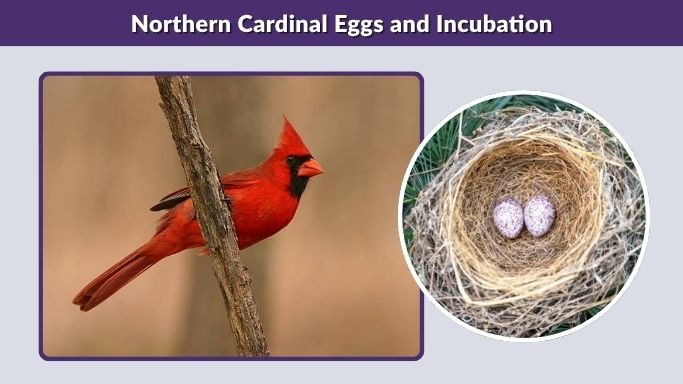
Northern Cardinal eggs are usually pale grayish, bluish-white, or greenish-white with brown, gray, or purple markings. A female cardinal commonly lays 2 to 5 eggs, with 3 or 4 eggs being very common.
She usually lays one egg per day until the clutch is complete. After that, incubation begins, and the eggs hatch in less than two weeks.
What Do Cardinal Eggs Look Like?
Cardinal eggs are small, oval, and lightly colored with speckling. The markings can vary from nest to nest. Some eggs may look heavily spotted, while others have lighter marks.
Key egg facts include:
- Clutch size: Usually 2 to 5 eggs
- Egg color: Whitish, bluish-white, grayish-white, or greenish-white
- Markings: Brown, gray, or purplish spots
- Laying pattern: Usually one egg per day
- Incubation period: Around 11 to 13 days
- Main incubator: Mostly the female
During incubation, the female sits on the eggs to keep them warm. The male may bring her food or stay nearby to defend the nesting area. If the nest is disturbed too often, the risk of abandonment or predator discovery may increase.
What to Do If You Find Cardinal Eggs
If you find cardinal eggs in a nest, the safest action is to leave them alone. Watching from a distance is fine, but touching the eggs or moving the nest can harm the nesting process.
You should avoid trimming shrubs, cutting vines, spraying chemicals, or moving objects near an active nest. Even if the adult birds are not visible, they may be nearby waiting for you to leave.
If an egg falls from the nest, do not assume you should put it back. In many areas, wild bird nests and eggs are protected by law, and handling them may not be allowed without permission. The best choice is to keep pets away and avoid further disturbance.
Baby Northern Cardinals in the Nest
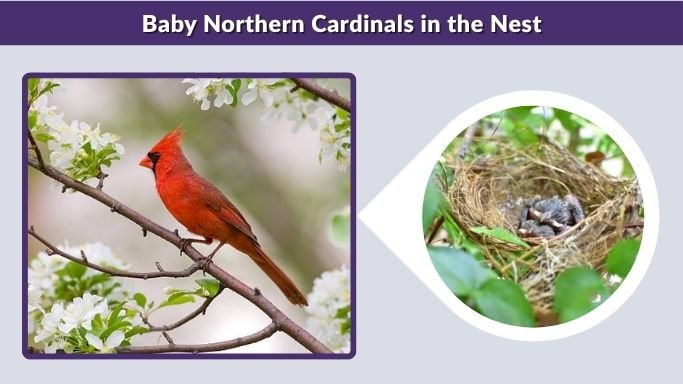
Baby Northern Cardinals hatch helpless, mostly naked, and dependent on their parents. They grow very quickly. Within days, they develop down and feathers, open their eyes, and become more active.
Both parents feed the chicks. Their diet includes many soft insects, which provide protein for fast growth. As the chicks get older, parents may also bring seeds and fruit.
When Do Cardinal Babies Leave the Nest?
Young cardinals usually leave the nest about 9 to 11 days after hatching. At this stage, they are called fledglings. They may not fly well at first, but leaving the nest early is normal for many songbirds.
A fledgling may sit on low branches, hop through shrubs, or hide in grass while the parents continue feeding it. This does not always mean the bird is abandoned.
Important fledgling signs include:
- Short tail feathers
- Soft, fluffy body feathers
- Weak or clumsy flight
- Hopping on the ground or low branches
- Parents calling or feeding nearby
If you find a fledgling, keep cats and dogs away. Do not take it indoors unless it is clearly injured or in immediate danger. In most cases, the parents are nearby and still caring for it.
What Do Baby Cardinals Eat?
Baby cardinals need protein-rich food, especially insects. Parents may feed them beetles, caterpillars, grasshoppers, spiders, flies, moths, and other small invertebrates. These foods help chicks grow feathers, muscles, and strong bodies.
As they mature, young cardinals gradually learn to eat seeds, berries, and other adult foods. Adult Northern Cardinals eat many seeds and fruits, but during nesting season, insects become especially important for raising healthy young.
A bird-friendly yard with native plants can support more insects naturally. This gives nesting cardinals a better food supply without needing artificial feeding.
Do Northern Cardinals Return to the Same Nest?
Northern Cardinals may return to the same general territory, but they usually do not reuse the exact same nest. Old nests can contain parasites, become weak, or be exposed to predators. For a new brood, the female often builds a fresh nest in a different nearby location.
However, cardinals may nest in the same shrub, hedge, or yard again if the area remains safe and provides food, cover, and low disturbance.
Will Cardinals Use the Same Nest Twice?
Most cardinals prefer a new nest for each nesting attempt. A used nest may look fine to humans, but birds often choose to start fresh. This helps reduce risks from mites, lice, bacteria, and predators that may have learned the nest location.
They may still stay close to the same nesting area. For example, a pair may build one nest in a honeysuckle vine and another later in a nearby rose bush or evergreen shrub.
To encourage cardinals to return, avoid removing dense vegetation immediately after nesting season. Keeping natural cover in the yard gives them more choices for future nesting.
Abandoned Northern Cardinal Nest
Sometimes a nest may appear abandoned when it is not. Adult cardinals do not always sit on the nest every minute, especially before incubation starts or after chicks grow larger. They may also stay hidden nearby when people approach.
A nest may truly be abandoned if no adults return for a long time, eggs remain cold for days, or the nest has been damaged by weather or predators. However, it is difficult to know for sure without careful observation from a distance.
If you suspect abandonment, do not move the nest or eggs. Give the birds space and check only from far away. If chicks are injured or in danger, contact a licensed wildlife rehabilitator for guidance.
How to Help Northern Cardinals Nest Safely
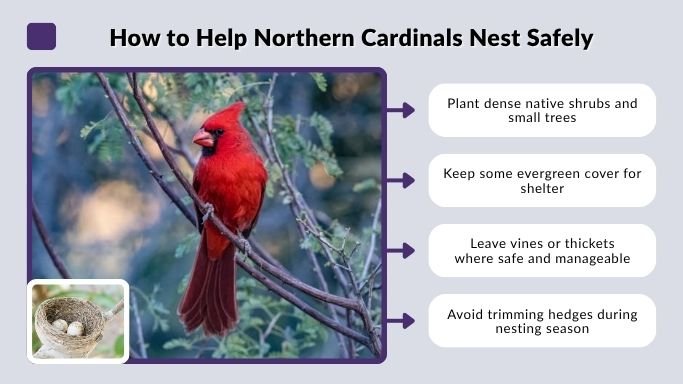
The best way to help nesting Northern Cardinals is to create a safe, natural, and quiet backyard. They need thick cover, food, water, and protection from predators. Small changes in landscaping can make a big difference.
Avoid disturbing shrubs during nesting season, especially if you see cardinals carrying nest material or food.
Cardinal-Friendly Backyard Tips
You can support nesting cardinals by making your yard more natural and protective.
Helpful steps include:
- Plant dense native shrubs and small trees
- Keep some evergreen cover for shelter
- Leave vines or thickets where safe and manageable
- Avoid trimming hedges during nesting season
- Keep cats indoors or supervised
- Reduce pesticide use to protect insects
- Provide clean water in a shallow birdbath
- Grow seed- and berry-producing plants
- Watch nests from a distance only
Cardinals are adaptable birds, but they still face threats from predators, outdoor cats, window strikes, and habitat loss. A quiet yard with thick plants can give them a better chance of nesting successfully.
Foods That Support Nesting Cardinals
Adult cardinals often visit feeders for sunflower seeds, safflower seeds, cracked corn, and other seed mixes. During nesting season, natural foods are just as important. Insects help feed chicks, while berries and seeds support adult birds.
Good plants for cardinals may include dogwood, serviceberry, elderberry, viburnum, blackberry, raspberry, grapevine, holly, and native grasses. These plants can provide food, nesting cover, and shelter across different seasons.
A feeder can help attract cardinals, but it should not replace natural habitat. Clean feeders regularly to prevent disease, and place them near cover but not so close that predators can easily ambush birds.
FAQs
Do Northern Cardinals build nests in birdhouses?
Northern Cardinals usually do not build nests in birdhouses because they are open-cup nesters, not cavity nesters. They prefer dense shrubs, vines, hedges, and small trees. If you want to attract nesting cardinals, planting thick native vegetation is more effective than installing a standard nest box.
Where do Northern Cardinals usually nest?
Northern Cardinals usually nest in dense shrubs, vines, thickets, hedges, small trees, and evergreen plants. They often choose places with thick cover that hides the nest from predators. Backyard nests may appear in honeysuckle, rose bushes, dogwood, holly, cedar, or tangled garden borders.
How many eggs do Northern Cardinals lay?
A female Northern Cardinal usually lays 2 to 5 eggs, though 3 or 4 eggs are common. The eggs are usually pale whitish, bluish-white, grayish-white, or greenish-white with brown, gray, or purple markings. Incubation usually lasts about 11 to 13 days.
When do baby cardinals leave the nest?
Baby cardinals usually leave the nest about 9 to 11 days after hatching. At this stage, they are fledglings and may not fly strongly yet. They often hop around low branches or the ground while the parents continue feeding and protecting them nearby.
Will Northern Cardinals use the same nest again?
Northern Cardinals usually do not reuse the exact same nest. Old nests can become weak, dirty, or easier for predators to find. However, a pair may return to the same yard, shrub, or nesting territory and build a new nest nearby if the habitat remains safe.
