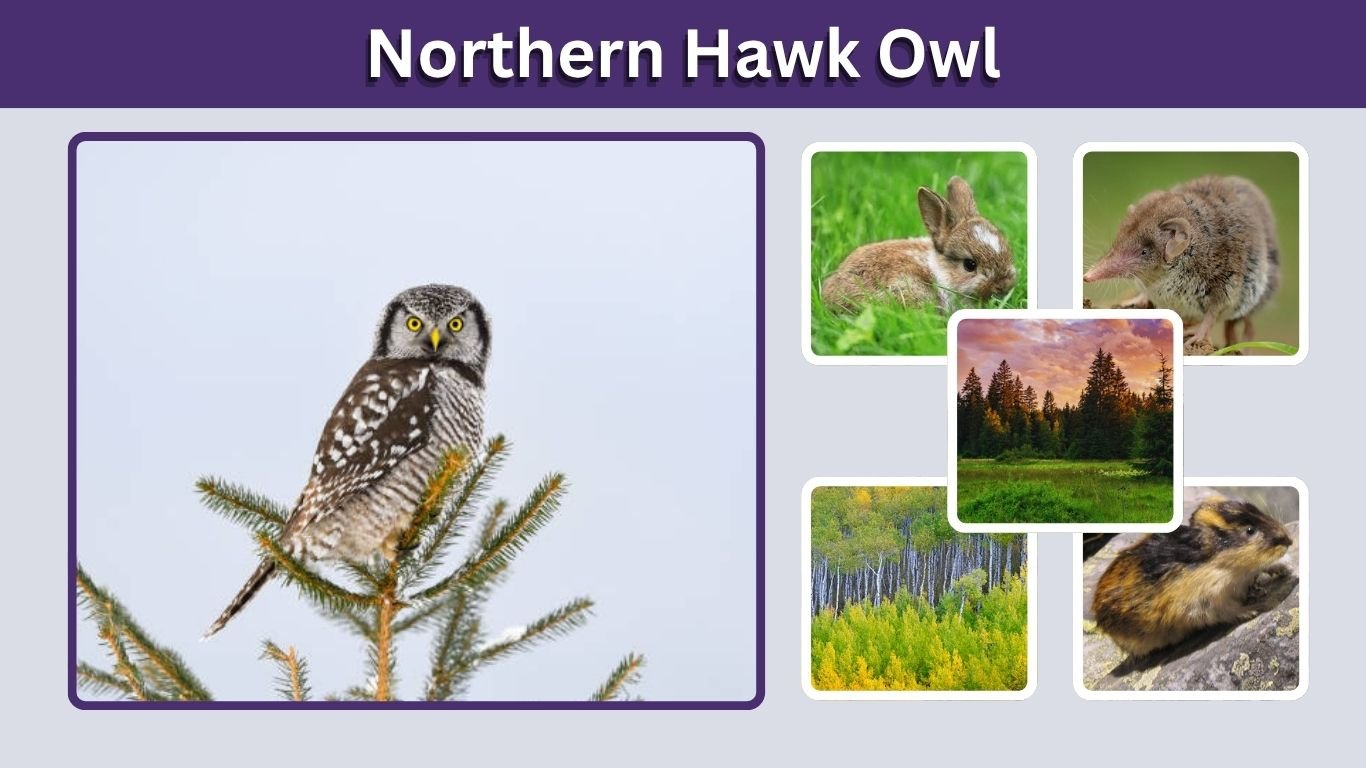
The Northern Hawk Owl is a striking owl of the boreal forest that combines the rounded face and bright eyes of an owl with the long tail, upright perching habits, and daytime hunting style of a hawk. Its scientific name is Surnia ulula, and it is the only living species in the genus Surnia. Unlike many owls that remain hidden until darkness, Northern Hawk Owls often hunt in full daylight from exposed treetops. They live across northern North America, Europe, and Asia, occasionally moving south during winter when prey becomes difficult to find.
Northern Hawk Owl Overview
Northern Hawk Owls are medium-sized members of the true owl family, Strigidae. Their long tails, relatively pointed wings, horizontal posture, and fast flight make them appear hawk-like, especially when seen crossing an open field. However, their rounded heads, facial disks, feathered bodies, and silent approach clearly identify them as owls.
| Feature | Northern Hawk Owl |
|---|---|
| Scientific name | Surnia ulula |
| Bird family | Strigidae |
| Average length | About 15–18 inches |
| Wingspan | Approximately 31–33 inches |
| Main habitat | Open boreal forest |
| Primary food | Voles and other small mammals |
| Activity period | Primarily daytime and twilight |
| Conservation status | Least Concern globally |
Northern Hawk Owl Identification
The Northern Hawk Owl has a distinctive appearance that separates it from most other northern owls. Its body is relatively slim, its tail is unusually long, and its posture may appear more horizontal than the upright stance of a Great Gray Owl or Boreal Owl.
Key Identification Features
- Rounded head without ear tufts
- Bright yellow eyes
- Yellow, sharply curved bill
- White facial disk surrounded by a dark border
- Dark brown upperparts with white spots
- White underparts marked with narrow brown bars
- Long, strongly banded tail
- Relatively narrow and pointed wings
- Feathered legs and feet
Dark vertical markings on both sides of the face can resemble a pair of black parentheses. The combination of these facial markings, the barred chest, and the long tail makes the species relatively easy to identify when seen clearly.
Northern Hawk Owl Size and Wingspan
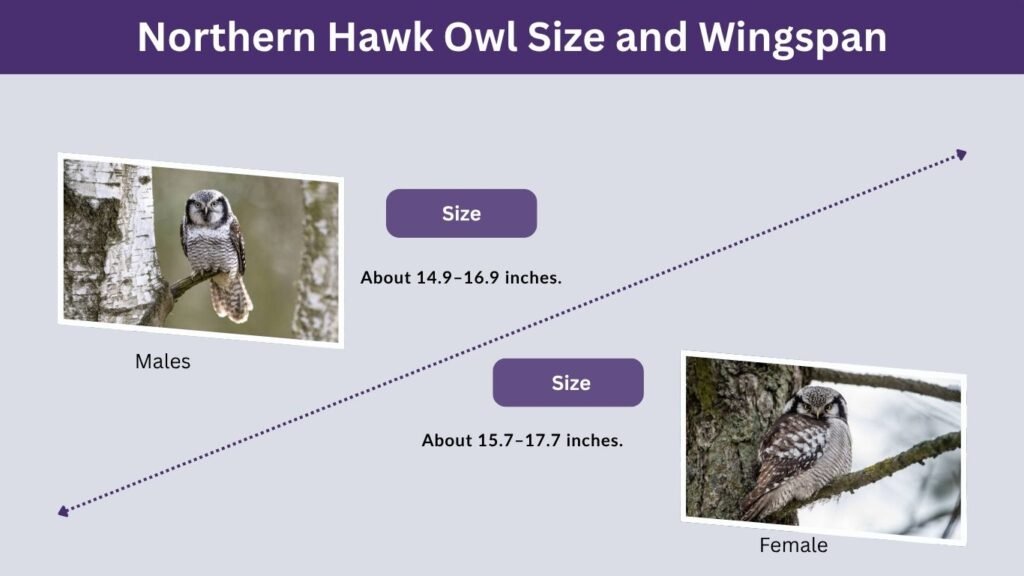
Northern Hawk Owls are approximately the size of a crow, although their broad feathers may make them look larger. Females are normally heavier and slightly longer than males, as is common among many birds of prey.
| Measurement | Male | Female |
|---|---|---|
| Length | About 14.9–16.9 inches | About 15.7–17.7 inches |
| Weight | Approximately 10.6–12.7 ounces | Approximately 12.7–15.5 ounces |
| Wingspan | About 31–33 inches | About 31–33 inches |
Despite the difference in body weight, males and females have similar wingspans. Their long tails help them turn quickly while pursuing prey through open woodland and around scattered trees.
Northern Hawk Owl Range
The Northern Hawk Owl occupies a vast circumpolar range across the Northern Hemisphere. In North America, it occurs from Alaska across much of Canada. Its Eurasian range stretches through Scandinavia, Russia, Siberia, Central Asia, northern Mongolia, and parts of northern China.
The species is generally considered nonmigratory, but individuals may move considerable distances when food becomes scarce. These irregular movements are called irruptions.
During some winters, Northern Hawk Owls travel south into northern parts of the United States. Sightings may occur in states such as Minnesota, Maine, New York, Michigan, Wisconsin, and occasionally farther south. Such appearances are unpredictable and often attract large numbers of birdwatchers.
Northern Hawk Owl Habitat
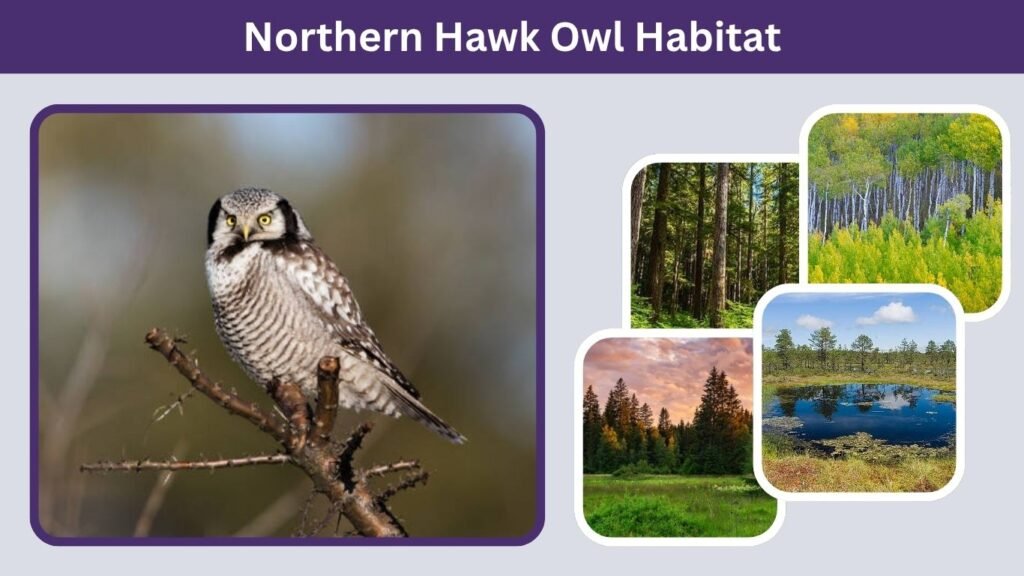
Northern Hawk Owls are strongly associated with the boreal forest, also known as the taiga. Rather than living inside dense, unbroken woodland, they generally prefer open areas containing scattered trees and elevated hunting perches.
Common habitats include:
- Open coniferous forests
- Mixed birch, willow, poplar, and spruce woodland
- Forest clearings
- Bog and muskeg edges
- Burned forests
- Meadows surrounded by trees
- River valleys
- Recently logged or disturbed woodland
Burned areas can provide especially useful habitat because dead trees offer open perches while grasses and young vegetation support large populations of voles. The owls generally avoid extremely dense spruce and fir forests where spotting and pursuing prey would be more difficult.
What Do Northern Hawk Owls Eat?
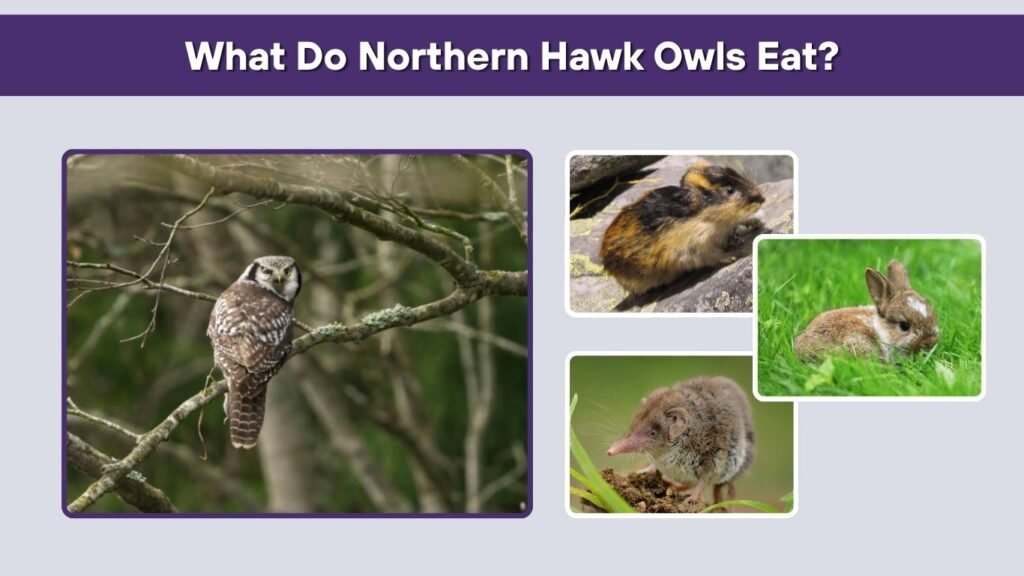
Northern Hawk Owls are carnivores that feed mainly on small mammals. Voles are particularly important, but the exact diet changes with season, location, and prey abundance.
Common Prey
Their diet may include voles, lemmings, mice, shrews, rats, squirrels, young rabbits, snowshoe hares, and small birds. During summer, rodents usually dominate the diet. Birds such as grouse and ptarmigan may become more important during winter when deep snow makes mammals harder to catch.
The availability of voles can strongly influence breeding success and winter movements. When rodent populations fall sharply, some owls leave their normal northern territories in search of better hunting conditions.
Northern Hawk Owl Hunting Behavior
The Northern Hawk Owl is one of the most visibly daytime-active owls. It commonly sits at the top of a dead tree, spruce, utility pole, or other elevated perch while scanning the ground.
Its hunting style resembles that of a kestrel or small hawk. Once prey is detected, the owl launches from its perch, flies rapidly over the ground, and drops feet-first onto the target.
Northern Hawk Owls have excellent hearing and can detect rodents moving beneath vegetation or snow. They may plunge into snow to capture concealed prey. Their vision is also well suited to daylight hunting, allowing them to locate small animals from considerable distances.
They can hunt during the day, at dawn, at dusk, and sometimes at night. Daytime activity is particularly valuable in the far north, where summer daylight may continue for most or all of the day.
Northern Hawk Owl in Flight
In flight, the Northern Hawk Owl looks more streamlined than many other owls. Its long tail, relatively narrow wings, and rapid wingbeats create a distinctly hawk-like silhouette.
It can glide low over snow or open ground, maneuver quickly between trees, and accelerate rapidly after prey. White spotting across the darker upper wings may become visible when the wings are spread.
Like other owls, it possesses specialized flight feathers that help reduce sound. Quiet flight allows it to approach prey without providing much warning, while its pointed wings support faster, more direct pursuit than the broader wings of many woodland owls.
Northern Hawk Owl Sounds and Calls
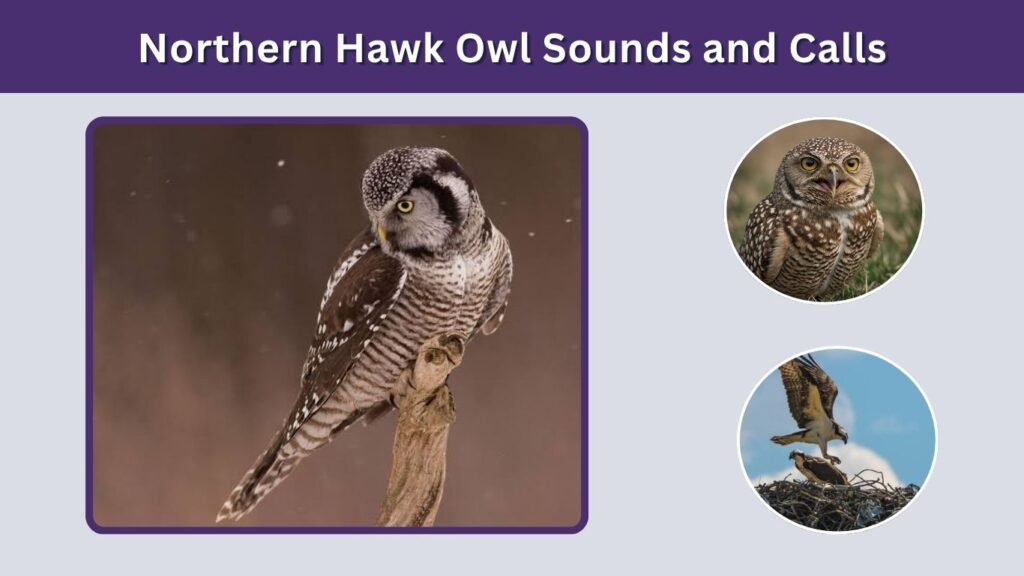
Northern Hawk Owls produce several calls, with vocalizations varying according to sex, season, and situation.
The male’s mating call is usually a rapid, rolling series of whistled notes. It may continue for several seconds and is used to attract a female or advertise territory. The female’s calls tend to sound higher, rougher, or more irregular.
When alarmed, the owl may give sharp, repeated notes. Adults defending a nest can produce screams, yelps, or rapidly repeated warning calls. Parents also use short calls to warn young owls about approaching danger.
Northern Hawk Owls are often especially vocal during late winter and early spring when pairs are forming and territories are being established.
Breeding and Nesting
The breeding season generally begins near the end of winter or in early spring. Males call to attract females and may display around possible nest locations.
Northern Hawk Owls do not normally construct a completely new nest. Instead, they use natural tree cavities, broken tree trunks, hollow snags, abandoned woodpecker holes, or old nests originally built by crows and other large birds.
The female lays a clutch that can vary with food availability. In years when voles are abundant, pairs may produce more eggs and raise more young. The female handles most incubation while the male provides food.
After hatching, young owls remain in the nest until they are developed enough to leave. They may climb and move among nearby branches before becoming capable fliers. Both parents continue feeding and defending them after they leave the nest.
Adults can become highly defensive around their young and may dive toward humans or animals that approach too closely.
Northern Hawk Owl Adaptations
Northern Hawk Owls possess several adaptations that allow them to survive and hunt in cold northern environments.
Their thick plumage insulates the body during severe winter weather. Feathers also cover much of the legs and feet, helping reduce heat loss.
The owl’s long tail provides stability and precise steering during fast pursuits. Its bright eyes support sharp daytime vision, while sensitive hearing helps locate rodents beneath grass or snow.
Strong feet and sharply curved talons allow it to hold struggling prey. A hooked bill helps tear meat into pieces small enough to swallow.
The ability to hunt during daylight is particularly important in northern summers, when darkness may be brief or absent. During winter, it can adjust its activity to the limited hours of available light.
Northern Hawk Owl Lifespan and Predators
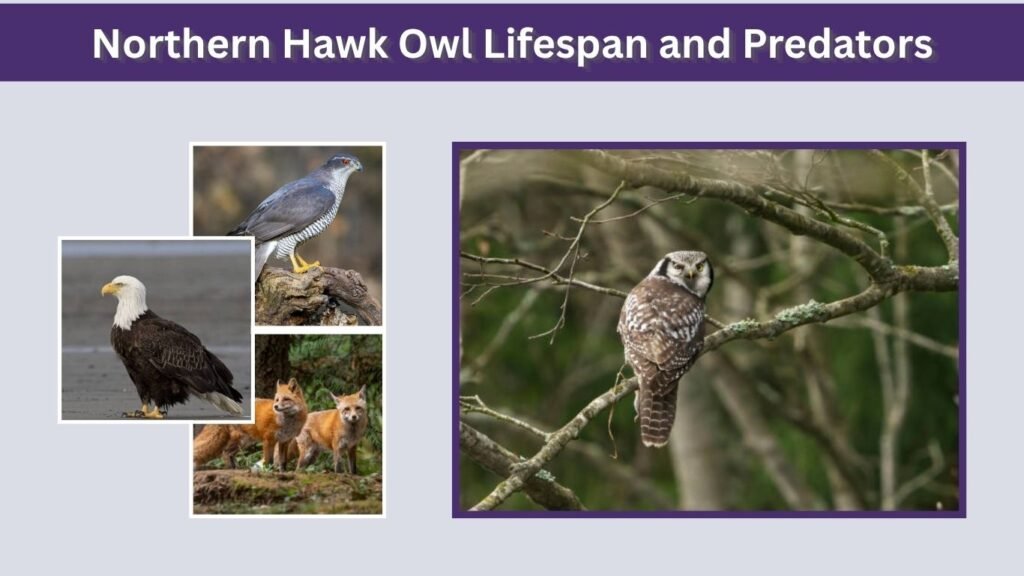
The exact average lifespan of wild Northern Hawk Owls is difficult to determine because many individuals are never banded or monitored throughout their lives. Like other medium-sized owls, they face the greatest risks when young, while adults that survive their first years may live considerably longer.
Potential predators include larger owls, goshawks, eagles, foxes, martens, and other mammals capable of reaching nests. Eggs and young owls are more vulnerable than healthy adults.
Severe weather, starvation during prey shortages, vehicle collisions, and habitat disturbance can also reduce survival. Adults defend their nests aggressively, using alarm calls and diving attacks to discourage intruders.
Is the Northern Hawk Owl Endangered?
The Northern Hawk Owl is currently classified globally as a species of Least Concern because it occupies an extremely large range and maintains a substantial overall population. BirdLife estimates the global population at roughly 160,000 to 711,000 mature individuals, although numbers are difficult to measure across such remote northern habitat.
This global classification does not mean that the species faces no threats. Forestry practices, loss of nesting snags, changing wildfire patterns, collisions, prey fluctuations, and climate-driven habitat changes may affect local populations.
Leaving standing dead trees where it is safe to do so can preserve nesting cavities and hunting perches used by hawk owls and many other boreal birds.
Interesting Northern Hawk Owl Facts
The Northern Hawk Owl is the only living member of the genus Surnia. Its species name, ulula, comes from a Latin word associated with a screeching owl.
It can hunt successfully in bright daylight, unlike the strongly nocturnal behavior commonly associated with owls. It often perches on the highest available branch, making it more visible than many forest owls.
Its hawk-like shape is not just superficial. The long tail, pointed wings, rapid flight, exposed perches, and visual hunting strategy allow it to occupy a daytime predatory role similar to that of small hawks.
Northern Hawk Owls may remain in the same northern region year-round, but shortages of voles can trigger dramatic southward movements. This is why the species may be absent from an area for years and then suddenly appear during a single winter.
FAQs
Where Do Northern Hawk Owls Live?
Northern Hawk Owls live across the boreal regions of Alaska, Canada, Scandinavia, Russia, Siberia, and parts of Central Asia. They prefer open coniferous or mixed forests containing clearings, meadows, bogs, burned areas, and tall trees that provide elevated hunting perches.
How Big Is a Northern Hawk Owl?
A Northern Hawk Owl is approximately 15 to 18 inches long and has a wingspan of roughly 31 to 33 inches. Females are generally heavier than males, although both sexes have similar plumage and wingspan measurements.
What Does a Northern Hawk Owl Sound Like?
The male produces a fast, rolling whistle during courtship and territorial displays. Females often give sharper or more irregular calls. Adults may also make repeated alarm notes, screams, or yelping sounds when predators approach a nest or fledglings.
What Do Northern Hawk Owls Eat?
Northern Hawk Owls mainly eat voles, lemmings, mice, shrews, and other small mammals. They may also capture squirrels, young rabbits, grouse, ptarmigan, and smaller birds, particularly when rodents are difficult to find during winter.
Are Northern Hawk Owls Found in the United States?
Yes. They regularly occur in Alaska and may appear in northern parts of the contiguous United States during winter. Occasional southward movements bring them into states such as Minnesota, Maine, Michigan, Wisconsin, and New York, although sightings are irregular.