
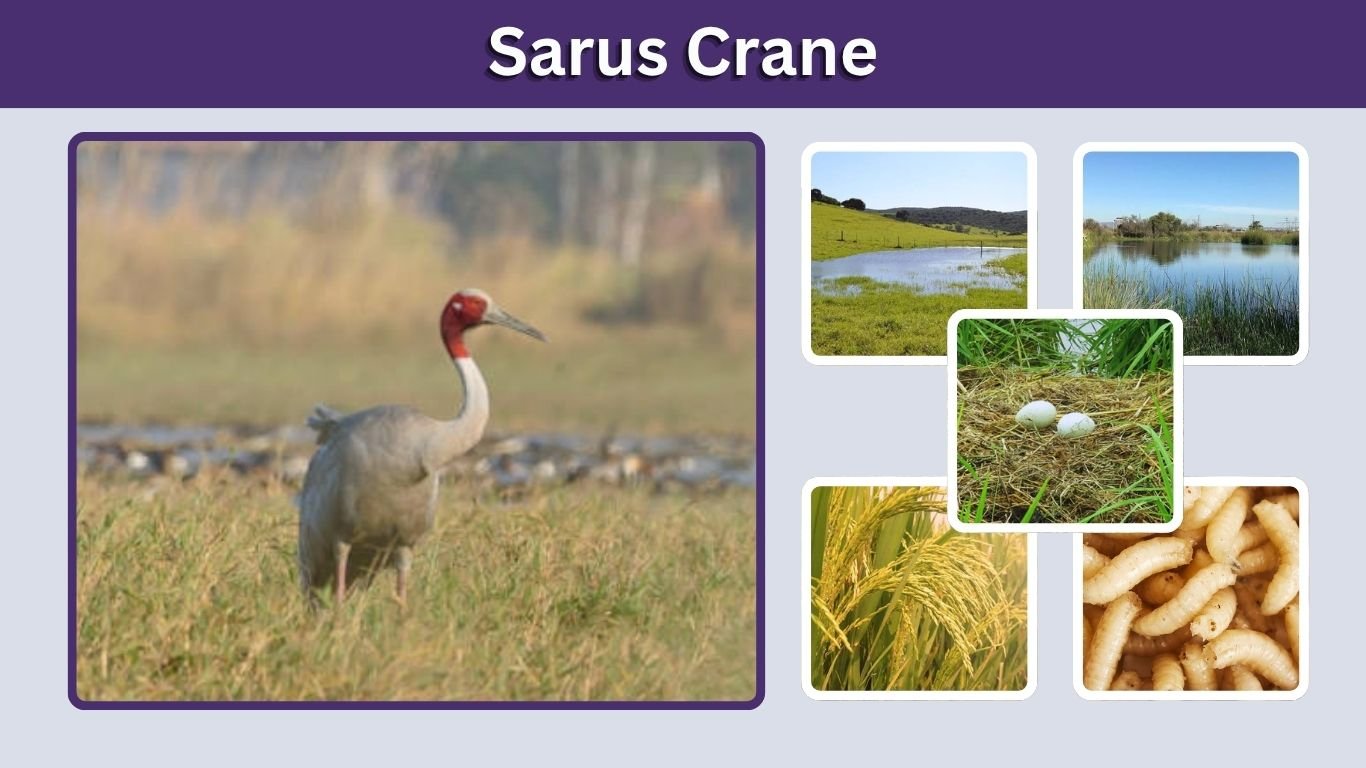
The Sarus crane is a towering wetland bird recognized by its gray body, long pinkish legs, and bright red head and upper neck. Reaching almost the height of an adult person, it is considered the world’s tallest flying bird. Sarus cranes are also famous for their powerful calls, elegant courtship dances, and lasting pair bonds. Although they can live successfully around farms and rice fields, wetland destruction, pollution, power lines, and human disturbance continue to threaten their survival.
What Is a Sarus Crane?
The Sarus crane is a large bird belonging to the crane family, Gruidae. Its accepted scientific name is Antigone antigone, although older publications may call it Grus antigone.
Three commonly recognized forms occur across different regions:
- Indian Sarus crane
- Eastern Sarus crane
- Australian Sarus crane
The Indian form occurs mainly across northern and northwestern India and parts of Nepal and Pakistan. Eastern Sarus cranes are found in parts of Myanmar, Cambodia, Laos, and Vietnam, while Australian Sarus cranes live in northern Australia.
Sarus Crane Identification
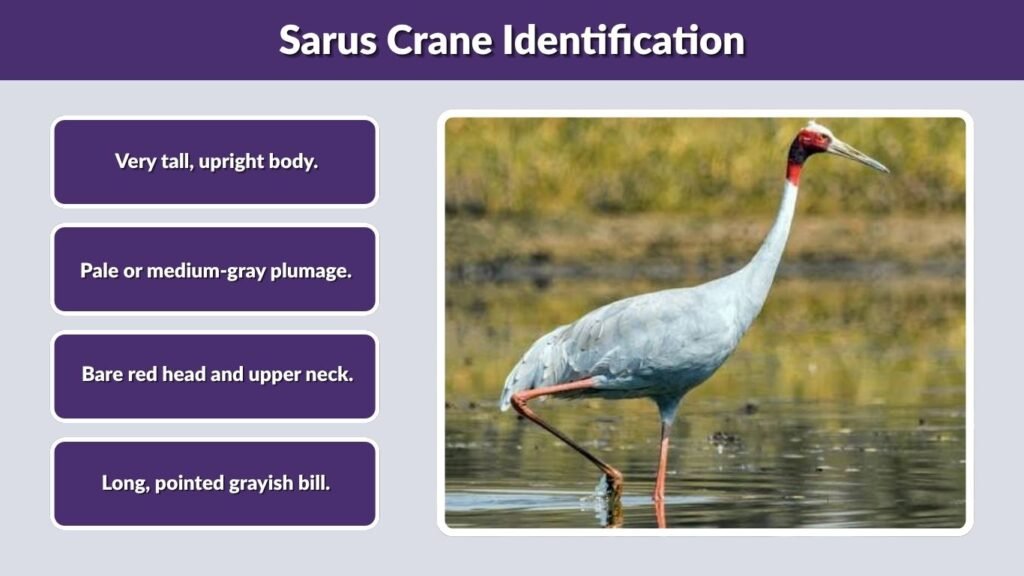
Adult Sarus cranes have an unmistakable appearance. Their bodies are mainly pale gray, while the head and upper neck have extensive bare red skin. A small gray or whitish patch occurs around the ear, and the crown may appear greenish-gray.
Key Identification Features
- Very tall, upright body
- Pale or medium-gray plumage
- Bare red head and upper neck
- Long, pointed grayish bill
- Long pink or reddish legs
- Dark wing tips visible during flight
- Straight neck and legs when flying
- Powerful, trumpet-like calls
Young Sarus cranes look different from adults. Juveniles usually have cinnamon-brown plumage and duller head coloring. The distinctive red skin becomes more noticeable as the bird matures.
Male vs Female Sarus Crane
Male and female Sarus cranes have almost identical plumage. Both possess gray bodies, red heads, long legs, and pointed bills.
Males are generally slightly larger and taller, but size differences may be difficult to judge unless a bonded pair is standing together. Their behavior and positions during their paired calls can sometimes help experienced observers distinguish them.
How Tall Is a Sarus Crane?
An adult Sarus crane normally stands approximately 150 to 180 centimeters, or about 5 to nearly 6 feet tall. Exceptional individuals can reach around 1.8 meters.
This makes the Sarus crane the tallest flying bird in the world. When standing beside an average adult human, its head may reach approximately shoulder level, eye level, or even higher, depending on the height of both the bird and person.
| Measurement | Typical range |
| Standing height | 150–180 cm |
| Body length | Around 150–156 cm |
| Wingspan | Approximately 220–250 cm |
| Weight | Commonly around 5–8 kg |
Despite its great height, the Sarus crane is not the heaviest flying bird. Its long neck and legs account for much of its impressive height.
Sarus Crane Habitat
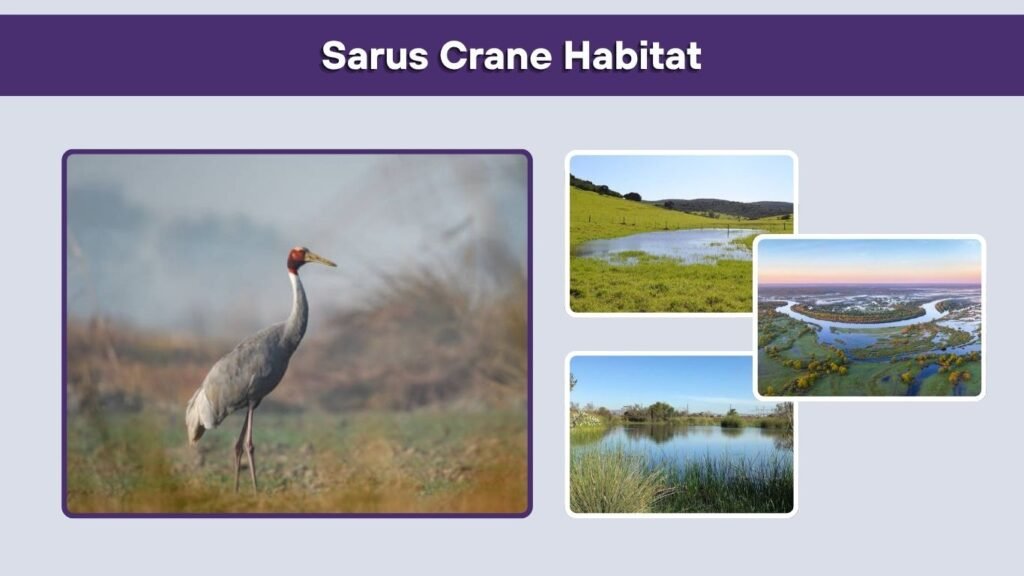
Sarus cranes depend on open areas containing shallow water, wet soil, and nearby feeding grounds. Their habitats vary somewhat among regions.
Common habitats include:
- Freshwater marshes
- Seasonal wetlands
- Floodplains
- Shallow ponds
- Wet grasslands
- Rice paddies
- Irrigated farmland
- River margins
- Savannas and open woodlands in Australia
In India and Nepal, Sarus cranes frequently live near villages and agricultural areas. Flooded rice fields can provide nesting locations and abundant food when natural wetlands are limited. In northern Australia, some pairs also use woodland wetlands and artificial waterholes on cattle properties.
Where Do Sarus Cranes Live?
India supports the largest remaining population, particularly across Uttar Pradesh, Rajasthan, Gujarat, and parts of Madhya Pradesh.
Smaller and more fragmented populations occur in Nepal, Pakistan, Myanmar, Cambodia, Laos, Vietnam, and northern Australia. The species has disappeared from several parts of its former range, including areas where wetlands have been drained or heavily altered.
What Do Sarus Cranes Eat?
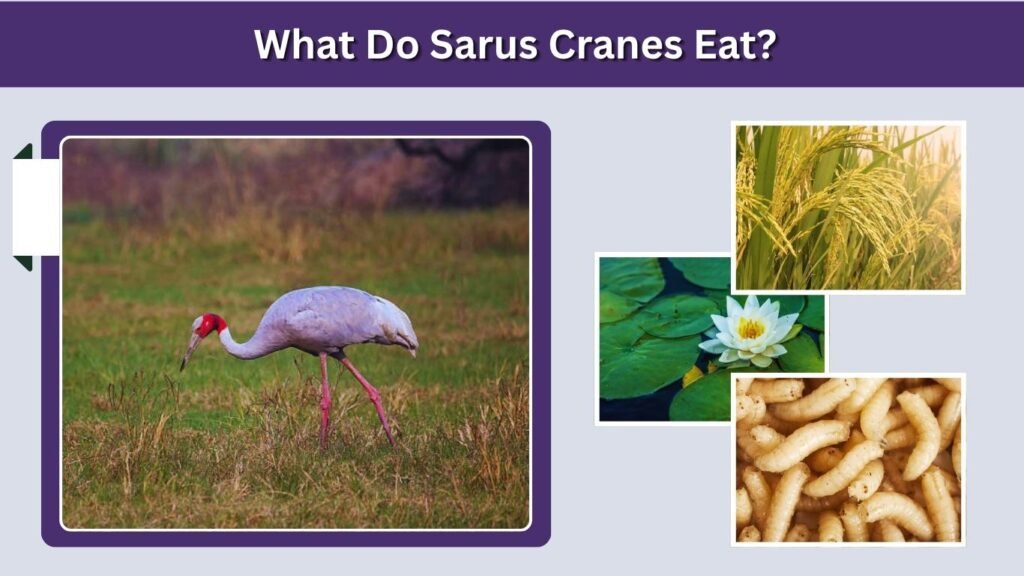
Sarus cranes are omnivores, meaning they consume both plant and animal foods. They normally forage by walking slowly through shallow water, grasslands, and cultivated fields.
Their long bills help them probe mud, pull up underground plant parts, and capture small animals.
Sarus Crane Diet
Common foods include:
- Aquatic plants
- Roots, bulbs and tubers
- Seeds and grains
- Rice and other crops
- Insects and insect larvae
- Snails and other invertebrates
- Frogs and tadpoles
- Small fish
- Crustaceans
- Small reptiles and vertebrates
The proportions of plant and animal foods vary with habitat, season, rainfall, and availability. The International Crane Foundation describes their diet as including aquatic plants, grains, insects, invertebrates, and small vertebrates.
Sarus Crane Behavior
Sarus cranes are usually seen alone, in pairs, as family groups, or in small flocks. During nonbreeding periods, larger gatherings may form at productive feeding and roosting areas.
Sarus Crane Call
The call is a loud, resonant trumpet that can travel across open wetlands. A pair may perform a coordinated unison call to reinforce its bond and warn other cranes away from its territory.
During a unison call, the birds stretch their heads upward and call in a carefully coordinated sequence. Their long windpipes help produce the far-carrying sound.
Sarus Crane Dance
Sarus cranes perform dramatic dances involving:
- Bowing
- Running
- Leaping into the air
- Wing spreading
- Tossing grass or sticks
- Circling around one another
Dancing is closely associated with courtship, but it is not limited to mating adults. Juveniles and established pairs may also dance. The behavior may strengthen social bonds, release excitement, or develop coordination.
Do Sarus Cranes Mate for Life?
Sarus cranes are strongly monogamous and frequently maintain long-term pair bonds. Their coordinated calls, dances, territorial defense, and shared parenting contribute to their reputation as symbols of love and marital loyalty.
However, describing every pair as remaining together for life is an oversimplification. A surviving bird may eventually choose another mate if its partner dies, and occasional pair changes can occur.
Nesting and Reproduction
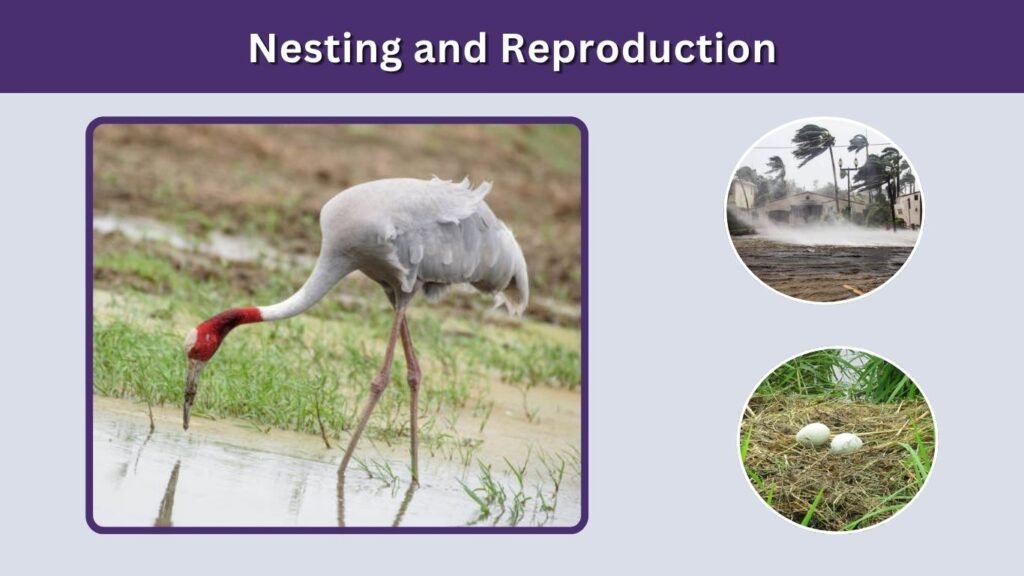
Breeding is closely connected to rainfall and wetland conditions. In India, most nesting occurs during the monsoon, when wetlands and rice paddies contain enough water to protect nests and provide food for chicks.
The male and female work together to construct a large platform of reeds, grasses, and other wetland vegetation. The nest is usually built in shallow water.
Eggs and Chicks
A female commonly lays one or two eggs. Both parents participate in protecting the nest, although their exact incubation roles may differ.
The chicks hatch covered in soft down and can leave the nest soon afterward. They follow their parents through shallow water and feeding areas while learning where and how to find food.
Both adults aggressively defend their chicks against possible threats. Young cranes remain with their parents for months and may not separate until the adults prepare for another breeding attempt.
Do Sarus Cranes Migrate?
Most Sarus cranes are considered resident or largely non-migratory. Indian and Australian populations usually remain within the same general regions while making local movements in response to water, rainfall, and food.
Eastern Sarus cranes may travel seasonally between breeding wetlands in northern Cambodia and dry-season habitats in the Mekong Delta. Therefore, movement patterns vary among populations rather than following one universal pattern.
Sarus Crane Lifespan
Sarus cranes are long-lived birds, and individuals may survive for several decades under favorable conditions. Estimates commonly place their potential lifespan at approximately 30 to 40 years, although reliable maximum ages in completely wild populations are difficult to determine.
Survival depends on wetland quality, food availability, breeding success, disease, predation, collisions, and human activity. Young cranes face the highest risks because eggs and chicks are vulnerable to flooding, predators, farming operations, and disturbance.
Are Sarus Cranes Endangered?
The Sarus crane is currently classified as Vulnerable, meaning it faces a high risk of extinction in the wild if major threats continue. Estimates vary, but the International Crane Foundation places the worldwide population at roughly 20,000 to 30,000 birds, with the overall trend described as stable or decreasing depending on the population.
Major Threats
Sarus cranes face several serious pressures:
- Wetland drainage and conversion
- Changes in farming practices
- Pesticide and chemical poisoning
- Collisions with electrical lines
- Egg and chick collection
- Hunting in parts of their range
- Disturbance near nests
- Invasive plants
- Reduced water supplies
- Climate-related rainfall changes
Conservation programs focus on protecting wetlands, working with farmers, preventing power-line collisions, reducing poisoning, and protecting nests in agricultural landscapes.
Sarus Crane vs Brolga
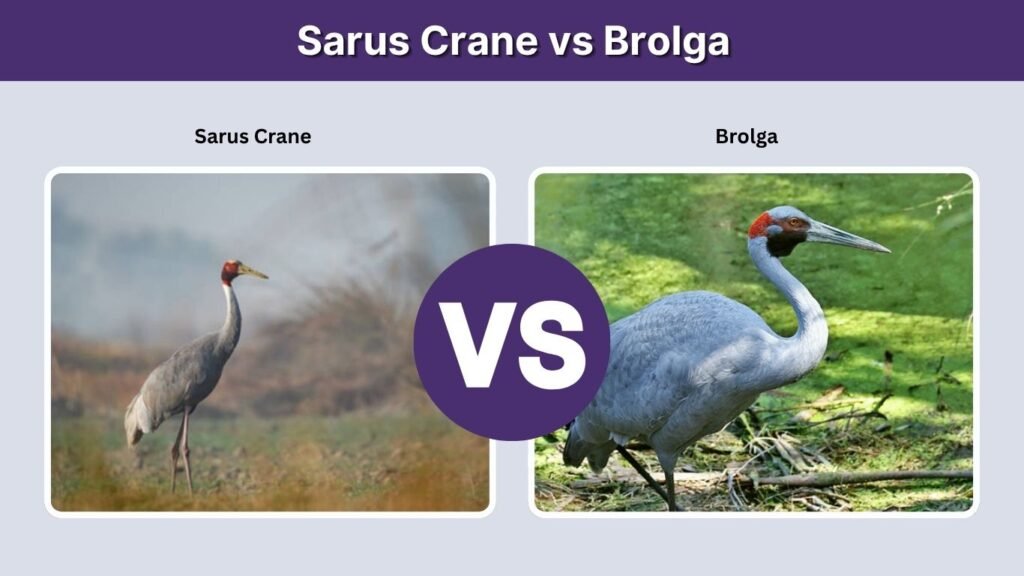
The Sarus crane and Brolga occur together in parts of northern Australia, where identification can be challenging.
| Feature | Sarus crane | Brolga |
| Head and neck | Extensive red on head and upper neck | Red mainly on head and throat |
| Legs | Pinkish to reddish | Dark gray to blackish |
| Body | Usually paler gray | Often darker silver-gray |
| Height | Usually taller | Slightly shorter |
| Range | Asia and northern Australia | Australia and New Guinea |
| Habitat preference | More wooded and riverine wetlands in some areas | Often favors open grasslands |
Both species are tall, gray cranes that dance, call loudly, and eat a mixture of plants and animals.
Interesting Sarus Crane Facts
- The Sarus crane is the world’s tallest flying bird.
- Adults may stand almost six feet tall.
- A bonded pair performs synchronized trumpet calls.
- Sarus cranes often nest in flooded rice fields.
- Both parents help raise and defend their chicks.
- Their red head and neck become brighter during excitement.
- They usually fly with their neck and legs fully extended.
- The species is culturally associated with love and faithfulness.
- Most populations do not make long-distance migrations.
- The species is classified as Vulnerable.
FAQs
Can a Sarus crane fly?
Yes. Despite standing as tall as many humans, the Sarus crane is a capable flyer. It takes off by running and beating its broad wings, then flies with its neck extended forward and its long legs trailing behind.
Are Sarus cranes aggressive?
Sarus cranes are generally cautious around humans, but breeding pairs can become highly territorial. Adults may charge, call, spread their wings, or strike with their bills and feet when defending eggs or chicks.
Is the Sarus crane found in the Philippines?
The species does not currently have an established wild population in the Philippines. Historical references sometimes connect an extinct regional population with Luzon, but today the main populations occur in South Asia, Southeast Asia, and northern Australia.
What does the Sarus crane symbolize?
In parts of South Asia, Sarus cranes symbolize love, loyalty, good fortune, and marital faithfulness. This symbolism comes from their conspicuous pair bonds, coordinated calls, and the frequent sight of two adults remaining together.
How can Sarus cranes be protected?
Protecting natural wetlands and shallow agricultural habitats is essential. Other important actions include reducing pesticide exposure, marking dangerous power lines, preventing nest disturbance, working with farmers, and stopping the illegal collection of birds and eggs.
