
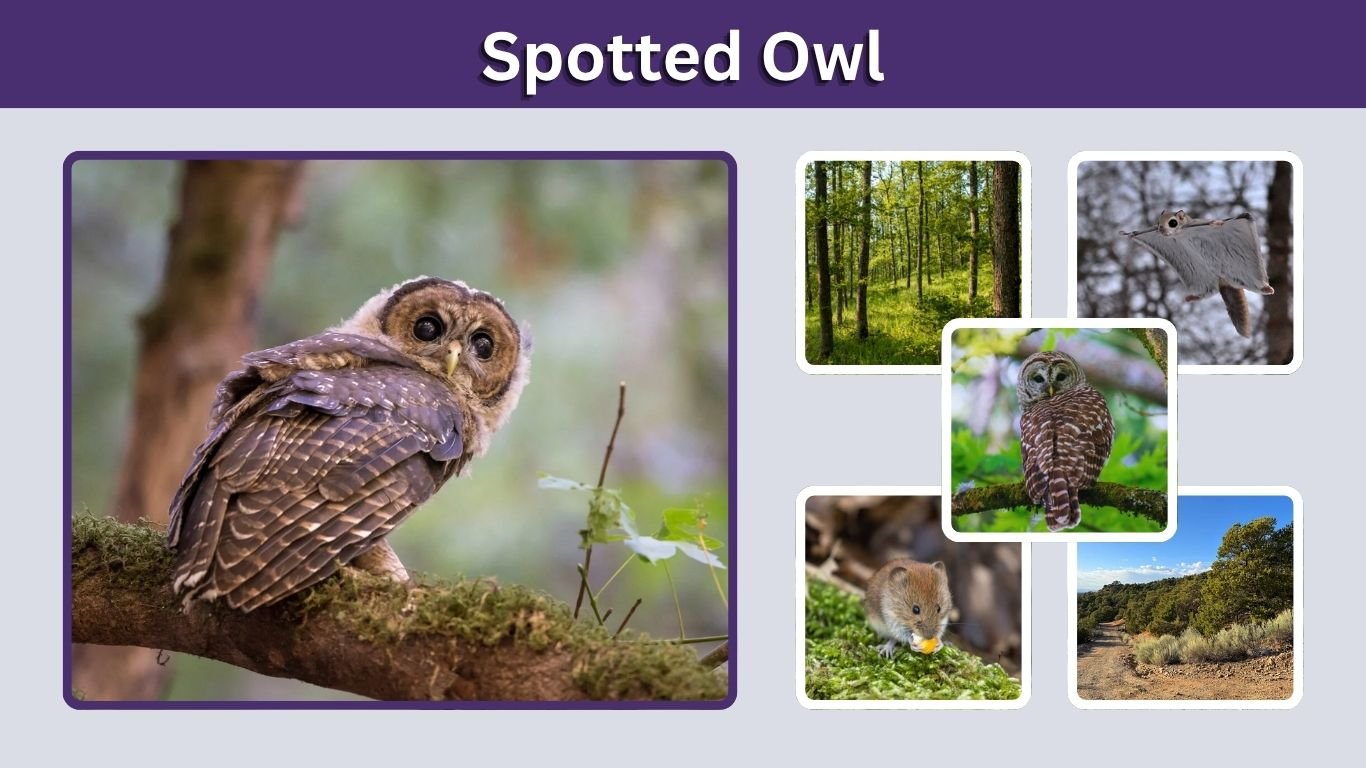
The spotted owl is a medium-sized woodland owl recognized by its dark brown eyes, rounded head, and chocolate-brown feathers covered with white spots. It lives in the mature forests, wooded canyons, and mountain habitats of western North America.
Spotted owls are quiet, secretive birds that spend most daylight hours resting beneath a shaded forest canopy. After sunset, they emerge to hunt flying squirrels, woodrats, mice, voles, and other small animals. Three subspecies are recognized: the northern spotted owl, California spotted owl, and Mexican spotted owl. Although they share many physical characteristics, each occupies a different geographic range and faces distinct environmental challenges.
What Is a Spotted Owl?
The spotted owl, scientifically known as Strix occidentalis, belongs to the typical owl family, Strigidae. It is closely related to the barred owl but is native primarily to forests in western North America.
Unlike great horned owls and screech-owls, spotted owls do not have visible ear tufts. They have broad facial discs that help collect sound and direct it toward their ears. This adaptation allows them to detect small animals moving through leaves, branches, and forest debris at night.
Spotted owls are generally nonmigratory. A breeding pair may remain within the same forest territory throughout the year as long as it provides enough prey, nesting locations, and protected roosting areas.
Spotted Owl Identification
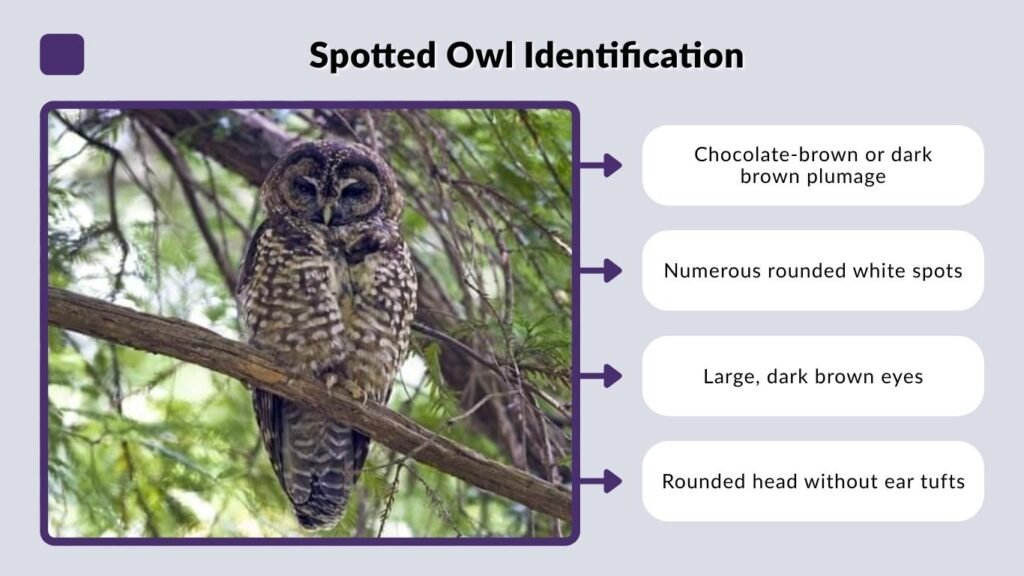
A spotted owl has a rounded head, broad wings, a relatively short tail, and heavily patterned plumage. Its dark coloring helps it blend into tree trunks, shaded branches, and the dim interior of mature forests.
What Does a Spotted Owl Look Like?
The most important identification features include:
- Chocolate-brown or dark brown plumage
- Numerous rounded white spots
- Large, dark brown eyes
- Rounded head without ear tufts
- Brown facial disc with pale markings
- White spots across the chest and belly
- Barred wings and tail
- Yellowish-green bill
- Feathered legs and powerful talons
The combination of dark eyes and rounded white body spots separates the spotted owl from many other North American owls. Great horned owls, screech-owls, and northern saw-whet owls normally have yellow eyes.
Mexican spotted owls are generally paler and display larger white markings than the northern and California subspecies.
Spotted Owl Size
An adult spotted owl usually measures approximately 18.5–18.9 inches, or 47–48 centimeters, in length. Its wingspan is around 39.8 inches, or 101 centimeters, and adults generally weigh between 17.6 and 24.7 ounces.
Females are typically larger and heavier than males, although both sexes have nearly identical plumage. Their broad, rounded wings allow them to maneuver carefully between trees instead of flying rapidly across open areas.
| Feature | Average measurement |
|---|---|
| Body length | 18.5–18.9 inches |
| Wingspan | About 39.8 inches |
| Weight | 17.6–24.7 ounces |
| Eye color | Dark brown |
| Body color | Brown with white spots |
Types of Spotted Owls
There are three recognized spotted owl subspecies. All belong to the same species, but they occupy different areas and show minor differences in color, size, and habitat preferences.
Northern Spotted Owl
The northern spotted owl lives from southwestern British Columbia through Washington and Oregon into northern California. It is strongly associated with mature and old-growth forests containing large trees, natural cavities, broken trunks, fallen logs, and multiple layers of vegetation.
Northern spotted owls depend on forests that provide secure daytime roosts and suitable nesting structures. They have received considerable conservation attention because of habitat loss and increasing competition from barred owls.
California Spotted Owl
The California spotted owl occurs mainly in California’s Sierra Nevada, coastal mountains, and Southern California forests. It occupies mixed-conifer forest, pine forest, oak woodland, and wooded canyon habitats.
California spotted owls can use a somewhat wider range of forest types than northern spotted owls. However, they still depend on large trees, shaded nesting areas, and healthy populations of small mammals.
Mexican Spotted Owl
The Mexican spotted owl lives in parts of Arizona, New Mexico, Colorado, Utah, western Texas, and Mexico. It is the palest of the three subspecies and often has larger white spots on its body.
This owl inhabits pine-oak woodland, mixed-conifer forest, mountain ranges, and steep rocky canyons. Some Mexican spotted owls nest or roost on protected cliff ledges rather than in tree cavities.
Where Do Spotted Owls Live?
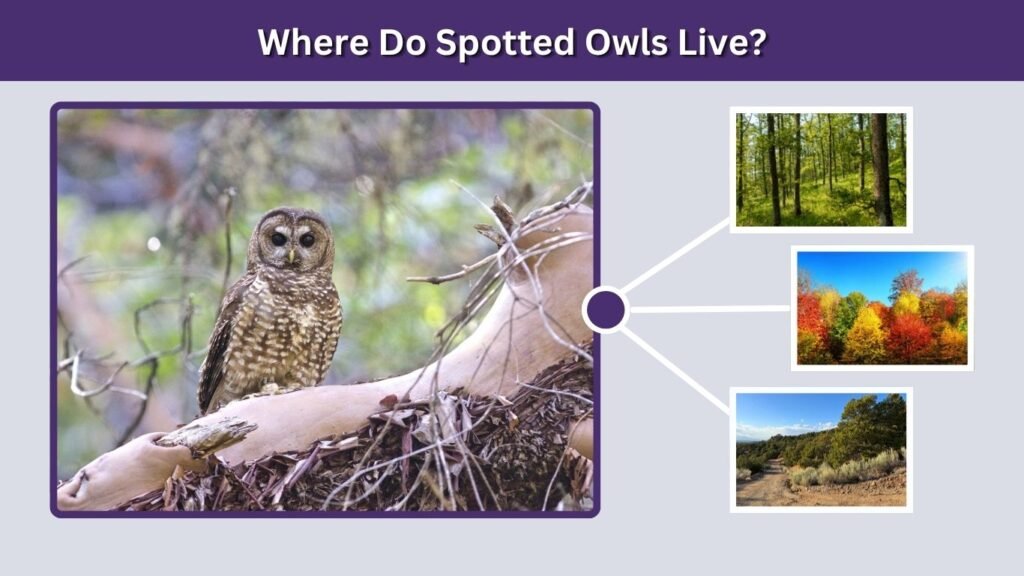
Spotted owls live in western North America, from southwestern Canada to Mexico. Their exact habitat changes according to the subspecies and region.
Northern birds are closely connected to cool, mature conifer forests. California spotted owls occupy conifer forests and oak woodlands, while Mexican spotted owls may live in pine-oak forest, mixed forest, and steep desert canyons.
Spotted Owl Habitat
An ideal spotted owl habitat normally contains:
- Large, mature trees
- Natural tree cavities
- Broken tree tops
- Dense overhead canopy
- Several layers of vegetation
- Fallen logs and woody debris
- Cool, shaded roosting locations
- Open hunting areas nearby
- Abundant small mammals
Dense canopy cover provides protection from extreme temperatures, bad weather, and predators. Older trees also develop cavities and broken sections that spotted owls can use for nesting.
Spotted owls generally avoid wide-open fields, treeless areas, and heavily disturbed forests. They may cross open spaces, but they depend primarily on wooded environments for survival.
What Do Spotted Owls Eat?
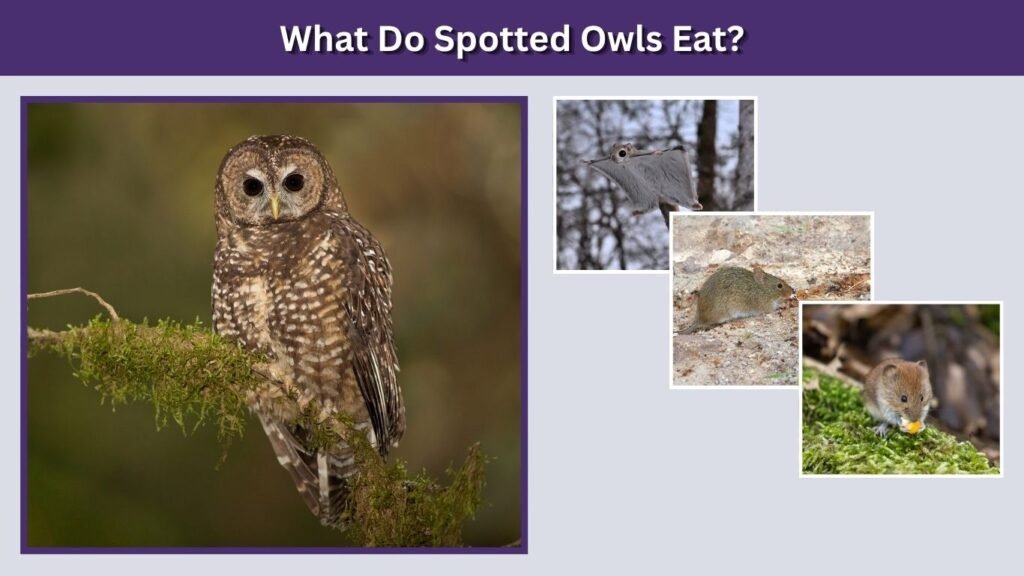
Spotted owls are carnivorous birds that feed mainly on small mammals. Their diet varies by location because different prey animals occur in different forest habitats.
Common foods include:
- Flying squirrels
- Woodrats
- Deer mice
- Voles
- Pocket gophers
- Bats
- Small rabbits
- Small birds
- Insects
- Reptiles and amphibians
Northern spotted owls frequently prey on flying squirrels in moist forests. Woodrats are particularly important to spotted owls living in California and the southwestern United States.
How Do Spotted Owls Hunt?
Spotted owls normally hunt after sunset. An owl waits quietly on a branch while listening for movement in the trees or on the forest floor. When it detects prey, it glides silently from its perch and captures the animal with its talons.
Specialized wing feathers soften the sound of air moving over the wings. This quiet flight allows the owl to approach prey without providing an early warning.
Small prey may be swallowed whole, while larger animals are torn into manageable pieces. Later, the owl regurgitates a pellet containing indigestible bones, teeth, fur, and feathers.
What Does a Spotted Owl Sound Like?
The spotted owl produces several hoots, whistles, barks, and squealing calls. Its best-known territorial call consists of four deep notes, with the middle two notes delivered close together.
Males use calls to announce ownership of a territory and communicate with females. Mated pairs may call back and forth, particularly during courtship and the nesting season.
Young spotted owls produce high-pitched begging calls when requesting food from their parents. Since the species is active at night and difficult to see in dense woodland, its calls are often the first sign that an owl is nearby.
Spotted Owl Nesting and Reproduction
Spotted owls do not construct traditional stick nests. Instead, they use natural hollows, broken tree tops, abandoned nests made by other large birds, or sheltered platforms where forest debris has accumulated.
The female creates only a shallow depression and adds little nesting material. Artificial nesting cavities may also be used in suitable habitat.
Eggs and Young Owls
A female spotted owl commonly lays two eggs, although a clutch may contain one to three. The female performs most of the incubation while the male hunts and delivers food.
After hatching, the chicks remain in the nest until they are developed enough to move onto nearby branches. Young owls may leave the nest before they can fly confidently, but their parents continue feeding and protecting them.
Spotted owl pairs do not always breed every year. Poor food availability, severe weather, habitat disturbance, wildfire, or the loss of a mate may cause them to skip a breeding season.
Spotted Owl vs Barred Owl
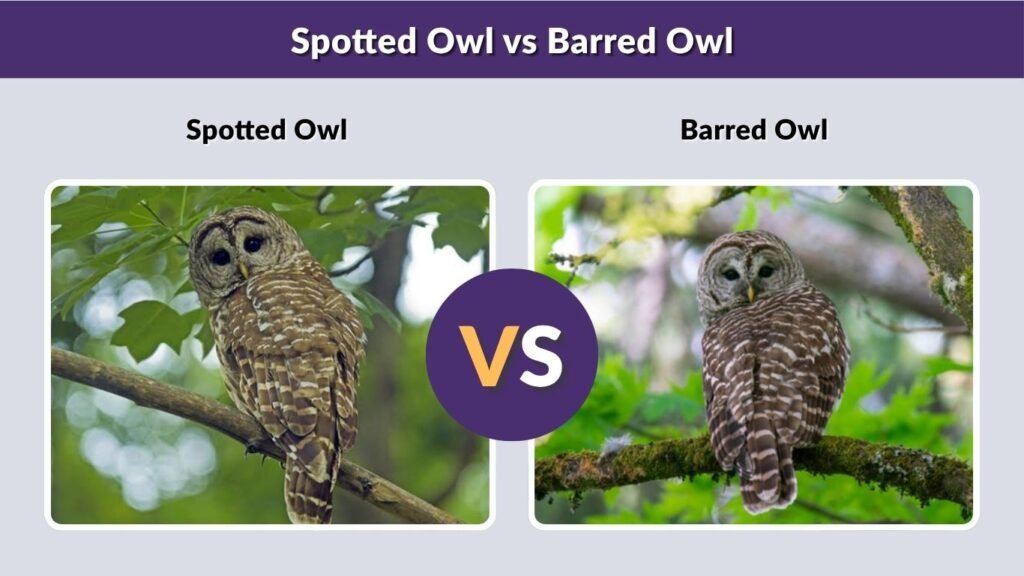
Spotted owls and barred owls can be difficult to distinguish because both have rounded heads, dark eyes, and brown plumage. However, their body patterns, calls, ranges, and behavior differ.
| Feature | Spotted owl | Barred owl |
|---|---|---|
| Main markings | Rounded white spots | Horizontal bars and vertical streaks |
| Eyes | Dark brown | Dark brown |
| Head | Rounded without ear tufts | Rounded without ear tufts |
| Typical call | Four-note hoot | “Who cooks for you?” pattern |
| Native range | Western North America | Primarily eastern North America |
| Preferred habitat | Mature western forests | Many types of forests and wetlands |
| Body size | Medium-sized | Usually larger and heavier |
Barred owls are more adaptable than spotted owls. They can live in younger forests, wetlands, suburban woodlands, and other altered environments. They also eat a wider variety of prey.
As barred owls expanded into the Pacific Northwest, they began competing with northern spotted owls for food, territories, and nesting sites. Research has found more severe northern spotted owl declines in areas where barred owls are numerous and have been established for longer periods.
Are Spotted Owls Endangered?
The conservation status differs among the three subspecies and geographic populations. Northern and Mexican spotted owls have long received protection under the U.S. Endangered Species Act, while California spotted owl populations have also become the focus of increased federal protection and management.
The most serious threats include:
- Loss of mature forest
- Fragmentation of habitat
- Competition from barred owls
- Destructive wildfires
- Drought and climate change
- Reduced prey availability
- Removal of nesting trees
- Disturbance around active nests
Protecting forest habitat remains essential, but habitat conservation alone may not solve every problem. In 2024, the U.S. Fish and Wildlife Service adopted a strategy allowing trained professionals to manage barred owls in selected areas to reduce pressure on northern and California spotted owls.
How Long Do Spotted Owls Live?
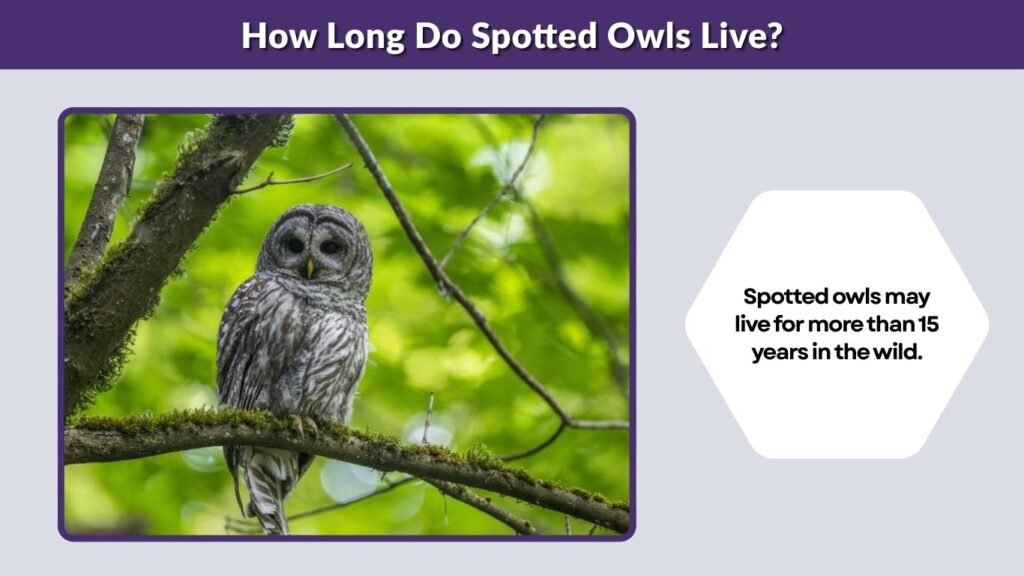
Spotted owls may live for more than 15 years in the wild, although many young birds do not survive to adulthood. Survival depends on habitat quality, food supply, weather conditions, predation, disease, and competition.
Adult spotted owls often remain in familiar territories for many years. Their dependence on established forest areas means sudden habitat changes can make it difficult for them to find suitable replacement territories.
Interesting Spotted Owl Facts
- Spotted owls have dark eyes rather than the yellow eyes seen in many owls.
- Three recognized subspecies live in western North America.
- Females are normally larger than males.
- Spotted owls primarily hunt small mammals at night.
- They do not build conventional nests.
- A pair may occupy the same territory for several years.
- Their feathers allow them to fly with very little noise.
- Barred owls are among their most serious competitors.
- Mexican spotted owls may inhabit steep rocky canyons.
- They rely heavily on mature trees and protected forest cover.
FAQs
Are spotted owls nocturnal?
Yes. Spotted owls are primarily nocturnal and conduct most of their hunting after sunset. They usually rest on shaded branches during the day but may occasionally become active around dawn, dusk, or when caring for young.
What does a northern spotted owl eat?
Northern spotted owls mainly eat small forest mammals. Flying squirrels, woodrats, mice, voles, and pocket gophers are important foods. They may also catch bats, birds, insects, reptiles, or amphibians when available.
Where does the northern spotted owl live?
The northern spotted owl lives from southwestern British Columbia through Washington and Oregon into northern California. It is closely associated with mature and old-growth forests containing large trees, dense canopy cover, nesting cavities, and abundant prey.
Why are spotted owls endangered or threatened?
Spotted owls are affected by habitat loss, forest fragmentation, severe wildfire, reduced food supplies, and competition from barred owls. Their dependence on mature forests makes it difficult for them to adjust quickly when nesting and hunting habitats disappear.
Can spotted owls and barred owls mate?
Spotted owls and barred owls can occasionally produce hybrids, sometimes informally called sparred owls. However, hybridization is uncommon. Competition for territories, nesting sites, and prey is a much greater conservation concern.
