
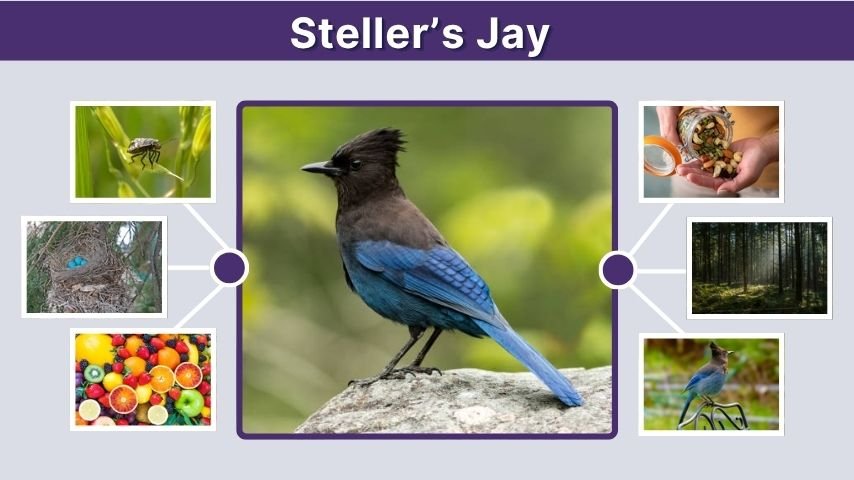
The Steller’s Jay is one of the most eye-catching jay birds in North America. With its dark crest, deep blue body, loud call, and bold behavior, this bird is easy to notice in western forests, mountain parks, campgrounds, and wooded neighborhoods. Many people compare it with the Blue Jay because both birds are intelligent, noisy, and colorful members of the crow family. However, the Steller’s Jay has its own unique look, range, diet, and personality.
What Is a Steller’s Jay?
The Steller’s Jay is a large songbird in the corvid family, the same bird family that includes crows, ravens, magpies, and other jays. It is best known for its dark head, pointed crest, and bright blue wings and tail.
This bird is common in many parts of western North America. It often lives in forests, especially coniferous and mixed woodlands, but it can also become comfortable around people. Campers, hikers, and backyard birdwatchers often see Steller’s Jays near picnic areas, feeders, and mountain towns.
| Feature | Steller’s Jay |
| Bird family | Corvid family |
| Main colors | Blue and black |
| Crest | Tall and pointed |
| Common range | Western North America |
| Common habitats | Forests, mountains, parks, wooded neighborhoods |
| Diet type | Omnivore |
Steller’s Jay Identification
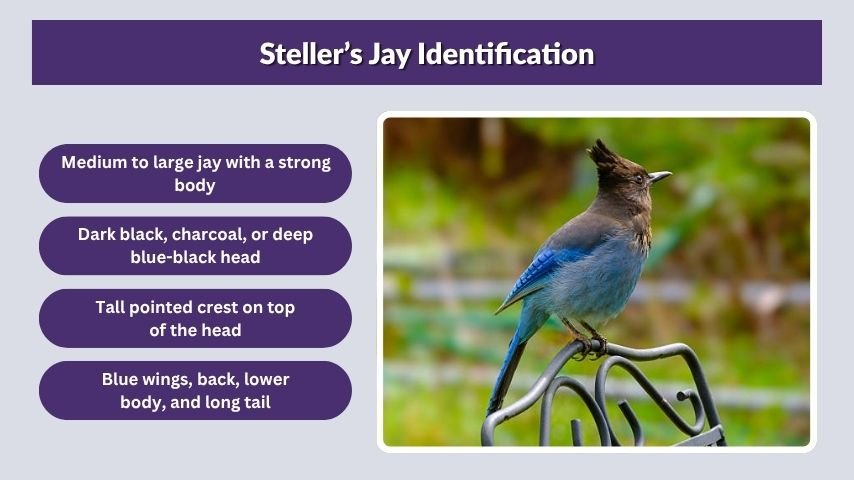
The Steller’s Jay is usually easy to identify because of its bold colors and dramatic crest. Unlike many scrub-jays, it has a raised head crest that gives it a sharp, alert appearance.
Key Identification Features
- Medium to large jay with a strong body
- Dark black, charcoal, or deep blue-black head
- Tall pointed crest on top of the head
- Blue wings, back, lower body, and long tail
- Dark bill, dark eyes, and dark legs
- Pale blue or white streaks sometimes visible on the forehead
- Loud, harsh calls that often reveal the bird before it is seen
- Often moves confidently around trees, feeders, and picnic areas
The Steller’s Jay does not look exactly the same everywhere. Birds in coastal areas may appear darker, while birds in some inland or southern areas may show more blue on the head or lighter markings. Even with these differences, the dark crest and blue body are the main clues.
Steller’s Jay Range and Location
The Steller’s Jay is mainly found in western North America. Its range stretches from Alaska and western Canada through the western United States, Mexico, and into parts of Central America.
In the United States, it is often associated with states such as Washington, Oregon, California, Colorado, Arizona, New Mexico, Idaho, Montana, Utah, and parts of the Rocky Mountain region. Many people search for Steller’s Jay in Colorado, Oregon, California, Alaska, Yosemite, and Washington State because these birds are commonly seen in forested or mountain areas there.
Where You Might See One
Steller’s Jays are often found in conifer forests, pine-oak woodlands, mountain forests, forest edges, campgrounds, and wooded suburbs. They may appear at backyard feeders if the area has enough tree cover nearby. In national parks and mountain recreation areas, they can become bold around picnic tables, although feeding wild birds is not recommended.
They are usually not birds of open grassland or treeless desert. They prefer places where trees provide cover, nesting sites, and food.
Steller’s Jay Habitat
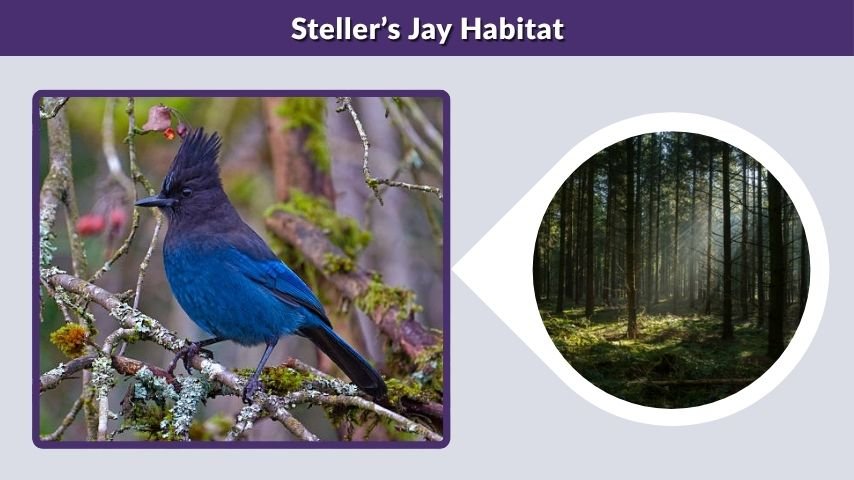
Steller’s Jays are strongly linked to forests, especially evergreen forests. They are common in areas with pine, fir, spruce, cedar, and other conifer trees. They also use mixed forests where conifers grow alongside oaks or other broadleaf trees.
This bird adapts well when human areas are close to natural woodland. That is why it may visit homes, cabins, parks, and campgrounds. However, it still depends on trees and shrubs for safety, nesting, and food.
A good Steller’s Jay habitat usually has tall trees, nesting cover, natural foods like seeds and nuts, and nearby perches where the bird can watch for danger.
Steller’s Jay Call and Sound
The Steller’s Jay call is loud, rough, and attention-grabbing. Many people hear the bird before they see it. Its calls can sound harsh, raspy, scolding, or rattling.
Why Steller’s Jays Call Loudly
Steller’s Jays use calls to communicate with mates, family members, and nearby birds. They may call when warning others about predators, defending food, or moving through the forest. Their loud voice also helps them stay connected in thick woodland where visibility is limited.
Like other corvids, Steller’s Jays can be excellent mimics. They may copy sounds from other birds, including hawks. This can confuse birdwatchers because a Steller’s Jay may sound like a predator even when no hawk is nearby.
What Do Steller’s Jays Eat?
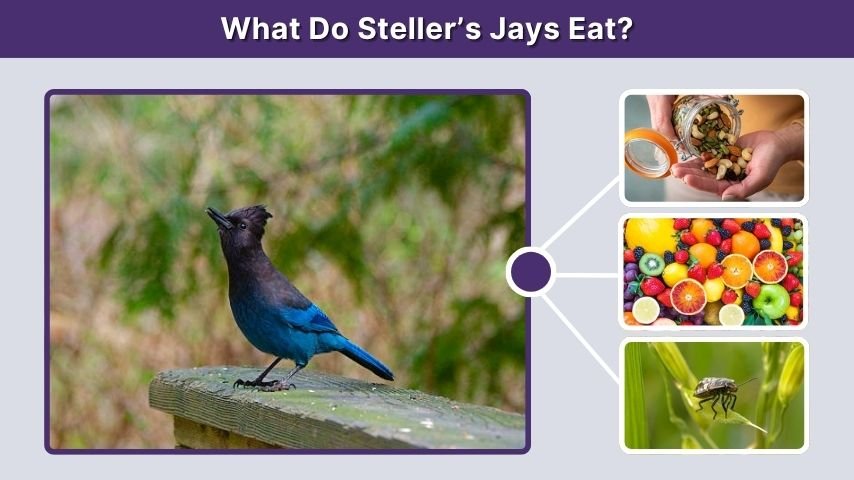
Steller’s Jays are omnivores, meaning they eat both plant and animal foods. Their diet changes depending on season, habitat, and food availability.
| Food Type | Examples |
| Nuts and seeds | Acorns, pine seeds, sunflower seeds, peanuts |
| Fruits and berries | Wild berries, small fruits |
| Insects | Beetles, caterpillars, grasshoppers |
| Animal matter | Eggs, nestlings, small reptiles, small animals |
| Human-related food | Crumbs or scraps near picnic areas |
Steller’s Jays are opportunistic feeders. In the wild, they search through trees, leaf litter, bark, and forest edges. Around people, they may visit feeders for peanuts, suet, and sunflower seeds. They may also investigate picnic areas, which is why they have a reputation for being bold.
Food Caching Behavior
One interesting habit of Steller’s Jays is food caching. They may hide seeds or nuts in the ground, bark crevices, or other hidden places and return later to eat them. This behavior shows strong memory and intelligence. When forgotten seeds grow into plants, jays may also help spread trees and shrubs through their environment.
Steller’s Jay Male vs Female
Many people search for the difference between a female Steller’s Jay and a male Steller’s Jay. In most cases, males and females look very similar. Both have the tall crest, dark head, and blue body.
Size can sometimes give a small clue, as males may be slightly larger on average, but this difference is difficult to judge in the field. Behavior during nesting season may offer better clues. For example, one bird may spend more time near the nest while the other brings food or guards the area.
For casual birdwatchers, it is usually best to identify the species rather than trying to separate male and female Steller’s Jays by appearance alone.
Steller’s Jay vs Blue Jay
The Steller’s Jay and Blue Jay are related, and both are bold, intelligent, blue-colored birds. However, they are different species with different appearances and ranges.
Main Differences
The Blue Jay is mostly found in eastern and central North America, while the Steller’s Jay is mainly a western bird. The Blue Jay has a blue, white, and black pattern with a paler underside. The Steller’s Jay usually has a much darker head and upper body with deep blue wings and tail.
The Steller’s Jay also has a more dramatic dark crest. Blue Jays have a crest too, but their overall pattern is brighter and more evenly marked with white and black. If you are in a western mountain forest and see a dark-crested blue bird, it is likely a Steller’s Jay. If you are in eastern woodlands or suburbs and see a blue, white, and black jay, it is likely a Blue Jay.
Steller’s Jay Nesting and Eggs
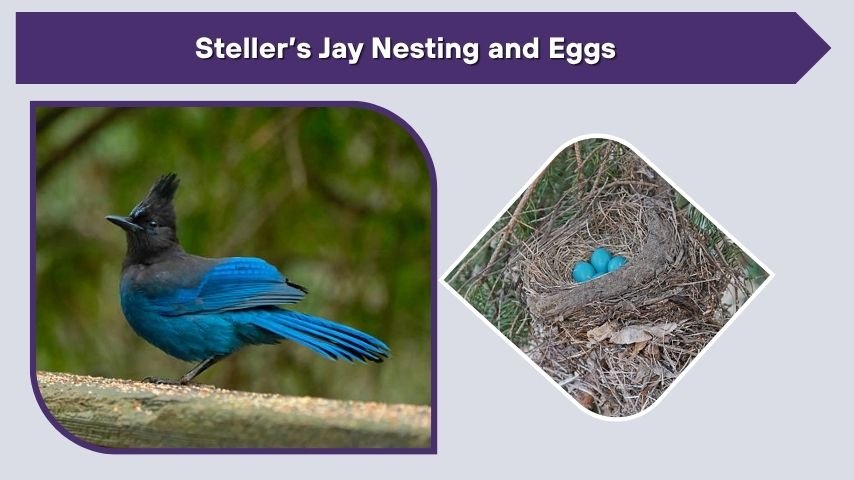
Steller’s Jays usually build nests in trees, often hidden in branches or dense cover. The nest is generally cup-shaped and made with twigs, plant fibers, roots, moss, leaves, and other natural materials.
The female usually lays several eggs. Both parents may help protect the nesting area and feed the young. Like many jays, Steller’s Jays can be defensive around their nest. They may call loudly or act aggressively if a predator or person gets too close.
Juvenile Steller’s Jay
A juvenile Steller’s Jay may look duller than an adult. Young birds may have less polished coloring, shorter crest feathers, or a less confident appearance. After leaving the nest, fledglings still depend on their parents for food and protection while they learn how to survive.
Young Steller’s Jays may follow adults around, begging for food with loud calls. During this stage, they practice flying, foraging, and recognizing danger.
Are Steller’s Jays Aggressive?
Steller’s Jays can seem aggressive because they are loud, bold, and protective. They may chase smaller birds away from feeders, scold predators, or defend nesting areas. However, this behavior is normal for a wild bird trying to protect food, territory, and young.
They are also curious and intelligent. Around campgrounds and feeders, they may approach people closely, but that does not mean they are tame. It is better to watch them without feeding them by hand. Feeding wild birds human food can cause health problems and encourage unnatural behavior.
How to Attract Steller’s Jays
People who live in the Steller’s Jay range may attract them with the right habitat and feeder setup. These birds are more likely to visit yards near woods or tall trees.
Good food options include unsalted peanuts, sunflower seeds, suet, and platform feeder foods. Native trees and shrubs are also helpful because they provide natural cover and seasonal food.
Avoid offering salty snacks, bread, processed foods, or sugary foods. A clean birdbath may also attract jays, especially in dry weather. If Steller’s Jays become too dominant at feeders, use different feeder styles to give smaller birds safer feeding spaces.
Interesting Facts About Steller’s Jays
Steller’s Jays are among the most intelligent backyard and forest birds in western North America. Their corvid relatives are famous for memory, problem-solving, and social behavior, and the Steller’s Jay shares many of these traits.
They can remember hidden food locations, recognize threats, communicate with loud calls, and adapt to changing food sources. Their ability to mimic other birds adds to their mysterious personality. Some people also connect the Steller’s Jay with symbolism, meaning, or spiritual ideas because of its bold appearance and strong voice, although these meanings depend on personal or cultural interpretation.
FAQs
Is a Steller’s Jay a Blue Jay?
No, a Steller’s Jay is not the same species as a Blue Jay. Both are jays and both belong to the crow family, but they have different ranges and appearances. The Steller’s Jay is mainly found in western North America and has a dark crest with a blue body. The Blue Jay is more common in eastern and central North America.
What does a Steller’s Jay eat?
A Steller’s Jay eats nuts, seeds, berries, fruits, insects, eggs, small animals, and sometimes food from feeders. It especially likes peanuts, sunflower seeds, suet, acorns, and pine seeds. It is an omnivore, so its diet includes both plant and animal foods.
What does a Steller’s Jay sound like?
A Steller’s Jay sounds loud, harsh, raspy, and sometimes scolding. It may also make rattling calls and can mimic other birds, including hawks. Many people hear its call before they see the bird.
Are male and female Steller’s Jays different?
Male and female Steller’s Jays look very similar. Males may be slightly larger on average, but this is hard to notice in the field. Behavior during nesting season may help, but appearance alone is usually not enough for easy identification.
Are Steller’s Jays rare?
Steller’s Jays are not rare across much of their western range. They are common in many forests, mountains, parks, and wooded neighborhoods. However, local numbers can vary depending on habitat, food supply, elevation, and region.
