
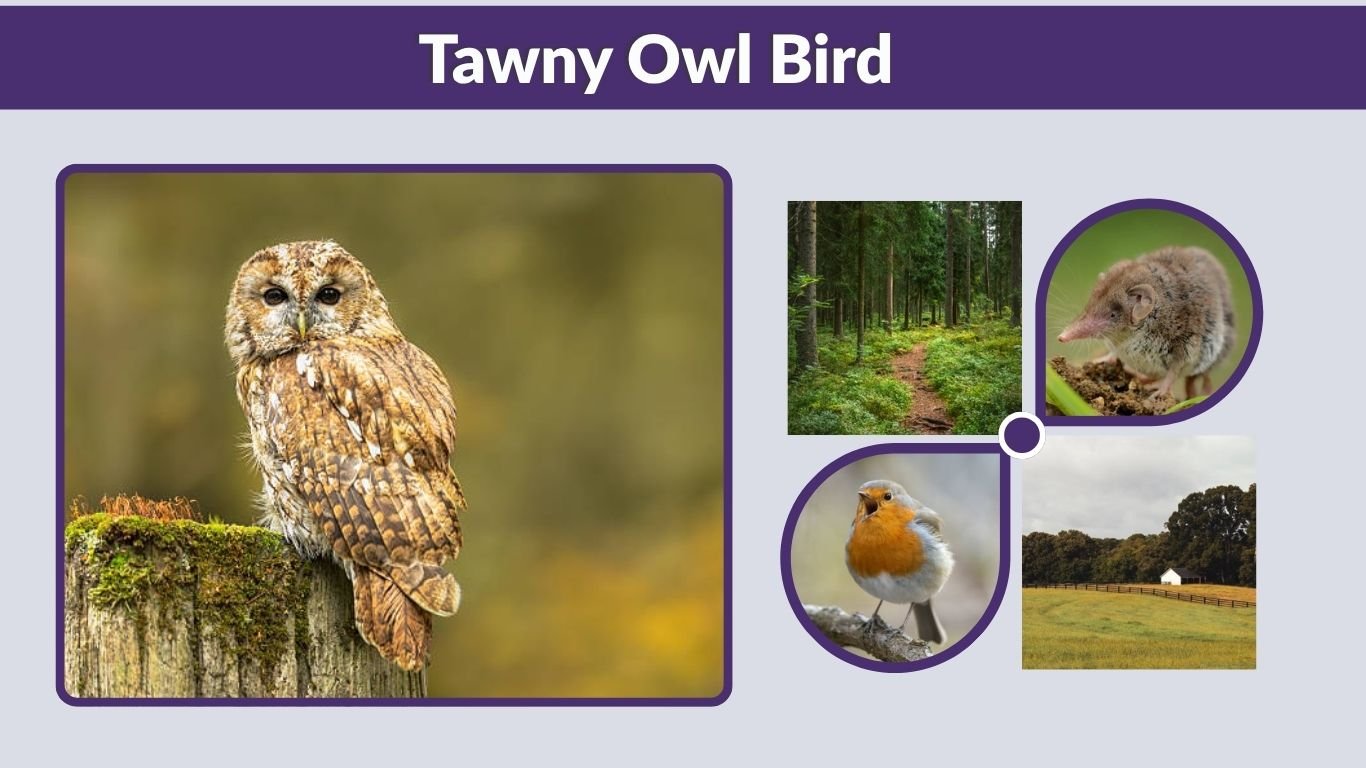
The tawny owl bird (Strix aluco) is a stocky, woodland-dwelling owl recognized by its rounded head, dark eyes, mottled feathers, and haunting nighttime calls. It is one of the most familiar owls across Britain and much of Europe, although people hear it far more often than they see it.
Tawny owls are mainly nocturnal, spending daylight hours hidden in tree cavities or among dense branches. At night, they hunt rodents, small birds, amphibians, insects, and other available prey. Their excellent hearing, silent flight, and strong territorial behavior make them highly effective woodland predators.
What Is a Tawny Owl?
The tawny owl is a medium-sized member of the typical owl family, Strigidae. Its scientific name is Strix aluco, and it is sometimes called the Eurasian tawny owl because its range extends across a large portion of Europe and Asia.
This species is strongly associated with mature trees. Broadleaved woodlands are its preferred environment, but tawny owls also inhabit mixed forests, wooded farmland, cemeteries, city parks, and large gardens. They generally remain within the same territory instead of migrating long distances.
Tawny Owl Identification
A tawny owl has a compact body, broad wings, a large rounded head, and no visible ear tufts. Important identification features include:
- Large, almost completely black eyes
- Rounded facial disc
- Mottled brown, reddish-brown, or grey plumage
- Pale markings across the shoulders
- Streaked underparts
- Short, hooked bill
- Feather-covered legs and powerful talons
The owl’s patterned feathers provide excellent camouflage against tree bark. Some individuals have a warm reddish appearance, while others are noticeably greyer. These color differences do not necessarily indicate the bird’s age or sex.
Unlike the barn owl, the tawny owl does not have a white, heart-shaped face. Its darker coloration and rounded outline help distinguish it from other common owl species.
Tawny Owl Size and Appearance
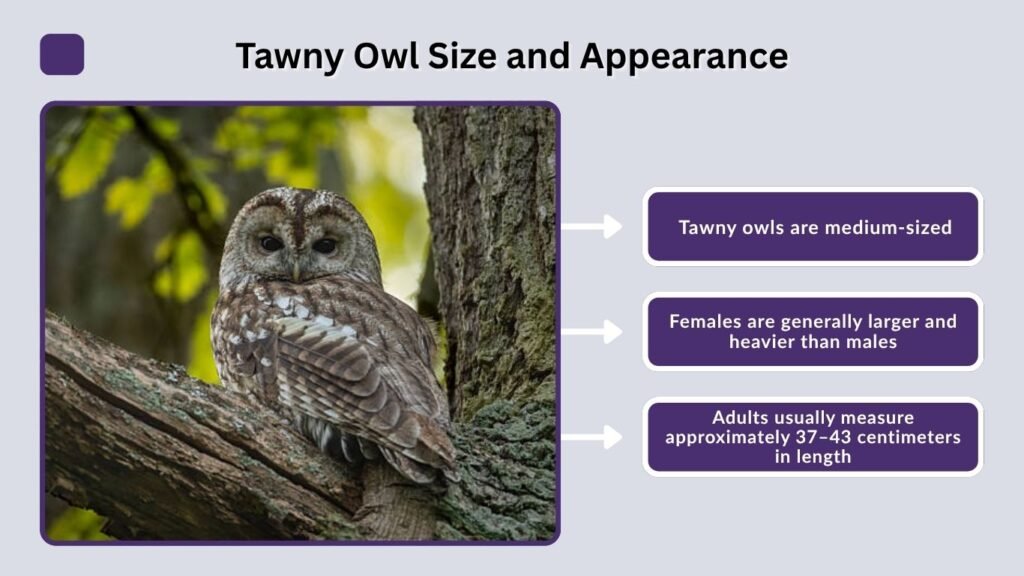
Tawny owls are medium-sized but often appear larger because of their thick feathers and broad body. Females are generally larger and heavier than males, a pattern called reverse sexual size dimorphism.
Adults usually measure approximately 37–43 centimeters in length, although size varies among regions and subspecies. Their rounded wings are suited to moving between trees rather than traveling rapidly across wide, open landscapes.
Despite their solid appearance, tawny owls fly quietly. Soft edges on their wing feathers reduce turbulence and sound, allowing them to approach prey without giving away their position.
Male vs Female Tawny Owl
Male and female tawny owls look very similar. Plumage color is not a dependable method for separating them.
The main differences are:
| Feature | Male Tawny Owl | Female Tawny Owl |
|---|---|---|
| Body size | Usually smaller | Usually larger |
| Weight | Lighter | Heavier |
| Typical call | Long, wavering hoot | Sharp contact call |
| Breeding role | Hunts and supplies food | Incubates eggs and protects young |
The male is responsible for much of the hunting while the female incubates the eggs. Once the chicks grow larger, both parents may participate in feeding and defending them.
What Does a Tawny Owl Sound Like?
The tawny owl sound is one of the most recognizable noises in European woodlands. The familiar “twit-twoo” often associated with owls is not always produced by one bird. It may represent an exchange between two tawny owls.
The male commonly gives a long, trembling hoot with a pause between its opening note and the remaining phrase. Females are more closely associated with a sharp “ke-wick” contact call. Mated pairs may answer one another, creating the classic two-part owl sound.
Tawny owls call throughout the year, but vocal activity often becomes especially noticeable during autumn as pairs strengthen their bonds and defend territories before the spring breeding season.
Why Do Tawny Owls Hoot?
Tawny owls use calls to:
- Defend their territory
- Communicate with a mate
- Locate family members
- Warn competing owls
- Maintain pair bonds
- Signal during the breeding season
Their calls travel well through forests at night. Hearing an owl repeatedly from one area may indicate that the bird has established a permanent territory nearby.
Young tawny owls make high-pitched begging calls when requesting food. These sounds can continue after the chicks have left the nest but still depend on their parents.
Where Do Tawny Owls Live?
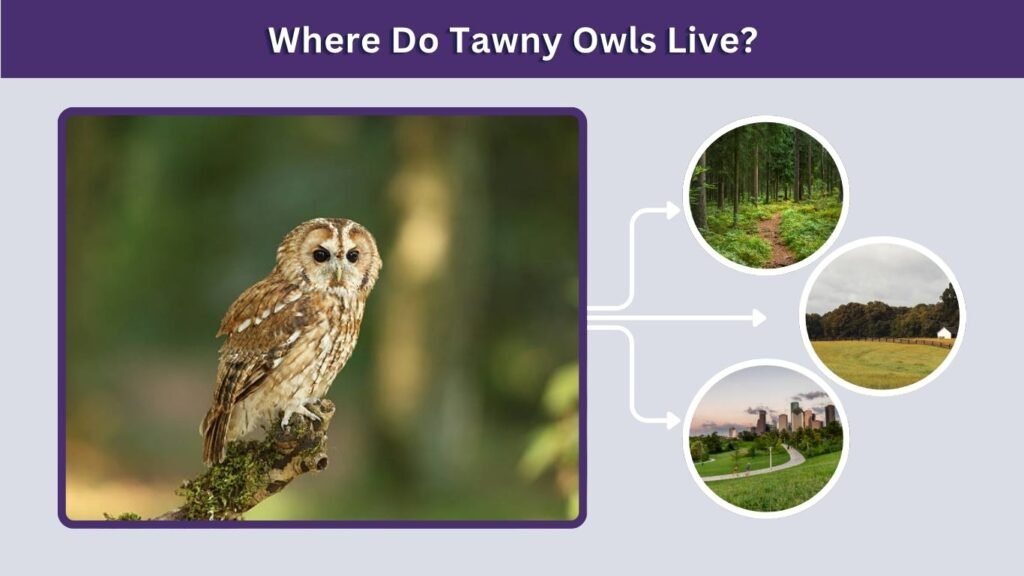
Tawny owls occur across much of the Palearctic region, from western Europe through parts of Russia and Asia. In Britain, they are found throughout England, Wales, and much of Scotland. They are naturally absent from Ireland, which is often connected to their sedentary nature and reluctance to cross large stretches of open water.
Tawny Owl Habitat
Their preferred habitats include:
- Mature deciduous woodland
- Mixed forest
- Wooded farmland
- Large urban parks
- Cemeteries with old trees
- Established gardens
- Orchards and tree-lined countryside
Old trees are particularly important because they provide nesting cavities and sheltered daytime roosts. A suitable territory must also contain enough prey and open spaces where the owl can hunt.
Tawny owls can adapt to suburban environments, but they need connected tree cover. Removing old trees, clearing woodland understory, and fragmenting forest habitats may reduce suitable nesting and hunting areas.
What Do Tawny Owls Eat?
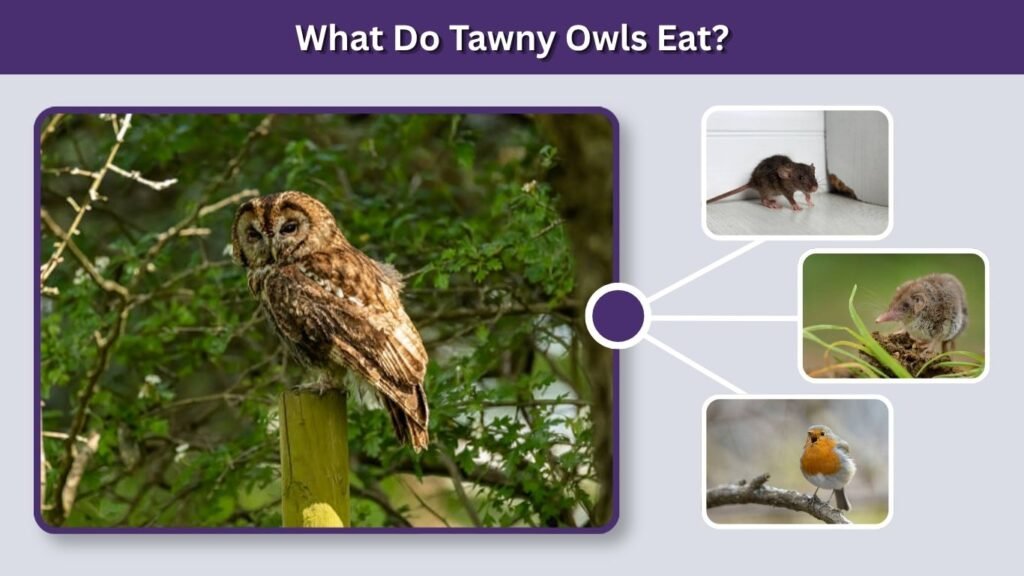
Tawny owls are opportunistic predators. Their diet changes according to habitat, season, and local prey availability.
Common foods include:
- Mice
- Voles
- Shrews
- Rats
- Small rabbits
- Small birds
- Frogs
- Earthworms
- Beetles and other insects
- Occasionally bats or fish
Rodents usually form an important part of the diet, but tawny owls living near cities may catch more birds. Those occupying damp woodland may take frogs, while insects and earthworms can become useful foods when small mammals are difficult to find.
How Do Tawny Owls Hunt?
Most hunting occurs after sunset. A tawny owl often waits silently on a branch, listening and watching for movement below. Once it detects prey, it drops from the perch and captures the animal with its talons.
Its facial disc helps direct sound toward the ears. This allows the owl to detect prey in darkness or beneath vegetation. The bird may also fly slowly through its territory while searching for movement.
Small prey is usually swallowed whole. Later, the owl regurgitates a compact pellet containing fur, feathers, teeth, bones, and other material it cannot digest.
Tawny Owl Nesting and Breeding
Tawny owls usually nest in natural holes within mature trees. They may also use old nests built by crows or other large birds, sheltered ledges, buildings, or appropriately designed owl nest boxes.
The species normally produces one brood per year. Egg laying commonly begins in March or April, although timing can vary with weather and food conditions. A typical clutch contains two or three white eggs.
Tawny Owl Chicks
The female incubates the eggs for approximately 30 days. During this period, the male brings food to her and later supplies prey for the young.
The chicks remain associated with the nest for around five weeks. Before they can fly properly, they may leave the nesting cavity and sit on nearby branches. This stage is known as branching.
A young tawny owl found on the ground is not always abandoned. Healthy chicks can climb tree trunks using their talons and beaks, while their parents usually remain nearby. People should avoid handling them unless the owl is injured or in immediate danger.
Tawny owls are strongly protective around their nests. Adults may swoop at humans, dogs, cats, or other animals that approach their chicks.
How Long Do Tawny Owls Live?
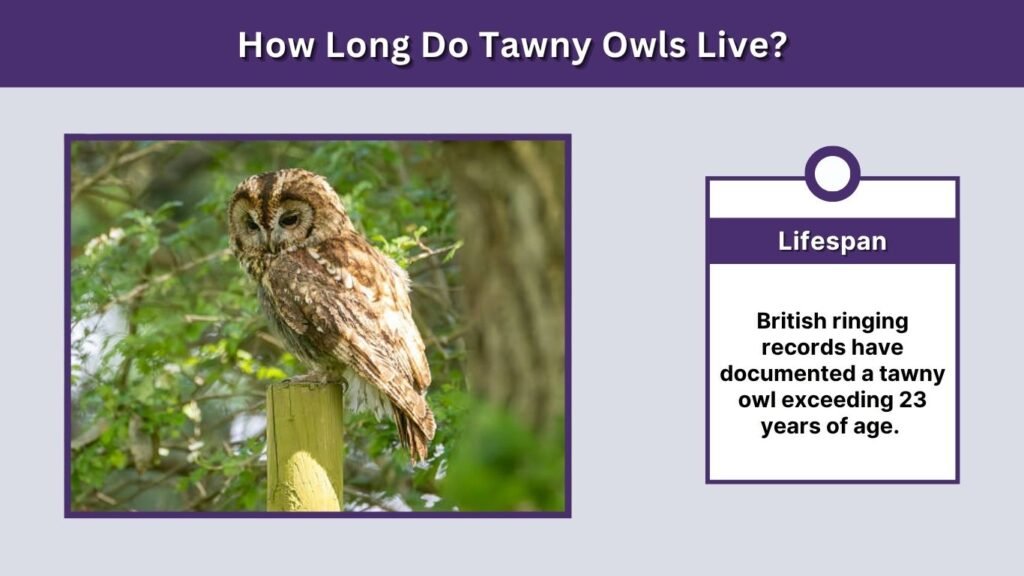
The typical recorded lifespan is around four years, but many young owls die before reaching adulthood. Birds that survive their early years may live considerably longer.
British ringing records have documented a tawny owl exceeding 23 years of age. Such exceptional longevity is uncommon, but it demonstrates how long the species can survive under favorable conditions.
Major threats include road collisions, starvation, habitat loss, severe weather, poisoning, and accidents involving human structures.
Tawny Owl vs Barn Owl
Although both species may live in the same general region, they have different appearances and habitat preferences.
| Feature | Tawny Owl | Barn Owl |
|---|---|---|
| Face | Rounded and brown-grey | White and heart-shaped |
| Eyes | Dark | Dark |
| Main habitat | Woodland and parks | Farmland and open grassland |
| Call | Hoots and sharp contact calls | Screeches and hisses |
| Plumage | Brown, reddish, or grey | Pale gold and white |
| Hunting area | Forest edges and clearings | Open fields |
Barn owls are more likely to be seen hunting over open ground, sometimes before complete darkness. Tawny owls usually remain close to trees and are more difficult to observe.
Is a Tawny Frogmouth an Owl?
The tawny frogmouth is not a true owl. It is an Australian bird belonging to a different family. Its broad head, large eyes, nocturnal behavior, and mottled feathers create an owl-like appearance, which explains the common confusion.
Unlike tawny owls, tawny frogmouths have wide, flattened bills designed for catching insects and other small prey. They also rely heavily on remaining motionless and resembling a broken tree branch.
The tawny fish owl is another separate species and should not be confused with the Eurasian tawny owl.
Are Tawny Owls Dangerous?
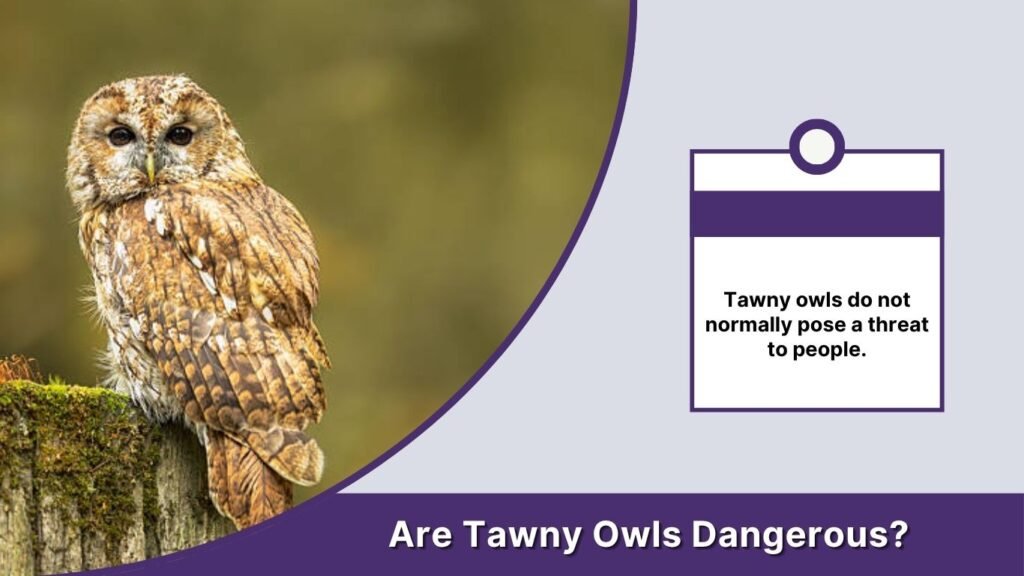
Tawny owls do not normally pose a threat to people. They avoid close contact and usually remain hidden during daylight.
However, a nesting pair may aggressively defend its chicks. The owl’s talons can cause serious scratches, particularly if someone approaches a nest at night. Giving the area space is the safest response.
Tawny owls may occasionally capture very small pets, but rodents, birds, amphibians, and invertebrates are much more typical prey.
Are Tawny Owls Endangered?
The tawny owl is classified as a species of Least Concern at the European level, and its European population has been assessed as broadly stable. This does not mean every local population is secure. Loss of mature woodland, fragmented habitats, declining prey, road traffic, and removal of nesting trees can still affect regional numbers.
Protecting mature trees, maintaining connected woodland, avoiding disturbance near nests, and installing correctly designed nest boxes can support local tawny owl populations.
FAQs
Are tawny owls nocturnal?
Yes. Tawny owls are primarily nocturnal and conduct most of their hunting and territorial activity after sunset. They may occasionally appear during daylight, especially when disturbed, feeding chicks, or resting near an exposed tree cavity.
Do tawny owls mate for life?
Tawny owls commonly form long-lasting pair bonds and may remain together within the same territory for many years. However, a surviving bird may find another mate if its original partner dies or disappears.
How many eggs do tawny owls lay?
A typical tawny owl clutch contains two or three eggs. Larger or smaller clutches are possible, depending on the female’s condition, food availability, habitat quality, and local weather during the breeding season.
How far can a tawny owl see?
There is no single dependable distance for tawny owl vision. Their eyes are highly adapted for detecting movement in low light, but hearing is equally important. They can locate small prey even when vegetation or darkness makes it difficult to see clearly.
Is a tawny owl a mammal?
No. A tawny owl is a bird. It has feathers, wings, a beak, and lays eggs. Like all birds, it is warm-blooded, but it belongs to the class Aves rather than the mammalian class.