
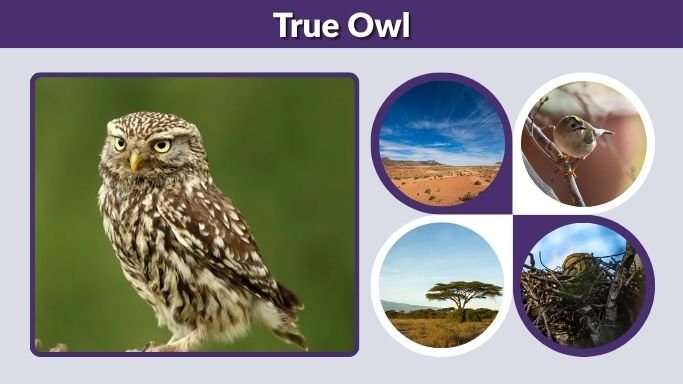
A true owl is any owl that belongs to the family Strigidae, also called the typical owl family. This group includes most of the owls people know, such as great horned owls, snowy owls, barred owls, screech owls, eagle-owls, pygmy owls, and tawny owls. Barn owls are real owls too, but they are not classified as true owls because they belong to a different owl family called Tytonidae. Owls are divided into these two main families: Tytonidae and Strigidae.
What Is a True Owl?
A true owl is a member of the owl family Strigidae. These owls are sometimes called typical owls because they include the majority of owl species worldwide. They usually have rounded facial discs, strong talons, hooked bills, forward-facing eyes, soft feathers, and excellent night-hunting abilities.
True owls are birds of prey, which means they hunt and eat other animals. Like other raptors, they use sharp talons and curved bills to catch and tear prey. Most owls are active at night, although some true owls, such as the northern hawk owl and burrowing owl, may also be active during the day.
| Feature | True Owls |
| Family | Strigidae |
| Common examples | Great horned owl, snowy owl, barred owl, tawny owl |
| Face shape | Usually round |
| Eyes | Forward-facing |
| Diet | Mostly animals, including mammals, birds, insects, reptiles, and fish |
| Activity | Mostly nocturnal, but some are diurnal or crepuscular |
| Distribution | Worldwide except Antarctica |
The word “true” does not mean barn owls are fake owls. It simply means Strigidae is the family known as true or typical owls.
True Owls vs Barn Owls
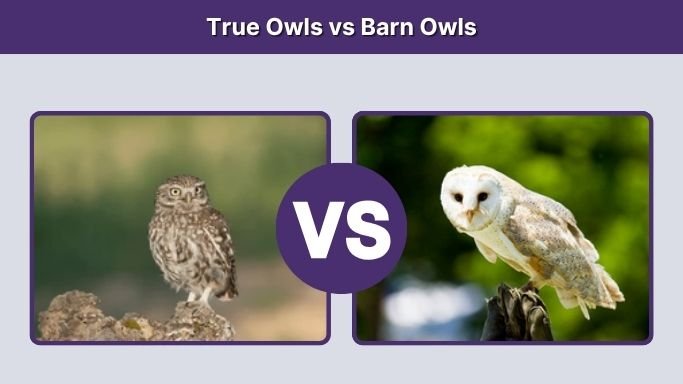
True owls and barn owls both belong to the order Strigiformes, but they are placed in different families. True owls are in Strigidae, while barn owls are in Tytonidae. The Owl Research Institute explains that Tytonidae includes barn owls with heart-shaped faces, while Strigidae includes the other owls, most of which have round faces.
| Difference | True Owls | Barn Owls |
| Family | Strigidae | Tytonidae |
| Face shape | Mostly round | Heart-shaped |
| Eye size appearance | Often large-looking | Relatively smaller-looking |
| Common calls | Many hoot, trill, whistle, or scream | Often screech, hiss, or rasp |
| Examples | Great horned, barred, snowy, tawny | Barn owl, grass owl, masked owl |
| Body style | Varies widely | Often long-legged and pale-faced |
Barn owls look different from many true owls because of their heart-shaped facial disc, long legs, short tail, and dark eyes. The Owl Research Institute notes that the Barn Owl is classified in a different family from all other North American owls.
Are Barn Owls True Owls?
No, barn owls are not true owls in the taxonomic sense. Barn owls are real owls, but they are not members of the true owl family Strigidae. They belong to the family Tytonidae. Cornell lists the American Barn Owl in the order Strigiformes and the family Tytonidae.
This is why searches like barn owls vs true owls, true owl vs barn owl, and why are barn owls not true owls all point to the same answer: barn owls are separated because of differences in structure, face shape, and evolutionary classification.
Common True Owl Species
True owls include many of the most famous owls in the world. They range from tiny owl species to very large eagle-owls. Some live in forests, some in deserts, some in grasslands, and some in Arctic tundra.
Popular True Owls
Common true owl species include:
- Great horned owl
- Barred owl
- Snowy owl
- Great gray owl
- Eastern screech owl
- Western screech owl
- Eurasian eagle-owl
- Tawny owl
- Long-eared owl
- Short-eared owl
- Northern hawk owl
- Burrowing owl
- Northern saw-whet owl
- Pygmy owl
- Spotted owl
These owls can look very different from one another, but they are grouped together because they share family-level characteristics.
Where Do True Owls Live?
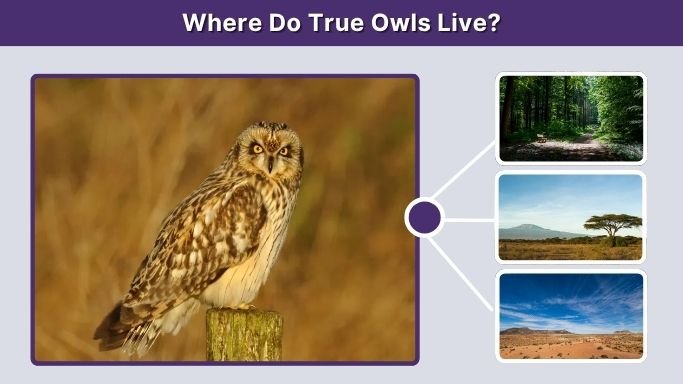
True owls live on nearly every continent and in many habitat types. The Owl Research Institute states that owls live on every continent except Antarctica.
True owls can live in:
- Forests
- Woodlands
- Grasslands
- Deserts
- Mountains
- Tundra
- Wetlands
- Farms
- Urban parks
- Suburban neighborhoods
Their habitat depends on the species. A snowy owl is adapted to open Arctic landscapes, while a barred owl is strongly associated with wooded areas. A burrowing owl may live in open grasslands and use ground burrows, while a great horned owl can adapt to many habitats.
What Do True Owls Eat?
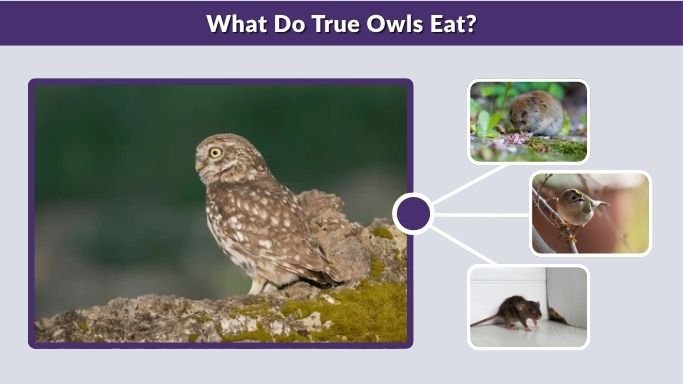
True owls are carnivores. Their diet includes small mammals, birds, reptiles, amphibians, insects, fish, and other animals depending on the species and habitat. Many owl species depend heavily on small rodents such as mice and voles.
Some true owls are generalist hunters. Great horned owls, for example, can take a wide range of prey. Other owls specialize more. Some small owls eat many insects, while fish owls and fishing owls hunt aquatic prey. The exact diet depends on body size, habitat, season, and prey availability.
Common True Owl Foods
True owls may eat:
- Mice
- Voles
- Rats
- Rabbits
- Small birds
- Snakes
- Lizards
- Frogs
- Fish
- Beetles and other insects
Owls usually swallow smaller prey whole and later cough up pellets containing bones, fur, feathers, and other undigested parts.
True Owl Hunting Adaptations
True owls are built for hunting. They have forward-facing eyes for depth perception, sharp talons for gripping prey, hooked bills for tearing food, and soft feathers that help reduce flight noise. The Owl Research Institute notes that owls have forward-facing eyes, soft feathers, short tails, and a reversible toe that can point forward or backward.
Many true owls hunt by sitting quietly on a perch and dropping onto prey. Others search while flying. The perch-and-pounce method is common among many owl species, while some open-country owls may hunt by flying low over the ground.
True Owl Sounds
Many people think all owls hoot, but true owl sounds vary widely. Some true owls hoot, while others whistle, bark, scream, trill, or give soft calls. Owl sounds are useful for identification because many owls are easier to hear than see at night.
Great horned owls are famous for deep hoots. Barred owls have a loud, rhythmic call. Screech owls may trill or whinny. Saw-whet owls give repeated high notes. The Owl Research Institute explains that many owl species vocalize at low frequencies, which helps their songs travel long distances through vegetation.
True Owl Size
True owl size varies greatly. Some true owls are tiny, while others are among the largest owls in the world. Small species like pygmy owls and saw-whet owls may be only a few inches tall, while eagle-owls and great gray owls can look massive.
Size affects diet and hunting style. Small true owls often eat insects, small mammals, and small birds. Large true owls can catch bigger prey, including rabbits, ducks, snakes, and other animals.
True Owl Nesting
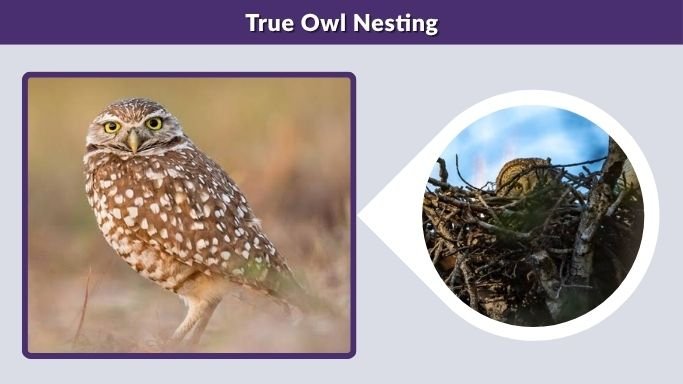
Most true owls do not build complex nests. Many use tree cavities, old nests made by hawks or crows, cliffs, burrows, ledges, or human-made nest boxes. Nesting style depends strongly on species.
Great horned owls often use old nests built by other large birds. Screech owls often nest in cavities. Burrowing owls use underground burrows. Snowy owls nest on the ground in open tundra.
Female owls usually do most of the incubation, while males often bring food during early nesting. Chicks are usually helpless when they hatch and depend on adults for warmth, protection, and food.
True Facts About Owls
Owls have many unusual features that make them different from other birds. Their eyes face forward, giving them a strong depth perception. Their heads can rotate far because of special neck anatomy. Their feathers are soft and help many species fly quietly.
10 True Facts About Owls
- True owls belong to the family Strigidae.
- Barn owls belong to a different family called Tytonidae.
- Most owls are nocturnal, but not all are active only at night.
- Owls are birds of prey with sharp talons and hooked bills.
- Many owls rely heavily on hearing when hunting.
- Owl eyes face forward like human eyes.
- Owls cannot move their eyes around like people can.
- Many owls cough up pellets after eating prey.
- True owls live in many habitats around the world.
- Some true owls are tiny, while others are very large.
These facts help explain why owls are such successful hunters and why they are popular in wildlife articles, myths, stories, and birdwatching guides.
True Owl Lower Classifications
The true owl family includes many genera. Some of the best-known genera include Bubo, Strix, Asio, Megascops, Glaucidium, Aegolius, and Athene. These groups include horned owls, wood owls, screech owls, long-eared owls, short-eared owls, pygmy owls, saw-whet owls, and little owls.
Taxonomy can change as scientists study DNA, anatomy, and vocal differences. For example, Cornell notes that in 2024 ornithologists split the widespread Barn Owl into American Barn Owl, Eastern Barn Owl, and Western Barn Owl. This shows that owl classification can be updated as research improves.
Why the Term “True Owl” Can Be Confusing
The term “true owl” sounds like it means some owls are real and others are not. That is not correct. Barn owls, masked owls, and grass owls are still real owls. They are simply not in the family Strigidae.
Another reason the keyword is confusing is that people also search for unrelated entertainment topics such as “The Owl House King true form,” “Grey Owl true story,” “Night Owl true story,” and “True Detective owl.” Those topics are not about owl biology. In bird classification, “true owl” specifically means an owl in the family Strigidae.
FAQs
What is a true owl?
A true owl is an owl in the family Strigidae. This family includes most owls, such as great horned owls, snowy owls, barred owls, tawny owls, eagle-owls, and screech owls.
Are barn owls true owls?
No, barn owls are not true owls in taxonomy. They are real owls, but they belong to the family Tytonidae, while true owls belong to Strigidae.
What is the difference between true owls and barn owls?
True owls usually have rounder faces and belong to Strigidae. Barn owls have heart-shaped faces and belong to Tytonidae. Barn owls also have a different body structure and are classified separately.
What do true owls eat?
True owls are carnivores. They eat animals such as mice, voles, rats, birds, insects, reptiles, amphibians, fish, and rabbits depending on the species.
Where do true owls live?
True owls live in many habitats, including forests, grasslands, deserts, mountains, wetlands, tundra, farms, and urban areas. Owls as a group occur on every continent except Antarctica.
