
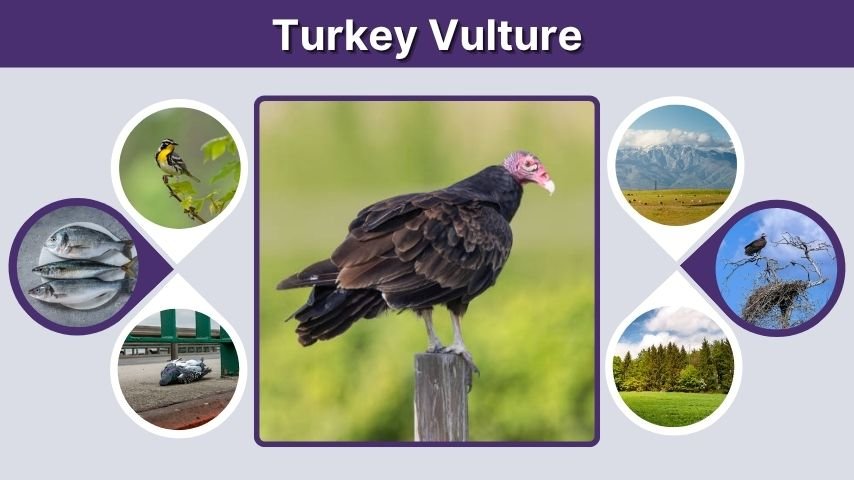
The turkey vulture is one of the most recognizable soaring birds in North America. With its red bald head, dark body, broad wings, and wobbly flight, this bird is often seen circling high above roads, fields, forests, and open country. Although many people call it a turkey buzzard, the turkey vulture is a unique scavenger with an important role in nature.
What Is a Turkey Vulture?
A turkey vulture is a large scavenging bird that feeds mostly on carrion, which means dead animals. Its scientific name is Cathartes aura. The name is often connected with the idea of cleansing or purification, which fits the bird’s role as nature’s cleanup crew.
Turkey vultures are New World vultures, meaning they belong to the vulture group found in the Americas. They are not the same as Old World vultures from Europe, Africa, and Asia, even though they look and behave similarly.
Many people mistake turkey vultures for hawks, eagles, black vultures, or even wild turkeys. However, once you know their shape and flight style, they become easy to recognize.
Quick Turkey Vulture Facts
- Scientific name: Cathartes aura
- Common names: Turkey vulture, turkey buzzard, buzzard
- Main food: Carrion
- Wingspan: About 5.5 to 6 feet
- Head color: Red in adults, grayish or dark in juveniles
- Flight style: Wobbly soaring with wings held in a V-shape
- Nest type: No traditional nest; eggs are laid in sheltered places
- Sounds: Mostly hisses and grunts
- Range: Found across much of the Americas
Turkey Vulture Identification
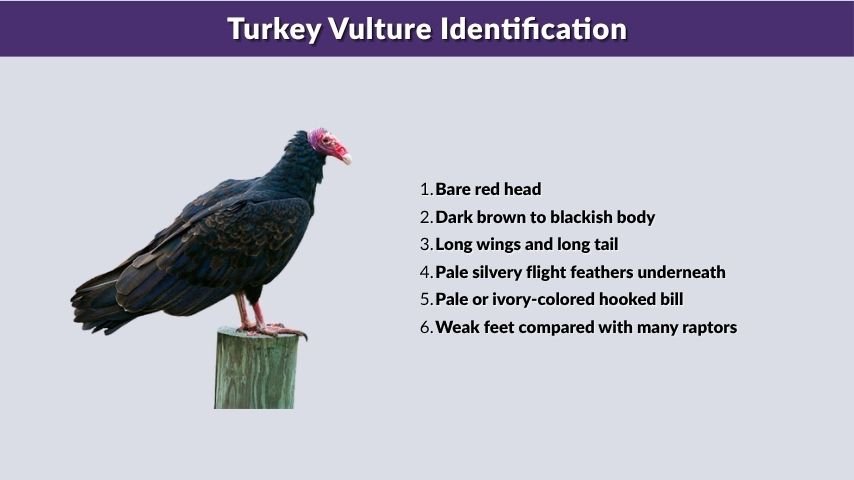
The turkey vulture is a large dark bird with long wings, a long tail, and a small red head. From below, its wings often show a two-toned pattern. The front part of the wing looks darker, while the flight feathers appear paler or silvery.
The easiest way to identify a turkey vulture is by watching how it flies. It holds its wings slightly raised in a shallow V-shape, also called a dihedral. As it soars, it often rocks or tilts from side to side.
What Does a Turkey Vulture Look Like?
Adult turkey vultures have:
- Bare red head
- Dark brown to blackish body
- Long wings and long tail
- Pale silvery flight feathers underneath
- Pale or ivory-colored hooked bill
- Weak feet compared with many raptors
- Wobbly soaring flight
Juvenile turkey vultures look different from adults because they have a grayish or dark head instead of a red one. This is why a young turkey vulture can sometimes be confused with a black vulture.
Turkey Vulture Size and Wingspan
Turkey vultures are large birds, but they are not as heavy as they may look. Their broad wings help them glide for long periods without flapping much. This saves energy while they search for food over large areas.
| Feature | Turkey Vulture Description |
| Scientific name | Cathartes aura |
| Average wingspan | About 5.5 to 6 feet |
| Body length | About 25 to 32 inches |
| Adult head color | Red and bare |
| Juvenile head color | Grayish or dark |
| Main diet | Carrion and roadkill |
| Flight style | Soaring, rocking, wings held in a V |
| Main habitat | Open country, forests, deserts, farms, roadsides, and wetlands |
A turkey vulture in flight may look bigger than it actually is because of its long wings. Compared with many hawks, it has a more unstable, teetering flight style.
Turkey Vulture Flight
Turkey vultures are excellent soarers. They use rising warm air, called thermals, to stay in the sky with very little effort. Instead of flapping constantly, they circle, glide, and drift across the landscape.
How to Recognize a Turkey Vulture in Flight
Look for these flight clues:
- Wings held in a shallow V-shape
- Rocking or wobbling motion
- Long tail
- Broad, fingered wings
- Slow circling over open areas
- Little flapping when riding thermals
This flight style is one of the best ways to separate a turkey vulture from a hawk or eagle. Hawks usually fly with steadier wing posture, while turkey vultures often seem to tip and sway in the air.
What Do Turkey Vultures Eat?
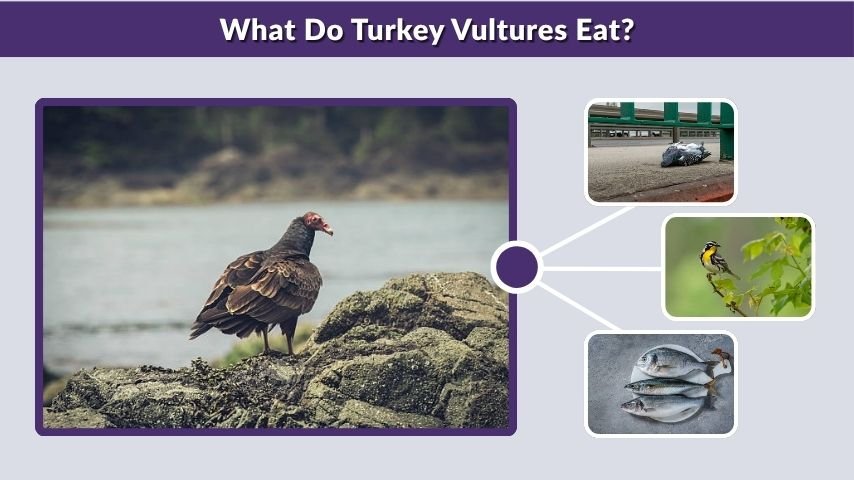
Turkey vultures eat mostly dead animals. Their diet includes roadkill, dead mammals, birds, reptiles, amphibians, and fish. They prefer fresh carrion rather than badly decayed carcasses.
Turkey vultures are famous for their strong sense of smell. Unlike many birds, they can detect the scent of gases released by dead animals. This helps them find food hidden under trees, brush, or forest cover.
Do Turkey Vultures Eat Live Animals?
Turkey vultures rarely eat live animals. They are mainly scavengers, not hunters. Their feet are weaker than those of hawks and eagles, so they are not built for catching and killing prey.
In rare cases, they may eat very weak, helpless, or newly born animals, but this is not their normal feeding behavior. Black vultures are more likely than turkey vultures to attack vulnerable live animals.
Turkey Vulture Habitat
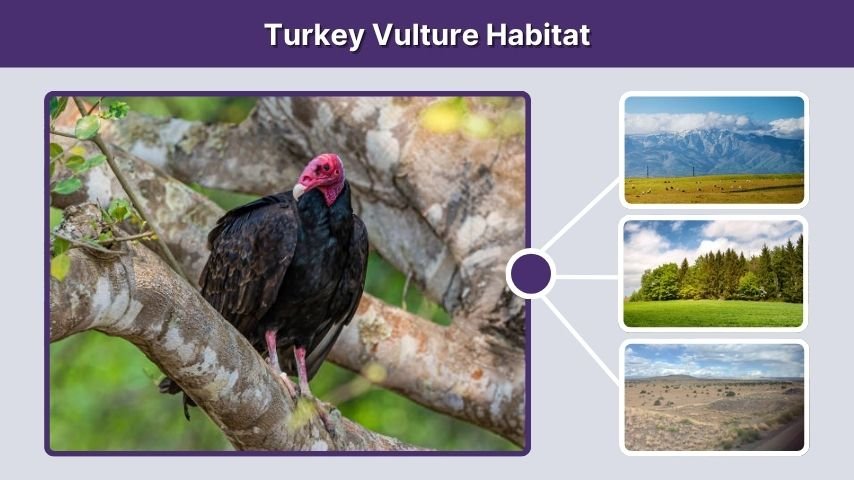
Turkey vultures live in many different habitats. They are often seen over open country, farms, roadsides, forests, deserts, foothills, wetlands, and suburban areas. They need places to find carrion, safe roosting sites, and sheltered nesting areas.
They are especially common around areas where open land meets woods, cliffs, barns, or rocky spaces. These places give them both feeding opportunities and secure spots for nesting or resting.
Common Turkey Vulture Habitats
Turkey vultures may be found in:
- Open fields and pastures
- Forest edges
- Highways and roadsides
- Wetlands and river valleys
- Deserts and semi-open country
- Farms and ranches
- Foothills and rocky areas
- Suburban and rural landscapes
Because they feed on dead animals, roadsides often attract them. However, this can also put them at risk of vehicle collisions.
Turkey Vulture Range and Migration
Turkey vultures live across much of the Americas. They are found in North America, Central America, and South America. In the United States, they are common in many states, including California, Florida, Texas, Ohio, Illinois, and Michigan.
Some turkey vultures migrate, while others stay in the same region all year. Birds in colder northern areas are more likely to migrate south during winter. In warmer regions, such as the southern United States and parts of Central and South America, many turkey vultures remain year-round.
Do Turkey Vultures Migrate?
Yes, many turkey vultures migrate. Northern populations often move south when temperatures drop and food becomes harder to find. During migration, large numbers may gather and travel together, creating impressive groups of soaring birds.
A group of vultures flying together in circles is often called a kettle. When they are feeding, people may call them a wake. When roosting together, they may be called a committee.
Turkey Vulture Sounds
Turkey vultures are usually quiet birds. They do not sing like songbirds, and they do not make loud calls like many hawks. Their sounds are mostly limited to hisses, grunts, and low harsh noises.
What Does a Turkey Vulture Sound Like?
Turkey vulture sounds may include:
- Hissing
- Grunting
- Low rasping noises
- Harsh sounds near nests or food
They often make these sounds when threatened, disturbed, feeding, or near a nesting site. Because they lack the same vocal ability as many other birds, their sound range is limited.
Turkey Vulture Nesting and Breeding
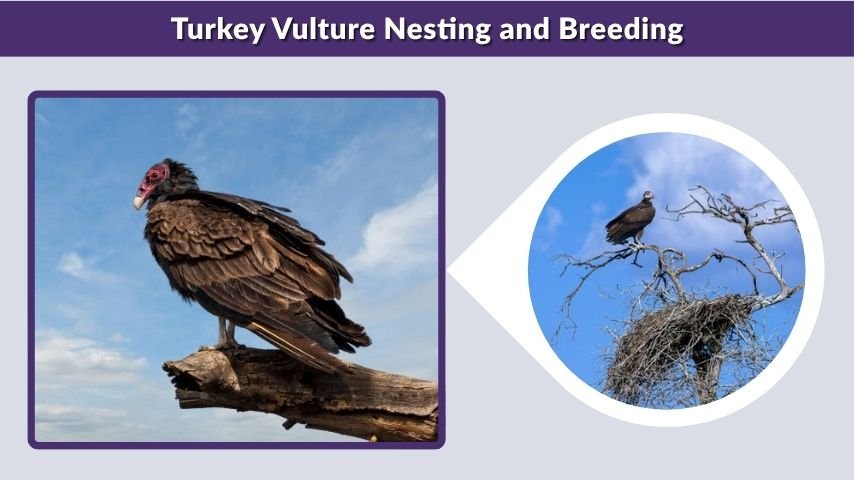
Turkey vultures do not build a typical stick nest. Instead, they lay their eggs in protected places such as caves, hollow logs, abandoned buildings, rock crevices, thickets, or dense vegetation.
The eggs are usually laid directly on the ground or surface of the nesting site. A typical clutch has one to three eggs, often two. Both parents help care for the young.
Where Do Turkey Vultures Nest?
Turkey vultures may nest in:
- Hollow trees
- Caves
- Rock ledges
- Abandoned barns
- Dense thickets
- Hollow logs or stumps
- Sheltered ground sites
Young turkey vultures are covered with pale down when they hatch. As they grow, they develop darker feathers and eventually begin to look like juvenile vultures with grayish heads.
Are Turkey Vultures Dangerous?
Turkey vultures are not usually dangerous to people. They are shy scavengers and normally avoid close contact with humans. They do not hunt people, pets, or healthy livestock.
However, they can create problems when large groups roost near homes, farms, or buildings. Their droppings can be messy, and their presence may be unpleasant. They may also damage property by pulling at rubber, caulk, or other soft materials.
How to Get Rid of Turkey Vultures Safely
Because turkey vultures are protected in the United States, you should not harm, trap, shoot, or disturb nests without proper permission. For nuisance problems, safe methods may include:
- Removing food sources such as carcasses
- Securing trash and compost
- Using approved visual deterrents
- Blocking access to roosting spots
- Contacting wildlife control professionals
- Checking local wildlife laws before taking action
The best approach is humane prevention, not harm.
Are Turkey Vultures Protected?
Yes, turkey vultures are protected in the United States under the Migratory Bird Treaty Act. This means it is illegal to kill, capture, possess, or disturb them, their eggs, or their nests without proper authorization.
This protection exists because turkey vultures are native birds with an important ecological role. By eating carrion, they help clean the environment and may reduce the spread of disease.
Black Vulture vs Turkey Vulture
The black vulture and turkey vulture are often confused, but they are easy to separate with practice. Turkey vultures have red heads as adults, longer tails, and a rocking flight style. Black vultures have black or dark gray heads, shorter tails, broader wings, and a more direct flight with quick flaps.
In flight, black vultures show white patches near the wing tips. Turkey vultures show pale flight feathers along much of the underside of the wing.
Turkey vultures also have a stronger sense of smell. Black vultures often follow turkey vultures to carcasses because turkey vultures are better at locating food by scent.
Turkey Vulture vs California Condor
The California condor is much larger than a turkey vulture. Condors have a massive wingspan that can reach around 9 feet, while turkey vultures are usually closer to 6 feet. Condors also have large white patches under the wings and a much heavier body.
Turkey vultures are common across many parts of the Americas. California condors are rare and carefully managed through conservation programs. If you see a large soaring bird in most places, it is far more likely to be a turkey vulture than a condor.
Turkey Vulture vs Hawk
Turkey vultures are often mistaken for hawks when they soar high in the sky. The biggest difference is flight style. Turkey vultures hold their wings in a V and rock from side to side. Hawks usually hold their wings flatter and fly more steadily.
Hawks are predators with strong feet and sharp talons for catching prey. Turkey vultures are scavengers with weaker feet and a strong sense of smell for finding dead animals.
Turkey Vulture vs Wild Turkey
A turkey vulture is not the same as a wild turkey. A wild turkey is a ground-dwelling game bird with a heavy body, strong legs, and a fan-shaped tail. A turkey vulture is a soaring scavenger with long wings and a bald red head.
The name “turkey vulture” comes from the bird’s red head, which can resemble the head of a wild turkey. The two birds are not closely related in behavior or diet.
Turkey Buzzard vs Turkey Vulture
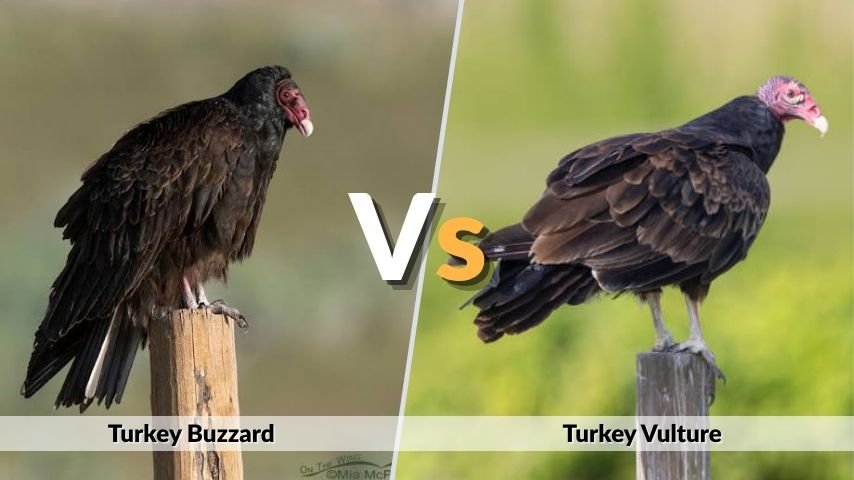
“Turkey buzzard” is a common nickname for the turkey vulture in parts of North America. In everyday speech, many people use buzzard and vulture as if they mean the same thing.
Technically, in Europe and other Old World regions, buzzard often refers to hawks in the genus Buteo. In North America, however, “turkey buzzard” usually means turkey vulture.
Turkey Vulture Spiritual Meaning
Many people connect turkey vultures with spiritual meanings such as cleansing, renewal, transformation, patience, and survival. Because they remove dead animals from the landscape, they are often seen as symbols of purification and natural balance.
A turkey vulture may also represent the idea of using what others overlook. In this sense, its meaning is not only about death, but also about renewal, usefulness, and the cycle of life.
Spiritual meanings vary by culture and personal belief. In nature, the turkey vulture’s real role is clear: it helps recycle nutrients and keep ecosystems cleaner.
Turkey Vulture Feathers
Turkey vulture feathers are dark brown to blackish, with paler flight feathers visible from below. These pale feathers create the two-toned wing pattern that helps birdwatchers identify the species in flight.
Although people may find turkey vulture feathers on the ground, collecting feathers from protected birds may be illegal in the United States without a permit. It is best to enjoy feathers where you find them and leave them in nature.
Turkey Vulture Lifespan
Turkey vultures can live for many years, especially when they avoid major risks such as vehicles, poisoning, habitat loss, and human conflict. Wild birds may live more than a decade, while captive individuals can live much longer.
Their slow breeding rate makes adult survival important. Protecting roosts, nesting areas, and safe food sources helps support healthy populations.
FAQs
What do turkey vultures eat?
Turkey vultures mostly eat carrion, including dead mammals, birds, reptiles, amphibians, and fish. They often feed on roadkill and prefer fresher carcasses. They are scavengers, not active hunters, and they play an important role by cleaning dead animals from the environment.
Are turkey vultures dangerous?
Turkey vultures are not usually dangerous to people or pets. They are shy birds that prefer to avoid humans. Problems can happen when large groups roost near buildings, but they should be managed humanely because turkey vultures are legally protected in many areas.
What is the wingspan of a turkey vulture?
A turkey vulture’s wingspan is usually about 5.5 to 6 feet. Its long, broad wings help it soar for long periods with little flapping. In flight, it often holds its wings in a shallow V-shape and rocks from side to side.
Do turkey vultures migrate?
Yes, many turkey vultures migrate. Birds from colder northern regions often move south for winter, while turkey vultures in warmer areas may stay year-round. During migration, they may gather in large soaring groups known as kettles.
What is the difference between a black vulture and a turkey vulture?
A turkey vulture has a red head as an adult, a longer tail, and a wobbly V-shaped flight. A black vulture has a dark head, shorter tail, broader wings, and white patches near the wing tips. Turkey vultures also use smell more effectively to find carrion.
