
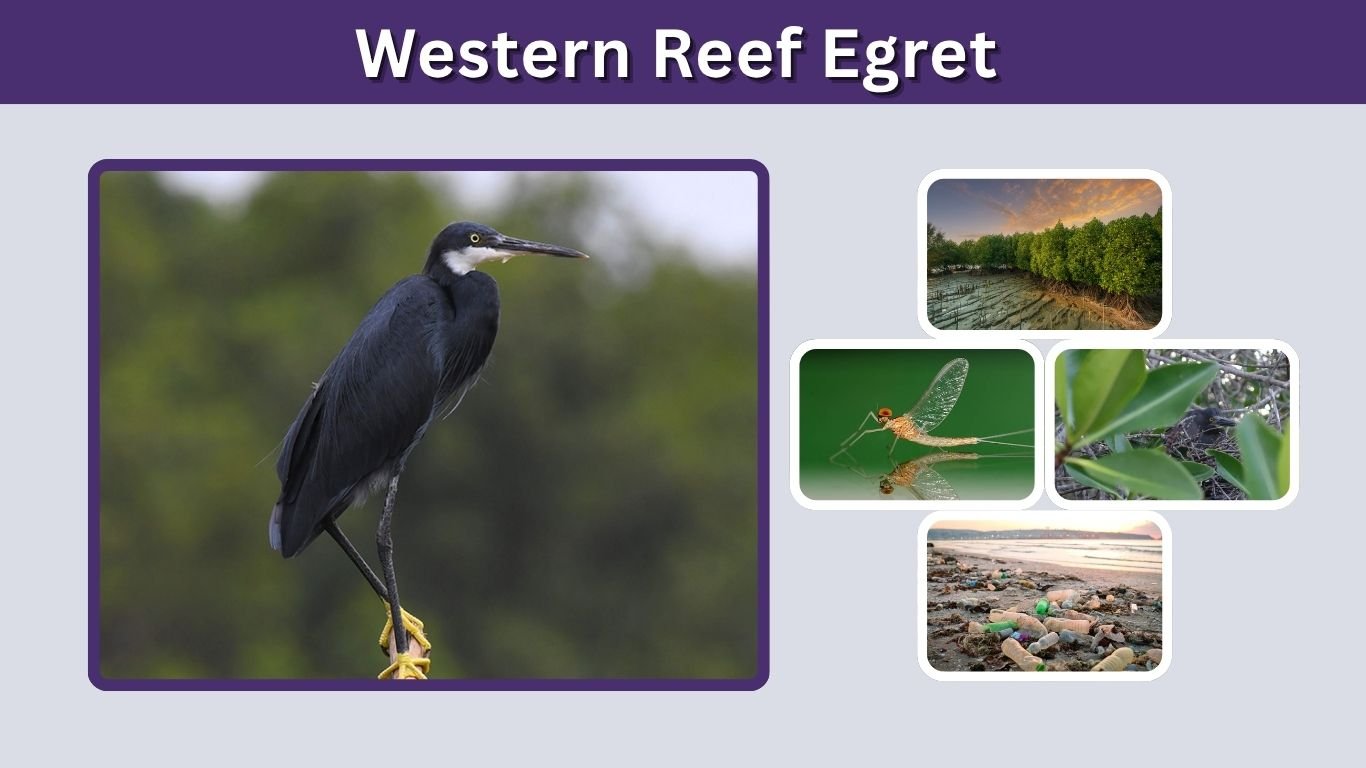
The Western Reef Egret is a medium-sized coastal heron known for appearing in dramatically different colors. Some individuals have dark slate-gray plumage, while others are completely white. Both forms belong to the same species and may live, feed, and breed together. Found mainly along the coasts of Africa, the Middle East, and South Asia, this adaptable hunter searches tidal flats, mangroves, lagoons, and rocky shores for fish and crustaceans. Its color variation and resemblance to other egrets can make identification challenging.
Western Reef Egret Overview
The Western Reef Egret, also called the Western Reef Heron, belongs to the heron family Ardeidae. Its scientific name is Egretta gularis. The word “gularis” refers to the throat, an important identification feature in dark-colored birds.
Two principal subspecies are generally recognized. E. g. gularis occurs along the coast of western Africa, while E. g. schistacea ranges from the Red Sea and Persian Gulf eastward along the coast of South Asia.
| Feature | Description |
|---|---|
| Common name | Western Reef Egret |
| Alternative name | Western Reef Heron |
| Scientific name | Egretta gularis |
| Family | Ardeidae |
| Length | Approximately 55–65 cm |
| Wingspan | Approximately 86–104 cm |
| Weight | Generally around 350–650 g |
| Color | Dark gray, white, or intermediate |
| Diet | Fish, crabs, shrimp, mollusks, and insects |
| Habitat | Mangroves, tidal flats, reefs, estuaries, and lagoons |
| Nest | Platform of sticks or coastal vegetation |
| Typical clutch | Two to four eggs |
| Conservation status | Least Concern |
Western Reef Egret Identification
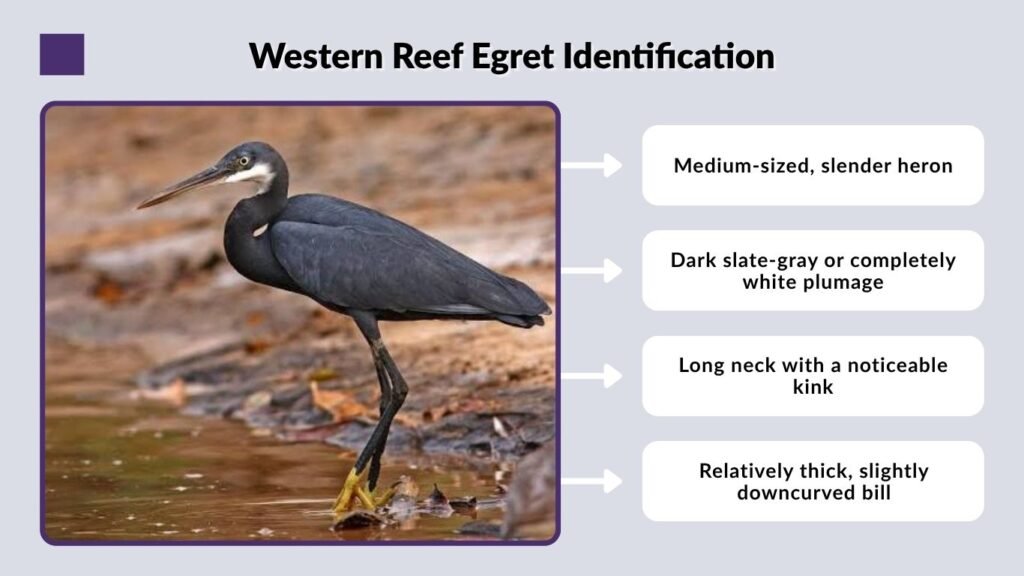
The Western Reef Egret has a medium-sized body, relatively long neck, strong legs, and a thick, pointed bill. Its appearance varies considerably because it occurs in dark, white, and occasionally mixed plumage forms.
The dark form is usually easier to recognize because few other egrets within its range have slate-gray plumage. The white form can be confused with the Little Egret, especially when viewed from a distance.
Key Identification Features
- Medium-sized, slender heron
- Dark slate-gray or completely white plumage
- Long neck with a noticeable kink
- Relatively thick, slightly downcurved bill
- Yellowish, brownish, gray, or dark bill
- Thick legs compared with a Little Egret
- Yellowish, greenish, gray, or dark legs
- Whitish chin or throat in many dark individuals
- Active feeding behavior along coastlines
- Rounded wings and folded neck during flight
- Ornamental head and back plumes during breeding
Male and female Western Reef Egrets look alike. Males may average slightly larger, but their measurements and plumage overlap too much for reliable visual identification of sex.
Western Reef Egret Color Morphs
Color polymorphism is one of the Western Reef Egret’s most fascinating characteristics. A color morph is a naturally occurring difference in appearance within a species. It does not indicate a separate species, sex, or age group.
Dark Morph
Dark-morph Western Reef Egrets have slate-gray, charcoal, or nearly black plumage. The throat and chin may be noticeably paler or white, particularly in the West African subspecies.
The bill can appear yellowish, gray-brown, or dark, depending on the individual and breeding condition. The legs may be greenish-yellow, brown, gray, or almost black.
Dark plumage may provide camouflage against rocks, reefs, wet mud, and shaded mangrove roots. However, feeding success can also depend on light, water depth, tidal conditions, and prey behavior.
White Morph
White-morph birds have completely white plumage and can closely resemble Little Egrets. They generally have a heavier body, thicker legs, and a more substantial bill than the Little Egret.
The bill is often paler, broader, or more yellowish than the Little Egret’s narrow black bill. However, bill and leg colors vary, so identification should be based on several features rather than color alone.
Intermediate and Pied Morphs
Some Western Reef Egrets have a mixture of gray and white feathers. These birds may appear pale gray, mottled, or distinctly pied. Intermediate coloring is less common than the primary dark and white forms.
Both dark and white birds can breed with each other. Their chicks may develop either parental color or an intermediate appearance, depending on the inherited combination of color-related genes.
Size and Physical Appearance
An adult Western Reef Egret generally measures around 55–65 cm, or approximately 22–26 inches, from bill to tail. Its wingspan is commonly between 86 and 104 cm, or about 34–41 inches. Weight varies with sex, region, and physical condition but generally falls between 350 and 650 grams.
Its long neck often appears slim when extended but compact when folded against the body. The bird may hold its body more horizontally while hunting than a Little Egret does. This posture is particularly noticeable when it is walking quickly across a tidal flat.
During the breeding season, adults develop long ornamental feathers on the nape, chest, and back. Their facial skin and legs may temporarily become brighter, sometimes taking on reddish, pinkish, or orange tones.
Juveniles have duller bare-part colors and lack the long breeding plumes. Young dark-morph birds may appear browner or more unevenly colored than adults.
Western Reef Egret Habitat
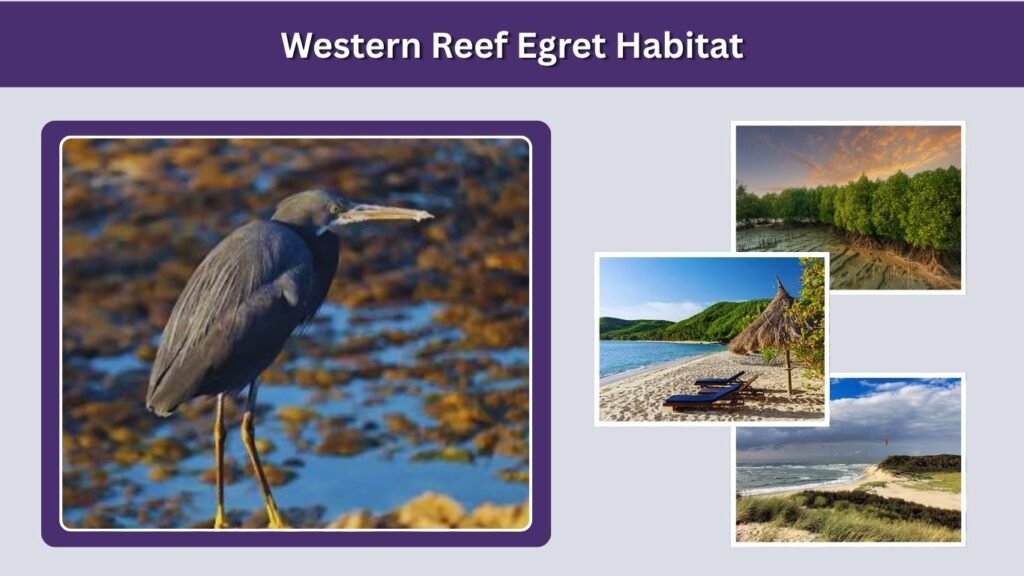
The Western Reef Egret is more closely associated with marine and coastal environments than most other egrets. It is particularly well adapted to feeding in salty, tidal habitats.
Common habitats include:
- Rocky shorelines and reefs
- Sandy beaches
- Coastal mudflats
- Mangrove forests
- Tidal creeks
- Estuaries
- Saltwater lagoons
- Salt pans
- Sheltered bays
- Coral reefs
- Coastal islands
- Harbors and fishing areas
Although primarily coastal, Western Reef Egrets occasionally visit inland wetlands, rivers, artificial ponds, and flooded fields. These inland appearances are far less typical than those of Little or Intermediate Egrets.
Mangroves are especially important because they provide feeding areas, roosting sites, and protected nesting locations. When the tide falls, exposed mud and shallow pools concentrate fish, crabs, mudskippers, and other prey.
Where Do Western Reef Egrets Live?
Western Reef Egrets occur along tropical and subtropical coastlines. The nominate subspecies is distributed along the Atlantic coast of western Africa, from Mauritania south toward Gabon. Small populations or occasional birds also occur near southwestern Europe and offshore Atlantic islands.
The eastern subspecies occupies the Red Sea, Arabian Peninsula, Persian Gulf, Gulf of Oman, and coastal regions around the Indian subcontinent. Its distribution extends along parts of India and Sri Lanka, with most birds remaining close to the sea.
The species is generally resident, but individuals may make local movements according to tides, food supply, rainfall, and breeding conditions. Some birds wander beyond their usual range and have been recorded as rare visitors in Europe and the Americas.
What Do Western Reef Egrets Eat?
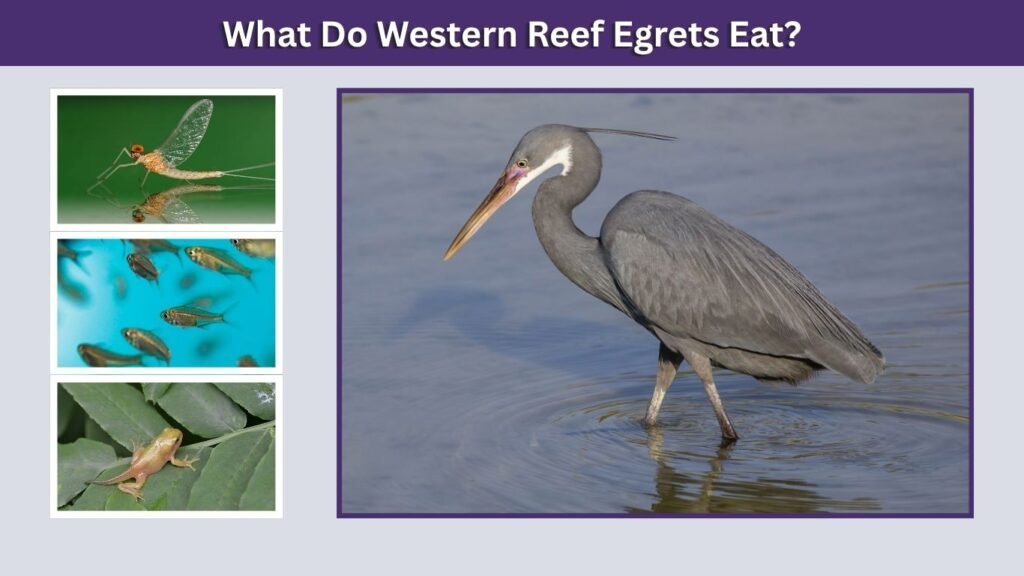
Western Reef Egrets are carnivorous and feed predominantly on coastal animals. Their diet varies according to habitat, season, tide, and the prey available at each location.
Common Foods
- Small fish
- Mudskippers
- Gobies
- Sardines and anchovies
- Crabs
- Shrimp and prawns
- Crayfish
- Marine worms
- Snails
- Small clams
- Aquatic insects
- Frogs and tadpoles
- Occasionally small lizards or rodents
Fish usually make up a significant part of the diet, particularly during the breeding season when adults must provide protein-rich food for their chicks. Crabs and other crustaceans are also important in mangroves and tidal flats.
The bird normally catches prey with a rapid strike of its bill. Small animals are swallowed immediately, while larger fish or crabs may be repositioned before being eaten.
Hunting and Feeding Behavior
Western Reef Egrets use several hunting techniques. A bird may stand motionless and wait for fish to approach, but it often hunts more actively by walking or running through shallow water.
It may shuffle its feet to disturb hidden prey, flick its wings, or hold one wing over the water. Wing shading reduces glare and creates a patch of shadow that can make fish easier to see. Some prey may also move into the shade, giving the egret a better opportunity to strike.
Feeding activity is closely connected to the tidal cycle. Low tide exposes mudflats, pools, reefs, and mangrove channels where prey becomes concentrated. As the tide rises, the egret moves toward higher ground or hunts along the advancing waterline.
Birds may feed alone or gather in loose groups at productive sites. An individual can become territorial when prey is concentrated in a small pool and may chase other egrets away.
Western Reef Egret Nesting
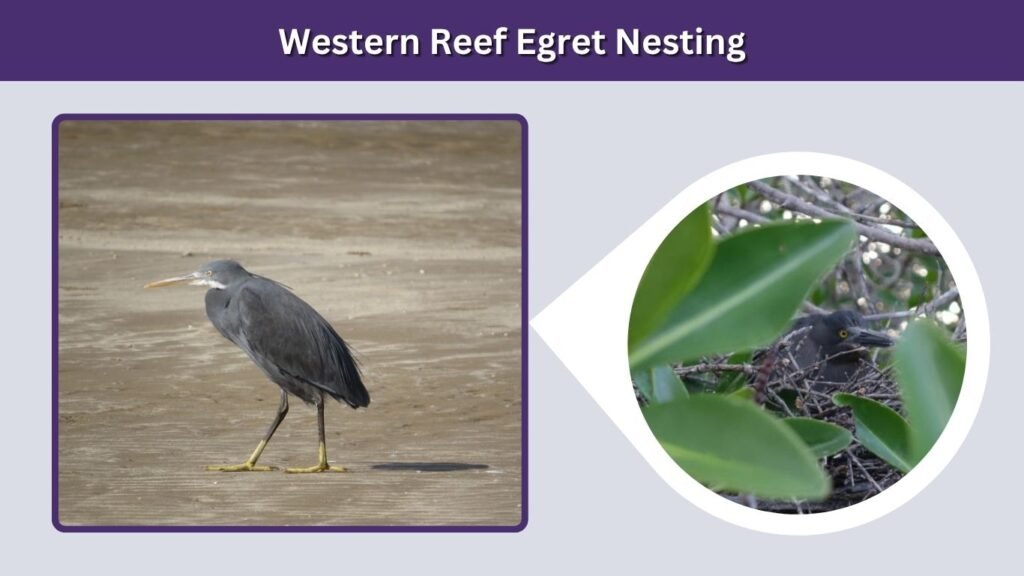
Western Reef Egrets may nest as isolated pairs, in small groups, or in colonies. They sometimes share a colony with other egrets and small herons. Breeding time differs by region and is often associated with rainfall, monsoon conditions, or periods of abundant coastal food.
Courtship and Pair Formation
A male selects a nest site and performs displays to attract a female. He may raise his long plumes, stretch his neck, point his bill upward, bow, or produce low calls.
After a pair forms, both birds defend the immediate nest area. Dark and white morphs freely pair with each other, confirming that they are color variations of the same species.
Nest Location
The nest is a loose platform made from sticks, twigs, reeds, seaweed, or other available vegetation. It may be placed:
- In a mangrove tree
- In a coastal shrub
- Among reeds
- On a rocky ledge
- On an offshore island
- On the ground beneath vegetation
- Between large boulders
- In trees close to salt pans
Nest height varies greatly. Some pairs build close to the ground, while others select trees more than 10 meters above it. Elevated or island sites can reduce access for ground-dwelling predators.
Eggs and Incubation
A typical clutch contains three or four pale blue eggs, although some pairs may lay only two. Incubation begins when the first egg is laid, meaning the chicks do not all hatch at the same time.
Both parents incubate the eggs, which generally hatch after approximately 23–24 days. One adult usually remains near the nest while the other searches for food.
Chicks and Fledging
Newly hatched chicks have pale down, sometimes with gray markings. They depend entirely on their parents for warmth, protection, and food. Adults regurgitate partially digested fish and other prey for the chicks.
The age difference between chicks can create competition. The oldest chick may be larger and better able to obtain food, particularly when prey is scarce.
Parents may stand over the nest to shade their chicks from intense coastal sunlight. Young birds generally leave the nest after approximately four or five weeks, although they may remain nearby and continue receiving food.
Western Reef Egret vs. Little Egret
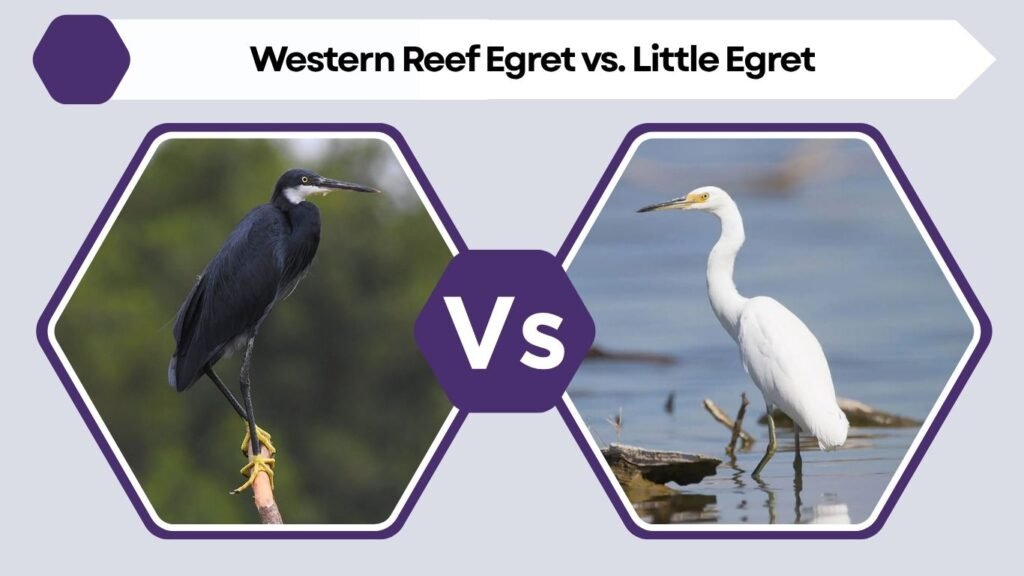
White-morph Western Reef Egrets are frequently confused with Little Egrets. Structure and bill shape are often more dependable than leg color.
| Feature | Western Reef Egret | Little Egret |
|---|---|---|
| Body | Heavier and more elongated | Slender and delicate |
| Bill | Thicker, often paler or yellowish | Thin and usually black |
| Neck | Long with a noticeable kink | Graceful and S-shaped |
| Legs | Relatively thick | Long and thin |
| Feet | Variable in color | Usually bright yellow |
| Typical habitat | Marine coasts and tidal reefs | Freshwater and coastal wetlands |
| Posture | Often holds body horizontally | Usually appears more upright |
| Plumage forms | Dark, white, or intermediate | Normally white |
A bird’s location can provide a helpful clue. A heavy-billed white egret hunting on a rocky marine reef is more likely to be a Western Reef Egret, but all physical features should still be checked.
Western Reef Egret vs. Pacific Reef Heron
The Pacific Reef Heron occurs farther east, particularly around Australia, New Zealand, Pacific islands, and parts of Southeast Asia. Both species have white and dark color morphs and occupy rocky coastlines.
The Pacific Reef Heron is generally stockier, with a shorter, thicker neck, heavier bill, and shorter legs. The Western Reef Egret often appears taller and slimmer, with a longer neck and legs. Geography is among the most reliable clues because the ranges of the two species have limited overlap.
Flight and Communication
When flying, a Western Reef Egret retracts its neck against its body while extending its legs behind the tail. Its broad, rounded wings produce steady wingbeats. Dark-morph birds may show lighter areas around the throat or wings, while white birds appear entirely pale.
The species is generally quiet outside its nesting grounds. When disturbed, it may produce a low “kwok,” harsh croak, or grating call. Colonies are noisier because adults and chicks call during territorial disputes, courtship, and feeding.
Conservation Status and Threats
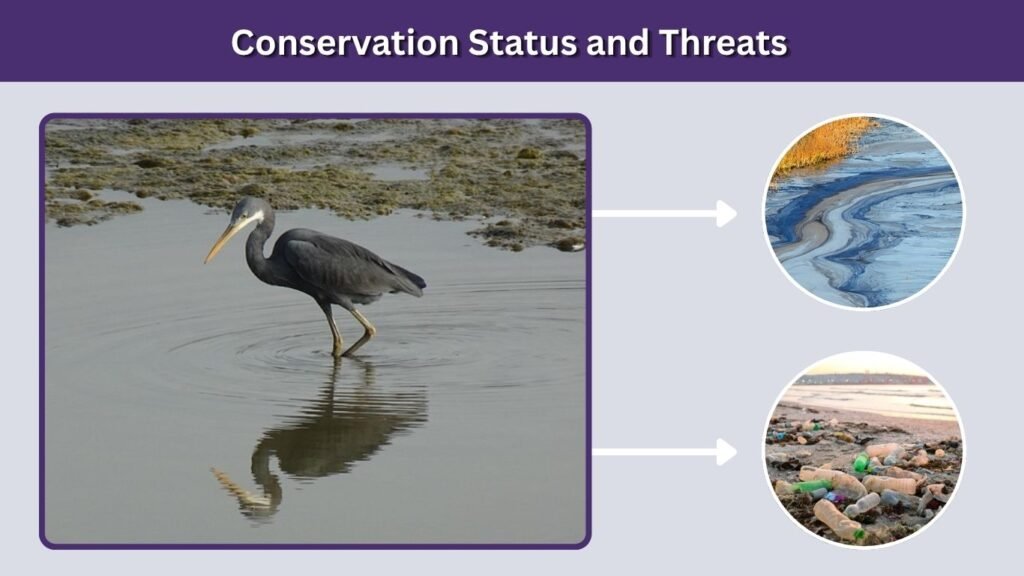
The Western Reef Egret is classified as Least Concern because it has a broad distribution and is not currently considered globally threatened. Nevertheless, coastal development can destroy its feeding and breeding habitat.
Mangrove removal, land reclamation, oil pollution, plastic waste, disturbance of nesting colonies, and changes to tidal ecosystems can affect local populations. Eggs and chicks may also be taken by rats, cats, crows, and other predators.
Protecting mangroves, tidal flats, reefs, salt marshes, and undisturbed coastal islands is essential for the species. These habitats support not only reef egrets but also fish, shorebirds, crabs, and numerous other marine animals.
FAQs
Why do Western Reef Egrets have different colors?
The species naturally occurs in dark, white, and intermediate color morphs. These differences are genetically influenced and do not represent separate species or sexes. Dark and white individuals can mate and produce chicks with either color.
Is a Western Reef Egret the same as a Western Reef Heron?
Yes. Western Reef Egret and Western Reef Heron are two common names for Egretta gularis. Both names refer to the same medium-sized coastal bird found around Africa, the Middle East, and South Asia.
How can you identify a white Western Reef Egret?
Look for a heavier body, thicker bill, thicker legs, kinked neck, and relatively horizontal feeding posture. Its bill is often paler than a Little Egret’s black bill. Coastal reef or mangrove habitat also supports the identification.
Do Western Reef Egrets migrate?
Most populations are resident or make relatively short local movements. Birds may travel between coastal feeding areas according to tides, rainfall, breeding conditions, and food availability. Wandering individuals occasionally appear far outside the species’ regular range.
What do Western Reef Egrets eat?
They primarily eat small fish, mudskippers, crabs, shrimp, mollusks, marine worms, and aquatic insects. They may also capture frogs, tadpoles, lizards, or other small animals when available.
