
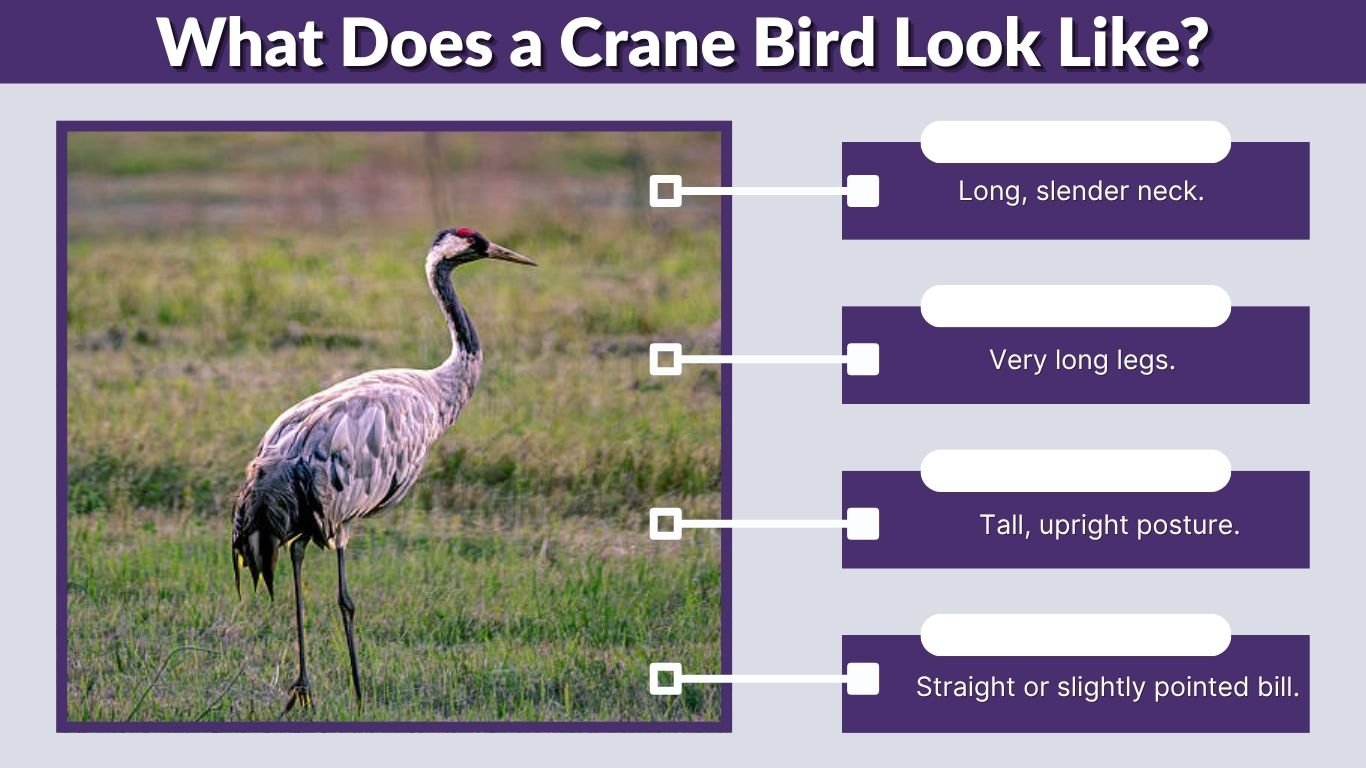
A crane is a tall, long-legged bird with an extended neck, broad wings, a straight bill, and an upright walking posture. Most species are gray, white, black, or a combination of these colors, while several have red, gold, or blue markings on the head. Cranes are often mistaken for herons, egrets, storks, and ibises. However, their heavy bodies, drooping rear feathers, loud calls, and straight-necked flight make them easier to identify.
What Does a Crane Bird Look Like?
Cranes have a distinctive body shape designed for walking through wetlands, grasslands, and open fields. Their bodies are relatively heavy, but their long necks and legs give them an elegant appearance.
Main Identification Features
- Long, slender neck
- Very long legs
- Tall, upright posture
- Straight or slightly pointed bill
- Broad, powerful wings
- Small head compared with the body
- Short tail hidden beneath drooping wing feathers
- Gray, white, black, brown, or patterned plumage
- Neck extended fully during flight
- Legs trailing behind the body in flight
Sandhill cranes, for example, are tall, heavy-bodied birds with broad wings, long black legs, a small head, and a straight bill longer than the head. Drooping feathers around the rear create a distinctive “bustle.”
How Big Is a Crane?
Crane size varies considerably among species. Smaller cranes may stand around three feet tall, while the largest species can approach six feet.
| Crane feature | Typical appearance |
| Height | Approximately 3–6 feet |
| Wingspan | Often 5–8 feet |
| Body | Tall and relatively heavy |
| Neck | Long and usually held straight |
| Legs | Long, thin, and exposed |
| Bill | Straight and pointed |
| Wings | Broad with separated primary feathers |
A Sandhill Crane measures about 47 inches long and has a wingspan near 79 inches. The larger Whooping Crane can reach about 59 inches in length with a wingspan exceeding 90 inches.
What Colors Are Crane Birds?
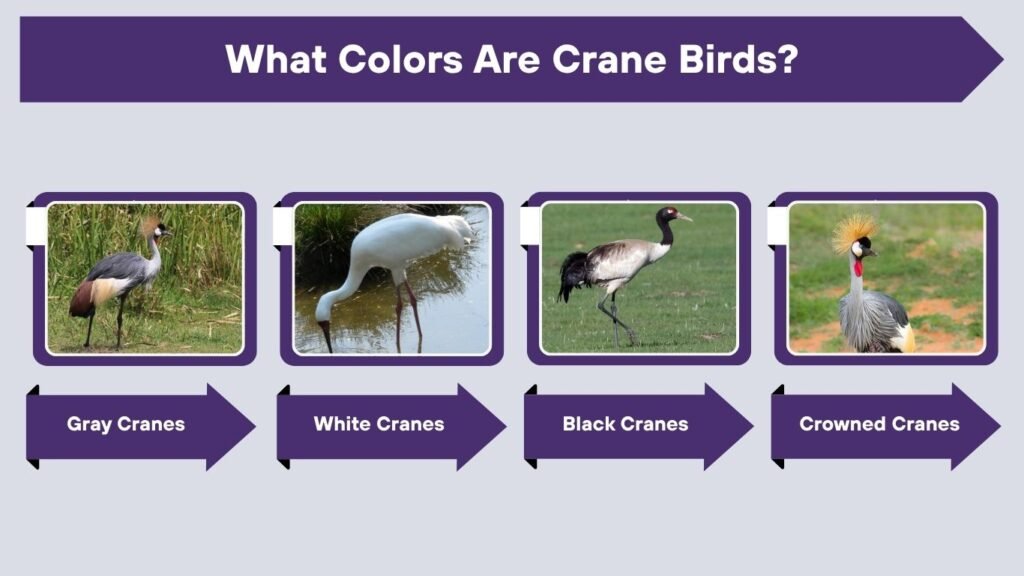
Many cranes are primarily gray or white, but their markings vary by species, age, and breeding condition.
Gray Cranes
Sandhill cranes have slate-gray plumage, a pale cheek, dark legs, and red skin on the crown. Their feathers may develop a rusty or brown wash after the birds apply iron-rich mud while preening.
Common or Eurasian cranes are also gray, but adults have a mostly black head and neck, a broad white facial stripe, and a red crown.
White Cranes
Whooping cranes are almost completely white, with a red crown, black facial markings, long dark legs, and black wingtips. The black wing feathers are generally hidden when the bird is standing and become clearly visible during flight.
Red-crowned cranes also have mostly white bodies, but their necks and parts of their wings are black. Adults have a bright red patch of skin on the forehead.
Black, Blue, and Crowned Cranes
Some species have darker or more decorative plumage. Black-necked cranes have gray bodies with black heads and necks. Blue cranes have pale blue-gray feathers, while Grey Crowned Cranes have gray bodies, white-and-gold wings, white cheek patches, and a crown of stiff golden feathers.
What Does a Crane Look Like in Flight?
Flight posture is one of the easiest ways to distinguish cranes from similar long-legged birds.
Straight Neck and Trailing Legs
A flying crane holds its neck fully extended in front of its body. Its long legs trail straight behind the tail. The broad wings move with slow, powerful strokes, although cranes may also soar and glide.
Sandhill and Whooping Cranes both fly with their necks outstretched. Whooping Cranes reveal black wingtips in flight, while Sandhill Cranes have gray wings without the same sharply contrasting black tips.
Cranes may fly alone, in pairs, in loose lines, or in V-shaped formations. Migrating flocks often travel high overhead while producing loud calls.
What Does a Baby Crane Look Like?
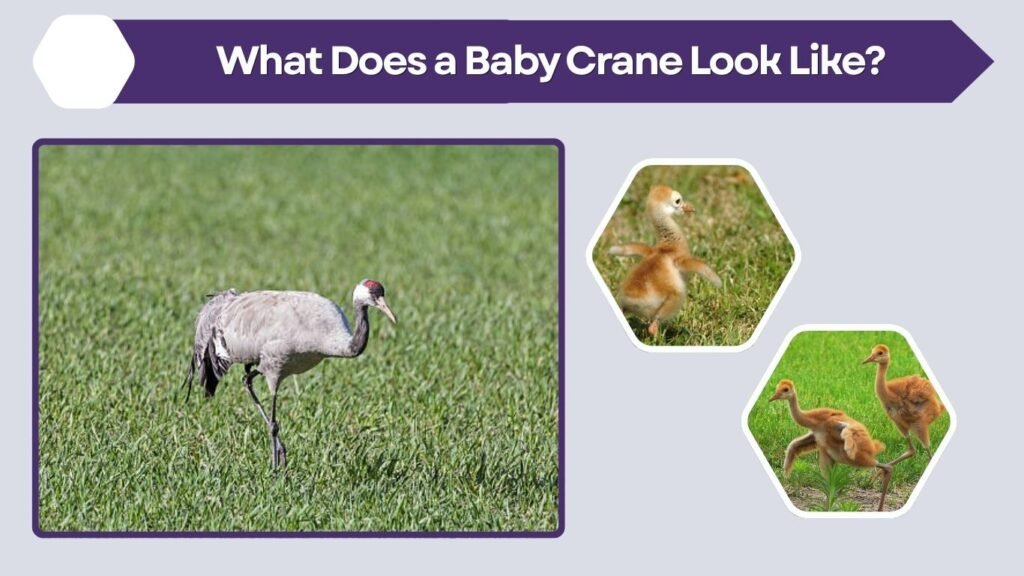
Baby cranes are called chicks or colts. Unlike the gray or white adults, young cranes are commonly covered in soft yellow, orange, cinnamon, tan, or brown down.
Crane Chick Identification
Newly hatched crane chicks have:
- Shorter legs and necks than adults
- Soft, fluffy down
- Orange, tan, brown, or yellow coloring
- Small, straight bills
- No red crown
- Long legs relative to their small bodies
Juvenile Sandhill Cranes are gray and rusty brown without the pale cheek and red crown of adults. Young Whooping Cranes have cinnamon-colored feathers on the head, neck, wings, and rear of the body.
As they grow, the legs and neck become longer, the flight feathers develop, and the juvenile plumage is gradually replaced by adult colors.
Birds That Look Like Cranes
Herons, egrets, storks, ibises, spoonbills, and limpkins may all be mistaken for cranes. Looking at flight posture, bill shape, body size, and feeding behavior can help separate them.
| Bird | How it differs from a crane |
| Heron | Usually flies with its neck folded |
| Egret | More slender and often completely white |
| Stork | Heavier bill and usually a bare or partly bare head |
| Ibis | Long, downward-curved bill |
| Spoonbill | Flat, spoon-shaped bill |
| Limpkin | Smaller with brown-and-white patterned feathers |
| Flamingo | Pink body and strongly bent bill |
Herons
Great Blue Herons are frequently called cranes, but they belong to a different bird family. A heron usually pulls its neck into an S-shaped curve when flying, while a crane keeps its neck extended.
Herons also tend to stand quietly near water and strike at fish. Cranes commonly walk through fields, prairies, and shallow wetlands while searching for plants, insects, grains, and small animals.
Egrets
A large white bird that looks like a crane may be a Great Egret. Egrets have slender bodies, long pointed bills, and long legs, but they are usually lighter and less bulky than cranes.
A Great Egret also folds its neck in flight. A Whooping Crane remains straight-necked and shows black wing feathers when its wings are open.
Storks
Storks have long legs and necks like cranes, but their bills are often larger and heavier. Many storks also have bald or partly featherless heads.
In flight, both groups extend their necks, so bill shape, head appearance, wing pattern, and location become especially useful identification clues.
Ibises and Spoonbills
Ibises can be separated by their long, narrow bills that curve downward. Spoonbills have wide, flat bills ending in a rounded, spoon-like tip.
Roseate Spoonbills may be described as pink crane-looking birds, but their pink feathers and unusual bills make them easy to distinguish at close range.
What Does a Sandhill Crane Look Like?
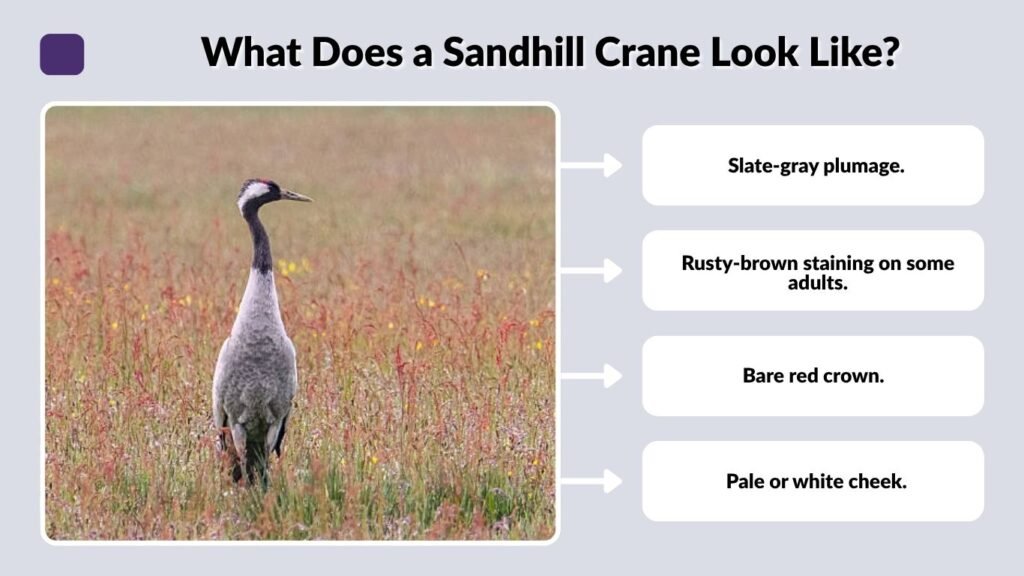
The Sandhill Crane is one of the most familiar cranes in North America. It has a gray body, long black legs, a red crown, a pale cheek, and a long straight neck.
Its most noticeable features include:
- Slate-gray plumage
- Rusty-brown staining on some adults
- Bare red crown
- Pale or white cheek
- Dark, pointed bill
- Drooping rear feathers
- Long black legs
Sandhill Cranes are bulkier than Great Blue Herons and do not normally hunch their necks while feeding or flying.
What Does a Whooping Crane Look Like?
The Whooping Crane is a very tall white bird with long black legs and a red crown. Adults also have black facial markings and black primary wing feathers.
When standing, it may look almost entirely white because the black wingtips are folded and hidden. During flight, the black ends of the wings become obvious. Whooping Cranes are larger and whiter than Sandhill Cranes.
How Do Cranes Behave?
Cranes commonly walk slowly while probing the soil or picking food from vegetation. They may appear alone, in pairs, with their chicks, or in large seasonal flocks.
They are also known for elaborate dancing displays involving:
- Bowing
- Running
- Wing spreading
- Leaping into the air
- Tossing grass or sticks
- Coordinated calling
Cranes have loud, trumpeting or rattling voices that can carry over long distances. Sandhill Crane calls may be heard from more than two miles away under suitable conditions.
FAQs
How can you tell whether a bird is a crane?
Look for a tall, heavy body, long legs, an extended neck, broad wings, a straight bill, and drooping feathers over the rear. In flight, a crane keeps its neck straight and its legs extended behind it.
What white bird looks like a crane?
A Great Egret is commonly mistaken for a white crane. Whooping Cranes and Red-crowned Cranes are true white cranes, while egrets are slimmer and fly with their necks folded.
What black bird looks like a crane?
A dark crane-looking bird may be a Black-necked Crane, Black Crane, heron, ibis, or stork. Location, bill shape, head markings, and flight posture are necessary for accurate identification.
What small bird looks like a crane?
Limpkins, rails, bitterns, juvenile herons, and smaller egrets can resemble miniature cranes. True cranes are generally much taller and have broader wings and heavier bodies.
Do cranes fly with their necks bent?
No. Cranes normally fly with their necks fully extended. Herons and egrets usually bend or retract their necks into an S-shaped position, making flight posture one of the best identification clues.
