
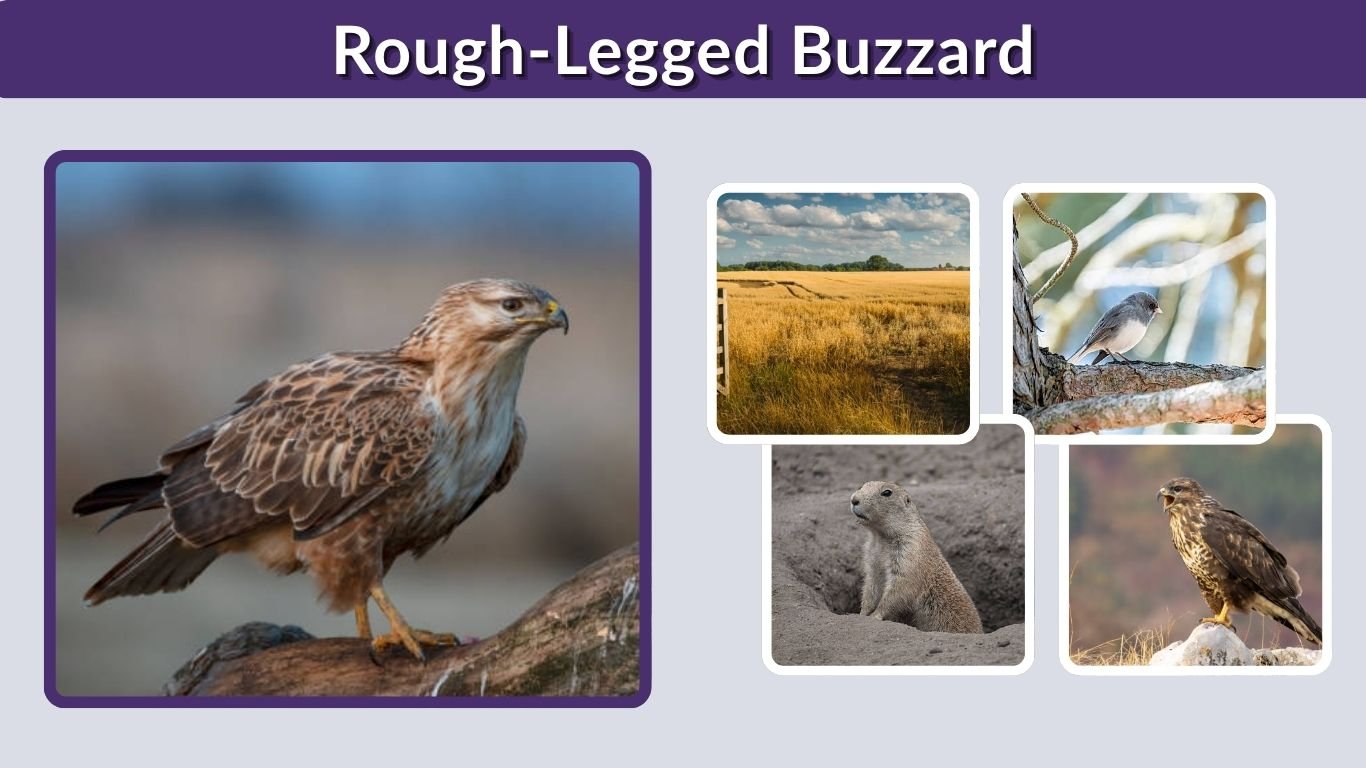
The Rough-legged Buzzard (Buteo lagopus) is a large migratory bird of prey adapted to cold, open landscapes. It breeds across Arctic regions and travels south to grasslands, farmland, marshes, and coastal areas during winter. Its most recognizable features include a pale tail with a dark tip, dark patches at the “wrists” of the wings, frequent hovering, and legs feathered down to the toes. In North America, the same species is called the Rough-legged Hawk.
Rough-Legged Buzzard Facts
This species belongs to the hawk and eagle family, Accipitridae. It is slightly larger and longer-winged than the Common Buzzard, although individual sizes overlap.
| Feature | Rough-Legged Buzzard details |
| Scientific name | Buteo lagopus |
| North American name | Rough-legged Hawk |
| Length | Approximately 47–60 cm |
| Wingspan | Approximately 120–150 cm |
| Weight | Approximately 600–1,400 g |
| Diet | Lemmings, voles, mice, shrews, birds, and carrion |
| Breeding habitat | Arctic tundra and northern open country |
| Winter habitat | Farmland, marshes, grasslands, dunes, and moorland |
| Typical clutch | 1–7 eggs |
| Conservation status | Least Concern |
Females are generally larger than males. The bird’s long wings and tail create a lighter, less compact shape than that of many other Buteo species.
Rough-Legged Buzzard Identification
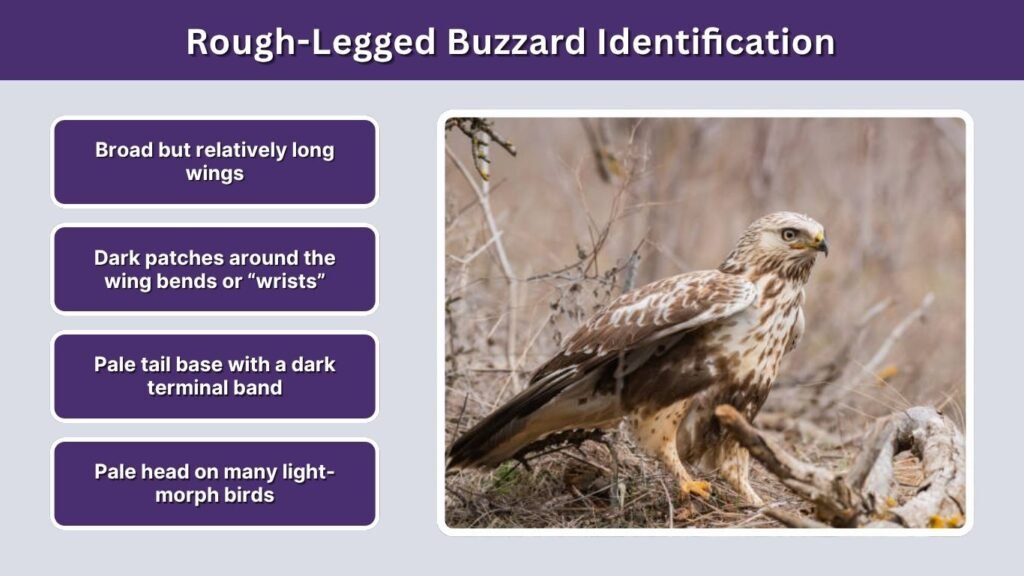
Plumage varies greatly according to age, sex, location, and color morph. For that reason, observers should combine several field marks instead of relying only on whether the bird appears pale or dark.
Key Identification Features
Look for the following characteristics:
- Broad but relatively long wings
- Dark patches around the wing bends or “wrists”
- Pale tail base with a dark terminal band
- Pale head on many light-morph birds
- Dark belly patch, especially noticeable on light females and juveniles
- Small-looking bill compared with the head
- Feathering extending down the legs to the toes
- Frequent hovering while searching for prey
- Wings held in a shallow V when soaring
The feathered legs provide insulation in Arctic conditions and give the bird its common name. However, this feature is usually difficult to see unless the bird is perched nearby.
Light and Dark Morphs
Light-morph birds have pale underwings with strongly contrasting dark carpal patches. The tail appears mostly white with one or more dark bands near the tip.
Dark-morph Rough-legged Buzzards are mainly dark brown underneath. They can still show a pale tail base, dark tail tip, and lighter flight-feather edges. Dark morphs may be confused with other dark buzzards, making shape and flight behavior particularly important.
Juvenile Rough-Legged Buzzard
Juveniles usually have a pale head, a strongly defined dark belly patch, and a broad dark band near the end of the tail. Their eyes are generally lighter than those of adults.
Young birds often show less precise barring than adults. The pale tail base, dark wrist patches, long wings, and hovering behavior remain useful identification clues.
Rough-Legged Buzzard Size and Wingspan
A Rough-legged Buzzard typically measures about 47–60 cm long and has a wingspan of approximately 120–150 cm. Recorded weights range from roughly 600 grams to 1.4 kilograms.
The bird is similar in general size to a Common Buzzard but often appears longer-winged and longer-tailed. Its wingtips may sweep slightly backward from the wrist, sometimes creating a shallow M-shaped outline in flight.
Where Do Rough-Legged Buzzards Live?
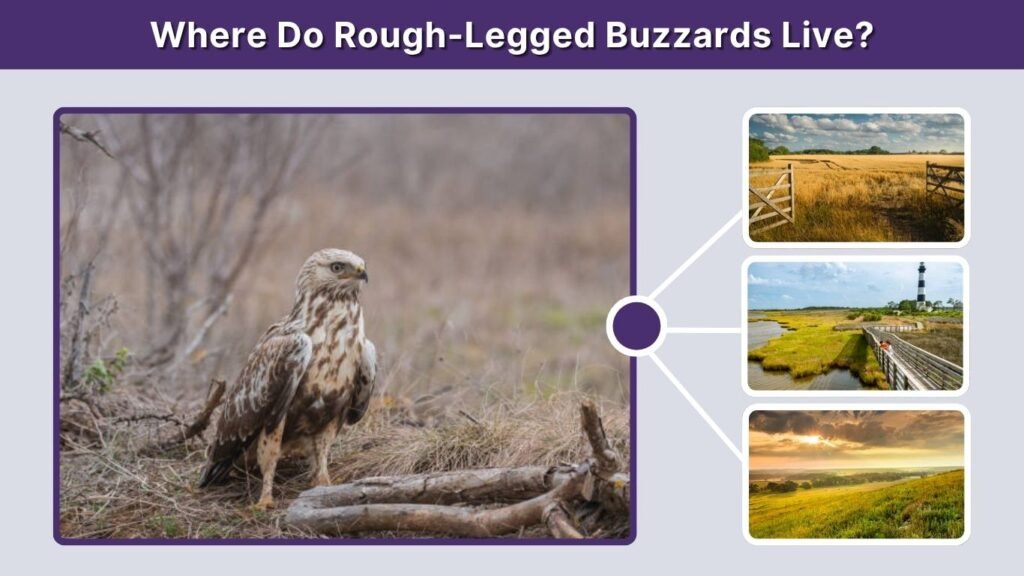
Rough-legged Buzzards have a broad northern distribution across North America, Europe, and Asia. Their location changes seasonally because most populations migrate.
Breeding Habitat
The species breeds in Arctic tundra, northern boreal regions, coastal cliffs, uplands, and alpine areas. Nesting territories typically contain open ground where the birds can locate rodents.
They often place nests on exposed cliffs or rocky outcrops. Some pairs use trees or human-made structures when suitable cliffs are unavailable.
Winter Habitat
During winter, Rough-legged Buzzards move into more temperate regions and occupy:
- Open farmland
- Coastal marshes
- Grasslands and prairies
- Moorland
- Shrub-steppe
- Bog edges
- Sand dunes
- Airports and other large open spaces
They avoid heavily forested landscapes because they hunt most effectively over open ground. Birds frequently perch on utility poles, fence posts, hay bales, and the narrow tops of trees.
Rough-Legged Buzzard in the UK
The Rough-legged Buzzard is a scarce winter visitor to Britain rather than a regular breeding species. Most arrive from Scandinavia during late autumn, and sightings are concentrated along the eastern coasts of England and Scotland.
Numbers vary significantly between years. Larger arrivals may occur after productive Arctic breeding seasons or when changes in rodent populations push birds farther south.
What Do Rough-Legged Buzzards Eat?
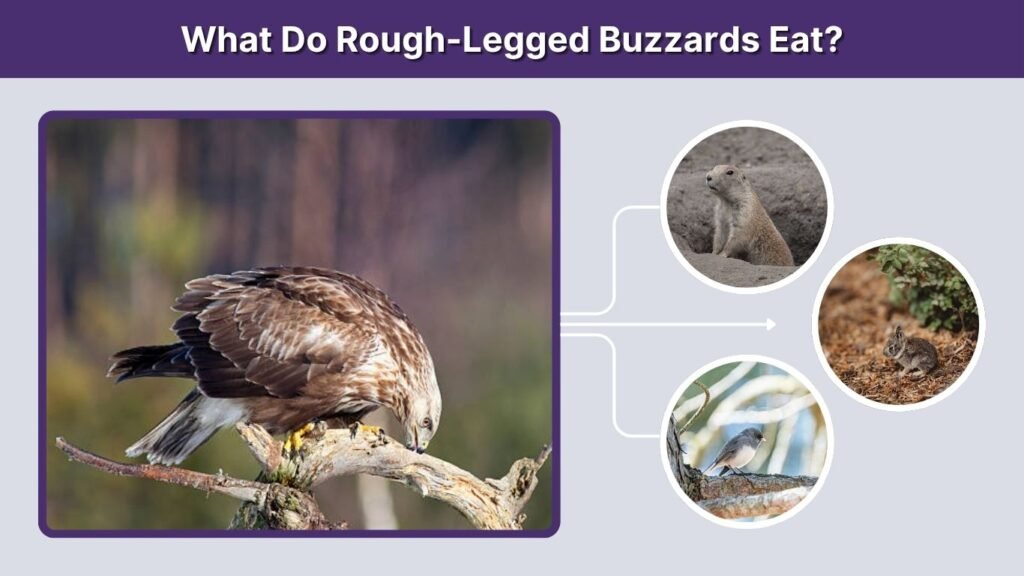
Small mammals form most of the diet. On Arctic breeding grounds, lemmings and voles are especially important. In winter, the birds mainly hunt voles, mice, and shrews.
Other foods can include:
- Ground squirrels
- Young hares
- Small birds
- Ptarmigan
- Reptiles
- Carrion
- Prey stolen from other raptors or ravens
Their breeding success can rise and fall with rodent abundance. When lemmings and voles are plentiful, pairs may lay larger clutches and raise more chicks.
Hunting and Flight Behavior
The Rough-legged Buzzard is well known for hovering. It faces into the wind, holds itself in one position with rapid wing adjustments, and scans the ground before dropping onto prey.
It also hunts from elevated perches and flies low over fields using a combination of steady wingbeats and gliding. When soaring, it often raises its wings slightly above the horizontal.
This regular hovering helps distinguish it from the Common Buzzard, although Common Buzzards may also hover occasionally. The Rough-legged species generally hovers more frequently and for longer periods.
Rough-Legged Buzzard Call
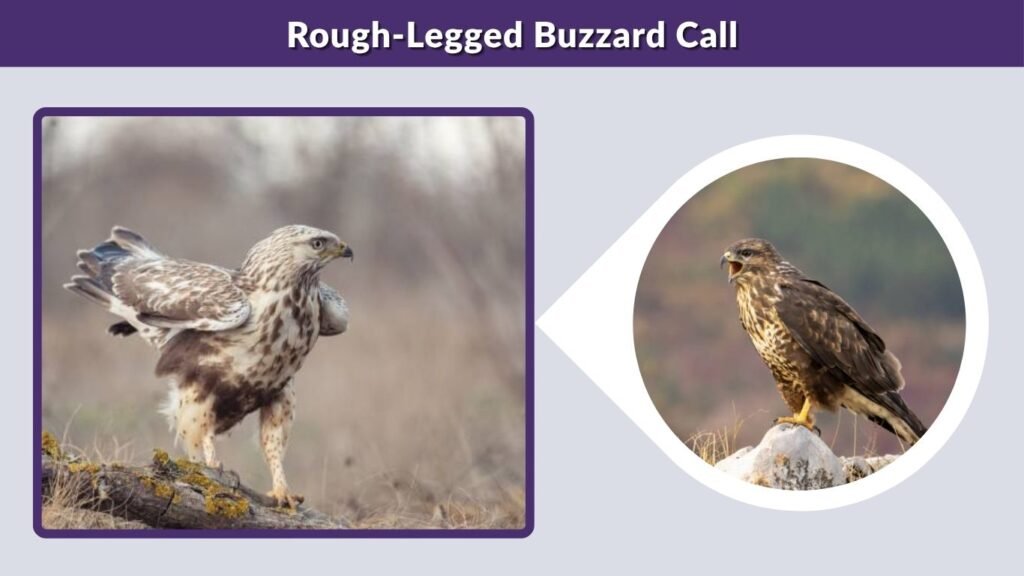
Away from its breeding territory, the Rough-legged Buzzard is often quiet. Alarmed nesting adults produce a loud, cat-like mewing call that lasts about a second and may be repeated at intervals.
Courtship and territorial calls can include high whistles, shrieks, and mewing notes. Birds may call either while perched or during aerial displays.
Nest, Eggs, and Breeding
Pairs usually build large stick nests on cliffs overlooking open hunting grounds. The nest may be lined with grasses, sedges, feathers, animal fur, and occasionally bones.
The female commonly lays between one and seven pale eggs marked with brown. Incubation lasts approximately 31–37 days, and the young remain in the nest for around 31–45 days.
Rodent availability strongly influences reproduction. During poor prey years, pairs may lay fewer eggs or fail to breed, while abundant food can support larger broods.
Rough-Legged Buzzard Lifespan
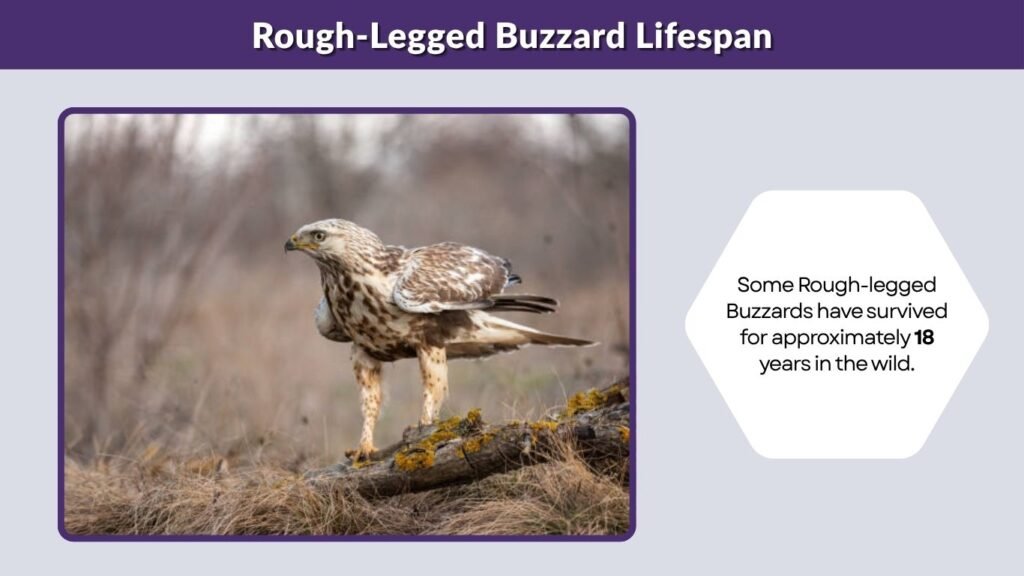
Some Rough-legged Buzzards have survived for approximately 18 years in the wild. However, mortality is high among young birds during their first year.
Adults face threats from vehicle collisions, power lines, severe weather, food shortages, and illegal persecution. Birds that survive their early years have a much better chance of living for an extended period.
Rough-Legged Buzzard vs Common Buzzard
These two birds can be difficult to separate because Common Buzzards have extremely variable plumage, including very pale individuals.
| Feature | Rough-Legged Buzzard | Common Buzzard |
| Wings | Longer and slightly narrower | Broader and more compact |
| Tail | Pale base with dark tip | Usually more evenly barred |
| Underwing | Strong dark wrist patches | Pattern highly variable |
| Legs | Feathered to the toes | Lower legs unfeathered |
| Hovering | Frequent | Less frequent |
| UK status | Scarce winter visitor | Common year-round resident |
| Habitat | Very open country | Open land near woodland |
A pale Common Buzzard may show light underparts, but it normally lacks the Rough-legged Buzzard’s combination of a white tail base, dark terminal tail band, long wings, strong wrist patches, and frequent hovering.
FAQs
Why is it called a Rough-legged Buzzard?
The name refers to its legs, which are covered with feathers down to the toes. This feathering helps protect the bird in the cold Arctic and sub-Arctic regions where it breeds.
Is a Rough-legged Buzzard the same as a Rough-legged Hawk?
Yes. Buteo lagopus is called the Rough-legged Buzzard in Europe and Asia and the Rough-legged Hawk in North America. Both names refer to the same species.
How can you identify a Rough-legged Buzzard in flight?
Look for long wings, dark wrist patches, a pale tail with a dark tip, a light head, and a darker belly. It frequently hovers into the wind before dropping onto prey.
Are Rough-Legged Buzzards rare in the UK?
They are scarce but regular winter visitors. Most records come from eastern England and Scotland, although birds may appear elsewhere during years when larger numbers migrate from Scandinavia.
Do Rough-Legged Buzzards attack people?
They normally avoid people and are not considered dangerous. Adults may defend a nest if someone approaches too closely, but attacks are unusual. Observers should watch nesting birds from a respectful distance.
