
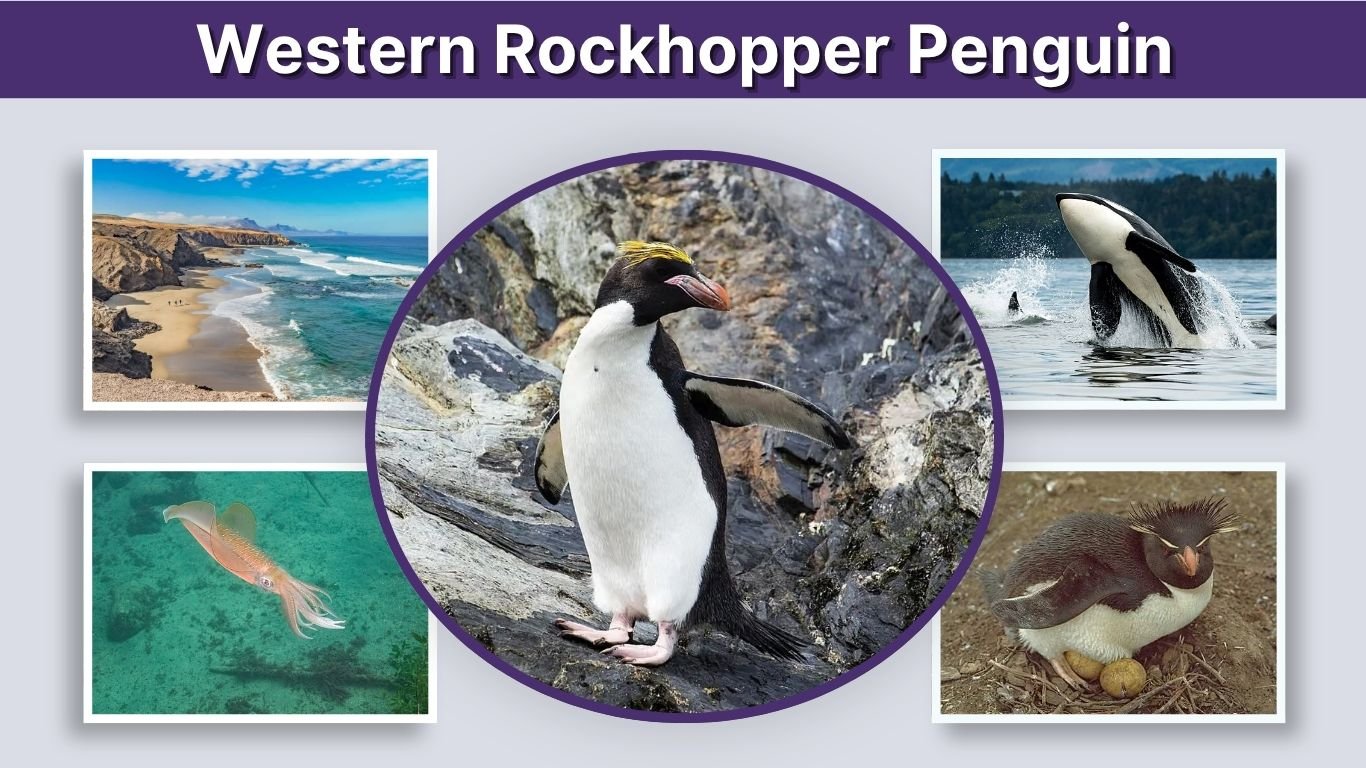
The western rockhopper penguin is a small crested penguin famous for its bright yellow eyebrow feathers, red eyes, orange-red bill, and energetic habit of hopping across rocks. The name generally refers to Eudyptes chrysocome, the South American and Falkland Islands rockhopper. These tough seabirds inhabit windswept islands and spend much of the year at sea. Their rocky habitat, varied marine diet, unusual breeding behavior, and declining population make western rockhopper penguins especially interesting to bird enthusiasts and conservationists.
What Is a Western Rockhopper Penguin?
Western rockhopper penguin is a common name associated with Eudyptes chrysocome. Historically, the western form was called Eudyptes chrysocome chrysocome, while an eastern form was classified as another subspecies. Recent BirdLife taxonomy recognizes E. chrysocome as the Southern Rockhopper Penguin and E. filholi separately as the Eastern Rockhopper Penguin.
Western Rockhopper Penguin Identification
Important identification features include:
- Scientific name: Eudyptes chrysocome
- Family: Spheniscidae
- Length: About 45–58 cm
- Weight: Roughly 2.8–3.0 kg on average
- Upperparts: Black to dark slate-gray
- Underparts: White
- Eyes: Bright red
- Bill: Orange-red
- Feet: Pink
- Crest: Thin yellow eyebrows ending in longer feathers behind the eyes
Their yellow crest is shorter and less elaborate than that of the northern rockhopper penguin.
Why Are They Called Rockhoppers?
Unlike many penguins that waddle across relatively flat terrain, rockhoppers frequently jump with both feet together when moving through steep, rocky colonies.
Their powerful legs and strong feet allow them to climb rough shorelines, negotiate boulders, and reach nesting sites above the sea. This distinctive behavior explains the name rockhopper penguin.
Where Do Western Rockhopper Penguins Live?
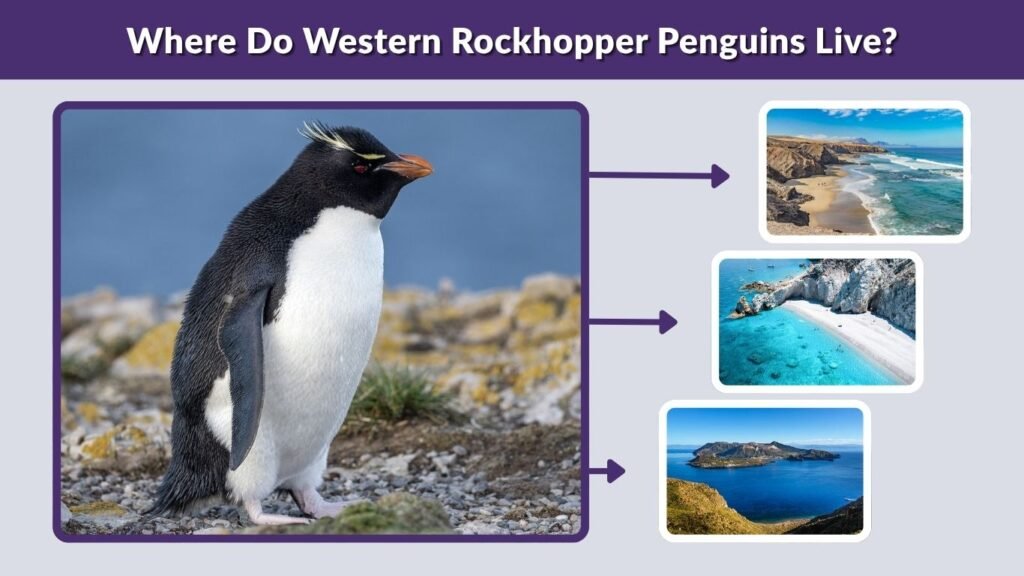
Western rockhoppers are associated primarily with the South Atlantic and southern South American region. Important breeding populations occur in the Falkland Islands and on islands around southern Argentina and Chile. Outside the breeding season, they become highly marine and may disperse hundreds or thousands of kilometers while searching for productive feeding areas.
Western Rockhopper Penguin Habitat
Typical habitat includes:
- Rocky oceanic islands
- Steep coastal cliffs
- Rocky shorelines
- Tussock-covered slopes
- Coastal grasslands
- Offshore pelagic waters
- Cold, nutrient-rich marine environments
Breeding colonies may occur from sea level to cliff tops. Rocky terrain provides nesting locations while surrounding seas supply the fish, crustaceans, and cephalopods needed for survival.
Where Do Western Rockhopper Penguins Live?
Major western populations occur in the Falkland Islands, southern Argentina, and Chile, including islands around Tierra del Fuego and Cape Horn.
Older estimates identified approximately 850,000 breeding pairs of the western E. c. chrysocome form across South America and the Falklands. Population estimates change as new surveys are completed, so figures should be treated as estimates rather than fixed totals.
What Happens After Breeding?
After breeding and molting, rockhopper penguins leave their nesting colonies and spend much of the nonbreeding season at sea.
Tracking research shows that Southern Rockhopper Penguins can travel considerable distances from their colonies during this period. They remain dependent on productive ocean habitats until returning to land for another breeding season.
What Do Western Rockhopper Penguins Eat?
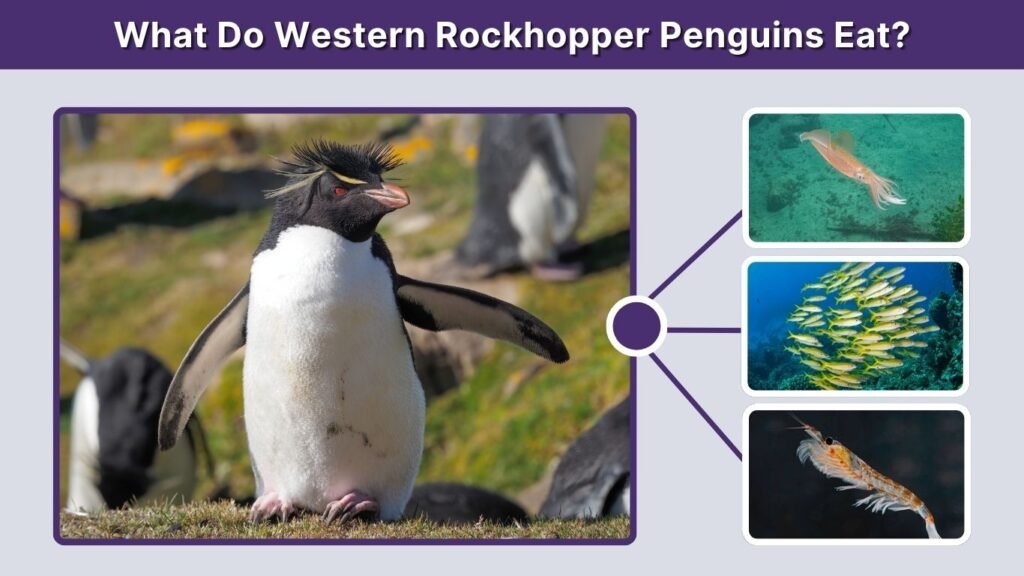
Western rockhopper penguins are carnivorous marine predators. Their diet varies according to location, season, prey availability, and ocean conditions. They are capable underwater hunters that use their flippers for propulsion and their streamlined bodies to pursue prey. Changes in prey availability may influence breeding success and long-term population trends.
Western Rockhopper Penguin Diet
Common foods include:
- Krill
- Other small crustaceans
- Small fish
- Squid
- Other cephalopods
The proportion of each food type differs between colonies and seasons. Rockhoppers may change their feeding strategies when environmental conditions or prey availability change.
How Do Western Rockhoppers Find Food?
Rockhoppers are excellent swimmers. Their wings have evolved into stiff, powerful flippers that push them rapidly through the water.
During breeding, adults make feeding trips from their colonies and return with food for their chicks. Their foraging strategy can change dramatically between years. Research in the Falkland Islands found males switching between shorter nearshore trips and longer offshore journeys depending on conditions.
Western Rockhopper Penguin Size and Wingspan
Western rockhoppers are among the smaller crested penguins. Their compact bodies are particularly useful for navigating rugged shores and swimming efficiently. Males tend to be slightly larger than females, but both sexes have similar coloration. Their modest size does not prevent them from crossing rough terrain or traveling substantial distances through the ocean.
How Tall Is a Western Rockhopper Penguin?
Southern rockhoppers are generally about 45–58 cm (18–23 inches) long. Penguins International gives a typical weight of approximately 2.8–3.0 kg, although body mass changes throughout the breeding and molting cycle.
Western Rockhopper Penguin Wingspan
Because penguins are flightless, scientific descriptions commonly emphasize flipper length rather than wingspan. Some bird references report an approximate spread of 66–77 cm for Southern Rockhopper Penguins.
Their flippers function much like underwater wings, creating propulsion rather than aerial lift.
Western Rockhopper Penguin Breeding and Life Cycle
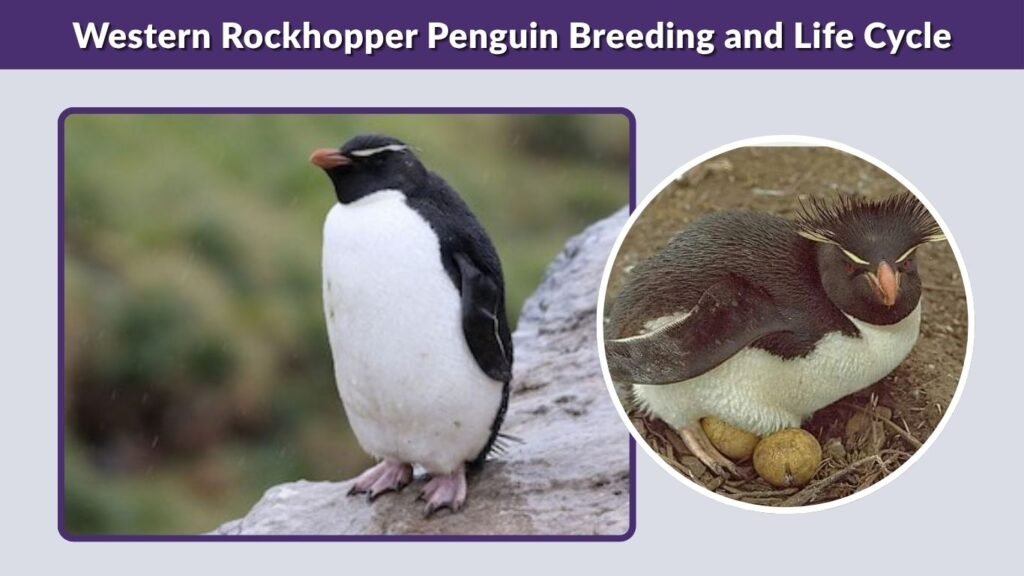
Western rockhoppers return to large colonies during the austral spring. Their nesting sites may contain enormous numbers of noisy, territorial birds. Pairs often return to established nesting areas, where they construct simple nests and share incubation responsibilities. The timing of egg laying, chick development, fledging, and molting follows a fairly synchronized annual cycle.
Eggs and Incubation
Females generally lay two eggs, but the first egg is usually noticeably smaller than the second. Incubation lasts roughly 32–34 days.
At many breeding colonies only one chick survives to fledging, although Southern Rockhopper Penguins in some Falkland colonies have successfully raised two chicks.
Western Rockhopper Penguin Chicks
After hatching, young chicks initially depend heavily on their parents for warmth, protection, and food.
As they grow, chicks gather in groups called crèches. This arrangement allows both adults to forage at sea. Chicks eventually develop juvenile waterproof plumage and leave the colony for their first period of independent life at sea.
Molting
Adults undergo an annual molt in which their old feathers are replaced with new waterproof plumage.
Before molting, they feed intensively and gain weight because they cannot forage normally while their waterproof feathers are being replaced. Once the new plumage is complete, they return to sea.
Western Rockhopper Penguin Behavior and Adaptations
Living on exposed islands requires specialized adaptations. Western rockhoppers must survive cold water, storms, rough coastlines, crowded colonies, and long periods at sea. Their swimming ability is especially important, but strong legs, waterproof feathers, insulation, and social communication also contribute to their survival in demanding Southern Ocean environments.
Important Adaptations
Western rockhopper adaptations include:
- Powerful flippers for swimming
- Streamlined bodies that reduce underwater resistance
- Dense waterproof feathers
- Insulating body fat
- Strong legs for jumping between rocks
- Feet and claws suited to rough terrain
- Black-and-white countershading
- Loud calls for communication in crowded colonies
These adaptations allow them to function efficiently both on rugged islands and in open water.
Social Behavior
Western rockhoppers are highly social during breeding. Colonies can become extremely noisy as birds communicate with mates, chicks, and neighbors.
They use calls, head movements, and body displays for recognition, courtship, and territorial defense. They can also be aggressive when protecting the small area surrounding their nests.
Western Rockhopper Penguin Predators
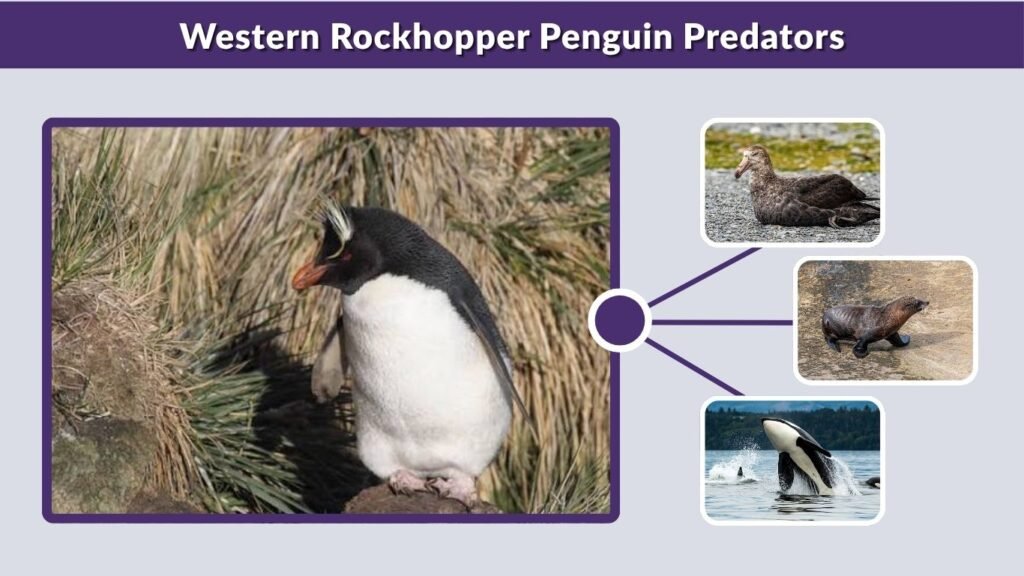
Western rockhoppers face different threats on land and at sea. Adults are agile swimmers, but marine predators can still catch them. Eggs and chicks are more vulnerable to predatory seabirds around breeding colonies. Predation is a natural part of their ecosystem and is different from human-driven threats affecting overall populations.
Common Predators
Potential predators include:
- Leopard seals
- Fur seals
- Sea lions
- Killer whales
- Skuas
- Giant petrels
- Gulls
Skuas, gulls, and giant petrels mainly target eggs or chicks, while seals and other marine predators can attack penguins at sea.
Western Rockhopper Penguin Conservation Status
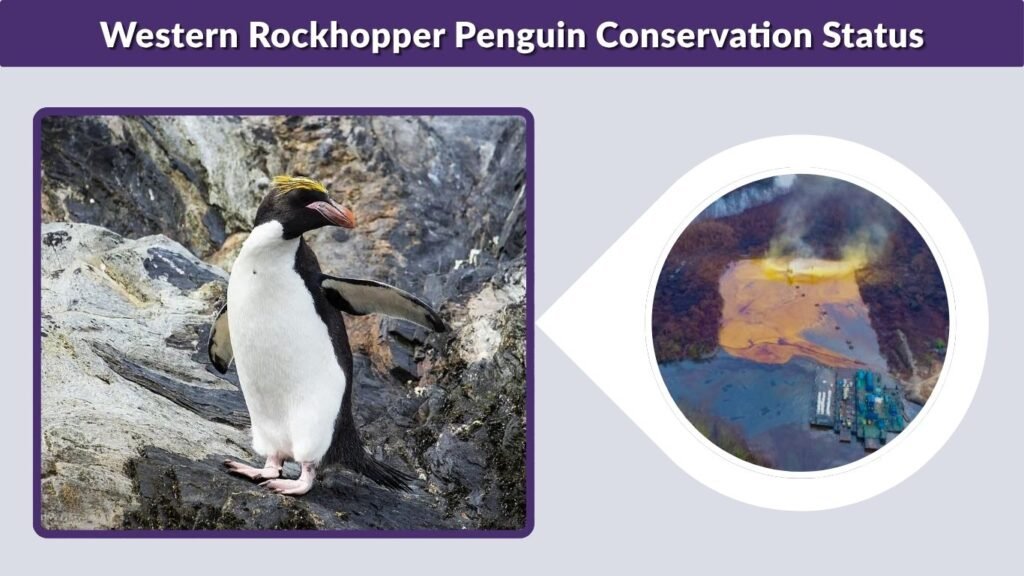
The western rockhopper’s conservation status is best understood through Eudyptes chrysocome. BirdLife’s 2026 assessment lists the Southern Rockhopper Penguin as Vulnerable and its population trend as decreasing. Long-term declines have occurred in several important colonies, although individual populations can fluctuate or remain relatively stable for certain periods.
Why Are Western Rockhopper Penguins Threatened?
Major concerns include:
- Climate-driven changes in ocean conditions
- Changes in prey availability
- Extreme weather
- Harmful algal blooms
- Oil pollution
- Fisheries-related ecosystem changes
- Disease outbreaks
- Introduced animals at some breeding locations
Because their survival is closely connected to marine food availability, changes in ocean temperature and productivity can have significant effects.
Is the Population Declining?
Across the broader Southern Rockhopper population, BirdLife reports about 2.5 million mature individuals and a decreasing global trend. Historical declines have been severe in several regions.
In the Falkland Islands, recent monitoring shows considerable annual variation, with some monitoring sites recording declines while longer-term patterns can be more complex.
FAQs
Western rockhopper penguins are sometimes confusing because their common and scientific classification has changed over time. Questions commonly concern their habitat, conservation status, diet, appearance, and relationship with other rockhopper penguins. These quick answers cover the most important points.
1. Where do western rockhopper penguins live?
They breed primarily around the Falkland Islands and islands off southern Argentina and Chile, including parts of the Cape Horn region.
2. What do western rockhopper penguins eat?
They eat a mixture of fish, krill and other crustaceans, and cephalopods such as squid. Diet composition varies by location and season.
3. Are western rockhopper penguins endangered?
Eudyptes chrysocome is currently classified as Vulnerable, rather than Endangered, under BirdLife’s 2026 assessment. Its overall population trend is decreasing.
4. How big is a western rockhopper penguin?
Adults are generally around 45–58 cm long and typically weigh approximately 2.8–3.0 kg, although weight changes seasonally.
5. What is the difference between northern and western rockhoppers?
Northern rockhoppers (Eudyptes moseleyi) generally have longer, fuller yellow crest feathers. Western/Southern rockhoppers (Eudyptes chrysocome) have shorter crests and breed mainly around southern South America and the Falkland Islands.
