
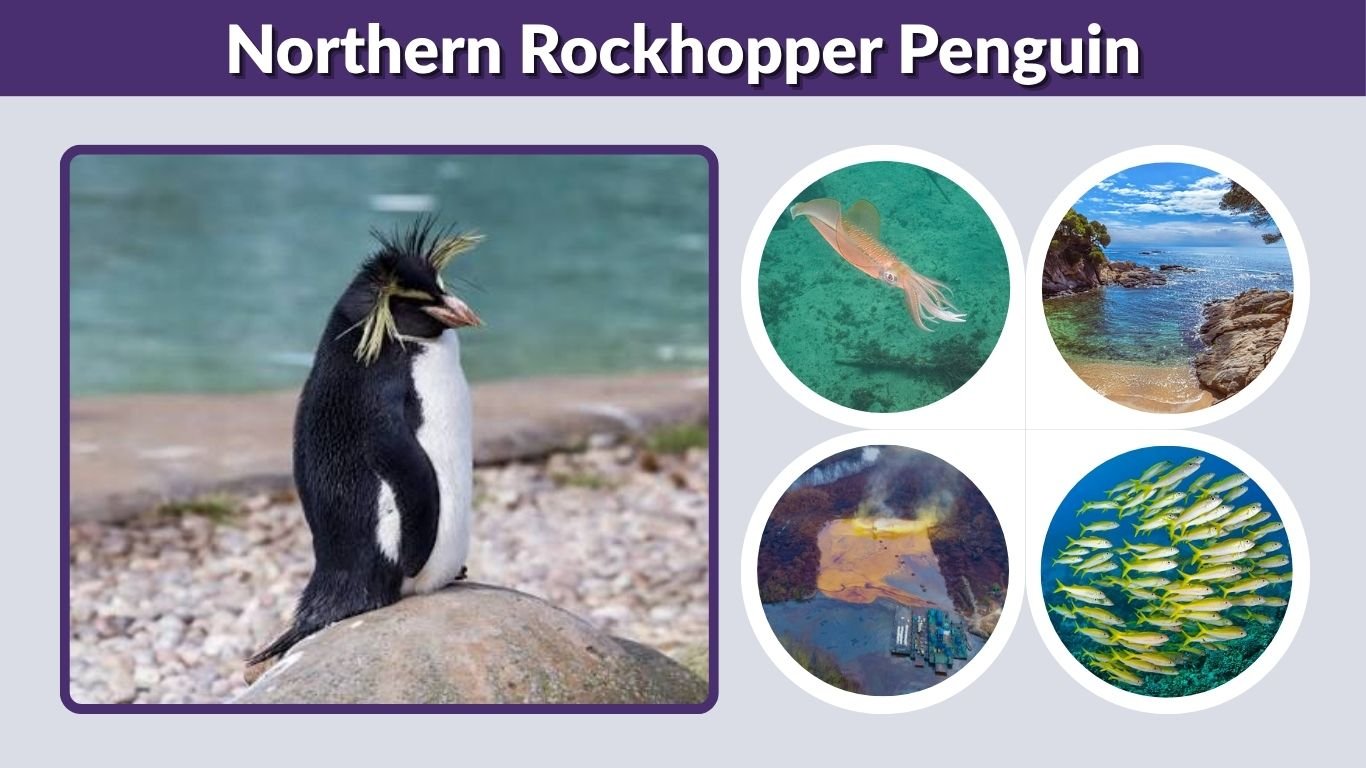
The northern rockhopper penguin (Eudyptes moseleyi) is a small, striking crested penguin recognized by its long yellow eyebrow feathers, red eyes, orange bill, and energetic hopping movements. It breeds on remote islands in the South Atlantic and Indian Oceans, including the Tristan da Cunha group and Gough Island. Despite its tough appearance and ability to navigate steep rocky coastlines, the species is classified as Endangered and has undergone major historical population declines.
What Is a Northern Rockhopper Penguin?
The northern rockhopper penguin belongs to the crested penguin genus Eudyptes. It is one of the smallest members of this group and was historically grouped with other rockhopper penguins. Its exceptionally long yellow crest feathers help distinguish it from the southern rockhopper. Northern rockhoppers are flightless but highly adapted for swimming and climbing rugged island terrain.
Northern Rockhopper Penguin Identification
The northern rockhopper has several noticeable characteristics:
- Scientific name: Eudyptes moseleyi
- Height: Approximately 52–55 cm
- Weight: Around 3 kg on average
- Body: Black upperparts with white underparts
- Eyes: Bright red
- Bill: Orange to reddish orange
- Feet: Pink
- Crest: Long yellow plumes extending above and behind each eye
- Movement: Frequently hops between rocks instead of waddling
Its long crest is particularly useful for separating it visually from related rockhopper penguins.
Why Are They Called Rockhoppers?
The name comes directly from the way these penguins travel across their rugged breeding islands. Instead of relying entirely on the classic penguin waddle, rockhoppers jump from rock to rock using both feet together.
This unusual locomotion allows them to climb steep rocky slopes, cross boulder fields, and reach nesting colonies that can be difficult for people to access. Their strong legs and feet make them surprisingly agile on land.
Where Do Northern Rockhopper Penguins Live?
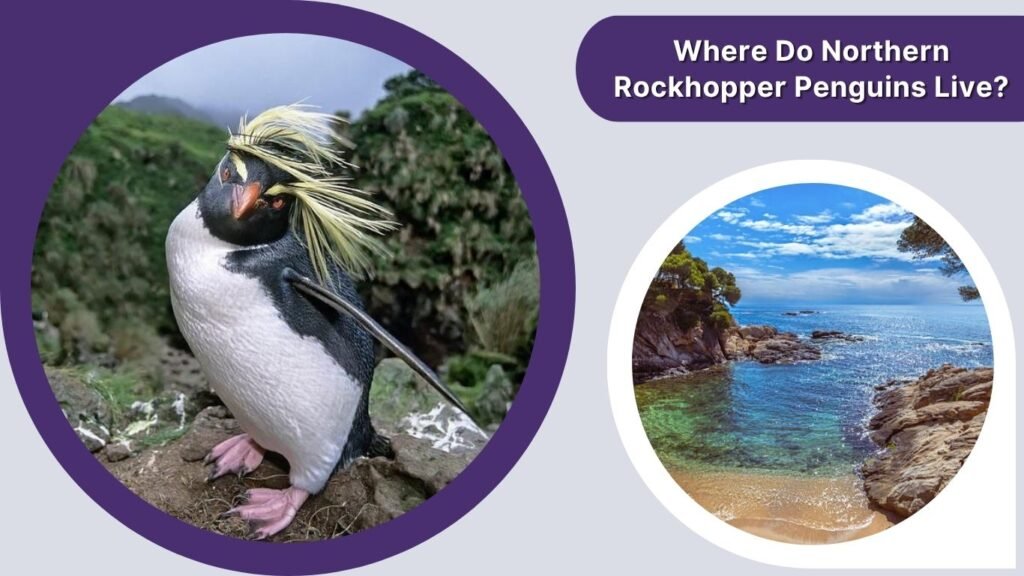
Northern rockhopper penguins have a highly restricted breeding distribution on remote oceanic islands. Their largest populations occur around Tristan da Cunha and nearby islands in the South Atlantic, while another population occurs around Amsterdam and Saint Paul islands in the Indian Ocean. Their isolation provides breeding habitat but also makes the species vulnerable to localized environmental disturbances.
Northern Rockhopper Penguin Habitat
Important habitats include:
- Rocky coastlines
- Volcanic islands
- Coastal cliffs and gullies
- Tussock-grass-covered breeding areas
- Offshore marine feeding grounds
- Rocky beaches and exposed shorelines
On Nightingale, Inaccessible, and nearby islands, nesting colonies can occur among protective tussock vegetation. On Tristan da Cunha and Gough Island, colonies also occupy rocky shores, gullies, and areas beneath cliffs.
Where Do Northern Rockhopper Penguins Live?
Major breeding locations include islands in the Tristan da Cunha archipelago, Gough Island, Amsterdam Island, and Saint Paul Island.
Historically, around 85% of the global population was reported from the Tristan da Cunha and Gough Island region, with the remaining population concentrated primarily on Amsterdam and Saint Paul islands. Population surveys continue because determining current numbers across these remote locations can be difficult.
Life Away From the Colony
Northern rockhopper penguins do not remain at their breeding colonies throughout the year. After breeding and molting, they spend extended periods at sea searching for food.
During this marine phase, they rely entirely on ocean ecosystems. Changes in water temperatures, currents, prey abundance, and other marine conditions can therefore influence survival even when the breeding islands themselves remain protected.
What Do Northern Rockhopper Penguins Eat?
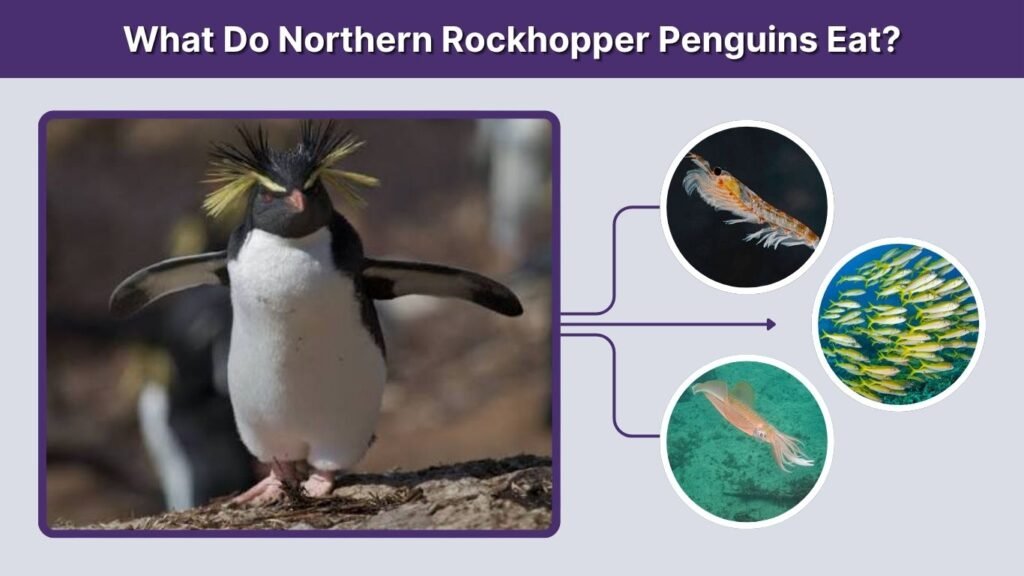
Northern rockhoppers are carnivorous marine hunters that capture their food underwater. Small crustaceans form an important part of their diet, but they are opportunistic enough to eat fish and squid when available. The exact diet varies geographically and seasonally because prey abundance changes with ocean conditions.
Northern Rockhopper Penguin Diet
Their diet commonly includes:
- Krill
- Other small crustaceans
- Small fish
- Squid and other cephalopods
- Other small marine animals
Penguins International describes crustaceans, particularly euphausiids, as important prey, with fish and smaller amounts of cephalopods also consumed.
How Do They Hunt?
Northern rockhoppers use their modified wings as powerful flippers. Their streamlined bodies allow them to “fly” through the water while chasing prey.
They can repeatedly leave breeding colonies to forage at sea before returning to feed their chicks. Females make frequent feeding trips during an important early stage of chick development while males remain ashore guarding the young.
Northern Rockhopper Penguin Breeding and Life Cycle
Breeding is highly synchronized because large numbers of penguins return to their islands within a relatively short period. Timing varies somewhat among colonies. Birds in the Tristan da Cunha archipelago generally begin breeding earlier than those on Gough Island, where the reproductive cycle starts several weeks later because of the island’s more southerly location.
Eggs and Incubation
Northern rockhopper penguins normally produce a two-egg clutch. As with several crested penguin species, the two eggs differ noticeably in size.
Males and females take turns incubating the eggs. At Tristan da Cunha, eggs are generally laid during September, whereas Gough Island breeding occurs about three to four weeks later. Incubation lasts roughly 32–34 days.
Northern Rockhopper Penguin Chicks
After hatching, the male initially remains with the young chick while the female travels to sea to obtain food. The male’s guard period lasts approximately 20–26 days in the Tristan population.
Older chicks later congregate together in groups known as crèches. This allows both parents to spend more time feeding at sea while the growing chicks remain within the colony.
Molting
Like other penguins, northern rockhoppers replace their plumage during an annual molt. Before molting, adults feed heavily and accumulate body reserves.
They must remain ashore during this period because their changing feathers temporarily prevent them from maintaining the waterproof insulation required for normal swimming. Once their new plumage develops, they return to the ocean.
Northern Rockhopper Penguin Adaptations
Survival on rough, isolated islands and in cold ocean water requires a combination of physical and behavioral adaptations. Northern rockhoppers are excellent swimmers, strong jumpers, and capable climbers. Their dense plumage protects them from cold water, while their feet and powerful legs allow them to reach nesting locations inaccessible to many other animals.
Important Adaptations
Major adaptations include:
- Strong flippers for underwater propulsion
- Streamlined bodies for efficient swimming
- Dense waterproof plumage
- Strong legs for jumping between rocks
- Sharp claws for gripping rugged surfaces
- Countershaded black-and-white coloring
- Fat reserves for fasting during molting
- Social nesting behavior in large colonies
These characteristics allow a relatively small penguin to cope with strong surf, steep slopes, rough rocks, and long periods spent at sea.
Northern Rockhopper Penguin Behavior
Northern rockhoppers can be energetic and vocal within breeding colonies. Pairs use vocalizations and visual displays to communicate in densely populated nesting areas.
Their most recognizable terrestrial behavior is hopping with both feet together. This allows them to move through rocky landscapes where traditional waddling would be slow or difficult. Their agility is one reason the species is so closely associated with rugged coastal islands.
Northern vs. Southern Rockhopper Penguin
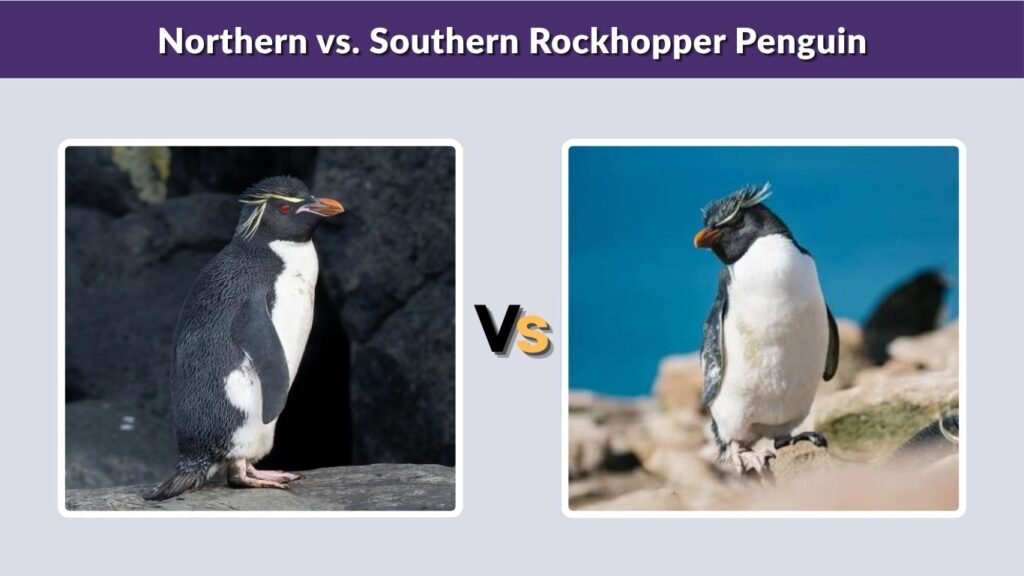
Northern and southern rockhoppers look very similar and were historically treated as closely grouped forms. Today, the northern rockhopper is generally recognized as Eudyptes moseleyi, while the southern rockhopper is Eudyptes chrysocome. Both have red eyes, orange bills, black-and-white plumage, and prominent yellow eyebrow feathers.
How Can You Tell Them Apart?
The easiest visual clue is the crest. Northern rockhopper penguins usually have considerably longer and fuller yellow crest feathers than southern rockhoppers.
Their geographic ranges also differ. Northern rockhoppers breed farther north on islands such as Tristan da Cunha, Gough, Amsterdam, and Saint Paul, while southern rockhoppers occupy sub-Antarctic islands farther south across the Atlantic, Indian, and Pacific regions.
Are Northern Rockhopper Penguins Endangered?
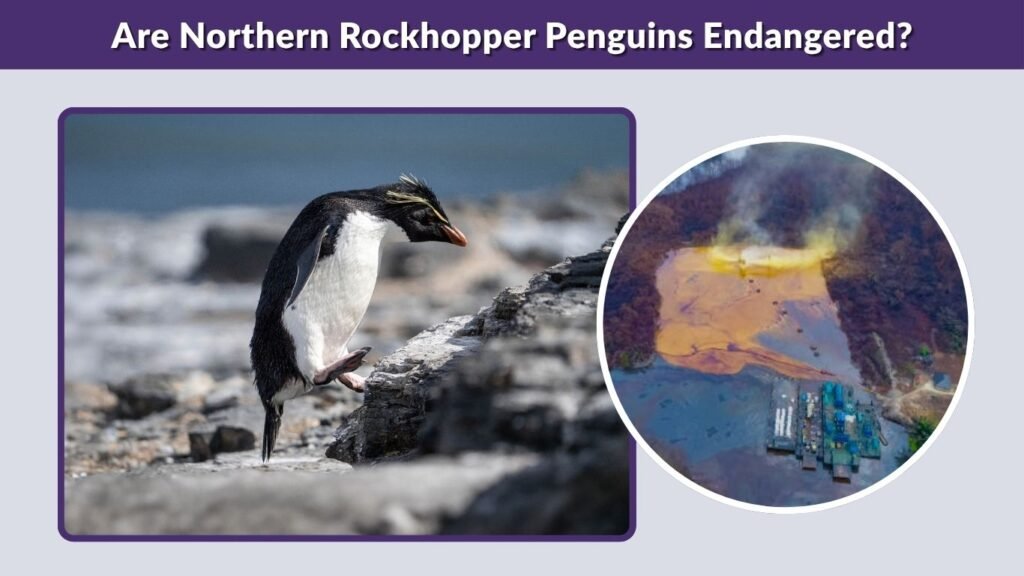
Yes. The northern rockhopper penguin is currently classified as Endangered on the IUCN Red List framework used by BirdLife International. Historical declines have been severe, and recent conservation work continues to improve population estimates, particularly across the South Atlantic breeding colonies.
Why Are Northern Rockhopper Penguins Endangered?
Important threats and concerns include:
- Changes in marine food availability
- Climate-driven ocean changes
- Pollution and oil spills
- Disease
- Introduced species on breeding islands
- Disturbance around breeding colonies
- Extreme weather and flooding
- Small and geographically restricted breeding range
The 2011 MS Oliva shipwreck, for example, caused serious oil pollution around Nightingale Island and affected northern rockhopper habitat.
Northern Rockhopper Penguin Population
Penguins International gives an estimated population of approximately 190,000–230,000 breeding pairs. However, conservation organizations continue conducting new colony surveys because accurate counts on isolated and difficult terrain are challenging.
The RSPB reported in 2026 that historical numbers had fallen by roughly 90% since the 19th century and that improved surveys are important for establishing the species’ current trend more precisely.
Interesting Northern Rockhopper Penguin Facts
Northern rockhoppers combine unusual appearance with remarkable physical abilities. Their dramatic crests may attract most of the attention, but their breeding behavior, island distribution, and ability to scale steep coastlines are equally distinctive.
Northern Rockhopper Penguin Fun Facts
- Their scientific name is Eudyptes moseleyi.
- They are among the smallest crested penguins.
- Adults are approximately 52–55 cm tall.
- They weigh around 3 kg on average.
- Their eyes are bright red.
- Both males and females have yellow crests.
- They hop over rocks using both feet simultaneously.
- They typically lay two eggs.
- They are classified as Endangered.
- Northern rockhoppers primarily feed on crustaceans, fish, and squid.
FAQs
Northern rockhoppers attract attention because of their unusual yellow crests and energetic behavior. Questions commonly focus on where they live, how large they become, what they eat, their lifespan, and why their population has declined. The following answers cover some of the most searched facts about this endangered penguin.
1. Where do northern rockhopper penguins live?
They breed mainly on remote South Atlantic and Indian Ocean islands, particularly the Tristan da Cunha archipelago, Gough Island, Amsterdam Island, and Saint Paul Island.
2. How tall is a northern rockhopper penguin?
An adult northern rockhopper is approximately 52–55 cm (20–22 inches) tall, making it one of the smaller crested penguins.
3. What do northern rockhopper penguins eat?
Their diet consists primarily of krill and other crustaceans, together with small fish and some squid or other cephalopods.
4. How long do northern rockhopper penguins live?
Penguins International gives an estimated northern rockhopper penguin lifespan of around 9–12 years, although survival varies among individuals and populations.
5. Why are northern rockhopper penguins endangered?
Their population has suffered major historical declines. Likely pressures include changes in marine ecosystems and food availability, pollution, extreme weather, disease, introduced species, and the vulnerability created by having relatively few isolated breeding locations.
