
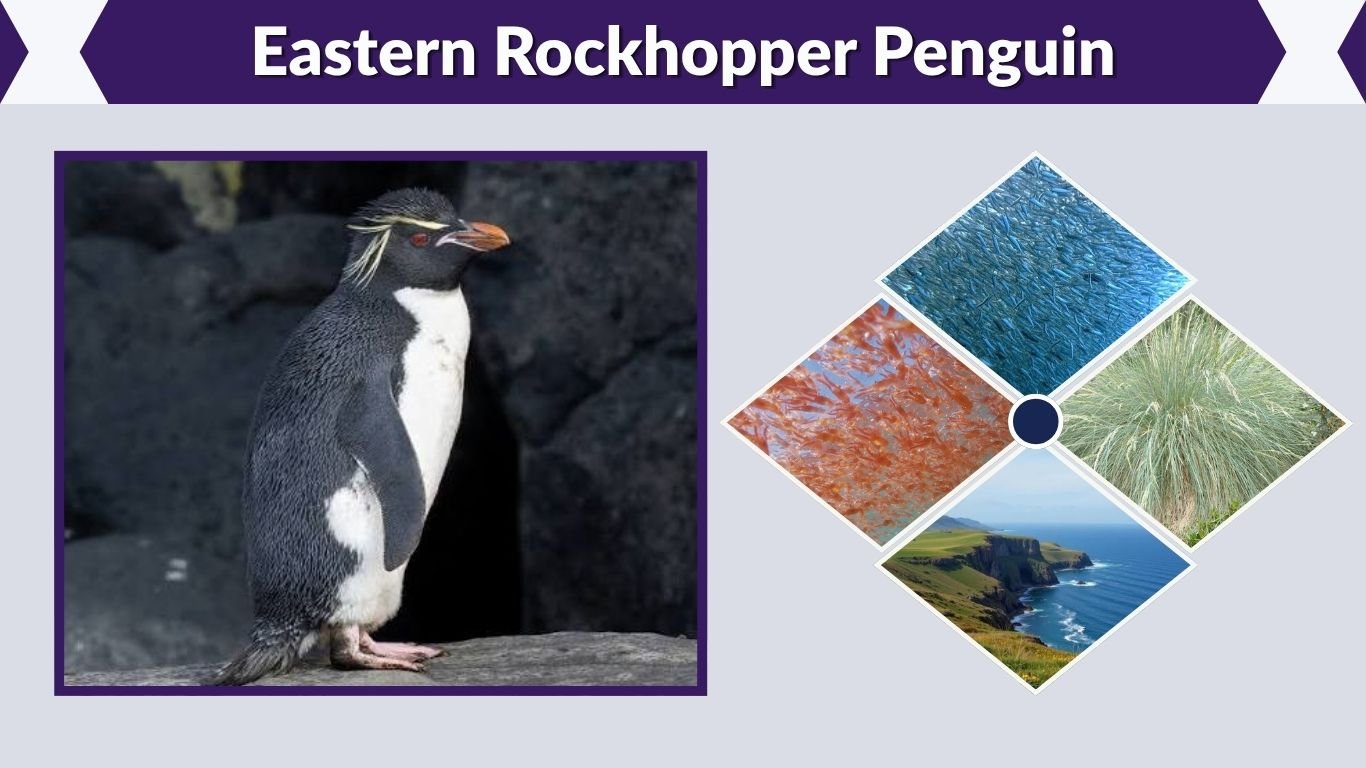
The Eastern Rockhopper Penguin is a fascinating seabird recognized by its bright yellow crest, reddish eyes, and remarkable ability to navigate rocky coastlines. Native to remote subantarctic islands, this penguin spends much of its life swimming through cold Southern Ocean waters and hunting marine prey. Often classified as Eudyptes chrysocome filholi, it is also recognized by some authorities as a separate species, Eudyptes filholi. Its unusual appearance and energetic movements make it one of the most distinctive crested penguins. This guide explores its identification, habitat, diet, breeding, behavior, adaptations, and conservation challenges.
What Is an Eastern Rockhopper Penguin?
The Eastern Rockhopper Penguin is a small, crested penguin belonging to the family Spheniscidae. It is one of the eastern forms of rockhopper penguins living on subantarctic islands. Scientists differ on whether it should be classified as a separate species or a subspecies of the Southern Rockhopper Penguin. Its distinctive yellow crest and rocky coastal habitat make it easily recognizable.
Eastern Rockhopper Penguin Scientific Classification
- Common name: Eastern Rockhopper Penguin
- Scientific name: Eudyptes filholi under the three-species classification
- Alternative classification: Eudyptes chrysocome filholi
- Family: Spheniscidae
- Order: Sphenisciformes
- Genus: Eudyptes
- Native region: Southern Indian Ocean and southwestern Pacific subantarctic islands
Eastern Rockhopper Penguin Identification
Eastern Rockhopper Penguins have a distinctive combination of dark plumage, white underparts, bright yellow facial feathers, and reddish eyes. Their compact bodies are adapted for swimming, while their strong feet allow them to navigate rugged coastal terrain. Although they closely resemble other rockhopper penguins, subtle differences in facial features, distribution, and genetic characteristics help scientists distinguish them.
Physical Characteristics
- Height: Approximately 45–58 cm (18–23 inches).
- Weight: Generally around 2–3.5 kg (4.4–7.7 pounds), depending on season.
- Head: Dark black with prominent yellow crest feathers.
- Eyes: Distinctive reddish-orange coloration.
- Chest and belly: Mostly white, contrasting with darker upperparts.
- Bill: Short, strong, and orange to reddish-orange.
- Feet: Pinkish feet with dark claws adapted for rocky surfaces.
Male vs. Female Eastern Rockhopper Penguins
Male and female Eastern Rockhopper Penguins look very similar.
Males tend to be slightly larger and may have heavier bills. However, differences overlap, making visual sex identification difficult without careful measurements.
Eastern Rockhopper Penguin Habitat and Distribution
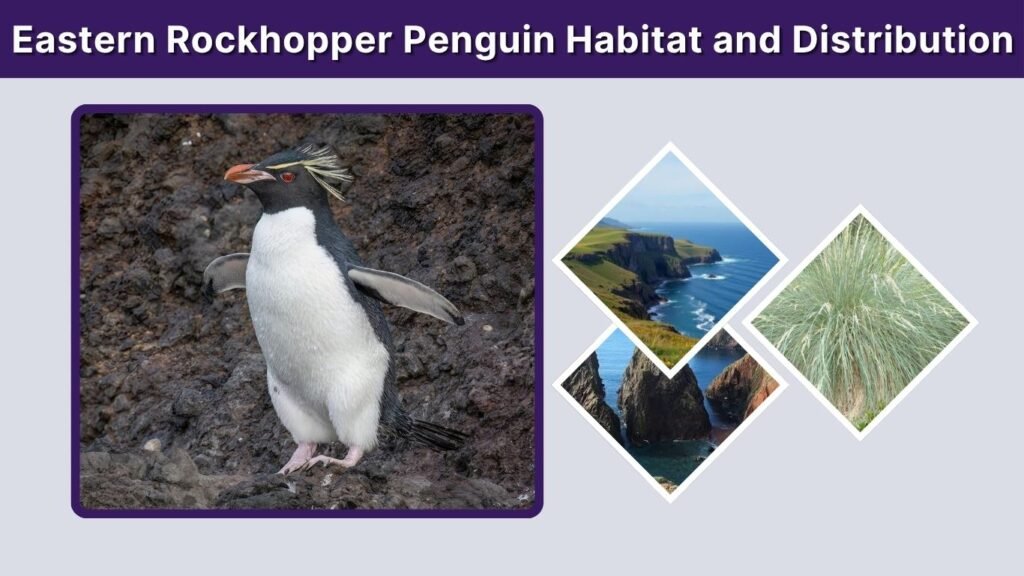
Eastern Rockhopper Penguins inhabit remote islands surrounded by the cold waters of the Southern Ocean. Their breeding colonies are often located on rocky cliffs, coastal slopes, and areas containing tussock grass. These environments provide access to marine feeding grounds while offering protected nesting locations. Their geographical distribution differs from that of western and northern rockhopper populations.
Where Do Eastern Rockhopper Penguins Live?
Eastern Rockhopper Penguins breed on islands including the Auckland, Campbell, Antipodes, Macquarie, Crozet, Kerguelen, Prince Edward, and Marion islands.
Their range extends across portions of the southern Indian Ocean and waters around New Zealand and Australia.
Preferred Nesting Habitat
These penguins commonly establish colonies on rocky coastal slopes, cliffs, and areas with dense vegetation.
Nests may be positioned among stones, tussock grasses, and sheltered ground depressions. Suitable nesting locations help protect eggs and chicks from harsh weather.
Eastern Rockhopper Penguin Behavior
Eastern Rockhopper Penguins are active, social seabirds that gather in breeding colonies during the reproductive season. They spend substantial periods at sea searching for food and return to land to reproduce and raise chicks. Their distinctive movements on rocky shores give rockhopper penguins their common name. Communication, territorial displays, and cooperative parental care are important aspects of colony life.
Why Do Eastern Rockhopper Penguins Hop?
Unlike penguins that primarily shuffle across relatively flat ground, rockhoppers frequently jump between rocks and ledges.
Their strong legs, feet, and claws help them negotiate uneven surfaces. This behavior is especially useful around steep coastal nesting areas.
Social Behavior and Communication
Eastern Rockhopper Penguins communicate using vocalizations, head movements, and visual displays.
During breeding, pairs may call to recognize each other, while neighboring birds defend nesting spaces through postures and occasional confrontations.
What Do Eastern Rockhopper Penguins Eat?
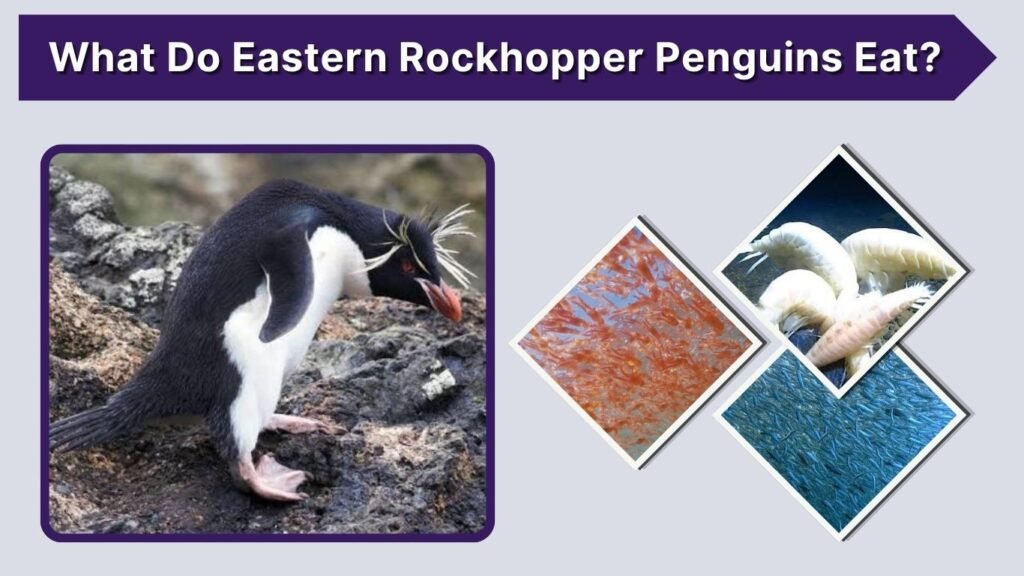
Eastern Rockhopper Penguins are carnivorous seabirds that obtain their food from ocean waters surrounding their breeding and feeding areas. Their diet varies according to prey availability, ocean conditions, and geographical location. Like other crested penguins, they are skilled underwater hunters that capture small marine animals using their strong bills.
Main Food Sources
- Krill: Small marine crustaceans that form an important food source in some areas.
- Other crustaceans: Amphipods and related marine animals.
- Small fish: Various small fish species captured underwater.
- Squid: Consumed when available in their feeding environments.
How Do They Hunt Underwater?
Eastern Rockhopper Penguins use their powerful flippers to propel themselves through the water.
They pursue prey underwater and capture it with their pointed bills. Their streamlined bodies help reduce resistance while swimming and diving.
Eastern Rockhopper Penguin Adaptations
Living on remote subantarctic islands requires specialized physical and behavioral adaptations. Eastern Rockhopper Penguins must cope with cold ocean temperatures, powerful waves, rocky shorelines, and changing food availability. Their waterproof feathers, insulating body tissues, and swimming abilities help them survive in demanding marine environments. These characteristics are shared with other penguin species but are especially useful in rugged island habitats.
Important Survival Adaptations
- Dense feathers: Provide insulation and help protect the body from cold water.
- Blubber: Adds insulation and stores energy.
- Powerful flippers: Generate propulsion during underwater swimming.
- Strong feet: Support movement across slippery rocks and uneven slopes.
- Streamlined body: Reduces drag during swimming.
- Countershading: Dark upperparts and pale underparts provide some camouflage in water.
Eastern Rockhopper Penguin Breeding and Life Cycle
Eastern Rockhopper Penguins return to land during the breeding season, gathering in colonies where pairs establish nesting territories. Their reproduction involves courtship displays, egg laying, incubation, and chick development. Both parents contribute to raising offspring, although their responsibilities change throughout the breeding period. Successful reproduction depends heavily on food availability and suitable nesting conditions.
Nesting and Egg Laying
Breeding usually begins during the Southern Hemisphere spring, although timing varies by location.
Females typically lay two eggs. The first egg is smaller, and usually only one chick survives to fledging.
Nests consist of shallow depressions lined with stones, vegetation, or other available materials.
Chick Development
Both parents participate in incubation and chick care.
After hatching, the male commonly guards the chick during its early development while the female gathers food. Older chicks may gather in groups called crèches before developing waterproof juvenile plumage.
Eastern Rockhopper Penguin Lifespan
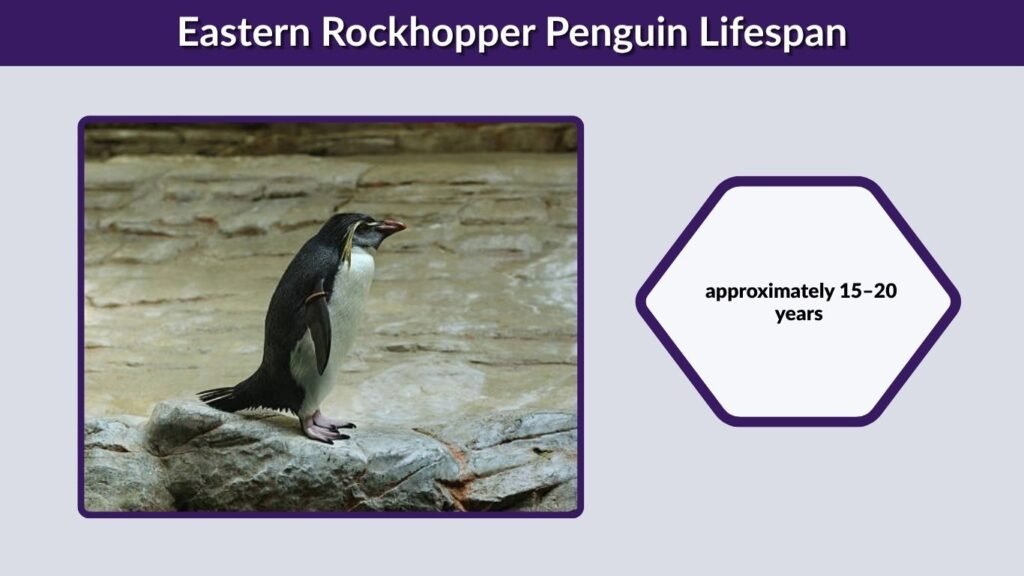
Eastern Rockhopper Penguins face several natural challenges throughout their lives, including food shortages, harsh weather, and predation. Their survival depends on successful feeding at sea and suitable conditions at breeding colonies. Like other long-lived seabirds, they may reproduce across multiple seasons, although individual longevity varies considerably with environmental conditions and survival pressures.
How Long Do Eastern Rockhopper Penguins Live?
Rockhopper penguins can survive for more than a decade in the wild, with some individuals reaching approximately 15–20 years or longer.
However, reliable lifespan estimates specifically for eastern populations are limited. Ocean productivity, disease, and predators can influence survival.
Eastern vs. Western vs. Northern Rockhopper Penguins
Rockhopper penguins are commonly divided into northern, western, and eastern forms. They share black-and-white plumage, red eyes, and conspicuous yellow crests, making them difficult to distinguish at first glance. Their breeding distribution provides one of the clearest differences. Scientists also examine genetics and subtle physical characteristics to understand relationships among the different populations.
Key Differences Between Rockhopper Penguins
| Feature | Eastern Rockhopper | Western Rockhopper | Northern Rockhopper |
|---|---|---|---|
| Scientific classification | E. filholi or E. c. filholi | E. chrysocome or E. c. chrysocome | E. moseleyi |
| Main breeding region | Southern Indian Ocean and New Zealand subantarctic islands | Southern South America and Falkland Islands | Tristan da Cunha, Gough, Amsterdam and St. Paul islands |
| Crest feathers | Yellow, relatively short | Yellow, relatively short | Generally longer and more elaborate |
| Appearance | Similar to western form | Similar to eastern form | Often more distinctive crest shape |
Eastern Rockhopper Penguin Conservation Status
Eastern Rockhopper Penguins face conservation challenges associated with changing ocean conditions and declining breeding populations in some locations. Their restricted breeding distribution makes them vulnerable to environmental changes affecting particular islands. Conservation assessments differ according to taxonomy, but the Southern Rockhopper Penguin complex is listed as Vulnerable by the IUCN, and eastern populations remain a significant conservation concern.
Major Threats to Eastern Rockhopper Penguins
- Climate change: Altered ocean conditions can affect prey availability.
- Food shortages: Changes in marine productivity may reduce breeding success.
- Introduced predators: Non-native animals threaten eggs and chicks in some colonies.
- Marine pollution: Plastic debris and oil contamination can affect seabirds.
- Fishing interactions: Competition for prey and accidental capture may threaten populations.
- Habitat disturbance: Human activity can disrupt sensitive breeding colonies.
Conservation and Protection Efforts
Protecting breeding islands and surrounding marine habitats is essential for long-term population survival.
Scientific monitoring helps researchers assess population trends and breeding success. Managing introduced predators and reducing harmful human impacts can support conservation.
FAQs
1. Where Do Eastern Rockhopper Penguins Live?
Eastern Rockhopper Penguins breed on subantarctic islands, including Macquarie, Campbell, Antipodes, Auckland, Crozet, Kerguelen, and the Prince Edward Islands.
2. What Do Eastern Rockhopper Penguins Eat?
They mainly consume krill, other marine crustaceans, small fish, and squid. Their diet varies with location and seasonal prey availability.
3. Why Are They Called Rockhopper Penguins?
They are named for their habit of hopping between rocks and ledges while traveling through rugged coastal habitats.
4. Are Eastern Rockhopper Penguins Endangered?
Eastern populations face significant conservation concerns. They are included within the Southern Rockhopper Penguin complex assessed as Vulnerable by the IUCN, although classifications vary among authorities.
5. What Is the Difference Between Eastern and Western Rockhopper Penguins?
Their primary differences involve breeding distribution and some genetic and morphological characteristics. Eastern populations inhabit southern Indian Ocean and southwestern Pacific islands, while western populations breed near southern South America.