
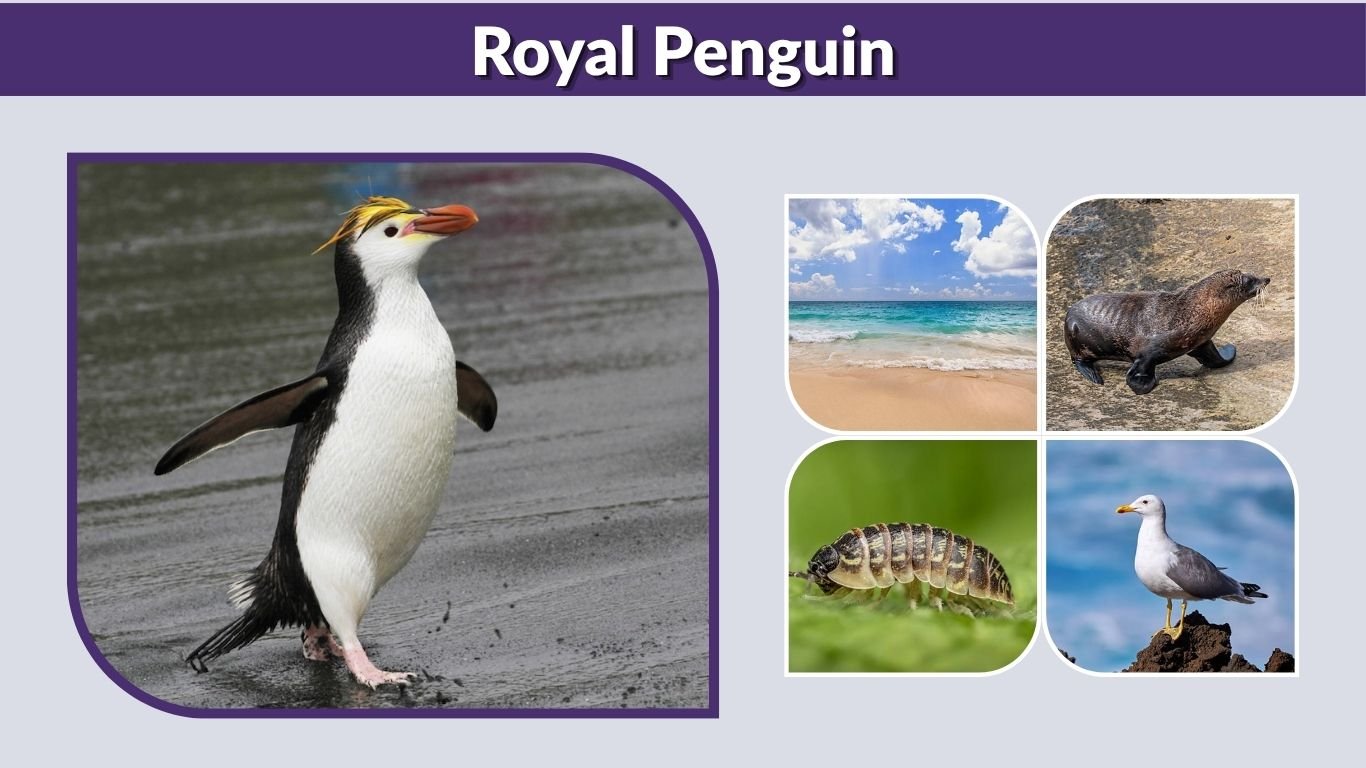
The royal penguin is a distinctive crested penguin best known for its pale face, bright yellow-orange crest, and restricted breeding range. Scientifically known as Eudyptes schlegeli, this seabird breeds almost entirely on Macquarie Island and nearby islets in the Southern Ocean. Royal penguins spend much of their lives at sea, returning to land for breeding and molting. Their unusual appearance, huge breeding colonies, specialized diet, and limited distribution make them one of the most fascinating penguins to study.
What Is a Royal Penguin?
Royal penguins belong to the crested penguin genus Eudyptes. They are closely related to macaroni penguins and can look remarkably similar at first glance. Their pale face, however, usually provides an easy clue for identification. They are medium-sized seabirds adapted to swimming, diving, cold ocean conditions, and spending extended periods away from land.
Royal Penguin Identification
A royal penguin can be identified by several distinctive features:
- Scientific name: Eudyptes schlegeli
- Body: Black upperparts and white underparts
- Face: Usually white to pale gray
- Crest: Yellow-orange feathers extending from the forehead
- Bill: Large and orange-red to reddish brown
- Feet: Pink
- Eyes: Dark reddish
- Height: Roughly 66–76 cm (26–30 inches)
- Typical breeding-season weight: About 4.2–6.3 kg
Royal penguins can become considerably heavier before their annual molt as they build energy reserves.
Royal Penguin vs. Macaroni Penguin
Royal and macaroni penguins are very closely related. The easiest visual difference is generally the face. Royal penguins usually have a white or pale-gray face and chin, whereas macaroni penguins normally have a much darker face.
Royal penguins can also be somewhat larger. Both possess conspicuous golden-yellow crests that meet across the forehead, which explains why the two are frequently confused.
Where Do Royal Penguins Live?
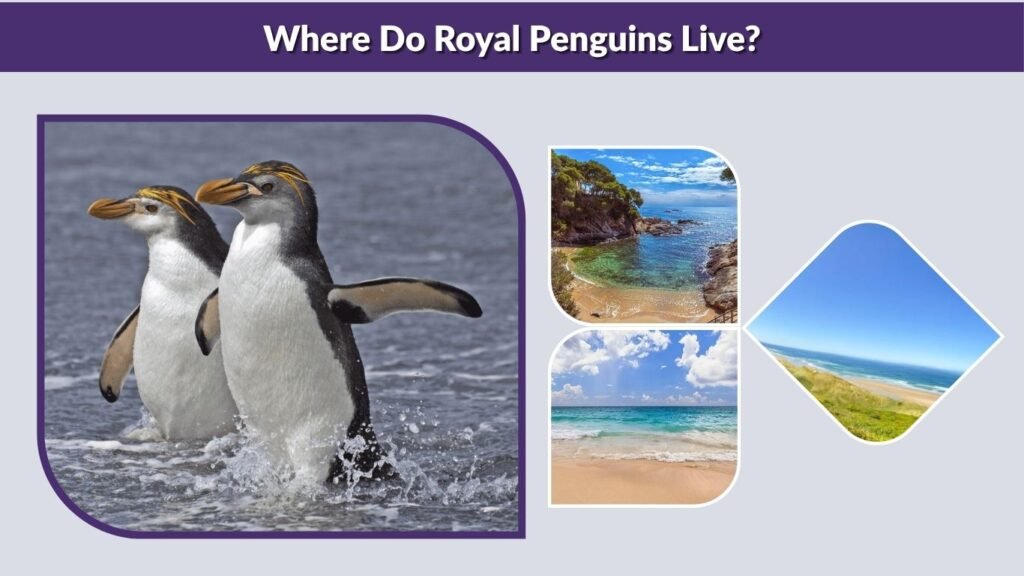
The royal penguin has one of the most restricted breeding distributions among penguins. Its breeding population is concentrated around remote Macquarie Island, located in the Southern Ocean roughly halfway between Tasmania and Antarctica. Nutrient-rich surrounding waters provide important feeding grounds for penguins, seals, seabirds, and many other marine organisms.
Royal Penguin Habitat
During breeding, royal penguins occupy coastal areas and large colonies on Macquarie Island.
Their habitat commonly includes:
- Rocky coastal areas
- Beaches
- Open ground near the coastline
- Slopes close to the ocean
- Dense breeding colonies
- Cold, productive Southern Ocean waters
The environment can be windy, wet, and harsh, but royal penguins are well adapted to these sub-Antarctic conditions.
Where Do Royal Penguins Live Outside Breeding Season?
After completing their annual molt, royal penguins leave Macquarie Island and spend roughly six months at sea. Their complete winter distribution is still not fully understood.
Sightings have occurred from around Tasmania into parts of the Southern Ocean. Some individuals travel extremely long distances while away from their breeding colonies.
Royal Penguin Colonies
Royal penguins gather in enormous breeding colonies. The Australian Antarctic Program has reported approximately 750,000 breeding pairs in more than 60 colonies across Macquarie Island, while older estimates vary. Hurd Point contains an exceptionally large colony with hundreds of thousands of breeding pairs.
Because nearly the entire breeding population is concentrated in one small geographic area, environmental changes around Macquarie Island can have an unusually large effect on the species.
What Do Royal Penguins Eat?
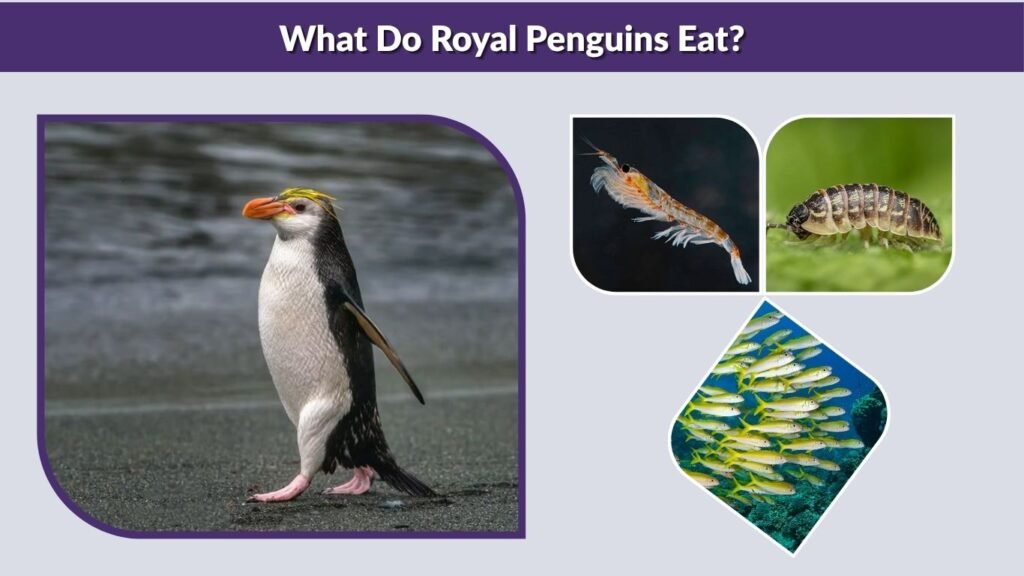
Royal penguins are marine predators that hunt underwater. Their diet changes somewhat depending on season, colony location, and breeding stage. Krill are especially important, but these penguins also eat small fish and other available marine prey. Their streamlined bodies and powerful flippers allow them to pursue prey efficiently beneath the ocean surface.
Royal Penguin Diet
Important foods include:
- Krill
- Lanternfish
- Other small fish
- Small crustaceans
- Occasional cephalopods
The Australian Antarctic Program identifies Euphausia vallentini as an especially important krill species in their diet, along with Thysanoessa gregaria and juvenile lanternfish.
How Do Royal Penguins Find Food?
Royal penguins leave their colonies and dive into offshore waters to catch prey. Their foraging distance varies according to breeding responsibilities.
During incubation, a bird may travel hundreds of kilometers from Macquarie Island before returning to its partner. During chick rearing, trips generally become shorter because adults must regularly bring food back to their growing chick.
Royal Penguin Breeding and Life Cycle
Royal penguins follow a highly synchronized annual breeding cycle. Thousands of birds return to their breeding grounds at roughly the same time, producing extremely crowded colonies. Males generally arrive first to establish nesting territories, followed shortly afterward by females. Raising a chick requires both parents to alternate between guarding duties and searching for food at sea.
Nesting and Eggs
Males typically begin returning to Macquarie Island in late September, while females arrive during early October. Egg laying occurs mainly from mid- to late October.
Royal penguins usually produce two eggs of noticeably different sizes. The smaller first egg rarely produces the chick that ultimately survives. Incubation is shared by the parents and lasts roughly one month.
Royal Penguin Chicks
Chicks generally begin appearing from late November into early December. Male penguins initially guard young chicks while females make feeding trips.
After several weeks, growing chicks gather in groups known as crèches. Both parents can then forage and return with food. By around February, the young penguins develop waterproof juvenile plumage and begin heading to sea.
Molting
Adults must replace their feathers annually. Before molting, they feed heavily and build substantial fat reserves because they cannot forage normally during the molt.
They return to land, shed their old plumage, grow new waterproof feathers, and eventually return to the ocean for the winter period.
Royal Penguin Adaptations and Behavior
Life in the Southern Ocean requires adaptations for cold water, efficient swimming, finding food far offshore, and surviving among huge numbers of neighboring birds. Royal penguins possess dense plumage, streamlined bodies, powerful flippers, and contrasting coloration that supports their marine lifestyle. Their social behavior is equally important during crowded breeding seasons.
Adaptations for Ocean Life
Royal penguins have several useful adaptations:
- Streamlined bodies reduce resistance underwater.
- Strong flippers provide underwater propulsion.
- Dense feathers help insulate the body.
- Fat reserves provide additional insulation and energy.
- Dark backs and pale undersides provide countershading.
- Strong feet help them move around rocky colonies.
Despite looking somewhat awkward while walking, royal penguins are highly specialized marine birds.
Social Behavior
Royal penguins are extremely social during breeding. Colonies can contain thousands or even hundreds of thousands of birds packed close together.
Communication through vocalizations and displays helps partners recognize each other among the crowd. Penguins may also defend small nesting territories from neighbors using calls, postures, and physical displays.
Royal Penguin Predators and Conservation
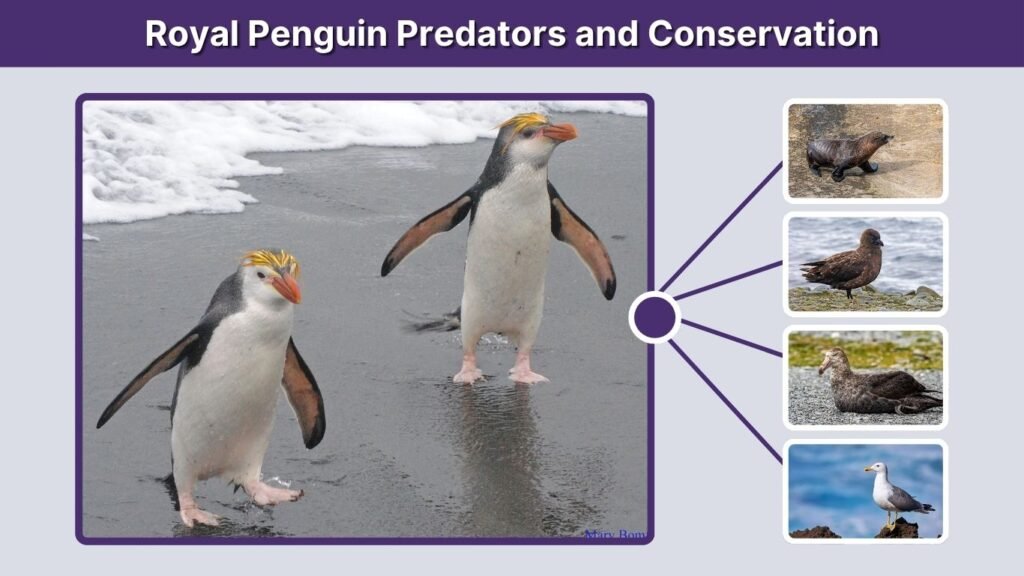
Royal penguins have recovered considerably from historic exploitation, when large numbers were killed for oil. Today, their population is considered relatively stable, but their extremely restricted breeding distribution remains a conservation concern. The Australian Antarctic Program lists the royal penguin as Near Threatened, emphasizing the vulnerability created by concentrating nearly the entire population around Macquarie Island.
Royal Penguin Predators
Potential predators include:
- New Zealand fur seals
- Leopard seals
- Orcas
- Subantarctic skuas
- Giant petrels
- Gulls
Skuas and large seabirds primarily threaten eggs and chicks, while marine predators can take adult penguins at sea.
Are Royal Penguins Endangered?
Royal penguins are not currently classified as Endangered. They are generally listed as Near Threatened.
Their restricted breeding range means that disease outbreaks, food-web changes, severe weather, pollution, or other major disturbances affecting Macquarie Island and surrounding waters could potentially influence a large proportion of the population.
Interesting Facts About Royal Penguins
Royal penguins stand out even among the colorful crested penguins. Their enormous colonies, long-distance ocean journeys, dramatic golden head feathers, and isolation on Macquarie Island provide many unusual aspects of their biology.
Royal Penguin Fun Facts
- Royal penguins breed almost exclusively around Macquarie Island.
- Their scientific name is Eudyptes schlegeli.
- Young birds do not immediately have the full crest of adults.
- Their pale face helps distinguish them from macaroni penguins.
- Some breeding adults travel hundreds of kilometers while foraging.
- They spend much of the year at sea.
- Their population includes hundreds of thousands of breeding pairs.
- Adults undergo a complete molt every year.
FAQs
Royal penguins generate many questions because they live in such a remote part of the world. Their appearance also causes frequent confusion with macaroni penguins. The following answers cover some of the most common questions about royal penguin size, habitat, diet, lifespan, and conservation.
1. Where do royal penguins live?
Royal penguins breed mainly on Macquarie Island, with a much smaller number breeding on the nearby Bishop and Clerk Islets. They spend much of the nonbreeding season at sea.
2. How tall are royal penguins?
Adults are approximately 66–76 cm (26–30 inches) tall, making them medium-sized members of the penguin family.
3. How much does a royal penguin weigh?
At the beginning of breeding, adults generally weigh around 4.2–6.3 kg. Weight changes significantly during breeding and molting as birds fast and rebuild fat reserves.
4. How long do royal penguins live?
Their exact wild longevity is not as firmly documented as some other characteristics, but commonly cited estimates place royal penguin lifespan at roughly 15–20 years.
5. What do royal penguins eat?
Royal penguins mainly eat krill and small fish, particularly lanternfish, with other crustaceans and occasional cephalopods contributing to their diet. The exact proportions can change between colonies and throughout the breeding season.
