
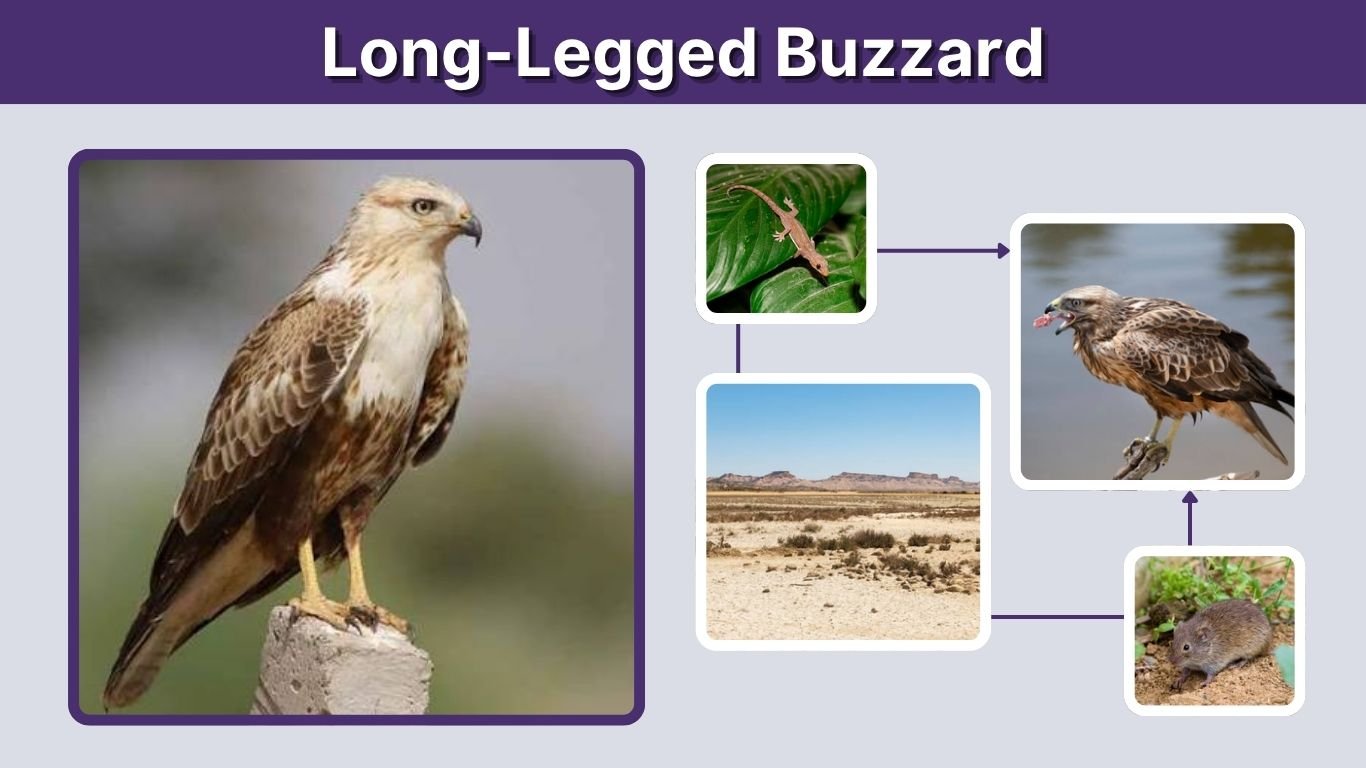
The Long-legged Buzzard (Buteo rufinus) is a large bird of prey associated with steppes, semi-deserts, rocky plains, dry farmland, and other open landscapes. It has long, broad wings, a powerful body, relatively long legs, and highly variable plumage. Pale, reddish, and dark individuals all occur, which can make identification challenging. Compared with a Common Buzzard, it usually looks larger, longer-winged, longer-tailed, and more eagle-like.
Long-Legged Buzzard Facts
The Long-legged Buzzard belongs to the family Accipitridae, which includes hawks, eagles, and other buzzards. It is one of the larger members of the genus Buteo.
| Feature | Long-legged Buzzard details |
| Scientific name | Buteo rufinus |
| Family | Accipitridae |
| Length | Approximately 50–65 cm |
| Wingspan | Approximately 126–155 cm |
| Plumage | Pale, rufous, intermediate, or dark |
| Diet | Rodents, reptiles, birds, insects, and carrion |
| Habitat | Steppe, semi-desert, farmland, rocky plains, and open woodland |
| Call | A short, sharp mewing sound |
| UK status | Exceptionally rare visitor |
Long-Legged Buzzard Identification
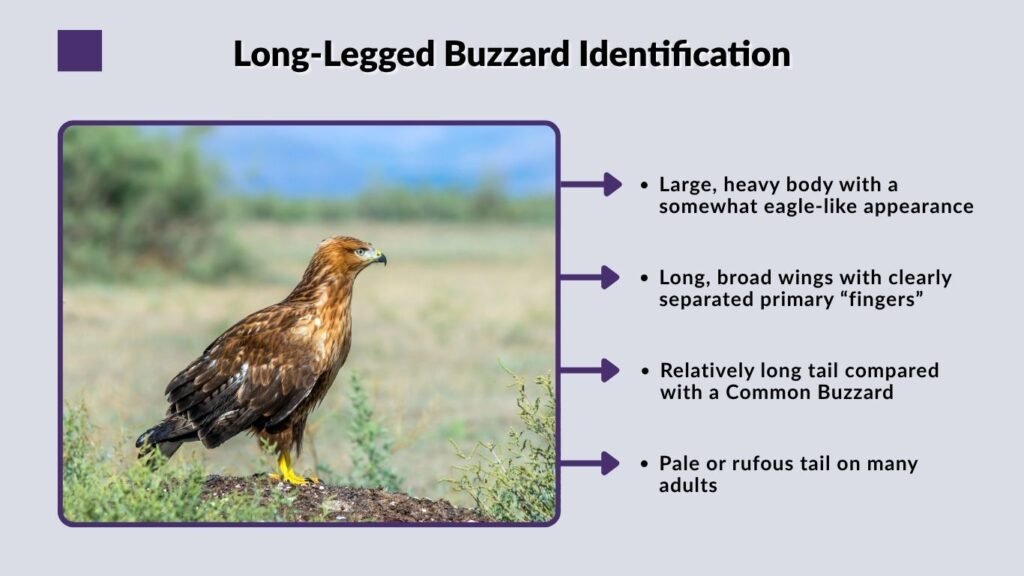
Plumage color varies greatly, so body shape and flight structure are often more dependable than color alone. The bird may resemble a small eagle when soaring over open country.
Key Identification Features
Look for the following characteristics:
- Large, heavy body with a somewhat eagle-like appearance
- Long, broad wings with clearly separated primary “fingers”
- Relatively long tail compared with a Common Buzzard
- Pale or rufous tail on many adults
- Dark carpal patches at the bends of the wings
- Pale head on many light-morph birds
- Long yellow legs and powerful feet
- Strong hooked bill with a yellow cere
- Wings commonly raised in a shallow V while soaring
- Upright posture when perched
Long-legged Buzzards often sit on utility poles, rocks, trees, mounds, or directly on the ground while watching for prey.
Light and Rufous Morphs
A light-morph adult commonly has a pale cream head and breast, a darker belly, conspicuous dark wrist patches, and a pale reddish or orange-brown tail. The underwings may look mostly pale, contrasting strongly with the dark flight-feather tips.
Rufous individuals appear warmer and more reddish-brown across the body and wing coverts. Their tail may be rusty and relatively plain rather than strongly barred.
Dark-Morph Long-Legged Buzzard
Dark-morph birds may be almost uniformly dark brown beneath. Their wing and tail patterns are less obvious, making them easy to confuse with dark Common, Upland, or Steppe Buzzards.
Even on dark birds, observers should look for the species’ long wings, relatively large size, extended neck, long-legged posture, and often paler or reddish tail. The underwing flight feathers may appear lighter than the dark wing coverts.
Juvenile Identification
Juveniles are generally browner and more heavily streaked than adults. They may have a pale head, streaked breast, dark belly, and finely barred tail.
Young birds lack the prominent dark trailing edge seen on adult wings. Their tail can also be more visibly barred, making them particularly difficult to separate from young Steppe or Common Buzzards. Shape, size, wing length, and location should therefore be considered together.
Long-Legged Buzzard Size and Wingspan
The Long-legged Buzzard measures approximately 50–65 cm from bill to tail and has a wingspan of about 126–155 cm. Females are generally larger and heavier than males, although the sexes have similar plumage.
Its body length overlaps with that of the Common Buzzard, but its longer wings and tail often make it appear substantially larger in flight. At close range, its strong bill, long legs, and powerful feet are also noticeable.
Where Do Long-Legged Buzzards Live?
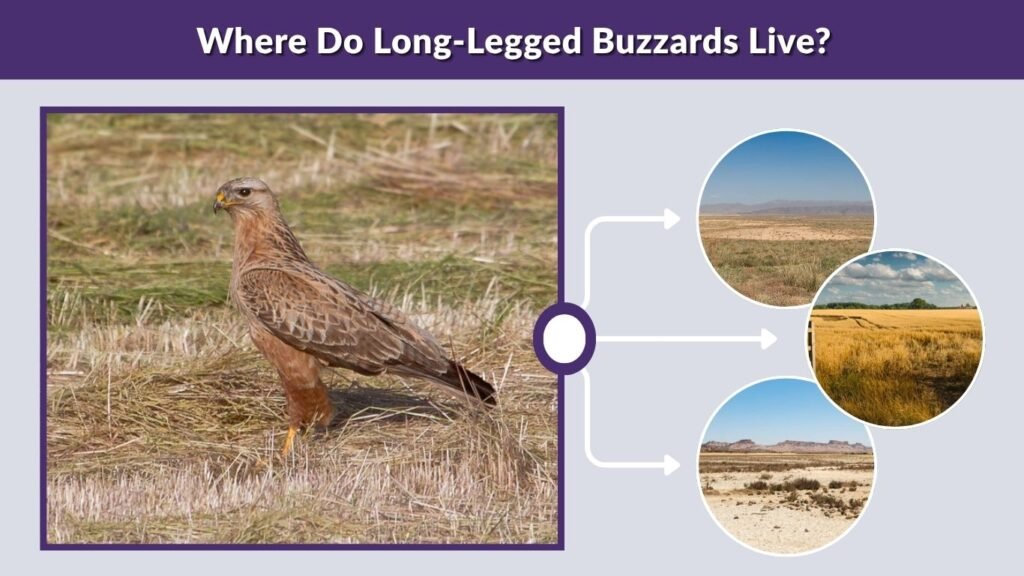
Long-legged Buzzards occur across parts of North Africa, southeastern Europe, the Middle East, Central Asia, northwestern China, Arabia, Iran, Pakistan, northwestern India, and nearby regions. Some eastern populations migrate south for winter, while many birds in warmer areas remain resident or make shorter seasonal movements.
Preferred Habitat
The species favors large, open environments where prey can be seen easily, including:
- Dry grassland and steppe
- Semi-desert and desert edges
- Rocky plains and hillsides
- Open farmland
- Scrubland
- Mountain valleys
- Open woodland near grassland
- Coastal plains and plateaus
It generally avoids extensive closed forest, although it may use scattered trees for nesting or perching when large open hunting areas are nearby.
Long-Legged Buzzards in Cyprus, Crete, and Rhodes
The eastern Mediterranean forms part of the species’ regular range. Long-legged Buzzards breed or occur seasonally on some islands and nearby mainland areas where dry, rocky terrain provides suitable nesting sites and hunting grounds.
They are especially associated with cliffs, open slopes, agricultural land, and sparsely vegetated country rather than densely forested areas.
Long-Legged Buzzard in the UK
The species is an exceptionally rare visitor to Britain. It was added to the British List following the acceptance of a bird photographed in Shetland and Fair Isle in 2019. A buzzard seen regularly in Britain is therefore far more likely to be a Common Buzzard unless clear photographic evidence shows otherwise.
What Do Long-Legged Buzzards Eat?
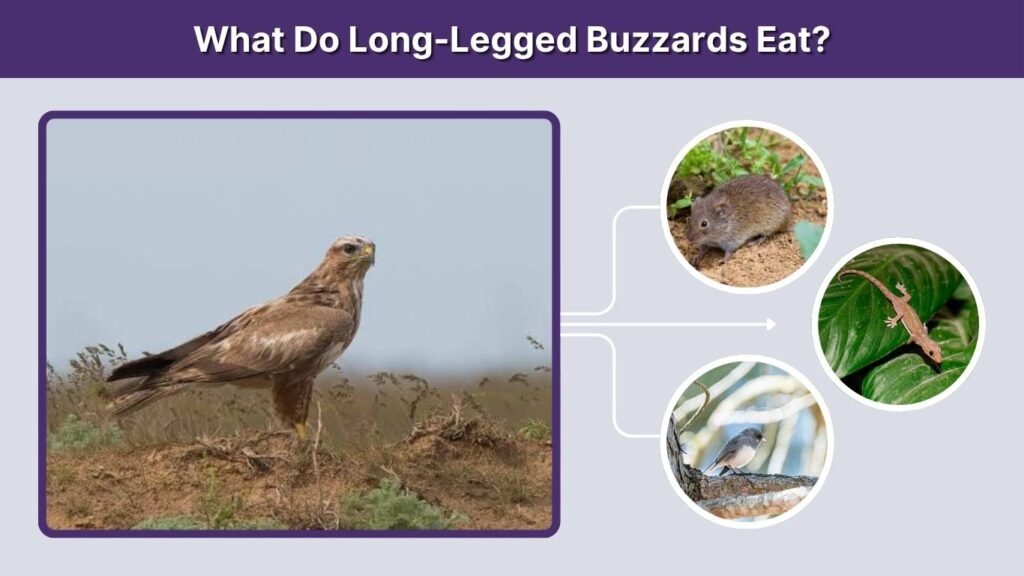
Long-legged Buzzards are opportunistic predators that take prey available in open habitats. Small mammals are particularly important, but diet varies by location and season.
Common prey includes:
- Voles, mice, rats, gerbils, and ground squirrels
- Lizards and snakes
- Small and medium-sized birds
- Young rabbits and hares
- Large insects
- Amphibians
- Carrion
Studies from different parts of the species’ range show that local prey availability strongly influences what breeding pairs bring to their nests.
How Do They Hunt?
A Long-legged Buzzard frequently watches from an elevated perch before dropping onto prey. It may also sit directly on the ground, soar over open country, or fly low while scanning for movement.
Its broad wings allow efficient soaring in warm rising air. Once prey is located, the bird descends rapidly and captures it with its talons.
Long-Legged Buzzard in Flight
In flight, the species has broad, long wings and a relatively long tail. When soaring, it commonly raises its wings into a shallow V and circles with little flapping.
Important flight marks include:
- Long wings with well-developed “fingers”
- Dark carpal or wrist patches
- Pale inner flight feathers on light morphs
- Dark outer primaries
- Pale, reddish, or orange-brown tail
- More eagle-like proportions than a Common Buzzard
The tail may be spread into a broad fan when circling or maneuvering. Flight shape is particularly helpful when the bird’s plumage is unusually dark or intermediate.
Long-Legged Buzzard Call
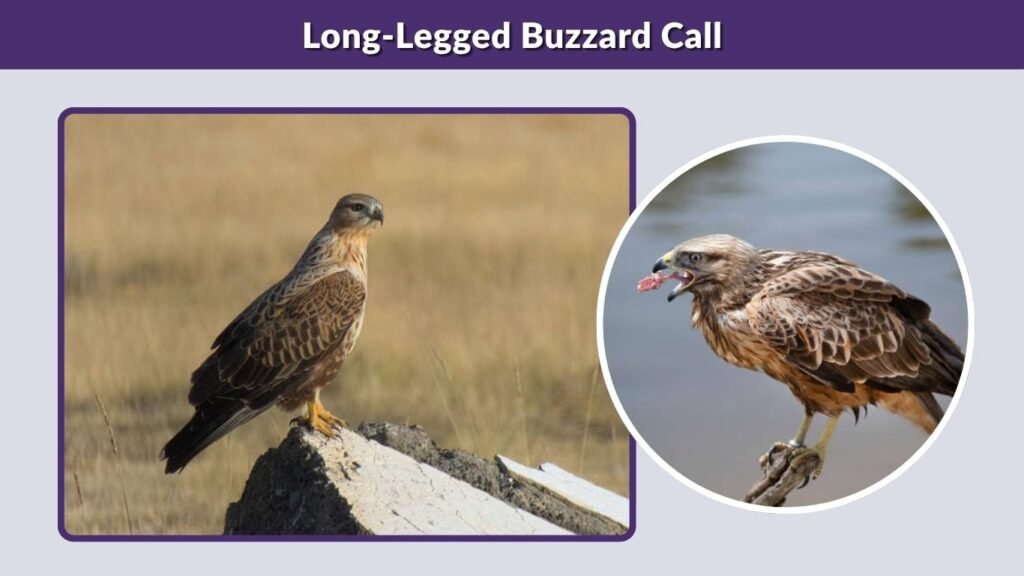
This buzzard is not usually considered highly vocal. Its most familiar sound is a short, sharp mew, broadly similar to the call of a Common Buzzard.
Calls are most likely to be heard near breeding territories, during aerial displays, or when adults are alarmed. Because the calls of related buzzards overlap, sound alone is rarely sufficient for reliable identification.
Nesting and Breeding
Long-legged Buzzards build large nests from sticks and line them with grass, wool, leaves, or other softer materials. Nest placement varies with the landscape.
Nests may be constructed on:
- Rocky cliffs and ledges
- Trees
- Utility pylons
- Ruined buildings
- Low rocky outcrops
- Occasionally the ground in treeless areas
Egg laying generally occurs during spring, though timing varies across the broad range. A clutch commonly contains three or four eggs, and both adults help defend the territory and supply food to the young.
Long-Legged Buzzard vs Common Buzzard
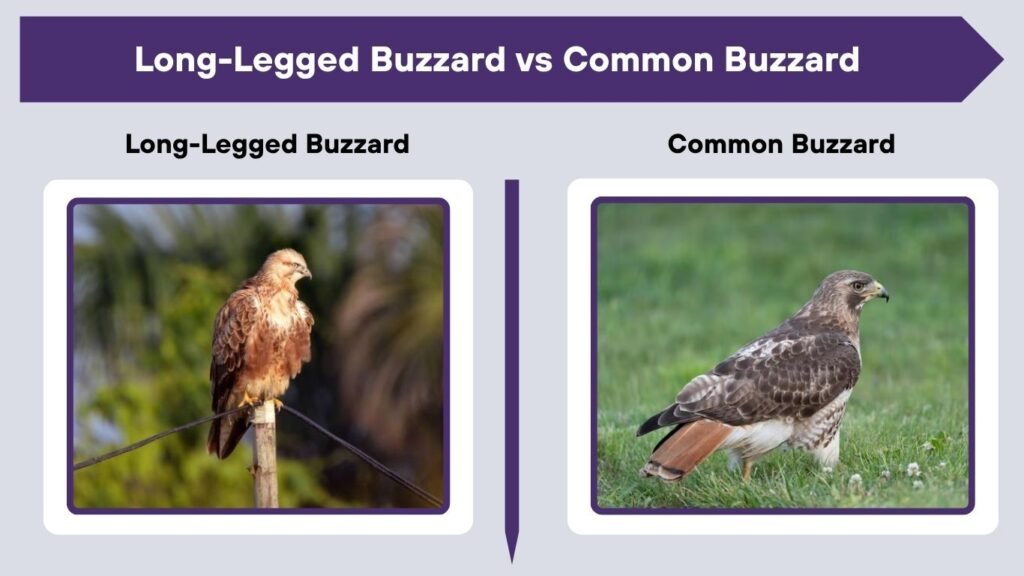
These species overlap in parts of Europe and western Asia, and both have extremely variable plumage. Identification should be based on multiple structural and plumage features.
| Feature | Long-Legged Buzzard | Common Buzzard |
| Overall size | Usually larger | Smaller and more compact |
| Wings | Longer and broader | Shorter and rounder |
| Tail | Relatively long; often pale or rufous | Shorter and commonly barred |
| Head | Often pale and eagle-like | Usually darker and rounder |
| Legs | Relatively long | Shorter-looking |
| Soaring posture | Wings often held in a shallow V | Wings broad and slightly raised |
| Habitat | Steppe, desert, and dry open country | Farmland, woodland edges, and mixed countryside |
| UK status | Exceptional rarity | Widespread resident |
A pale Common Buzzard may resemble a Long-legged Buzzard, while dark forms of both species can be extremely difficult to separate. The best combination for the Long-legged Buzzard is large size, long wings, extended neck, longer tail, dark wrist patches, and dry open habitat.
FAQs
Why is it called a Long-Legged Buzzard?
The name refers to its relatively long tarsi and tall appearance when standing. Its long legs are useful when capturing rodents, reptiles, and other prey on open ground, although they may be difficult to assess when the bird is flying.
Is the Long-Legged Buzzard larger than the Common Buzzard?
Yes, it is generally larger, longer-winged, and longer-tailed. However, individual sizes overlap, and females are larger than males. Wing shape, tail pattern, plumage, habitat, and flight posture provide more dependable identification than size alone.
Are all Long-Legged Buzzards pale?
No. The species occurs in light, rufous, intermediate, and dark morphs. Some birds have pale heads and reddish tails, while others are almost entirely dark brown. This variation is one reason the species is frequently confused with other buzzards.
Does the Long-Legged Buzzard hover?
It may hover briefly while hunting, particularly in windy conditions, but hovering is not as defining a behavior as it is for kestrels or Rough-legged Buzzards. Long-legged Buzzards more commonly hunt from perches, the ground, or soaring flight.
Is a Long-Legged Buzzard dangerous?
It normally avoids people and is not considered dangerous. Like other birds of prey, a nesting adult may defend its territory if approached closely. Observers should avoid disturbing nests and should never attempt to capture or handle a wild buzzard.
