
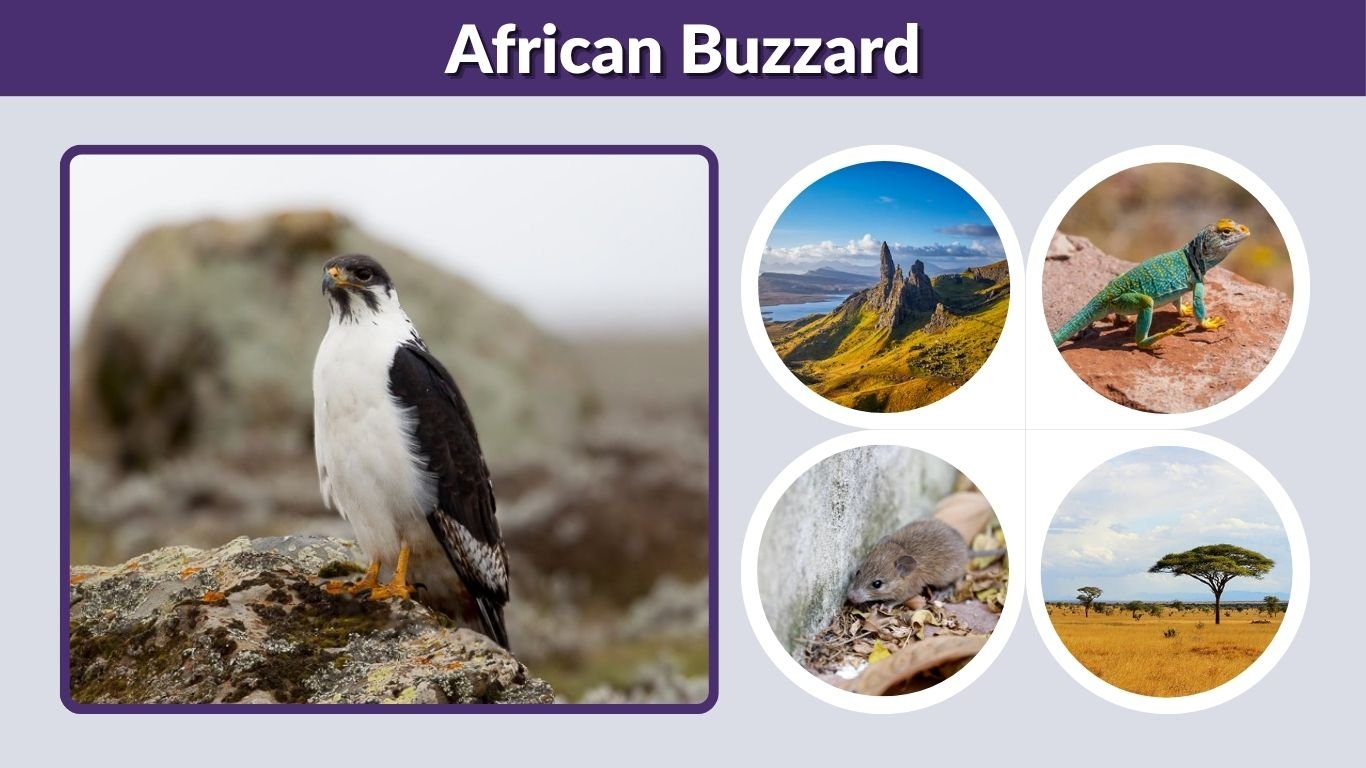
The term African buzzard does not refer to one officially recognized bird species. Instead, it describes several medium-sized birds of prey found across Africa, including the jackal buzzard, augur buzzard, forest buzzard, red-necked buzzard, lizard buzzard, and migratory steppe buzzard. Most have broad wings, rounded tails, hooked beaks, and powerful talons. However, their colors, ranges, habitats, and behaviors vary considerably.
What Is an African Buzzard?
Most birds commonly called buzzards belong to the genus Buteo, a group of broad-winged raptors within the family Accipitridae. They are related to hawks, eagles, and kites.
Buzzards often hunt by waiting on a tree, pole, or rock before dropping onto prey. They may also soar over open ground while searching for movement below. Members of the genus occupy environments ranging from forests and mountains to savannas, farmland, and semi-arid areas.
African Buzzard Identification
Typical buzzard characteristics include:
- Broad, rounded wings
- A relatively short, rounded tail
- A sharply hooked beak
- Strong feet with curved talons
- Brown, black, white, or rufous plumage
- Excellent eyesight
- An upright posture when perched
- Slow soaring with wings spread widely
Plumage can be highly variable. Some species and individuals occur in pale, intermediate, and dark forms, so location and flight pattern may be as important as color.
Common Types of African Buzzards
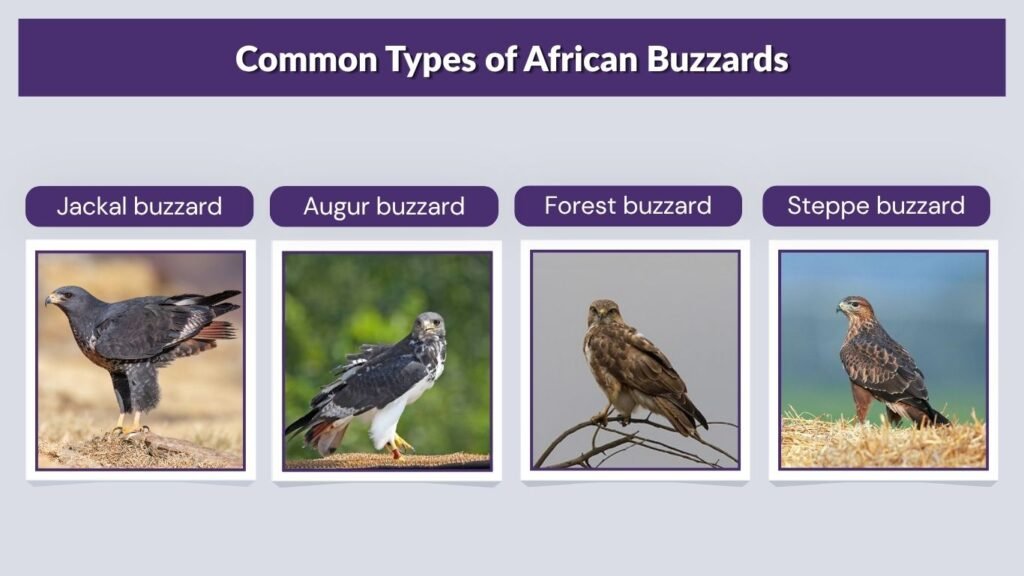
Africa supports several resident buzzards as well as migratory species arriving from Europe and Asia. The species encountered depend heavily on region and habitat.
| Species | Scientific name | Main African range | Key feature |
| Jackal buzzard | Buteo rufofuscus | Southern Africa | Dark body and chestnut breast |
| Augur buzzard | Buteo augur | Eastern and southwestern Africa | White underparts and reddish tail |
| Forest buzzard | Buteo trizonatus | Southern South Africa | Brown forest-dwelling buzzard |
| Steppe buzzard | Buteo buteo vulpinus | Seasonal visitor to southern Africa | Highly variable brown plumage |
| Red-necked buzzard | Buteo auguralis | Western and central Africa | Rufous head, neck, and tail |
| Lizard buzzard | Kaupifalco monogrammicus | Much of sub-Saharan Africa | Gray body and dark throat stripe |
Jackal Buzzard
The jackal buzzard is one of southern Africa’s most distinctive resident raptors. Adults generally have dark upperparts, a rich chestnut-colored breast, and strongly contrasting black-and-white underwings. The tail is usually reddish.
It can be found in South Africa and neighboring parts of southern Africa, particularly around mountains, grasslands, farmland, and rocky country. It often watches for prey from telephone poles, fence posts, cliffs, or trees. African Bird Club records classify the jackal buzzard as a member of the family Accipitridae and show it occurring widely in South Africa.
Augur Buzzard
The augur buzzard is a large, striking buzzard associated with eastern Africa. Its range extends from Ethiopia south toward Zimbabwe, with another population occurring between Angola and Namibia.
A typical adult has dark upperparts, pale or white underparts, and a reddish tail. Dark-plumaged individuals also occur. Augur buzzards use grasslands, shrublands, mountains, forests, agricultural areas, and even quieter edges of urban environments. They generally favor open hunting areas near suitable elevated nesting sites.
Forest Buzzard
The forest buzzard is closely associated with indigenous forests and forest edges in southern South Africa. It is particularly connected with the country’s southern and eastern forested regions.
This species is largely brown above with paler, patterned underparts. It can be difficult to distinguish from the steppe buzzard because both show considerable plumage variation. Habitat provides an important clue: forest buzzards are resident birds connected to wooded environments, whereas steppe buzzards are seasonal migrants. The forest buzzard is recognized as a South African endemic and is listed as Near Threatened in the African Bird Club’s country summary.
Steppe Buzzard
The steppe buzzard is the migratory form of the common or Eurasian buzzard that travels to southern Africa during the northern winter. It is frequently seen in South Africa during the warmer months before returning north.
Steppe buzzards vary from pale sandy brown to dark chocolate brown. Many have streaked breasts and lighter patches beneath their wings. They are often observed over farmland, grassland, roadsides, and open woodland. Records from South Africa identify these visitors as common or steppe buzzards belonging to Buteo buteo.
Red-Necked Buzzard
The red-necked buzzard occurs mainly across western and central Africa. Adults usually have a rufous head, neck, and tail, combined with a brown back and pale underparts marked with darker spots.
It favors savannas, woodland edges, cultivated areas, and forest clearings. Although primarily a West and Central African bird, rare individuals have been recorded farther south, which can create identification challenges for birdwatchers.
Lizard Buzzard
The lizard buzzard is not a member of the genus Buteo, but it belongs to the same broad raptor family. It is a compact African bird of prey with gray upperparts, pale underparts, and a noticeable vertical black stripe on the throat.
It is widespread across parts of sub-Saharan Africa and has been recorded in countries including Sierra Leone, The Gambia, Uganda, Zambia, Zimbabwe, and South Africa. It commonly watches the ground from exposed trees or roadside perches.
African Buzzard Habitat
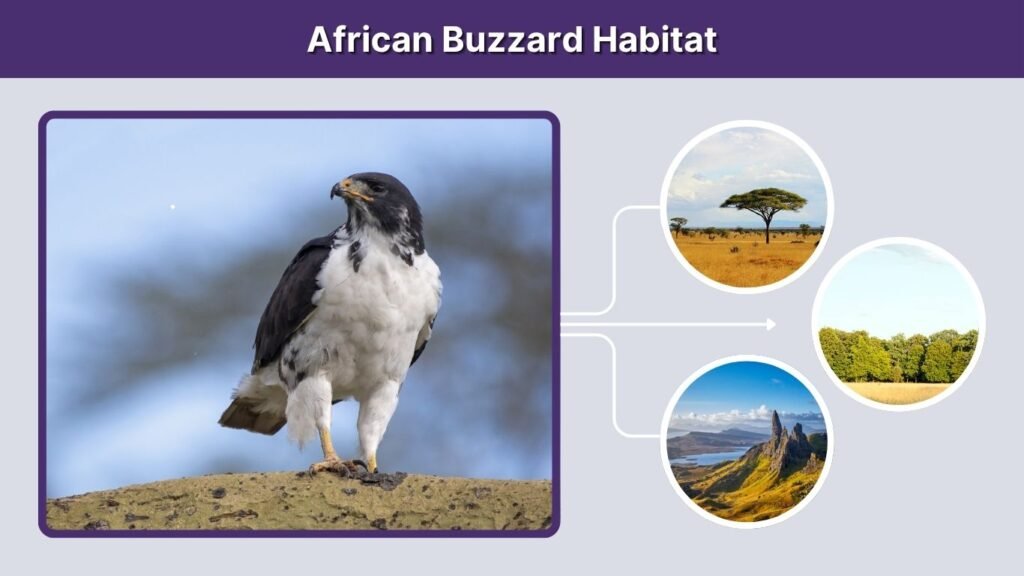
African buzzards occupy an unusually broad range of environments. Most need open ground for locating prey and elevated places from which to hunt or nest.
Grasslands and Savannas
Open grasslands support rodents, reptiles, insects, and other prey. Jackal, augur, and steppe buzzards commonly use such habitats, especially when trees, poles, rocks, or fence posts provide observation points.
Forests and Woodland Edges
Forest buzzards depend more heavily on wooded landscapes. Other species may hunt along forest margins, where open areas meet dense vegetation.
Buzzards generally find it more difficult to hunt inside completely closed forest because their broad wings are better suited to soaring and open-air maneuvering.
Mountains and Rocky Areas
Cliffs and rocky slopes provide nest sites, rising air currents, and excellent hunting positions. Augur and jackal buzzards are particularly associated with mountainous or hilly country in parts of their ranges.
Farmland and Roadsides
Agricultural land may provide rodents and insects, while utility poles offer convenient perches. However, roads and electrical infrastructure also expose raptors to vehicle collisions and power-line accidents. Jackal buzzards have been among the raptors reported as power-line fatalities in South Africa.
What Do African Buzzards Eat?
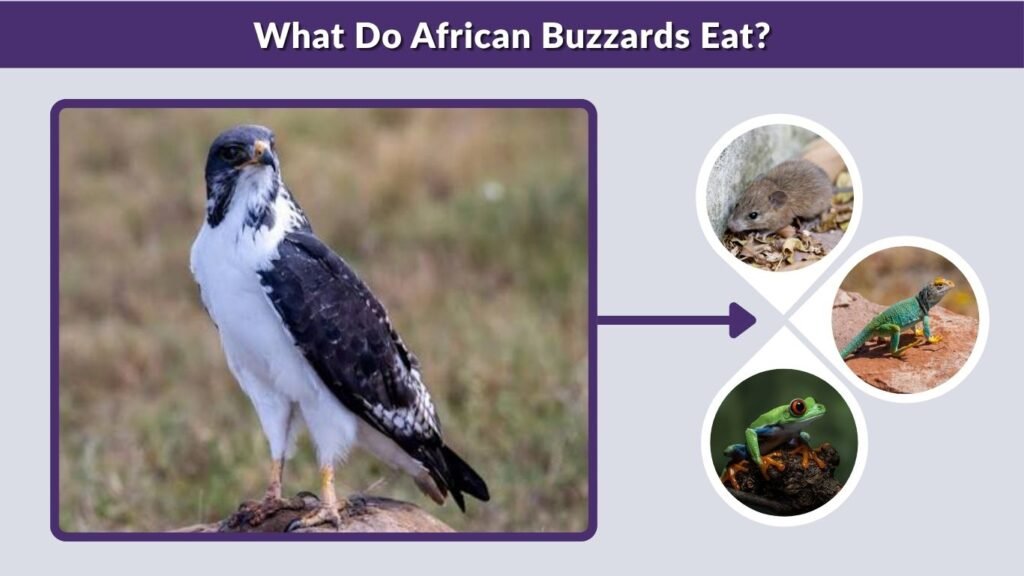
Most buzzards are opportunistic predators. Their diet changes according to habitat, season, and prey availability.
Common foods include:
- Mice, rats, and other rodents
- Lizards and snakes
- Frogs
- Small birds
- Large insects
- Young rabbits and other small mammals
- Carrion and roadkill
Buzzards usually attack from a perch or descend after spotting prey while soaring. Rodents are important food for many species, while the lizard buzzard consumes numerous reptiles and large insects. Jackal buzzards may also feed on carrion when available.
Do African Buzzards Eat Calves?
Healthy buzzards are not capable of killing normal calves. They may gather near livestock births to investigate afterbirth, insects, or a dead or severely weakened newborn.
Their feet and body size are designed for much smaller prey. A buzzard seen near cattle should not automatically be blamed for the death of a calf.
African Buzzard Breeding Behavior
Most buzzards form breeding pairs and build substantial stick nests in trees or on cliffs. Both parents contribute to raising the young, although the female usually performs more incubation while the male supplies food.
Buzzards may perform circling, diving, and calling displays over their territories. Their nests are often reused or repaired in later breeding seasons. General incubation among Buteo buzzards lasts approximately 30–40 days, though the exact timing differs among species.
Are African Buzzards Dangerous?
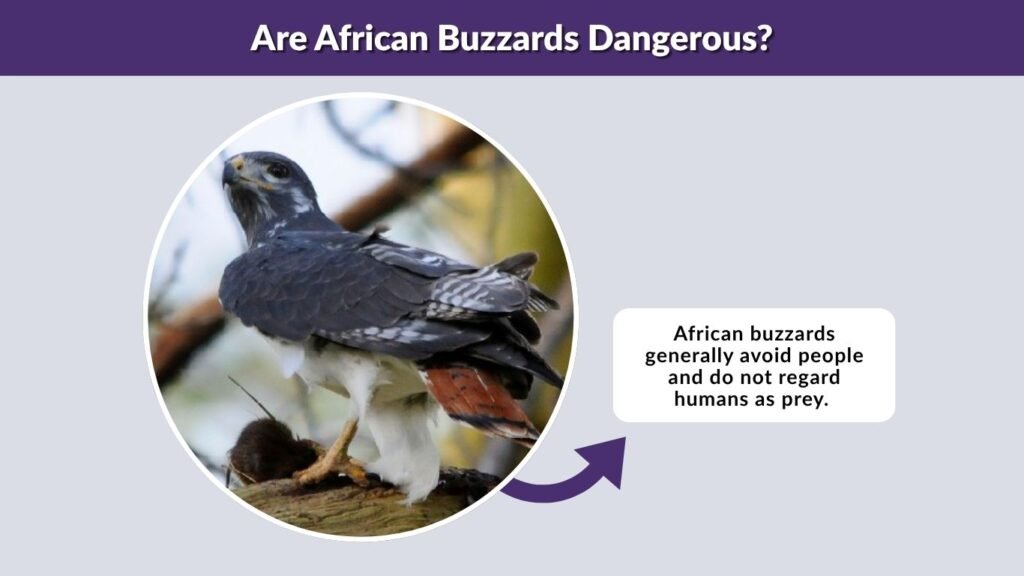
African buzzards generally avoid people and do not regard humans as prey. A nesting pair may call, circle, or dive toward an intruder that approaches too closely, but physical attacks are unusual.
They benefit ecosystems by controlling rodents, reptiles, and large insects. Buzzards should be watched from a respectful distance, particularly near nests or recently fledged young.
FAQs
Is there a bird officially called the African buzzard?
There is no single widely recognized species officially named the African buzzard. The phrase usually refers generally to buzzards living in Africa, such as the jackal, augur, forest, red-necked, lizard, or steppe buzzard.
What is the most common buzzard in South Africa?
The answer depends on region and season. Jackal buzzards are widespread residents, forest buzzards occur in southern forested areas, and migratory steppe buzzards become common in suitable open habitats during the southern African summer.
Is the common buzzard found in South Africa?
Yes. The steppe form of the common buzzard migrates to southern Africa. It is usually present during the southern summer and leaves for its northern breeding grounds around the end of the season.
What is the difference between a buzzard and a vulture?
Buzzards are active hunters that normally catch small live animals, although some eat carrion. Vultures are generally larger scavengers specialized for locating and consuming dead animals. The word “buzzard” is sometimes informally applied to vultures in North America, which causes confusion.
Are honey buzzards found in South Africa?
European honey-buzzards may occur as uncommon migrants in parts of Africa, including occasional southern African records. Despite their name, they are not typical Buteo buzzards and primarily search for the nests and larvae of wasps and other social insects.