
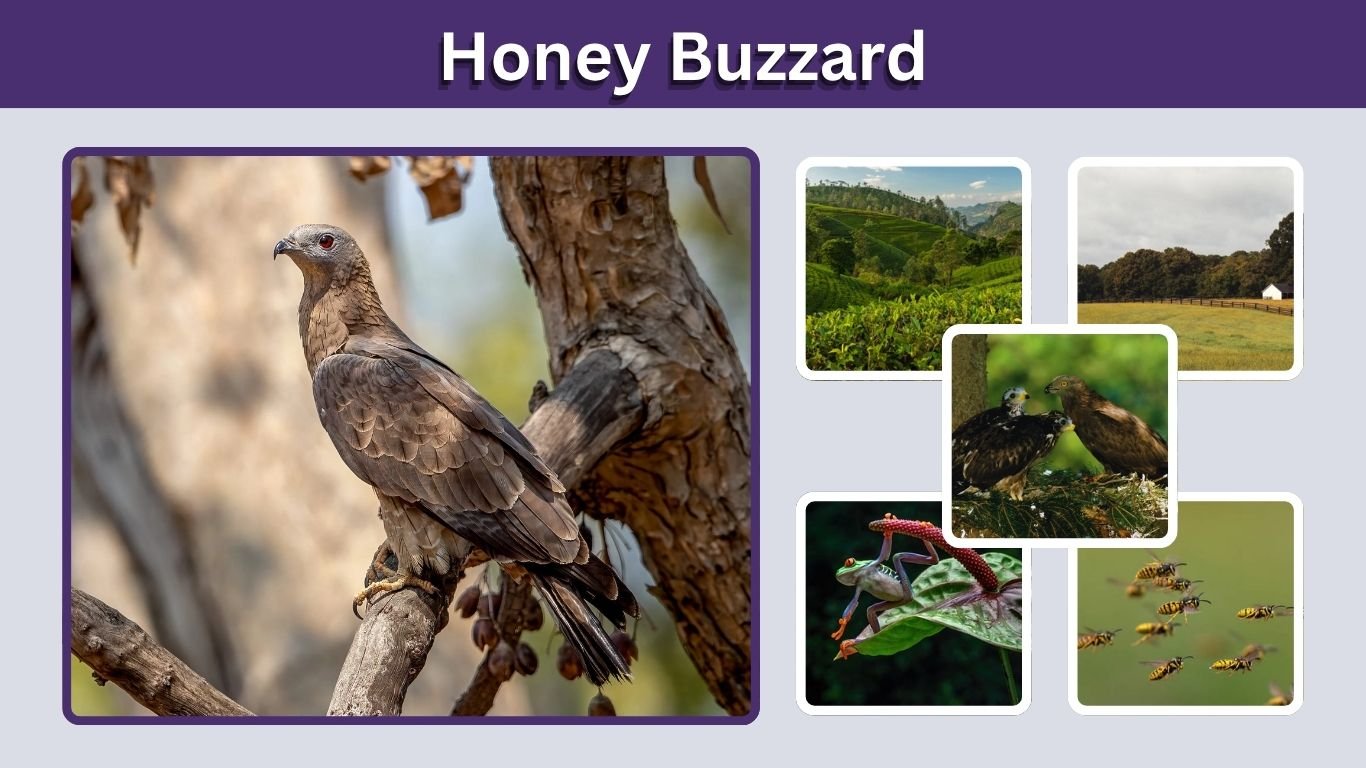
The honey buzzard is a large, woodland-dwelling bird of prey best known for raiding wasp and bee nests. Despite its name, it does not primarily eat honey. It searches for insect nests and feeds mainly on larvae and pupae hidden inside the combs. The European honey buzzard breeds across Europe and migrates to Africa, while the closely related crested or Oriental honey buzzard occurs across Asia. Its small head, long tail, specialized facial feathers, and unusual diet distinguish it from the common buzzard.
What Is a Honey Buzzard?
The European honey buzzard, scientifically known as Pernis apivorus, belongs to the hawk and eagle family Accipitridae. It is a large migratory raptor with broad wings, a relatively long tail, and highly variable plumage. Adults can measure approximately 52–60 centimeters long, weigh 600–1,100 grams, and have a wingspan of about 135–150 centimeters.
Although it resembles the common buzzard, the honey buzzard belongs to the genus Pernis rather than Buteo. Its structure, diet, behavior, and migration are also noticeably different.
Honey Buzzard Identification
Honey buzzards vary from pale grayish brown to very dark brown, so color alone is unreliable. Their body shape and flight pattern are often more useful for identification.
Look for these features:
- Small, pigeon-like head
- Long, narrow neck
- Broad but relatively long wings
- Long, rounded or paddle-shaped tail
- Dark bars across the tail
- Yellow eyes in many adults
- Slender, hooked bill
- Flat wings while soaring
- Loose, slow wingbeats
Male European honey buzzards often have grayer heads, while females generally have browner heads and more strongly barred wings and tails. Juveniles can be especially variable and may resemble common buzzards or other medium-sized raptors.
Types of Honey Buzzards
Several raptors are called honey buzzards. The European and Oriental species are the most widely recognized, although related species occur on islands and in tropical forests.
| Species | Scientific name | Primary range |
| European honey buzzard | Pernis apivorus | Europe, western Asia, and Africa during winter |
| Oriental or crested honey buzzard | Pernis ptilorhynchus | South, East, and Southeast Asia |
| Black honey-buzzard | Henicopernis infuscatus | New Britain |
| Long-tailed honey-buzzard | Henicopernis longicauda | New Guinea and nearby islands |
The European honey buzzard is a long-distance migrant, whereas populations of the Oriental honey buzzard include both resident and migratory birds.
European Honey Buzzard
The European honey buzzard breeds in woodland across much of Europe and parts of western Asia. It is a scarce summer breeding bird in the United Kingdom and spends the nonbreeding season south of the Sahara.
Its plumage ranges from almost white to dark brown. Typical adults have barred underwings, a long barred tail, and a small head that projects noticeably in flight.
Crested or Oriental Honey Buzzard
The crested honey buzzard, also called the Oriental honey buzzard, is an Asian species with several regional forms. It resembles the European species but can appear broader-winged and more eagle-like. Some individuals have a small crest, although it may not always be visible.
Oriental honey buzzards are especially famous for attacking bee and wasp colonies. Their plumage is extremely variable, with pale, reddish, brown, and almost black forms occurring.
What Do Honey Buzzards Eat?
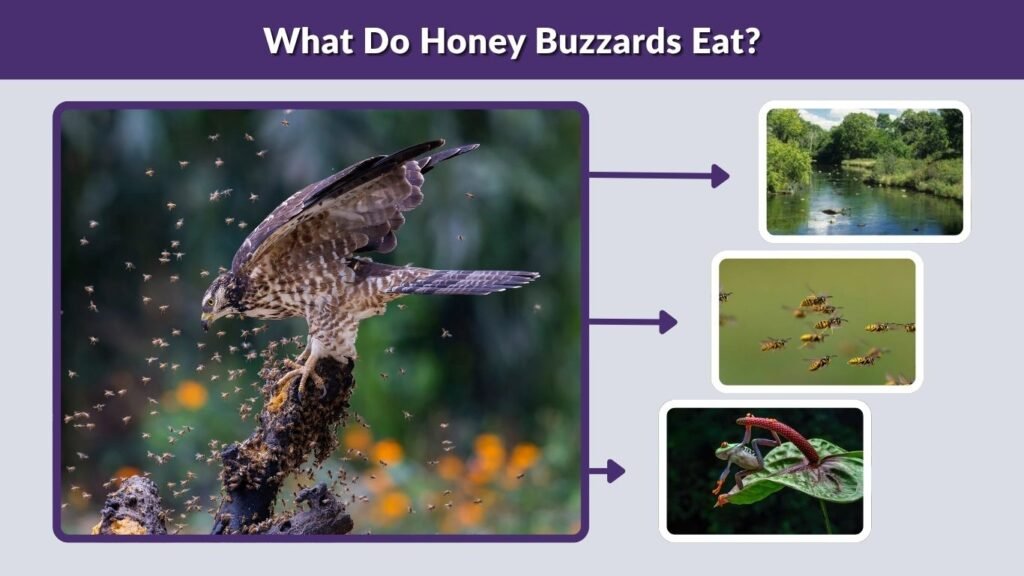
Honey buzzards mainly eat the larvae and pupae of social wasps and bees. They observe adult insects to locate colonies and then use their feet to uncover underground nests or break open exposed combs.
Their diet may also include:
- Adult wasps and bees
- Hornet larvae
- Other insects
- Frogs and small reptiles
- Nestling birds
- Small mammals
- Occasional fruit
Alternative foods become more important when wasp and bee colonies are difficult to locate or insect numbers are low.
Do Honey Buzzards Eat Honey?
The name is misleading. Honey buzzards primarily seek protein-rich larvae and pupae rather than honey itself. They may swallow small amounts of honey or wax while eating the contents of a nest, but honey is not their principal food.
Do Honey Buzzards Eat Hornets?
Honey buzzards can raid hornet nests and consume their larvae and pupae. They may also catch some adult hornets, but the developing insects inside the nest provide the most valuable food.
Their specialized protection allows them to approach nests that many other birds would avoid. However, this does not mean that every honey buzzard is completely immune to hornet venom.
Are Honey Buzzards Immune to Bee and Wasp Stings?
Honey buzzards are not known to possess complete immunity to stings. Instead, they have physical adaptations that reduce the likelihood of a stinger reaching vulnerable skin.
Protective Facial Feathers
The face, forehead, and areas around the eyes are covered with small, densely packed, scale-like feathers. Microscopic research on Oriental honey buzzards found tightly arranged facial feathers with an armor-like structure that may prevent insect stings from reaching the skin.
They also have narrow, slit-like nostrils that help keep insects, soil, and wax from entering while the birds dig into nests. Their legs and feet have protective scales that provide additional defense.
Honey Buzzard vs Common Buzzard
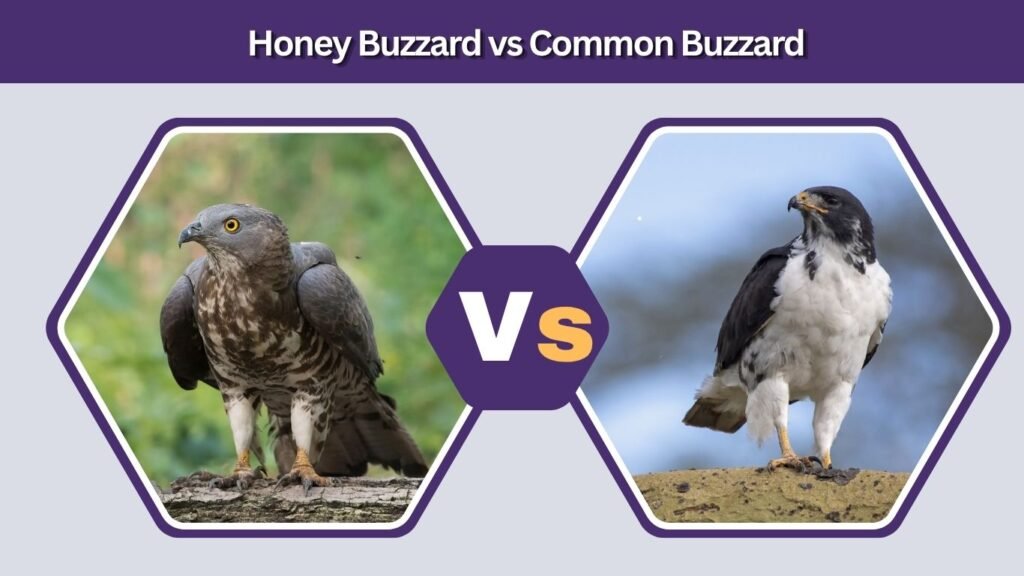
Honey buzzards and common buzzards are similar in overall size and can have almost identical colors. Their shape and movement provide the most dependable differences.
| Feature | Honey Buzzard | Common Buzzard |
| Head | Small and pigeon-like | Broad and rounded |
| Neck | Longer and narrower | Shorter and thicker |
| Tail | Long and rounded | Shorter and broadly fanned |
| Wings | Longer with narrowed bases | Broader and more compact |
| Soaring posture | Wings usually held flat | Wings commonly raised slightly |
| Flight | Loose, slow wingbeats | Stiffer, heavier wingbeats |
| Main diet | Wasp and bee larvae | Mammals, birds, worms, and carrion |
| Migration | Long-distance migrant | Often resident or short-distance migrant |
Honey buzzards generally appear slimmer, longer-tailed, and more graceful in flight. Common buzzards look heavier and more compact, although plumage variation can make identification difficult without prolonged observation.
Honey Buzzard Habitat
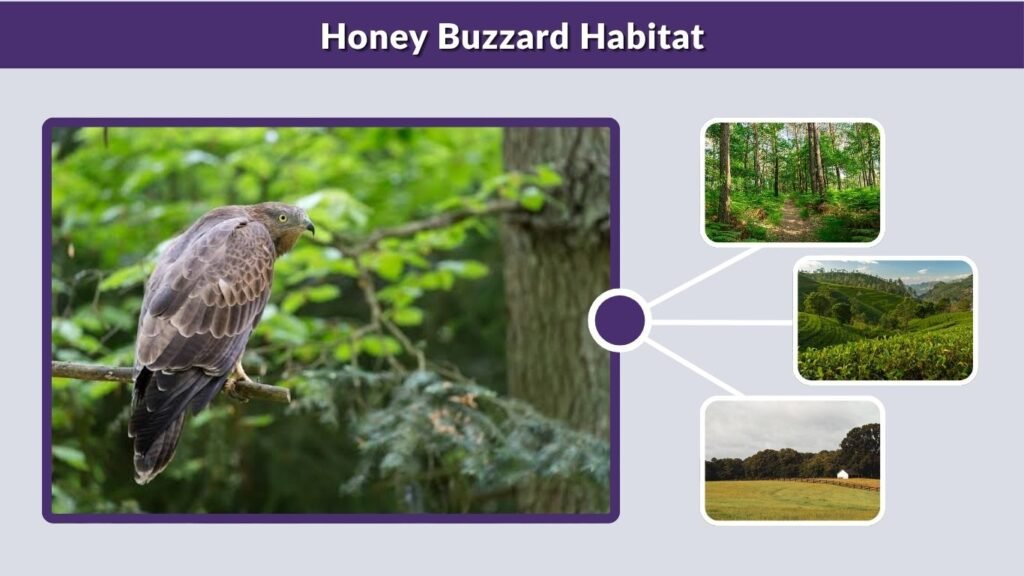
European honey buzzards favor mature deciduous, mixed, or coniferous woodland near clearings, fields, and other open feeding areas. Forests provide nesting sites, while woodland edges and surrounding countryside contain the wasp colonies on which they depend.
They are secretive during the breeding season and may spend considerable time beneath the forest canopy. As a result, they can be present in an area without being noticed.
Oriental honey buzzards also occupy forests, plantations, wooded farmland, and urban areas with mature trees. Migrating birds may gather in large numbers at mountain ridges and narrow sea crossings.
Honey Buzzard Migration
European honey buzzards breed in Europe during spring and summer before migrating to tropical and sub-Saharan Africa. They often travel through migration bottlenecks around the Mediterranean, where rising warm air allows them to soar while conserving energy.
They return relatively late in spring because their specialized insect food becomes abundant later than the prey used by many other raptors. Autumn migration begins after breeding and can produce large gatherings along favorable routes.
Are Honey Buzzards Found in South Africa?
European honey buzzards occur in southern Africa as nonbreeding visitors. Sightings have increased in parts of South Africa, and the species has become a regular summer visitor at some locations, including areas around Kirstenbosch and Bethlehem. It remains much less familiar than resident South African raptors.
Honey Buzzard Breeding
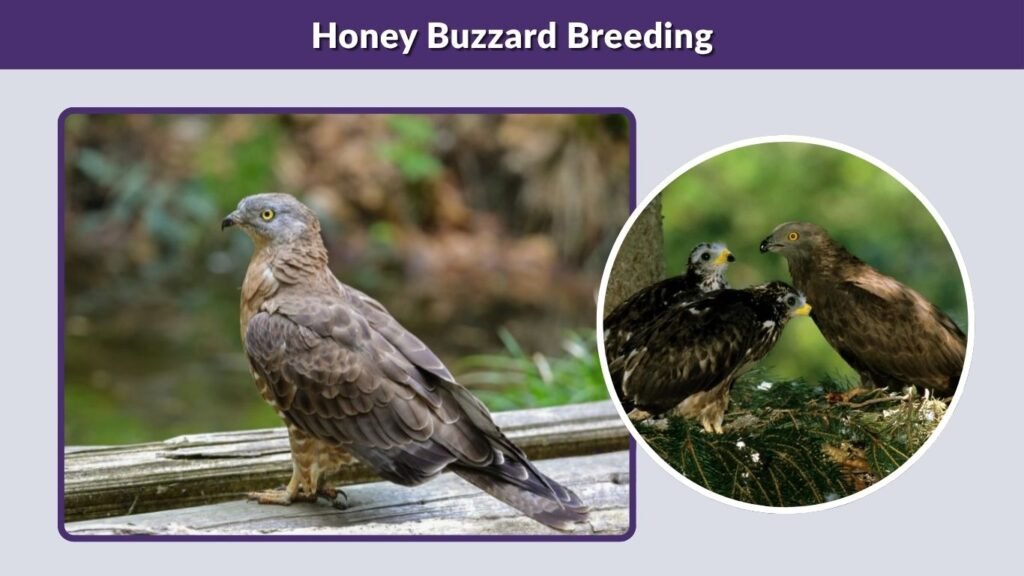
European honey buzzards usually nest high in mature trees. The nest is made from sticks and commonly lined with fresh green leaves.
A typical clutch contains two eggs, although one to three may be recorded. Incubation normally lasts about 30–35 days, and young birds remain in the nest for approximately 40–44 days before fledging. Both parents participate in caring for the young and supplying food.
Adults may carry pieces of wasp comb back to the nest. The chicks extract the larvae from the cells, although parents may also provide frogs, birds, and other prey.
FAQs
Is a honey buzzard an eagle?
A honey buzzard is not an eagle, although both belong to the family Accipitridae. It is a medium-to-large raptor in the genus Pernis and is more specialized for digging into insect nests than capturing large vertebrate prey.
Do honey buzzards kill honeybees?
They may consume adult bees, but their main targets are the larvae and pupae inside colonies. European honey buzzards commonly use wasp nests, while Oriental honey buzzards may frequently raid bee colonies.
Can honey buzzards be stung?
Yes, stings may still occur. The birds are protected by scale-like facial feathers, narrow nostrils, and scaled feet, but these features reduce exposure rather than proving complete immunity to venom.
What does a honey buzzard sound like?
Honey buzzards produce high, whistling calls, particularly near breeding territories or during interactions with other birds. They may also call while migrating or wintering, although they are generally less vocal away from nesting areas.
Is the honey buzzard rare?
Its abundance depends on location. The European honey buzzard is widespread across its total range but is scarce and difficult to observe in countries such as the United Kingdom because of its secretive woodland behavior.
